
Banned in 1978. Champion in 2022. The Fan Car Nobody Saw Coming.
Under 1,000 kg. 1,000 horsepower. And a system that sucks the car to the tarmac before the motor knows it’s moving. This is what happens when a Concorde engineer forgets that something has been banned for 44 years.
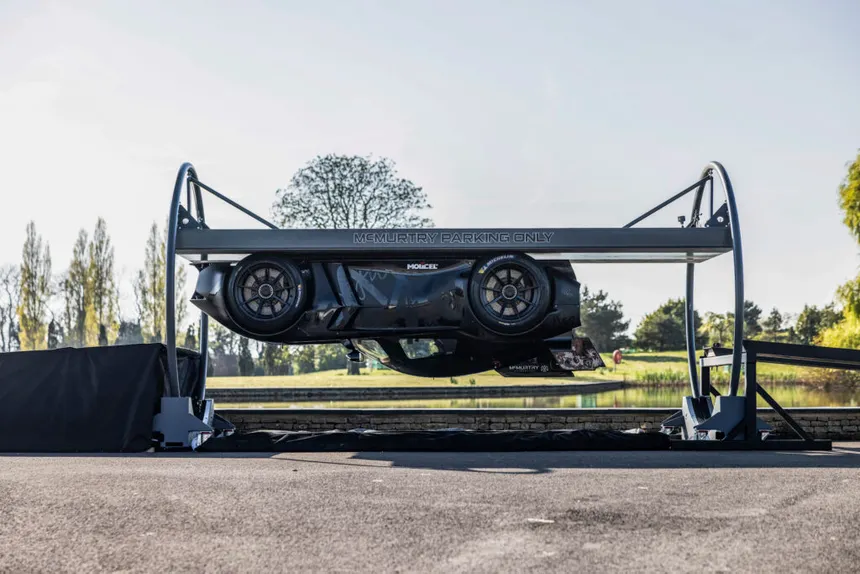
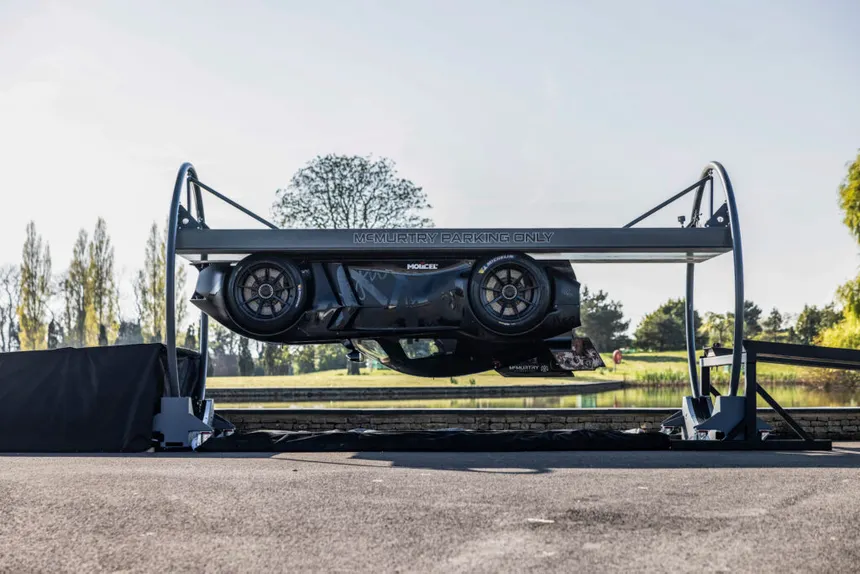
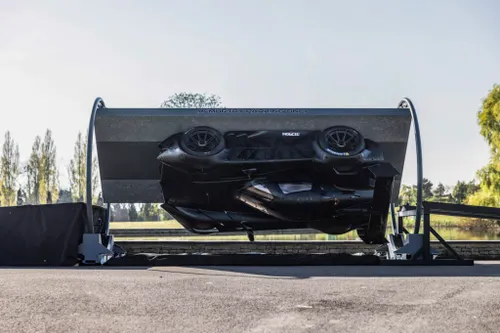
On 11 April 2025, a man named Thomas Yates drove a car upside down from a standing start. No ramp. No cable rig. No television trickery. The McMurtry Spéirling PURE generated enough aerodynamic load from zero speed to overcome gravity and hold itself to the ceiling of a rotating platform.
On that same day, that same car had obliterated the all-time lap record at the Top Gear test track, erasing the Renault R24 Formula 1 car that had ruled that circuit since 2004. The margin: 3.1 seconds. An eternity in lap time terms.
And before you move on from that: it weighs under 1,000 kg. It makes 1,000 horsepower. And its downforce system was already fully loaded before the motor woke up.
There is a thread that connects this car to the 1978 Swedish Grand Prix, to a Can-Am machine from the 1970s that was banned for being too fast, and to an engineer who spent his career working on the engines of Concorde. To understand the McMurtry Spéirling PURE, you need to understand where fan cars come from. That story is considerably longer than any press release will tell you.
The Forbidden Technology: Fan Cars Have a 55-Year History
The idea of sucking a car down onto the tarmac rather than pressing it down from above is not new. It is, in fact, one of the most brutally effective concepts in motorsport history — and it has been systematically banned for decades precisely because it works too well.
Chaparral 2J — Can-Am, 1970
Jim Hall did not invent aerodynamic downforce, but he did build the first fan car that genuinely worked in competition. The Chaparral 2J used two fans driven by a separate Snowmobile engine — entirely independent from the main powerplant — to generate a vacuum beneath the chassis. Lexan skirts sealed the sides of the car to the ground. The result was massive downforce completely independent of vehicle speed.
In theory, the 2J could corner just as quickly at 30 km/h as at 160 km/h. That is physically revolutionary. It is also why it was banned before the season was over. The competition protested. The technology was simply too much.
Brabham BT46B — Formula 1, Swedish Grand Prix, 1978
Gordon Murray designed the BT46B. The official story was that the large rear fan existed to cool the engine. The real story: it generated enormous aerodynamic load by extracting air from under the car. Murray’s stroke of genius was that the F1 regulations only prohibited mobile aerodynamic devices that directly affected the car’s handling — and he argued that the fan was a cooling component with the aerodynamic effect as a byproduct.
Niki Lauda drove it. He won the race. It was the first and only victory for a fan car in the history of Formula 1. Brabham withdrew it voluntarily before a formal ban could be issued, preserving that perfect 100% win rate in sanctioned competition.
From that day until Goodwood 2022, no fan car had competed in officially sanctioned motorsport.
Forty-four years of silence.
The Man Behind the Spéirling
Sir David McMurtry was not a wealthy enthusiast with a dream of building cars. He was an engineer of the highest order who had spent decades solving problems that others could not even properly formulate. As Chief of Concorde Engine Design at Rolls-Royce, he worked on the Olympus turbine engines that pushed 128 passengers across the Atlantic at Mach 2. When he encountered a precision measurement problem with turbine blades, he did not work around it: he invented the touch trigger probe, a technology that transformed precision manufacturing worldwide and remains fundamental to aerospace, medical and automotive production. That patent became Renishaw plc, a company that reached the FTSE 250.
In 2016, with all of that behind him, he decided to start a car company. Not because he needed the money. Because he had an idea that nobody else was willing to pursue: bringing the fan car into the 21st century.
Sir David McMurtry passed away in December 2024. He did not live to see a customer take delivery of the PURE, but he witnessed every record, every demonstration and every proof that he had been right. His sons Ben and Richard McMurtry are continuing his legacy alongside Thomas Yates and Kevin Ukoko-Rongione.
To execute it, he recruited Thomas Yates directly from Mercedes High Performance Powertrain, where Yates had been involved in optimising the F1 power units of Lewis Hamilton and Nico Rosberg during their dominant championship years. Kevin Ukoko-Rongione, Yates’s university contemporary and former Williams Advanced Engineering engineer, joined as Technical Director.
Three people. One idea. Today: 80 people across two facilities in the Cotswolds, with the first customer car scheduled for summer 2026.
How Downforce-on-Demand™ Actually Works
This is where the Spéirling PURE stops being an expensive car and becomes something qualitatively different from anything else on four wheels.
Conventional downforce requires speed. A wing generates aerodynamic load because air flowing over it creates a pressure differential. Without speed, there is no airflow. Without airflow, there is no downforce. That is why Formula 1 cars, for all their technology, remain machines that need to be moving to access their full aerodynamic potential.
The Spéirling does something fundamentally different. Two fans integrated behind the driver actively extract air from the space between the car’s floor and the tarmac, expelling it through a central rear tunnel. Skirts seal that space. The result is a permanent low-pressure zone beneath the car that is entirely independent of vehicle speed: the system generates 2,000 kg of aerodynamic load from a standstill.
The fans spin at 23,000 rpm. They produce approximately 120 dB of noise — comparable to a jet engine at close range. The Spéirling is not a quiet electric car. It is the exact opposite: it sounds like something that has a purpose.
With slick tyres, the consequence of all that aerodynamic load is lateral cornering forces above 3G. For context: the most extreme road cars on the market today rarely exceed 2G. Most people lose consciousness above 5G sustained. At 3G in a track car, you are dealing with a physical experience that very few non-professional drivers are prepared for.
The definitive demonstration of this system was not the Goodwood record or the Top Gear record. It was the video of the car being driven upside down. Because when the generated downforce exceeds the car’s own weight, physics stops being an abstraction and becomes an image.
The Numbers
The car you will see at circuits in 2026 has these verified specifications:
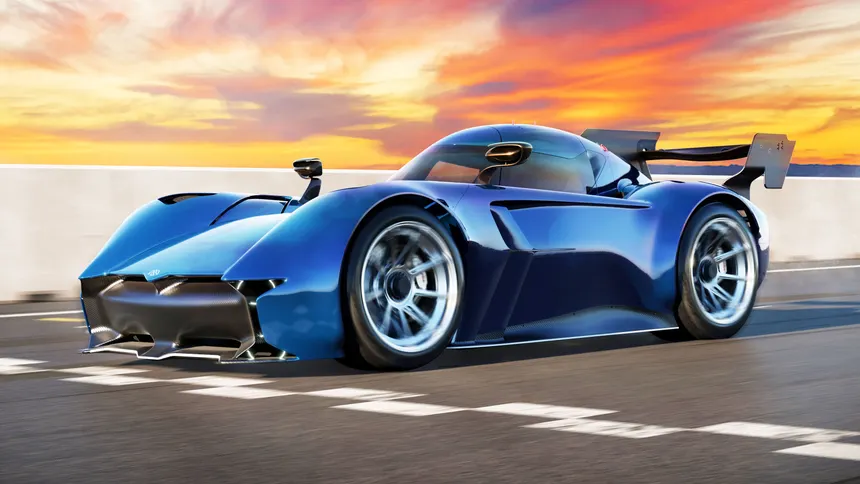
Dimensions and weight: Single-seat carbon fibre monocoque, approximately 3.2 metres in length — smaller than a Fiat Panda. Production-specification weight around 1,000 kg. Single central seat.
Powertrain: Two SPX242-94 electric motors built by British company Helix. Each unit weighs 33 kg and produces 368 lb-ft of torque. Rear-wheel drive only. Combined output: 1,000 hp. The drivetrain includes a revised gearbox compared to the Goodwood prototype, with a 0.5% efficiency improvement.
Top speed: 190 mph (306 km/h).
Acceleration: 0 to 60 mph in 1.5 seconds. At Goodwood, it covered the first 100 metres in 3.51 seconds.
Battery: 100 kWh unit integrated structurally into the chassis in a U-shaped configuration — not a bolt-on pack, but a structural element of the car itself. Estimated range of 30 to 60 minutes of full-pace circuit driving. Fast charge time: 20 minutes.
Production: 100 units. Starting price: £995,000 excluding taxes, shipping and options. First customer deliveries scheduled for summer 2026.
The Records, One by One
Goodwood Festival of Speed — 26 June 2022
Max Chilton completed the 1.16-mile Goodwood Hillclimb in 39.08 seconds, beating Romain Dumas in the Volkswagen ID.R (39.9 seconds, 2019) — a car built specifically to break that record following its performance at Pikes Peak — and the official standing record of Nick Heidfeld in the McLaren MP4/13 Formula 1 car (41.6 seconds, 1999).
It did not just win. It was the first fan car to compete in officially sanctioned motorsport since the 1978 Swedish Grand Prix. And it won. The historical record of fan cars in sanctioned competition remains 100% victories across nearly five decades.
Top Gear Test Track — 11 April 2025
The Spéirling PURE became the fastest car in the history of the Top Gear test track. The driver was The Stig — Top Gear’s anonymous test driver who in over two decades had never seen anything threaten that record. The previous benchmark, set by the Renault R24 Formula 1 car in 2004, stood at 59.0 seconds. The McMurtry crossed the line in 55.9 seconds. Three point one seconds of margin. More than two decades of Grand Prix car dominance erased in a single lap. On the same day Thomas Yates drove the car upside down from a standstill.
These two records are not marketing. They are proof that a team of 80 people in Gloucestershire, without the backing of Volkswagen Group or Ferrari or any major manufacturer, has built the most extreme car to have ever turned a wheel at either of those venues in their entire histories.
Why This Is a Story About Engineering, Not EVs
This is not a piece about the future of urban mobility. NEC does not write about electric cars because they are environmentally responsible. We write about competition engineering because it is the only environment where physics has no political opinion and solutions have to actually work.
The McMurtry Spéirling PURE is the answer to a question engineers have been asking for 55 years: what happens when you remove every homologation constraint, ignore the marketing department, and ask from first principles what is the most effective way to keep a car on the ground?
The answer McMurtry found had been banned since 1978. And the car weighs under 1,000 kg at a moment when the industry as a whole has spent two decades adding mass in the name of safety ratings, comfort features and driver assistance systems. The average new car is now significantly heavier than its equivalent from 20 years ago. The Spéirling goes in the opposite direction.
There is something that connects the Chaparral 2J, the Brabham BT46B and the McMurtry Spéirling. It is not the technology — it is the attitude. The attitude of engineers who refuse to accept that the limit is wherever the regulations say it is, and who keep asking questions when everyone else has already closed the conversation.
We write with grease on our hands and nothing held back. The McMurtry Spéirling PURE is exactly that: grease, physics, and no apologies whatsoever.
The FIA banned it in 1978. Physics unbanned it in 2025. Regulations can set limits. Gravity cannot.
Check you’re still alive.