
Barreiros: The Spanish Mechanic Who Beat the British, Defied Franco and Ended Up Building Engines for Fidel Castro

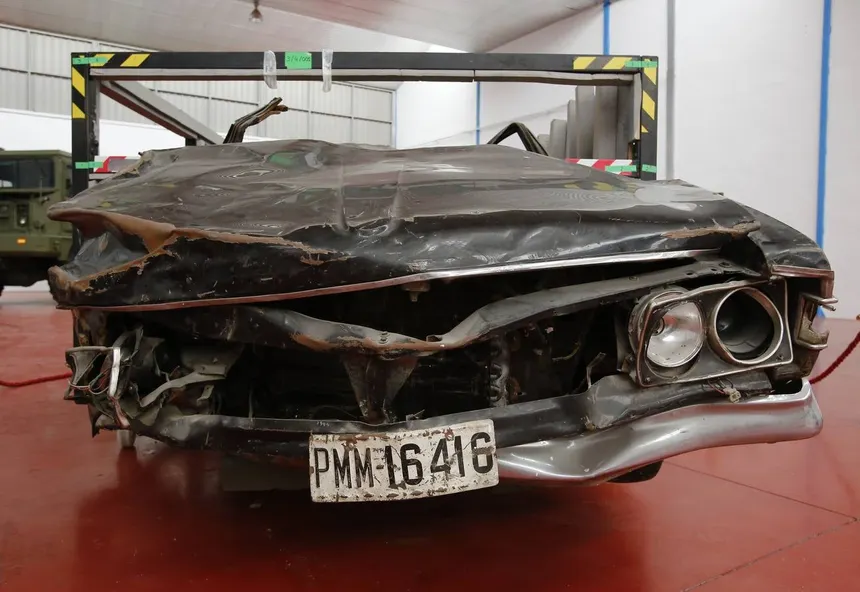
The black Dodge 3700 GT rolls up Claudio Coello Street at half past nine in the morning. December 20, 1973. Three men inside. The driver, José Luis Pérez Mogena. The bodyguard, police inspector Juan Antonio Bueno Fernández. And in the back seat, Admiral Luis Carrero Blanco — President of the Spanish Government, the most powerful man in the country after Franco.
The car weighs 1,800 kilograms. Inline six-cylinder engine, 3.7 liters, 165 horsepower. Built at the Villaverde plant in Madrid. Registered under the Ministerial Motor Pool: number 16,416. Dodges with plates above 16,400 were reserved for ministers and senior officials. This was the car of power in Spain.
Beneath the asphalt, an ETA commando unit has tunneled under the road. Inside, charges of Goma-2 explosive wait in the darkness. When the Dodge passes over the exact spot, the ground tears open. The blast hurls the car over the adjacent building. The 1,800-kilogram Dodge lands on the rooftop of the Jesuit residence. All three occupants die.
And the car that flew over Madrid — the car carrying the most powerful man in Spain, the car that changed the country’s history — didn’t bear the name of any European or American multinational. It had been built by a mechanic from Ourense who started out repairing buses with scrapyard parts during the postwar years.
His name was Eduardo Barreiros.
Start at the beginning. And the beginning is not an office or a university. The beginning is a workshop in Ourense reeking of diesel, with hands blackened by grease.
Eduardo Barreiros was born on October 24, 1919, in Gundiás, a small parish in Nogueira de Ramuín, province of Ourense, Galicia. His father ran a bus line. By twelve, Eduardo was already working as a ticket inspector on the Ourense–Os Peares route. By sixteen, he was an apprentice mechanic earning two pesetas a day. When the Spanish Civil War broke out, they sent him to the front as a driver — behind the wheel of one of the family buses that had been requisitioned to transport soldiers and wounded between A Coruña and Oviedo.
After the war, the family set up a small workshop where Eduardo rebuilt buses from whatever he could get his hands on: the chassis rails of a Citroën truck, a differential from a scrapyard, the engine and gearbox from a burnt-out truck. He ordered the bodywork new from Ourense. That was Spain in the 1940s. And that was Eduardo Barreiros: a man who grabbed junk and turned it into something that worked.
In those years, the trucks that had survived the war ran on gasoline engines — expensive and inefficient, some drinking forty liters per hundred kilometers. Gasoline was scarce. Diesel was cheaper, but nobody in Spain was converting gasoline engines to diesel. Nobody except Barreiros. In 1951, he patented the process. Demand exploded. The Ourense workshop wasn’t big enough anymore.
In 1954, with a capital of ten million pesetas — the legal minimum to incorporate — he founded Barreiros Diésel S.A. in Madrid. He bought land on the Andalusia highway and started manufacturing his own engines: the EB-6, six cylinders, entirely his own technology. Three engines a day. And that’s where the war began.

Because Barreiros wasn’t alone on the board. The INI — Instituto Nacional de Industria — controlled Spain’s automotive industry with an iron grip. SEAT made passenger cars. ENASA made trucks under the Pegaso badge. And Juan Antonio Suanzes, the INI’s founder and one of the most powerful figures in Franco’s industrial apparatus, refused to meet Eduardo Barreiros in person. To the INI, the Galician was an intruder. A threat to the state monopoly. They blocked his license to manufacture trucks.
He was not the first to hit that wall. In 1951 an artillery officer, Manuel Jiménez-Alfaro, broke Suanzes’s passenger-car monopoly by making Franco’s brother chairman of FASA.
If they close the door in Spain, he opens one in Portugal. Simple as that.
In 1957, Portugal’s Ministry of Defense announced an international tender for 300 military all-terrain trucks for their troops in Angola and Mozambique. Bedford showed up. GMC showed up. Mercedes-Benz showed up. ACLO from France showed up. The world’s best manufacturers, all in one room.
Barreiros didn’t have an official license to build trucks. But he built a prototype at the Villaverde workshops. They called it “El Abuelo” — The Grandfather. It was the TT 90-22. A Frankenstein of parts that shouldn’t have worked: axles from a Douglas crane, a winch from a GMC truck bought from the American army surplus in 1947, a Ross worm-type steering system, a Barreiros EB6 engine putting out 90 horsepower. And the tires — that was the secret weapon. Elliptical-section lipsoid tires, 650 millimeters wide, supplied by British firm Straussler. They looked like tractor wheels. But they let the truck move through mud, sand, and slopes where everything else got stuck.
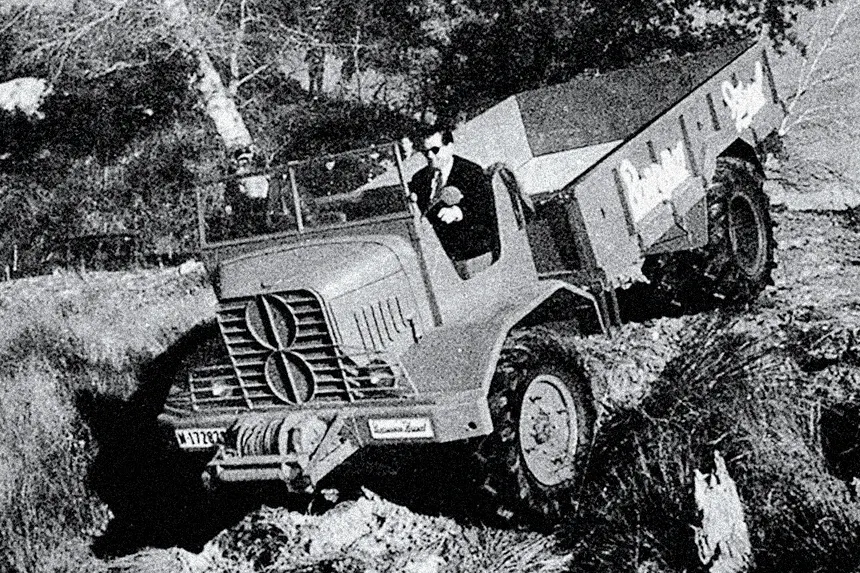
Eduardo Barreiros drove “El Abuelo” himself during the trials. Towing an artillery cannon, carrying three tons of payload, he crossed sand embankments and powered through a ravine where the front axle lost ground contact and the gradient hit ninety percent. No other truck even attempted that test.
Barreiros won the tender. Against Bedford. Against GMC. Against Mercedes-Benz. A Galician with no license and a hand-built prototype humiliated the global military-industrial complex.
The news hit Madrid like a shockwave. Franco requested a personal demonstration at the Montes del Pardo. Barreiros drove “El Abuelo” before the head of state with his hand bandaged — he’d burned it tuning the truck. He took the opportunity to remind Franco that he had 300 trucks to deliver to Portugal and no permit from the Ministry of Industry to build them.
Franco, standing in front of the INI president and the Minister of Industry, said four words: “Adelante, Barreiros, adelante.” — Go ahead, Barreiros, go ahead.
That sentence was the license. In 1958 he received authorization to build 1,000 trucks. By 1960, full-scale production clearance. And from that point, the machine didn’t stop.
Villaverde grew to two million square meters of facilities. Over 20,000 direct employees and 100,000 indirect jobs. Barreiros manufactured forty percent of Spain’s heavy vehicles. The New York Times listed him among the six most important industrialists in Europe. Azor and Super Azor trucks rolled across every road in the country. Hanomag-Barreiros tractors plowed half of Spain’s farmland. Exports reached 27 countries.
In numbers and in fact, Eduardo Barreiros was the largest private motor industry entrepreneur in Spain. And he’d built it starting from two pesetas a day in a workshop in Ourense.
But he needed more. He needed passenger cars. He needed capital. And in 1960s Spain, with the INI blocking doors and banks tightening the screws, options were limited. He negotiated with Fiat. With General Motors. No deal. In 1963, he struck an agreement with Chrysler Corporation: he sold them 40% of Barreiros Diésel for 18 million dollars — the largest foreign capital investment in Spain to date. They founded Barreiros Chrysler.
The Spanish Dodge Dart was born. Then came the Dodge 3700 GT — the car of ministers, high-ranking military officers, the men of power. Inline six-cylinder, 3.7 liters, ZF power steering, air conditioning, self-ventilating disc brakes. In a country where the SEAT 600 was king, the Dodge was another universe.
At first, everything seemed to work. Industrial vehicle sales held strong. Simca 1000s rolled off the line. But the trap was buried in the contract. Chrysler imposed tied purchases — forced acquisitions of discontinued vehicles and patent buys that drained capital. The promised access to Chrysler’s global network and technical support never materialized.
In 1967, when sales dropped, only Chrysler had the money the company needed. The capital increase pushed Barreiros into a minority position. The Americans went from 40% to 77%. Eduardo no longer controlled his own company. Chrysler slashed investment in industrial vehicles and focused on passenger cars. Everything Barreiros had built over two decades was now subordinate to decisions made in Detroit.
In May 1969, Eduardo Barreiros resigned as president of the company that bore his name. He sold his stake for roughly six hundred million pesetas and signed a non-compete clause: five years without designing, manufacturing, or selling anything related to engines or vehicles.
He was forty-nine years old. They had just taken away his entire life.
Any other man would have retired. Barreiros bought 5,000 hectares of barren land in La Solana, Ciudad Real, and turned it into a cattle operation. He founded PUVASA — Explotaciones Puerto Vallehermoso. At the Paris livestock fair, he acquired the five Charolais bulls that had won gold medals and 250 young breeding females of the finest French pedigree. PUVASA became one of the leading sources of breeding stock for cattle farms across Spain and Europe, running one of the continent’s best artificial insemination laboratories. He bought wineries in La Mancha. He started a tin and pyrite mining operation in Ourense.
A mechanic who can’t touch engines builds a cattle empire. Because Eduardo Barreiros was never just an engine man. He was a man who took whatever was in front of him and made it bigger than it was before.
In 1974, the five-year ban expired. He went back to diesel. He founded DIMISA — Diesel Motores Industriales S.A. At his laboratory in Pinto, just outside Madrid, he developed modular V-configuration engines in six and eight cylinders, certified by Lloyd’s Register — the British naval and industrial classification authority.
And that’s when Cuba appeared.
The Cuban government had contacted Lloyd’s Register looking for help solving its fleet disaster — three decades of the American embargo had left the island without engines. Lloyd’s offered several options: Nissan, Mercedes-Benz, and DIMISA, Barreiros’ company. An international tender was announced.
Barreiros’ eight-cylinder V engine ran for four continuous months, twenty-four hours a day, head-to-head against a Nissan unit. Lloyd’s acted as referee. The Barreiros engine won.
Carlos Rafael Rodríguez, Cuba’s vice president, had told Barreiros during a meeting in Madrid: “You must come to the Land of the Comandante and do there the same thing you did in Spain.” And Barreiros went.
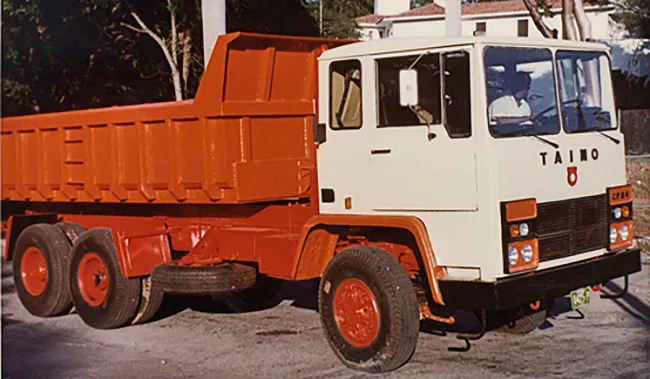
He signed a contract with Fidel Castro’s government to lead a full automotive development plan. He created the Taíno EB engines — diesel units ranging from six to twelve V-configured cylinders. He transformed the Soviet-Cuban Friendship engine plant, which before 1959 had housed the American firm Ambar Motor’s. Before starting on the Taínos, he proposed — and it was accepted — an experimental dieselization trial using two Soviet ZiL-130 engines.
He built three factories between 1982 and 1992. The Taíno engines went into Girón buses, trucks, sugarcane harvesters, railcars. The obstacles were brutal: no raw materials, no machined components, the American embargo crushing any possibility of imports.
Eduardo Barreiros was over sixty years old and he was building an industry from scratch on an island blockaded by the world’s largest economic power. And he was making it work.
On February 19, 1992, Eduardo Barreiros died in Havana of a heart attack. He was seventy-two. He never returned to Spain. His mind was already on the next project: Angola.
There’s one thing you need to understand about Eduardo Barreiros. He wasn’t a visionary entrepreneur. He wasn’t a motor industry genius in an ivory tower. He was a mechanic with wrecked hands who turned scrap into engines, engines into trucks, trucks into an empire — and when they took the empire away, he started over from zero. Twice.
Three fights defined his life. Against the INI — he won it with “El Abuelo” in Portugal. Against Chrysler — he lost it in Villaverde. Against oblivion — he’s winning that one, because his Taíno engines are still running on Cuban roads more than thirty years after his death.
The Dodge 3700 GT that flew over Claudio Coello Street no longer carried his name when it exploded. Chrysler had taken it away. But the car that Spain’s powerful chose to ride in — the car ETA chose for the most notorious assassination in Spanish history — had in its industrial DNA the hands of a Galician from Gundiás who started on a wage of two pesetas.
Barreiros wasn’t an entrepreneur. He was a mechanic with more guts than resources. And in Spain, that has always been a problem.
Check you’re still alive.