
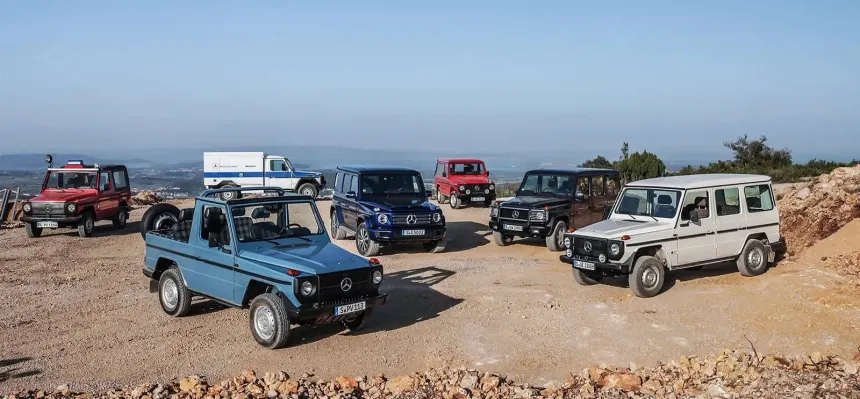
G-Class: The most expensive military truck on Earth is sold at your local Mercedes dealer
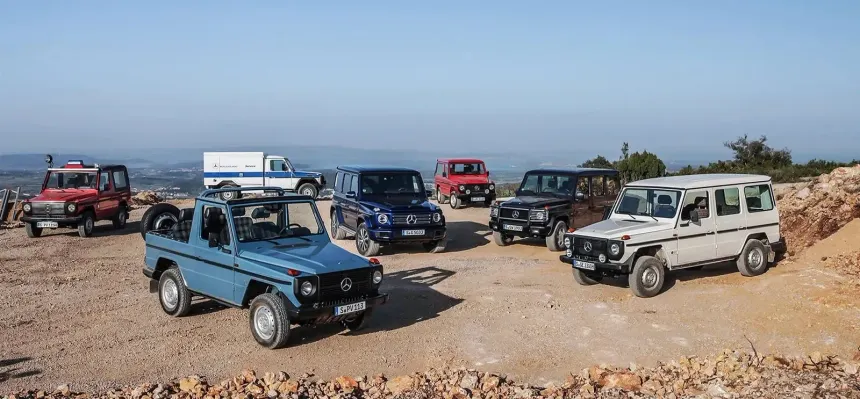
The German Army pays Mercedes-Benz roughly €224,000 per unit for the new Wolf 2 — the latest military Geländewagen, the one that has to start in -34°C in a Polish forest, ford rivers, climb 100% gradients, and keep four soldiers and their gear alive in the worst conditions on Earth. Up to 5,800 units are on order through 2032, total framework value €1.3 billion.
A civilian AMG G63, fully optioned, costs more than that.
Read it again, because the implications are uncomfortable.
The most expensive military off-road vehicle in the world is sold, in its civilian form, at your local Mercedes dealership. And the buyer who parks his G63 outside the gym in Beverly Hills is paying more for his truck than NATO’s most disciplined army pays for the version that has to actually go to war.
That is not an accident of pricing. That is a forty-five-year story about how the most respected military vehicle on the planet became the most photographed status symbol on Instagram. And the story starts with a king who never lived to receive his order.
A king ordered 20,000. He never got one.
In 1975, Mohammad Reza Pahlavi, the Shah of Iran, was a major shareholder of Daimler-Benz. He needed a proper military off-roader for the Imperial Iranian forces — something that could cross the Persian deserts and climb the Zagros mountains. Mercedes partnered with Austrian manufacturer Steyr-Daimler-Puch, founded a joint venture called Geländefahrzeug Gesellschaft, and got to work.
Seven years of development. February 4, 1979 — the W460 Geländewagen rolled out of the brand-new Magna Steyr plant in Graz with three locking differentials, rigid axles, ladder-frame chassis, and a body assembled almost entirely by hand.
Seven days after launch, the Shah was deposed by the Islamic Revolution.
The 20,000 units never shipped. Mercedes was sitting on a small Austrian factory full of military-grade off-roaders that nobody had asked for anymore.
So they did the only commercially sensible thing. They started selling it to civilians.
What followed is the strangest commercial trajectory in the modern automotive industry.
38 years to build 300,000 units. Six years to add 200,000 more.
Same plant in Graz. Same semi-handcrafted process. Same body-on-frame architecture, rigid axles, three differential lockers, the same ladder chassis welded by Austrians who go home every night to villages that look like postcards.
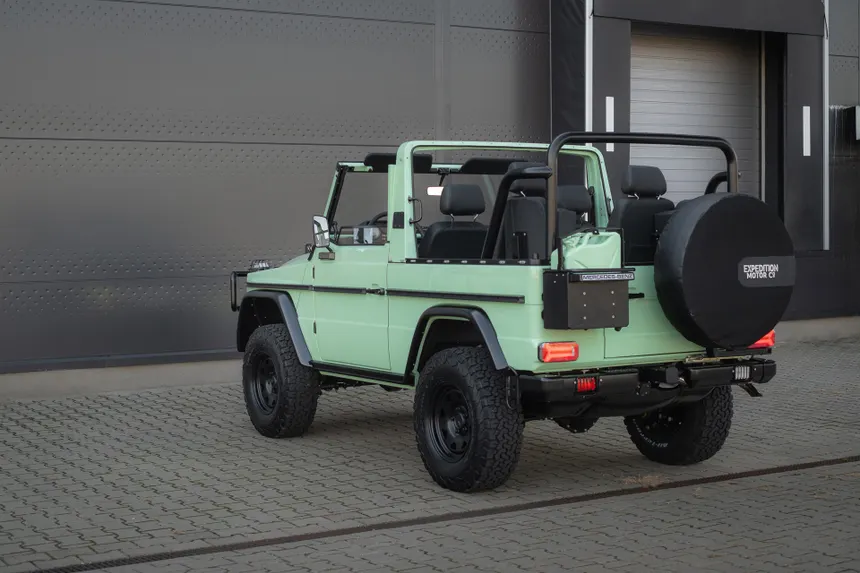
In April 2023, the 500,000th G-Class rolled off the line. Mercedes celebrated with a one-off in agave green, a paint code from the original W460 days. Pretty tribute. But the real number was buried in the press release and almost nobody underlined it.
Of those 500,000 units built across 44 years, the last 200,000 were produced in just six.
It took the G-Class 38 years to reach 300,000 units. It took six to add the next 200,000.
That is not organic growth. That is a cultural event documented in production data. And it’s the receipt for something that happened in front of all of us without anyone properly naming it: the most respected military off-roader on Earth became, in less than a decade, the favorite prop of rappers, influencers, and Beverly Hills valets. Marketing won that war. And when marketing wins, it doesn’t apologize.
But beneath the photoshoot, the truck never changed.
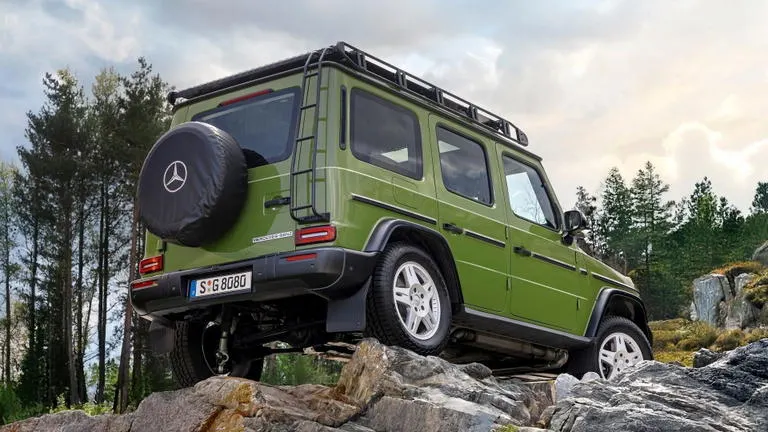
Forty-eight armies use it. They didn’t pick it for the styling.
A modern luxury SUV is a unibody construction with electronic all-wheel drive, independent suspension, and an “off-road mode” button that mostly remaps throttle response. The G-Class is the opposite of all that.
Body-on-frame ladder chassis, the way trucks were built when trucks meant something. Rigid axles front and back. A mechanical two-speed transfer case operated by a real lever. And three locking differentials engaged by three physical buttons sitting in plain sight on the center console.
Three buttons. Center, front, rear. You press them in sequence, and the truck becomes effectively impossible to bog down on any non-vertical surface.
That layout doesn’t exist in any rival in the luxury SUV segment. Not the Bentayga. Not the Cullinan. Not the X7. None of them. Because the G-Class wasn’t designed to compete with them. It was designed so a Polish soldier, a Mexican mechanic, and a Mongolian technician could press the same three buttons at 4,000 meters of altitude and come back alive.
Mercedes has delivered military variants of the G-Class to 48 countries. Russia and Ukraine buy the same truck. The United States operates it in modified form. United Kingdom, Switzerland, Sweden, Slovakia, Singapore, Slovenia, Poland, Mexico, Mongolia, Iraq, Lebanon, Hungary, Greece, Germany, France, Egypt — countries that hate each other rely on the same vehicle to move their troops. That, by itself, says something.
In Germany they call it Wolf. The Bundeswehr operated more than 12,000 units across 50 different variants — from standard command vehicles to the armored LAPV Enok assigned in 2008 to the Kommando Spezialkräfte, Germany’s special forces. The French Army built it under license as the Peugeot P4. When France and Germany — countries that fought two world wars trying to destroy each other — independently choose the same vehicle for their soldiers, they’re not buying styling.
The Bundeswehr doesn’t dress its tools up
In summer 2024, Mercedes-Benz signed a framework contract with the Bundeswehr for the new Wolf 2 (W464). Up to 5,800 units. €1.3 billion. Deliveries through 2032. First firm batch: 1,200 units in command-vehicle and military-police configurations.
Before signing, the German Army did what it always does. It tested the truck to destruction.
Endurance trials kicked off in November 2024 at Wehrtechnische Dienststelle 41 in Trier. Five pre-production vehicles covered 16,000 kilometers across mixed terrain, in a verified thermal range from -34°C to +49°C, with helicopter-suspension trials and rail-loading evaluations on top. Electromagnetic compatibility tests at Military Technical Center 81 in Greding. NATO-standard validation, no shortcuts.
When the German Army announced the test results, one passage circulated widely on German social media. The official Bundeswehr description, paraphrased: above 90 km/h you need ear protection, the canvas roof slaps the body in time with marching music, but it gets you from A to B in the worst conditions imaginable.
That’s not a copywriter selling a product. That’s a soldier describing a tool.
The Wolf 2 runs the same 3.0-liter inline-six diesel as the civilian G 450 d. Same block. But in military trim it produces 249 hp and 600 Nm — the civilian version puts out 367 hp and 750 Nm. Why detune it?
Because the Wolf 2 has to operate on whatever fuel is available in Mali, in Iraq, in places where the closest gas station is 400 kilometers away. It has to fire up cold-soaked at -34°C. It has to keep running after eight hours of cross-country movement on bad fuel, no AdBlue, no functioning particulate filter. It’s homologated only to Euro III, deliberately, because Euro VI emission systems are too fragile to survive that kind of life.
The civilian engine is tuned to extract maximum performance on autobahns. The military engine is detuned to extract maximum reliability under conditions that would kill any normal vehicle.
That’s the difference between engineering for a showroom and engineering for survival.
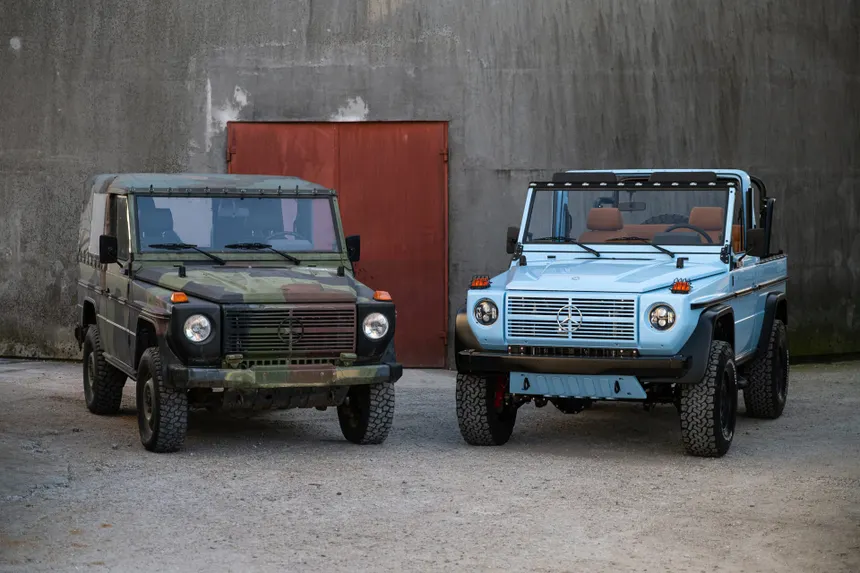
Land Rover and Toyota stopped trying. The G-Class didn’t.
When the Geländewagen launched in 1979, its natural rivals were the Land Rover Series III, the Toyota Land Cruiser FJ40, and the original Range Rover. All three shared a philosophy: ladder-frame chassis, rigid axles, mechanically simple, repairable with a screwdriver and a wrench in the middle of nowhere.
Where are they now?
The reborn Land Rover Defender (L663) abandoned the ladder frame entirely. It rides on a bonded aluminum monocoque now. Smoother, more refined, far more capable on tarmac — and the traditionalists have not forgiven Solihull. The Toyota Land Cruiser 300 keeps the ladder-frame chassis and the legendary reliability — but Toyota never tried to play in the extreme luxury league. The Land Cruiser is the honest workhorse of global overlanding, and it wears that role with quiet dignity.
The G-Class did something neither of them attempted.
It kept everything that made it indestructible — the ladder frame, the rigid axles, the three locking differentials, the semi-handcrafted assembly in Graz — and bolted on top of all that an S-Class interior, AMG biturbo engines, and a marketing campaign engineered with surgical precision.
The price it paid for keeping all of that is the paradox it has been living for the last twenty years.
When marketing wins, the truck loses its context
Time to call things by their name.
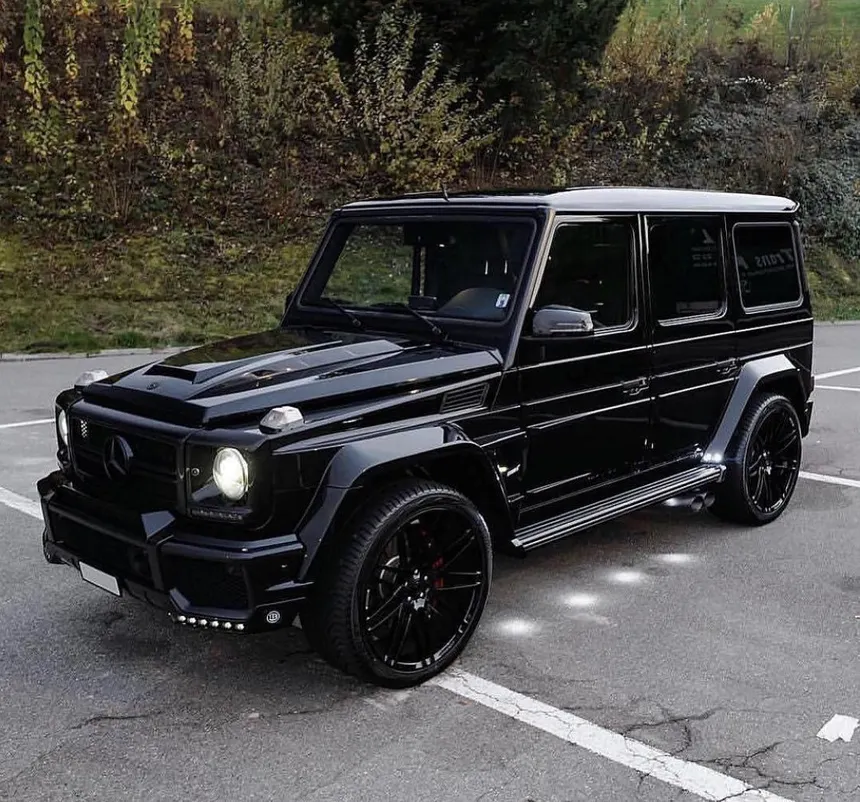
The current AMG G63 starts at around $180,000 in the United States and climbs hard from there. To put that in context: even the Wolf 2 the Bundeswehr is buying to carry fully-equipped troops at -34°C doesn’t cost that much. The civilian customer parking his G63 outside the gym is paying more for his Geländewagen than NATO’s most demanding army pays for the version that actually has to fight.
Mercedes-AMG was not naive about any of this. They built it for this. They positioned it for this. They put it in the music videos, in the films, in the feeds, in the valet stands of every five-star hotel from Dubai to Aspen. And it worked. It worked so well that the G-Class became the vehicle people buy to display wealth, gym time, and lifestyle on YouTube and Instagram. A photoshoot with four wheels. Glorious set dressing. And nobody is saying that’s wrong — we’re saying what it is.
The 200,000 units sold in the last six years were not bought by 200,000 soldiers.
The three buttons nobody presses
Now climb into a 2026 G63 fresh off the dealership lot. Settle into the Nappa leather, look at the redesigned dashboard with its twin digital displays, listen to the V8 bark when it fires up. Everything in the cabin screams luxury, performance, modern theater.
Now look down. Center console, between the two front seats.
There they are.
Three square buttons in a row, marked with minimal pictograms of an axle and a differential. Center, front, rear. Functionally identical to the buttons that sat in the same position on the W460 in 1979.
In the vast majority of G63s sold over the last five years, those buttons have never been pressed. Not once. Not even out of curiosity. The owners don’t know what they do, don’t need them, will never need them. The G63 goes to the gym, to school drop-off, to brunch, to the photocall, to the no-parking zone outside the steakhouse. It never sees mud. It never crosses a river. It never climbs an 80% gradient.
But the buttons are still there.
And that is the engineering miracle hiding in plain sight. Mercedes could have removed them. They would have saved weight, cost, mechanical complexity, validation testing, homologation work. Any consultant in any boardroom would have signed off on the report justifying their elimination from the civilian model. It would have been the rational, efficient, Excel-friendly thing to do.
They didn’t.
Because the same three locking differentials the G63 owner never uses are the ones the Bundeswehr’s Wolf 2 will engage at 4,000 meters of altitude, at -34°C, in the middle of a Finnish forest in February. The civilian and military variants share the mechanical heart. It’s not nostalgia. It’s not retro styling. It’s not a marketing flourish. It is real engineering that is still there because somewhere in the world, far from the photoshoot, somebody actually needs it.
Then came the EQG and rewrote the logic
In 2024 Mercedes unveiled the electric version. G580 with EQ Technology — Edition One MY2025, already in production. Four independent electric motors, one per wheel. 579 horsepower combined, 859 lb-ft of torque. A 116 kWh battery integrated inside the ladder-frame chassis, not on top of it. Mercedes reinforced the chassis to host the battery rather than abandoning it — and that single engineering decision tells you exactly where the soul of the truck lives.
But there’s a detail that changes the rules.
The EQG has no locking differentials. It doesn’t need them.
With four independent motors, the truck applies torque selectively to each wheel in milliseconds — that’s torque vectoring, and technically it’s superior to a mechanical lock because it modulates how much torque each wheel receives at each instant rather than just connecting or disconnecting drive. Mercedes calls them “virtual differential locks.” The system can spin the truck on its own axis (the G-Turn function) by driving the wheels on each side in opposite directions. It can tighten the turning circle on the fly (G-Steering). It can meter torque off-road without the driver touching anything (intelligent off-road crawl).
It’s a real technical leap. And here’s where it matters.
On the EQG dashboard, the chunky billet-style off-road controls are still there. Mercedes deliberately preserved them, even though their underlying mechanical function is gone. They’re the visible fingerprint of the truck’s DNA — the buttons remain, even though they no longer engage anything physical. That is the conscious decision of a manufacturer who knows it is selling a symbol, not just a vehicle.
But the purists have a point. The mechanical clunk you used to feel when a locker engaged, the physical click of the dog clutches connecting, the certainty that you had a real combat mule under you — that disappears. Software replaces it. And even though the software is more capable, it’s not the same thing.
Forty-five years after the Shah, the question is no longer whether the G-Class will survive.
It’s what survives of the G-Class.
Same truck, three lives, one factory
The Geländewagen started as a king’s order he never lived to collect. It became the workhorse of 48 armies. It ended up the most photographed vehicle in Beverly Hills, Dubai, and Monaco.
All three lives live inside the same chassis.
The AMG G63 the influencer drives and the Wolf 2 the Bundeswehr soldier drives are mechanical first cousins. Same plant in Graz. Same semi-artisanal process. Same chassis tags. Same engineering philosophy. Different finish, different power, different destination. But the DNA is identical.
The Bundeswehr contract guarantees the military W464 stays in production at least through 2032, with a service life of another 20 years stacked on top. The civilian variant continues out of the same line. The electric one joins the two combustion versions without replacing either.
The Shah ordered 20,000 units and never received one.
Mercedes has now sold half a million.
And those three buttons are still there, on the console, waiting for somebody — anybody — to actually press them.
Check you’re still alive.