
Mercedes-AMG built an EV that pretends to be a V8. That’s not progress. That’s surrender.
There’s a moment in Chris Harris’ video on the original Tesla Roadster where he says something quiet and revealing: the silence is part of the magic. The torque hits, the world tilts, and there’s no shouting, no theatre, no soundtrack. Just physics doing the work. The car is what it is. Take it or leave it.
Mercedes-AMG has now built the opposite of that.
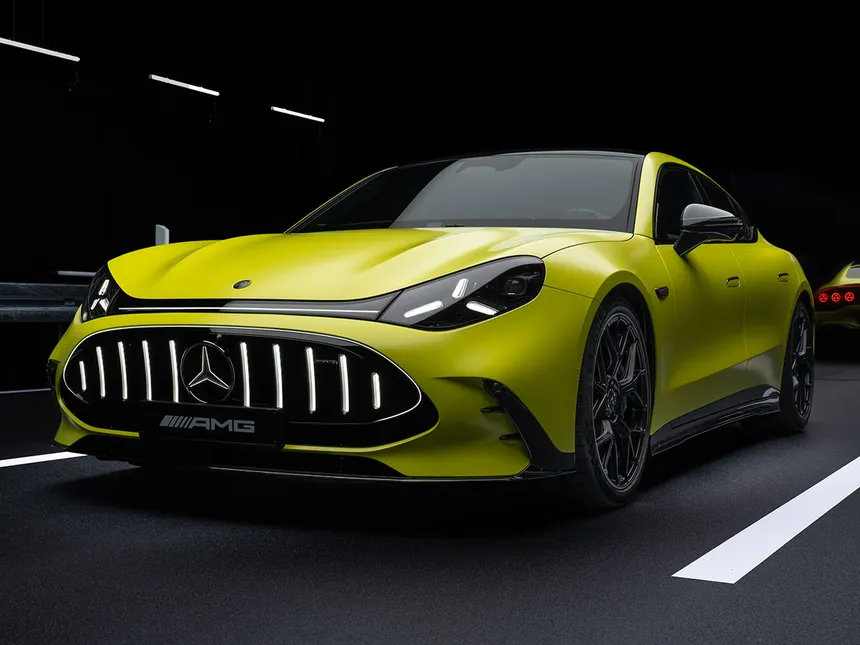
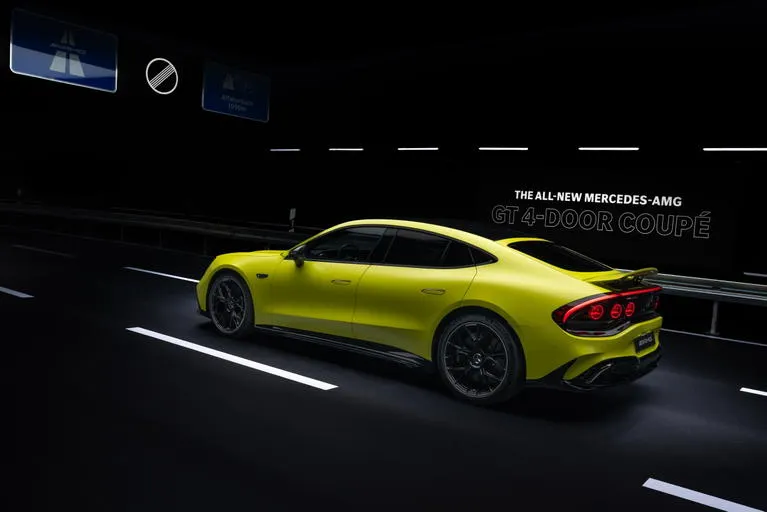
On the night of 20 May 2026, Mercedes-AMG shut down LA’s 6th Street Bridge, turned it into a temporary German autobahn, flew in 500 guests, parked Brad Pitt next to the prop, and revealed the new Mercedes-AMG GT 4-Door Coupé to the world. Second generation. The brand’s first ground-up electric. The world’s first series production car with three axial-flux drive motors. First model on the new dedicated AMG.EA platform. Pyrotechnics. Influencers. The full church.
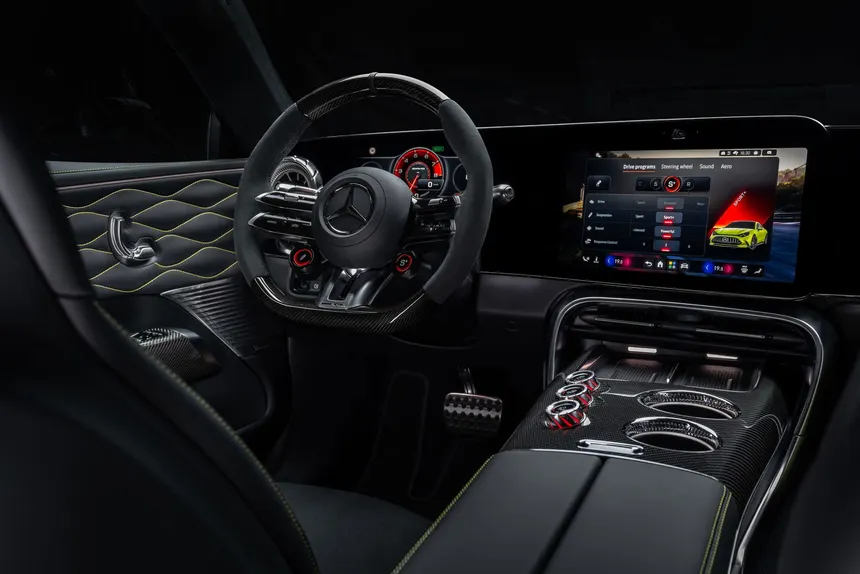
And the defining gesture of the car, the button AMG wants you to associate with the entire £150,000 proposition, is an acoustic illusion. It’s called AMGFORCE Sport+. You spin a dial on the wheel, and the car starts pretending it’s a V8. Synthesised soundtrack inside and outside the cabin. Haptic transducers in the seat structure mimicking combustion pulses. Simulated gear changes that briefly interrupt torque delivery to “feel” like shifts. A digital rev counter sweeping up and down without anything actually rotating in cylinders.
The sound, per Mercedes’s own press material, is derived from the V8 that lived under the bonnet of the previous C190 AMG GT R. They’ve digitised the voice of a combustion engine they stopped selling two model years ago, and now they pipe it through speakers into their first electric car.
This isn’t a buried sub-menu feature. This is the sales pitch. This is what AMG has decided you need to hear, sub-consciously, to accept that an EV can wear three letters from Affalterbach.
What they actually unveiled
Let’s get the facts straight before the argument starts. The new AMG GT 4-Door arrives in two trims, GT 55 and GT 63. The entry model produces 805 horsepower. The flagship GT 63 produces 1,153 horsepower (some sources quote 1,169 bhp; the underlying figure Mercedes communicates is a 860 kW peak system output, with the rest a unit conversion). Zero to sixty in 2.0 seconds flat in the GT 63. Zero to 124 mph in 6.4 seconds. Top speed of 186 mph (300 km/h) with the AMG Performance Package.
Three axial-flux electric motors from YASA, a wholly-owned Mercedes-Benz subsidiary since July 2021, arranged as two rear units inside a single HP.EDU (High Performance Electric Drive Unit) and one front motor acting as a booster, with a Disconnect Unit allowing automatic decoupling to reduce drag losses. The front unit spins beyond 15,000 rpm, the rear units sit above 13,000 rpm at top speed. Compared to a conventional radial-flux motor, an axial-flux unit packs roughly three times the power density into one third of the volume and two thirds less mass, according to figures Mercedes has supplied. Genuinely novel hardware.
The battery is new too. An 800-volt architecture with 2,660 cylindrical cells, cooled by an electrically non-conductive oil. Peak DC charging above 600 kW, which Mercedes claims recovers around 286 miles of range in ten minutes. WLTP range up to 700 km. Production starts at Sindelfingen this July; the motors are built separately at Berlin-Marienfelde using around 35 production techniques Mercedes describes as world firsts and which have generated more than 30 patent applications.
Braking is carbon-ceramic at the front, steel at the rear, with regenerative-hydraulic integration. Suspension is AMG Active Ride Control air with semi-active roll stabilisation. Three physical rotary dials on the centre console form the new AMG Race Engineer Unit, controlling response, agility and traction across nine stages each. A 10.2-inch instrument display and 14-inch central screen dominate the dashboard, with an optional second 14-inch screen for the passenger.
So this is what’s underneath. This is the engineering. This is what AMG has spent years and budgets on.
And this is what they don’t want you to hear while driving it.
“The best V8 we’ve ever developed”
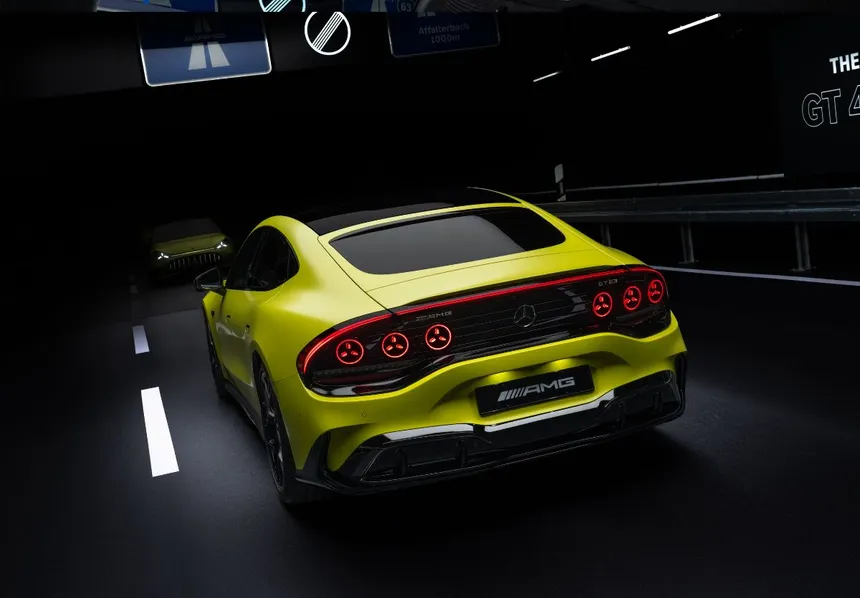
You couldn’t make this up if you were writing satire. According to Schiebe, when he took the Mercedes-Benz board of management for a prototype drive, one of them, an unnamed board member, came out of the car and said: “This is the best V8 we have ever developed.”
Read that again. A senior executive at Mercedes-Benz Group AG, describing a powertrain that contains zero combustion chambers, zero pistons, zero camshafts, zero crankshafts and zero litres of displacement, called it the best V8 they’ve ever built. And Schiebe repeated that line, in public, on the record, with apparent pride, all the way through the run-up to the LA launch.
This is the corporate equivalent of putting a lobster on the menu, serving the customer a piece of cauliflower painted red, and announcing it as “the best lobster we’ve ever cooked.” There is a word for that, and it isn’t innovation.
The board of Mercedes-Benz has, by their own CEO’s testimony, lost the ability to describe their own product. They’ve built something genuinely new, the first series production car in the world with a tri-motor axial-flux drivetrain, and the only language they have for it is the language of the thing they replaced.
That isn’t a marketing problem. That’s an identity collapse.
The dealer story is the smoking gun
Schiebe, in his press round tables ahead of the reveal, told this anecdote as a triumph: “It is so realistic that some of the dealers asked me, Michael, can you open the hood, because they did not believe me that there is no combustion engine in it.”
He told this as good news. He told this as proof the system works. He repeated it across multiple briefings.
Take a breath and re-read it. The CEO of AMG is bragging that he successfully tricked his own dealer network. That his sales force could not, in a blind setting, identify what they were trying to sell. That the indicator of success was the magnitude of the deception.
If you’re shipping a £150,000-plus electric performance saloon and your own commercial network won’t accept it until they’re acoustically misled into thinking it’s combustion-powered, you have not built a great car. You have built a car that doesn’t survive without the lie.
This is the kind of admission Chris Harris would take apart in two minutes flat, in that calm, surgical way he has, the one that doesn’t need to raise its voice because the evidence is doing the shouting. Top Gear’s own coverage records Schiebe saying explicitly: “Buying an AMG has never been a rational decision. It’s a very emotional decision.”
Translation: we know the maths doesn’t favour this product against a Lucid Air Sapphire, a Tesla Model S Plaid or a Porsche Taycan Turbo GT on raw merit, so we’re selling you memory instead. Nostalgia. The acoustic ghost of the car you wish you were still buying.
The contradiction that exposes everything
Here’s the bit that breaks AMG’s narrative completely, and it happened on the night of the launch itself.
While unveiling the electric GT 4-Door, Mercedes refused to confirm whether a petrol or hybrid version of the same four-door coupé will follow. Refused on the record. But the same executives confirmed, at the same event, that a new V8 combustion engine is in development, alongside a fresh Euro 7-compliant inline-six. Not for this car. For the next C63, the CLE63 and whatever else AMG has cooking in Affalterbach. The real engine. The combustion one. The one that makes noise because air gets pushed through valves and petrol ignites inside cylinders, not because a DSP plays back a stored sample of an AMG GT R that hasn’t been in production since 2024.
So the same company, at the same event, is doing two opposite things. On one side, an EV pretending to be a V8. On the other, the public confirmation that a real V8 is coming back because customers slaughtered the four-cylinder hybrid C63 in the showroom, a defeat Schiebe himself has acknowledged in multiple interviews.
That tells you everything. AMG knows its customer wants a real V8. They know because the four-cylinder C63 cost them sales the moment it landed. And rather than accept that the electric car is a different proposition, a different emotional language, a different product entirely, they’ve decided to disguise the electric one as the thing the customer is grieving for. Acoustic methadone.
That’s not a product strategy. That’s a brand without nerve.
The wider problem
This isn’t just AMG. Audi’s Gernot Döllner confirmed to Top Gear that the brand’s upcoming electric sports car will get fake gear changes too. Hyundai’s Ioniq 5 N already has them. Dodge’s Charger Daytona ships with the Fratzonic Chambered Exhaust, projecting a synthesised V8 from external speakers. Porsche offers its Electric Sport Sound. The entire premium industry is converging on the same answer: don’t ask the customer to face what an electric car actually is, just dress it up as what they used to drive.
And the debate Not Enough Cylinders needs to put on the table is this one: is the electric transition something you do by honouring the new medium, or by hiding it inside the old one?
Because if the answer is the second, we’re not solving the problem, we’re postponing it. We’re teaching an entire generation of premium buyers to relate to electric cars through a layer of sensory fiction. And in fifteen years, when those same buyers come back to renew, they’ll demand that the next electric AMG still sounds like a V8 that doesn’t exist anymore. Because that’s what they were trained to want.
That’s not building a market. That’s bequeathing the next generation of executives a problem the current one didn’t have the guts to solve.
What straight-shooting electrification actually looks like
This isn’t a purist objection. NEC has no problem with electric performance cars. We’ve covered Estrema’s Fulminea, Rimac, Lucid, the Pininfarina Battista. There’s serious engineering happening in the electric performance segment, and it deserves serious coverage.
But look at how those projects behave. Rimac’s Nevera doesn’t pretend to be a Bugatti Veyron. It sounds like what it is, a vehicle moving close to two thousand horsepower through electric motors with their own electromagnetic voice. Lucid doesn’t ship a fake six-cylinder mode. Estrema’s Fulminea, with its solid-state battery work, doesn’t impersonate a Ferrari. Even Hyundai, which does use fake shifts in the Ioniq 5 N, calls them what they are: a gimmick layer, a mode, a toy you can switch off. Hyundai doesn’t ask the customer to confuse the car for an Audi RS3.
Mercedes-AMG has done something different, and worse. They haven’t added a sensory layer. They’ve built the entire emotional case for the car around the simulation. AMGFORCE Sport+ isn’t an option, it’s the product. It’s the reason you’re being asked to pay an AMG premium instead of a similarly specced Lucid Air. And to make sure the costume reaches everywhere, the system plays a bass note when you unlock the doors, two heartbeat pulses on entry, separate audio profiles for charging, Launch Control, Boost mode and “Showtime” mode. Theatre, layer by layer, from the moment you touch the car.
Which means the moment you switch the costume off, the moment you drive the car in normal mode, in silence, the way an electric car actually exists in the world, you’re driving an extremely expensive Mercedes that the manufacturer itself does not believe in.
The car this could have been
Imagine, for a moment, the opposite version. Imagine Mercedes-AMG had taken the YASA axial-flux motor, which is genuinely cutting-edge hardware, and built an identity around what it actually is. A new acoustic signature, designed from scratch for the AMG.EA platform. A sound that didn’t reference combustion. A first AMG voice for a first AMG-born electric.
Imagine if the board, instead of applauding “the best V8 we’ve ever developed,” had applauded “the first genuinely new AMG in fifty years.” Imagine if the most powerful axial-flux drivetrain ever fitted to a production car had been allowed to speak its own language.
That would have been a car with a spine. With an argument. With a future tense.
Instead they’ve built a parlour trick. A reference car that points backwards. An EV that exists, fundamentally, to apologise for being an EV.
Where this leaves the car
The 2027 AMG GT 4-Door, in raw hardware, is exceptional. 1,153 horsepower in GT 63 trim. Two seconds to sixty. Above 600 kW DC charging. 700 km of WLTP range. The first production car in the world with a tri-motor axial-flux drivetrain. An 800-volt architecture derived from Formula 1 battery technology. Around 35 world-first production methods. More than 30 patent applications pending. Properly serious engineering.
But none of that is what the car will be remembered for. The car will be remembered for the day Mercedes-AMG, the most aggressive performance division in the German industry, looked at the most powerful and technologically advanced production EV they’d ever built and decided to bury it under a sampled, digitised recording of an engine they stopped making, because they didn’t trust their own customer to accept it on its merits.
That’s not progress. That’s not bravery. That’s not the future of performance.
It’s a confession.
A confession that AMG, in 2026, doesn’t know who AMG is.
So which is it, Affalterbach? Are you a V8 brand or an electric brand? Because if you’re trying to be both, in the same car, at the same time, what you’re selling isn’t the future. It’s a costume rental with a Mercedes badge on it.
And the customer who places his deposit when UK orders open in September, the moment he switches off AMGFORCE Sport+ and drives home in actual EV silence with the digital rev counter dark, is going to look at that empty screen and realise he bought a brilliant car that the people who built it were too scared to let him own.
That’s the kind of thing that destroys brands, eventually. Not all at once. Not in one product cycle. But slowly, the way trust always erodes, one fake noise at a time.
You can have a V8. You can have an EV. You cannot have a V8-EV, because there is no such thing, and pretending there is doesn’t make it real. It just makes the lie louder.
Check you’re still alive.