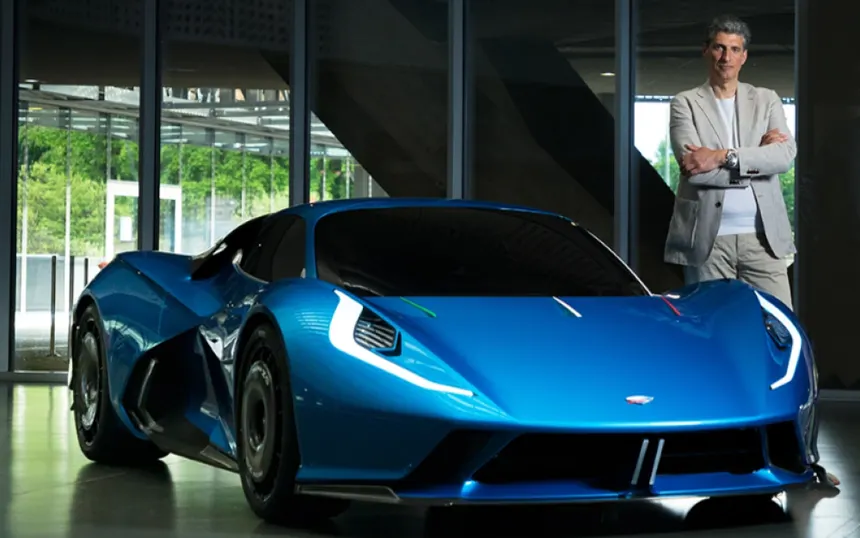
Automobili Estrema Fulminea — 2,040 HP Born in a WhatsApp Group During a Pandemic
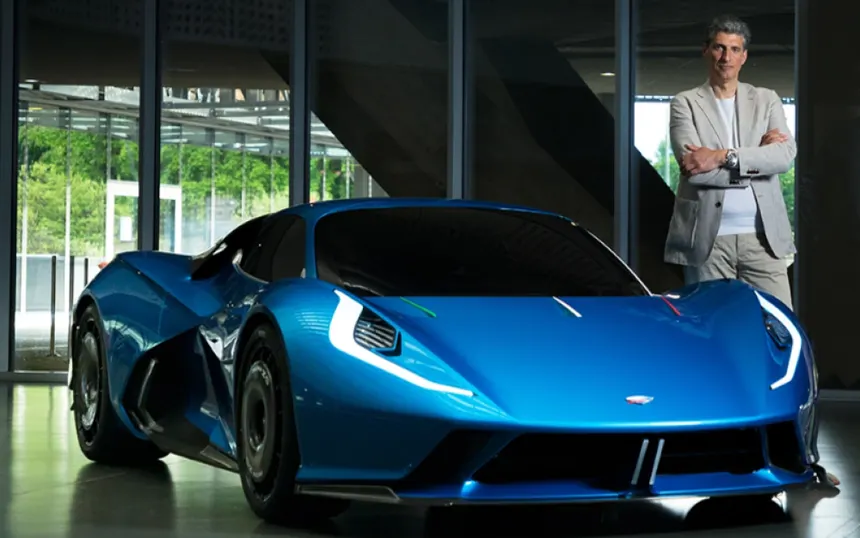
There’s one sure way to know if someone has what it takes. It’s not looking at how many times they’ve won. It’s looking at how many times they’ve got back up after losing everything.
Gianfranco Pizzuto put $2 million into Fisker Automotive, watched 338 Karmas burn at a port and over a billion dollars evaporate. We already told that story. If you missed it, search “Fisker Karma” on this site. If you read it, you know what comes next: when it all collapsed, he did what any sane person would do.
He started again.
But not the way you’d expect. He didn’t call investors. He didn’t rent offices. He didn’t hire lawyers. He did it from a WhatsApp group during a global pandemic. And from that group, a 2,040 hp electric hypercar was born — one that wants to break the Nürburgring record.
This is the story of Automobili Estrema and the Fulminea. And if it doesn’t give you goosebumps, check you’ve still got a pulse.
The man who doesn’t know how to quit
Franco — that’s what those who know him call him, and that’s what we’ll call him too, because he opened the doors to this story without conditions — was born in 1961, near Venice, and grew up in Merano, in the province of Bolzano, in Italy’s South Tyrol. He started his business career in 1983. In 1989 he co-founded FAE Group with three partners, a company specialising in agricultural, forestry, and heavy construction machinery that today is a world leader in its segment.
But Franco’s passion was always cars. In 2007, after leaving FAE due to internal tensions that were driving him toward burnout, he met Henrik Fisker and put $2 million in as Fisker Automotive’s first investor. He set up Fisker Italia as the first European distributor. He had in his showroom the very first Karma show car ever built, painted in the legendary “Laguna” colour. Today he still owns two Karmas: the original Laguna and Signature Edition number 61.
Then came the awards, the magazine covers, the celebrity investors, a $529 million loan from the U.S. Department of Energy, a ghost investor who promised a hundred million and left the account at zero, a rejected proposal to Sergio Marchionne to create FFCA — Fiat Fisker Chrysler Automobiles, Hurricane Sandy, and the bankruptcy. We’ve already told all of that.
After Fisker’s fall, Franco worked as a consultant in the automotive industry. He imported the California-edition Fiat 500 electric to Europe and developed an entirely new high-voltage battery to improve its range and charging capacity. He tried to launch a Formula E team. He learned to swim with sharks. He never stopped moving.
And then 2020 arrived. The pandemic. The world froze. And Franco felt depression for the first time in his life. “Never in my life had I experienced such a sense of helplessness and oppression. For many weeks you couldn’t go out, travel, or carry out normal business activities. Accustomed my whole life to moving internationally, this overwhelming sense of frustration initially made me depressed.”
The WhatsApp group that changed everything
Franco’s reaction to depression wasn’t to stop. It was to dream. He opened a WhatsApp group, called it “Progetto Hypercar,” and started adding friends. The first person he contacted was engineer Roberto Olivo, a veteran of the automotive industry. He knew Roberto was also confined at home and that the idea of designing — almost as a game — a beautiful super sports car would appeal to him.
By late summer 2020, the moment of truth arrived: they could stop playing and close the project, or found a company and make it real. Franco called Roberto again. He was on holiday in Sicily. Snorkelling. He couldn’t answer. He called back a bit later. Franco asked if he was willing to help out if he decided to found a company to build the Fulminea. Roberto said yes.
In October 2020, they founded Automobili Estrema.
“Being creative in the pursuit of beauty together with a group of friends can be seen as a therapeutic process against depression,” Franco says. And then he sums it up in three words that weigh a ton: “La grande bellezza mi ha curato.” The great beauty healed me.
The company was founded between Modena and Turin. In the heart of Italy’s Motor Valley. With a motto burned into its DNA: “Per Aspera Sic Itur Ad Astra.” Through hardship to the stars.
And with a philosophy built on four pillars: Romance, Elegance, Purity, and Balance. Romance as the excitement of creating something that didn’t exist before — the same impulse that drove Ferruccio Lamborghini to start a car company because Enzo Ferrari told him a tractor maker didn’t understand clutches. Elegance as the grace of classic, timeless Italian style. Purity as the elimination of the superfluous to reach essential design — every line justifies its existence or disappears. Balance as the ability to combine raw power with refinement without letting either dominate.
If it sounds like a manifesto from a madman, that’s because it is. But madmen who build cars in Italy have a track record that’ll keep you up at night.
Fulminea: the lightning bolt
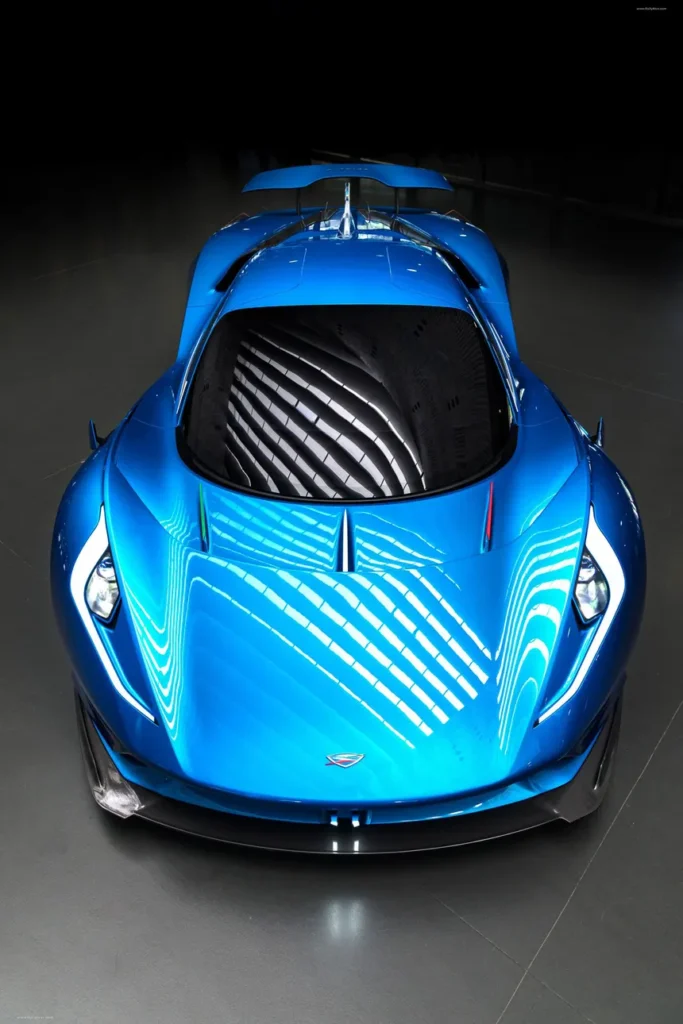
From the dream came the Fulminea. The name says it all: lightning in Italian. Fast, powerful, and electric.
The numbers hit like a slap. Four electric motors with all-wheel drive and torque vectoring. Total power output: 1.5 megawatts. Translated into the language you understand: 2,040 hp. Zero to 100 km/h (62 mph) in approximately 2.0 seconds. But that figure isn’t even the one that matters here. Zero to 320 km/h (200 mph) in under 10 seconds. Not zero to 100. Zero to 320. Estimated top speed around 415 km/h (258 mph), though the brand has discussed limiting it to roughly 350 km/h (217 mph).
When you ask Franco what makes the Fulminea different from a Rimac Nevera or a Pininfarina Battista, he doesn’t hesitate: “The hypercars you mention are by now a bit dated and use conventional cells, which means very heavy batteries. We want to give the Fulminea a soul that can give its future owners emotions similar to combustion-engined hypercars. We’re betting heavily on weight reduction using every technological solution available today.”
And here’s the technical key to the project.
The Fulminea will be the first street-legal car in the world to combine solid-state batteries with ultracapacitors in a single pack. To be clear: other cars have used supercapacitors — the Lamborghini Sián paired them with conventional lithium-ion cells. But solid-state plus ultracapacitors is something else entirely. Nobody has done it in a production car.
Here’s an important fact NEC can confirm first-hand: Estrema has ended its collaboration with ABEE, which was the original solid-state cell supplier. They’re now working in parallel with three alternative companies to see which one delivers on its promises and can supply the cells to complete the prototype. The collaboration with IMECAR Elektronik for battery pack construction remains active. Three suppliers in parallel. The lesson of A123 — the sole supplier that killed the Karma — has been well learned.
The 100 kWh pack with ultracapacitors on the front axle to maximise regenerative braking recovery remains the heart of the project. Projected WLTP range: 520 km (323 miles). But the weight target has changed. Current simulations put the Fulminea’s total mass at 1,800 kg (3,968 lb). That’s not the original 1,500, but still 350 kilos lighter than a Rimac Nevera. The greatest weight savings will come from solid-state cells and aerospace-derived materials produced using specialised 3D printers, in collaboration with a company born from an Airbus spin-off.
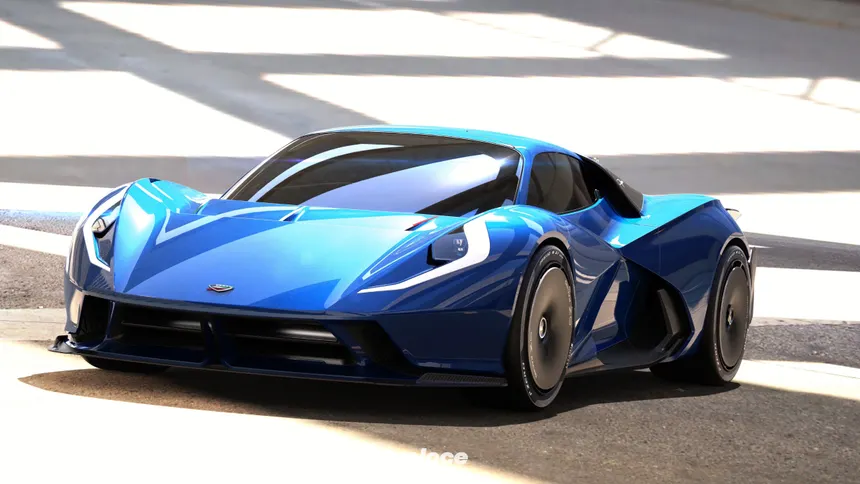
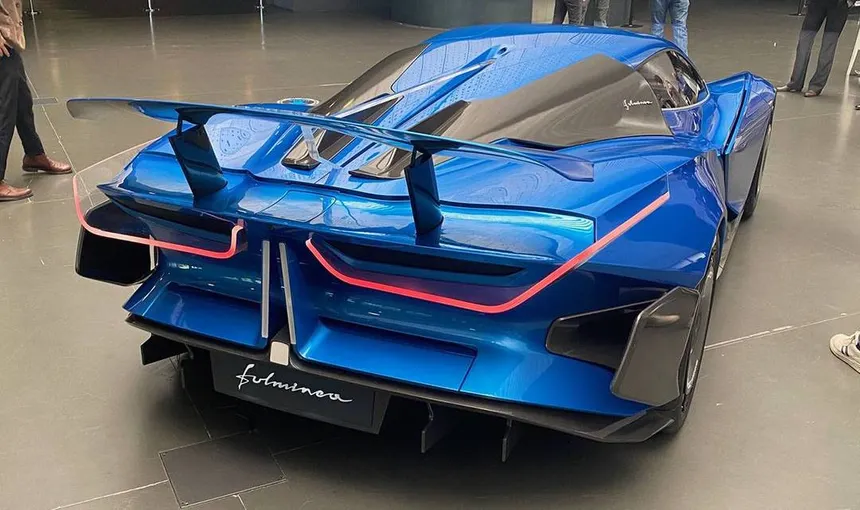
The chassis and body are made from next-generation carbon fibre. The design is pure Italy. Front and rear wings extending along the side profile creating a lightning-bolt silhouette. An adjustable rear wing. Shark fin. Massive diffuser. Butterfly doors. Two vertically slotted LED tail lights. OZ Racing wheels. Bridgestone tyres — with whom they’ll conduct testing at their Aprilia circuit south of Rome once the prototype is complete.
Inside, everything is driver-focused. Exposed carbon fibre across every surface. Competition-style bucket seats. Digital instrumentation without distractions. It’s a two-seater that makes no apologies for existing solely for driving.
And the aerodynamics aren’t just functional, they’re art. Air intakes under the bonnet generating front-axle downforce, an intake behind the rear wing, and massive side channels that vent hot air during braking. Everything works together. Nothing is decoration.
Only 61 units will be made. Why 61? “It’s my lucky number. I was born in ’61. 1961.” The same number as his Karma Signature Edition.
The launch colour will be Azzurro Savoia, chosen to honour Italy’s national teams and the colour of the House of Savoy, Italy’s royal family when the country was still a monarchy. But customers will be able to order the Fulminea in whatever colour they want.
Starting price: approximately €2.3 million. But Franco is clear: “In reality, the sale price will be higher because buyers of this type of car want to personalise it, which can push the price beyond €3 million.” To recoup the investment, they need to produce at least 10 units. Reaching all 61 will be very difficult. And Franco knows it.
The Fulminea won’t be built in a large factory. It will be produced by an Italian company specialising in one-off production, only to order. No massive capital. No thousand-worker factories. The antithesis of Fisker. The lesson learned.
Grugliasco: the dream that couldn’t be
In November 2023, Franco learned that Stellantis had put the former Maserati factory in Grugliasco, in the metropolitan area of Turin, up for sale. 210,000 square metres. Price: €25 million. The listing appeared on Immobiliare.it, as if it were a flat for rent.
But this was no ordinary factory. It was built in 1959 by Carrozzeria Bertone. Giorgetto Giugiaro and Marcello Gandini worked there. Gandini, barely 25 years old and freshly appointed head of design at Bertone after Giugiaro left for Ghia, designed the Lamborghini Miura there in just four months. From 2013, Maserati assembled the Quattroporte and Ghibli on that very site. At its peak, 1,700 people worked there.
Franco didn’t hesitate. His plan was to transform it into the Estrema Technology Hub: an open ecosystem with multiple companies, a training academy, and the Fulminea’s production line. He visited the factory multiple times. Brought investor delegations from Austria. Secured letters of intent from his partners. Met with the mayor of Grugliasco. Spoke with the Piedmont Region. Reached the national government in Rome.
It didn’t work.
“I did everything possible to find the funding and relaunch the former Bertone factory in Grugliasco. I spoke with institutions at every level, from the mayor of Grugliasco to the Piedmont Region to the current government in Rome. Lots of nice promises but no concrete help. After investing over a year of work looking for funding, I had to give up. It seems my country isn’t interested in producing electric cars. On the other hand, it’s working hard on behalf of the arms industry.”
He received many messages from the Maserati workers and the entire supply chain that depended on the Grugliasco factory. They had hopes in his relaunch project. Franco couldn’t deliver on that promise.
The last time he passed by Grugliasco was a few months ago. What he describes hurts: “I felt like crying. Everything is dilapidated now, ruined to the point where I don’t think it’s worth trying to save what’s left. When I think that in that factory some of the most beautiful cars in automotive history were designed and produced… such sadness.”
The factory where Gandini sketched the Miura is rotting. Nobody wanted to save it. Franco tried. He couldn’t.
The Italian connection
There’s something that ties everything Gianfranco Pizzuto does together: the stubborn belief that Italy can lead the automotive industry again. Not through nostalgia, but through technology.
Automobili Estrema was born in Modena, in the Motor Valley. The brand’s crest features a tricolour Italian lightning bolt piercing through the shield, set against an azzurro background with a carbon-fibre texture. Every detail is a statement of intent.
And the partners confirm it: three suppliers competing for solid-state cells, IMECAR for pack integration, McLaren Applied for performance systems, OZ Racing for wheels, Bridgestone for tyres, Epta Design and Bieffe Project for engineering, and a company born from an Airbus spin-off for aerospace materials. A network of European excellence with Italian DNA.
Franco puts it this way: “Fulminea is the sexy part of the project. We combine this sexy part with the economic part.”
What’s next
Franco can’t give exact dates. But he hopes to deliver the first Fulminea before the end of 2027. And he puts a figure in perspective that says a lot: “Even the great Horacio Pagani took 7 years to complete his first Zonda.”
Estrema maintains its intention to take the Fulminea to Nürburgring Nordschleife to attempt the production electric car lap record. The decision will be made once the prototype is finished, after testing at Bridgestone’s Aprilia circuit.
And when you ask him what he’d say to anyone who thinks Estrema is just more vaporware, another render hypercar that’ll never reach the road, the answer isn’t what you’d expect from a CEO defending his product: “I don’t really care to tell them anything. In my life I’ve already achieved a great deal. And even if the Fulminea never made it to production, it wouldn’t change anything for me.”
That’s what a man with nothing left to prove says. Who builds because building is his way of being alive. Who has swum with sharks and decided to keep swimming.
And the first thing he’ll do if the Fulminea reaches production and breaks the record at the Nürburgring? Franco doesn’t hesitate: “I’ll take my wife and leave immediately for our honeymoon. We’ve been married for over 30 years but we’ve never had time to do it. The time has come.”
Behind a 2,040 hp hypercar there’s a man who’s been promising his wife a holiday for three decades. The woman who saved him from burnout. The one who held him up when Fisker collapsed. The one who believed in him when he started again from a WhatsApp group.
There’s a phrase Franco carries with him. “Per Aspera Sic Itur Ad Astra.” Through hardship to the stars.
We asked him why he still believes in that phrase after the first time it led to bankruptcy, not the stars. His answer: “Even though the company went bankrupt financially, you can’t say it was a failure in itself. We managed to design — starting from a blank sheet — and produce one of the most beautiful and revolutionary cars of the last twenty years. Only through effort and hardship does one reach success.”
The road to the stars is full of potholes. But the man behind the wheel has already driven through several of them. And he’s still accelerating.
1 thought on “AUTOMOBILI ESTREMA”