Chrysler Built a 194 MPH Pace Car With a K-Car Engine, Then Lent It to a Charlie Sheen Movie
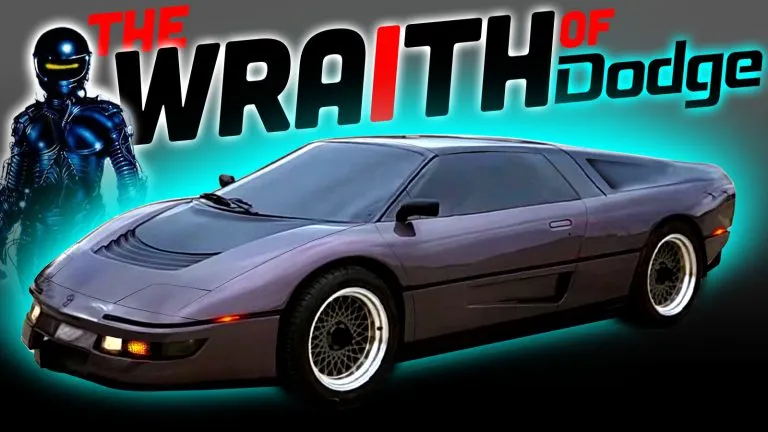
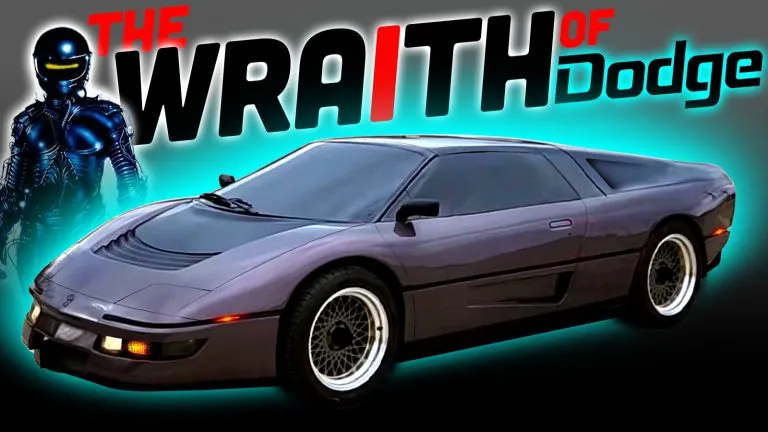
The Dodge M4S Turbo Interceptor was a real Le Mans-spec prototype. Hollywood borrowed it. And an assistant cameraman never came home.
Clarkson built half his Top Gear career on a simple premise: most cars that look futuristic are lying. They’re VW Golfs in fibreglass cladding, Pontiac Fieros with body kits, kit-car nonsense pretending to be the future. He’d point at them, lift a panel, and the joke would write itself.
The Dodge M4S would have stopped that joke dead.
Because the M4S wasn’t pretending. Underneath the spaceship-grade fibreglass shell sat a Cosworth-headed twin-turbo four-cylinder making 440 brake horsepower, a Huffaker-built semi-monocoque chassis straight out of the IMSA paddock, a Lockheed-tested aerodynamic body with a drag coefficient of 0.236, and a top speed of 194.8 mph certified on a closed circuit. This thing was a proper development prototype built by Chrysler Corporation, not a movie prop.
Then Hollywood asked if they could borrow it.
What happened next is one of the strangest, saddest stories in 1980s motoring cinema. And the most expensive cameo a Detroit Big Three manufacturer has ever donated to a B-movie.
When Chrysler Got Bored of Building K-Cars
To grasp what the M4S meant in 1984, you have to remember what Chrysler was selling that year. The K-car platform. The Aries. The Reliant. The Daytona. Front-engined, transverse-mounted, two-and-a-half boxes of beige domestic transport. Lee Iacocca had just dragged the company back from federal bankruptcy with a government loan, and Chrysler’s brand identity was “we’re still alive.”
Inside Highland Park, head of Dodge design Bob Ackerman was losing the will to live. He’d watched Pininfarina and Bertone produce one concept car after another while his department was being asked to facelift Aspens.
Then a phone call arrived from PPG Industries. PPG, the paint and coatings giant, was the title sponsor of the CART IndyCar World Series. They needed pace cars. Spectacular ones. They’d already commissioned them from Buick, Pontiac and Ford, and now they wanted a Dodge. The brief came back to Ackerman through the corporate chain, and according to people who were there, it was the closest thing to a blank cheque a Detroit designer ever got: have fun, go wild.
He went very wild indeed.
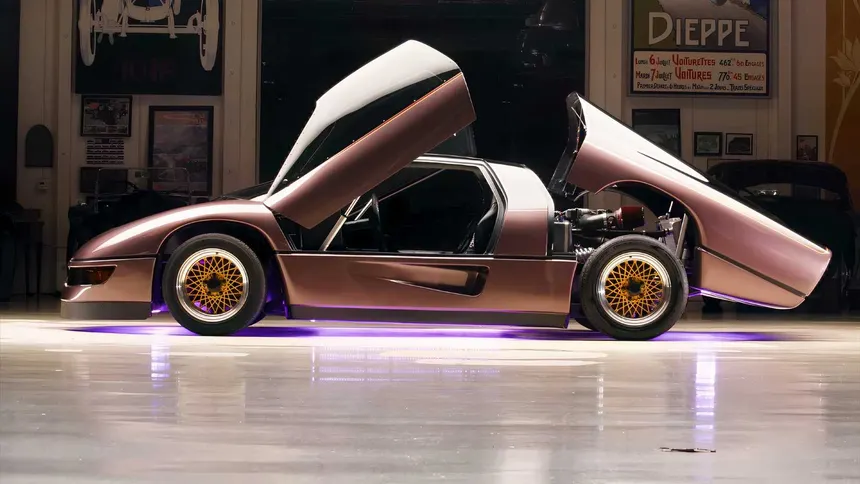
What he sketched was a mid-engined, two-seat coupe with a teardrop profile, Kamm tail, retractable headlamps and scissor doors. It looked like a Porsche 962 someone had shrunk and given number plates. The designation was deliberately unromantic: M4S. Mid-engine, 4-cylinder, Sport. The styling did the romance for him.
The project started in 1981. They wouldn’t finish it for three years.
The Engineering Was Properly Mental
This is the bit that matters. Anyone can mould a fibreglass body and stuff a Honda engine behind the driver. PPG wouldn’t have minded. The whole pace-car gig was about looking good while puttering around at 80 mph. But Ackerman wanted a real, fully developed running prototype. Not a display piece. Not a turntable special.
The engine block came from the Chrysler 2.2-litre four-cylinder. The same lump that powered the Aries K, the Reliant and the entry-level Daytona. A pushrod-derived eight-valve unit making 84 horsepower in your mum’s hatchback.
What Ackerman’s team did with that block defines what kind of project this was.
They commissioned Cosworth in Northampton to design a bespoke 16-valve, twin-cam aluminium cylinder head. They added Bosch electronic fuel injection. They bolted on two Garrett T25 turbochargers running parallel boost at 25 psi (1.72 bar) of maximum pressure.
The result: 440 bhp (446 PS metric) and 400 lb-ft (542 Nm) of torque from a block originally engineered to drag a Plymouth Reliant through a Walmart car park.
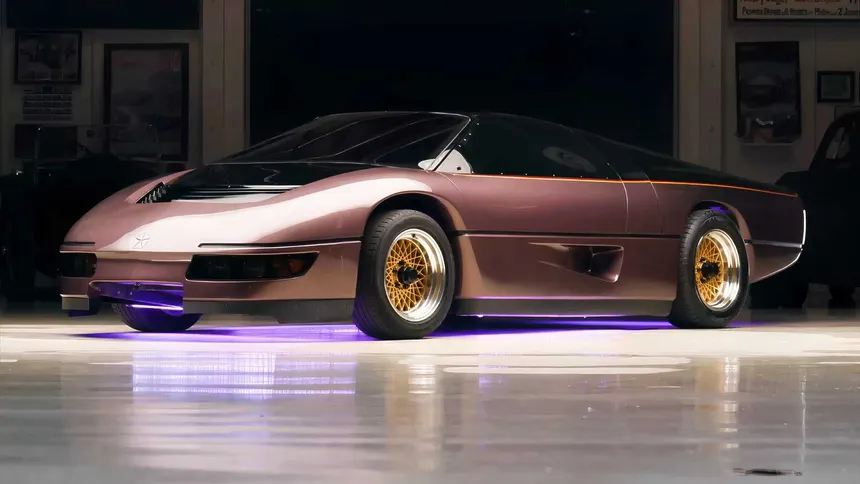
The gearbox was a five-speed Chrysler unit lifted from the Daytona Turbo Z, modified by Liberty Engineering to handle the torque, then strengthened internally by Weismann Transmissions, who built gearboxes for Formula One outfits. The chassis was a semi-monocoque tub built by Huffaker Engineering in Sonoma, California, the same outfit that supplied IMSA GTP and Trans-Am chassis. The body was clay-modelled by 3-D Industries in Madison Heights, Michigan, and finished by Special Projects in a custom PPG pearl paint called Root Beer Brown, layered over a black base coat that shifted hue depending on the light.
Total kerb weight: roughly 2,550 pounds. About 1,160 kilograms. Lighter than a Mk2 Volkswagen Golf GTI.
When they took it to Lockheed’s wind tunnel in Burbank, the same facility that tested SR-71 Blackbird airframes, the M4S registered a drag coefficient of 0.236. Reference point: today’s Tesla Model S manages 0.208 and that’s considered world-class. A 1984 Pontiac Fiero managed 0.38. Ackerman’s spaceship was operating in a different physics class entirely.
On the test track, the M4S clocked 194.8 mph (313.5 km/h) flat-out. The original brief had been 200. They missed by less than five. The 0-60 mph time was 4.1 seconds. In 1984. With a four-cylinder engine.
Chris Harris would probably explain what that means by comparison. In 1984, the Ferrari 288 GTO claimed 189 mph and 4.9 seconds to 60. The Porsche 959 didn’t exist in production form yet. The Lamborghini Countach 5000QV claimed 183 mph. The M4S, with a tweaked Plymouth Reliant motor, beat all of them in a straight line.
And Chrysler wasn’t going to sell it. Never planned to.
The Pace Car That Made Indy Cars Look Slow
The M4S started lapping American circuits in 1984 as the official pace car of the PPG-CART IndyCar World Series. Long Beach. Indianapolis. Mid-Ohio. Cleveland. Out it came at every round, warming tyres ahead of the field, ducking into pit lane while spectators pressed against the fences trying to work out what brand it was. A 240-km/h rolling billboard. PPG paid for everything and got their pearl coating photographed by every motoring journalist in North America.
Chrysler built four functional units of the M4S in total, alongside five non-functional shells (the functional ones evolved between 1981 and 1987). The functional cars did the pace-car circuit. The non-functional shells went to motor shows, dealer events, photo shoots.
Then Hollywood called.
Mike Marvin Needed a Ghost Car and Charlie Sheen Needed a Job
Mike Marvin was directing an oddball script: a murdered street racer comes back from the dead to take supernatural revenge on the gang that killed him, driving a car that doesn’t belong to this world. He needed a vehicle that, just by appearing on screen, would scream not from around here.
The budget was C$8 million. Modest. New Century Vista was distributing. Charlie Sheen, fresh off Platoon, was the lead. Sherilyn Fenn played the love interest, Nick Cassavetes the villain, Randy Quaid the sheriff.
Marvin’s location scouts called Chrysler. And Chrysler, in a corporate decision that still makes no obvious sense by any normal product-placement logic, said yes.
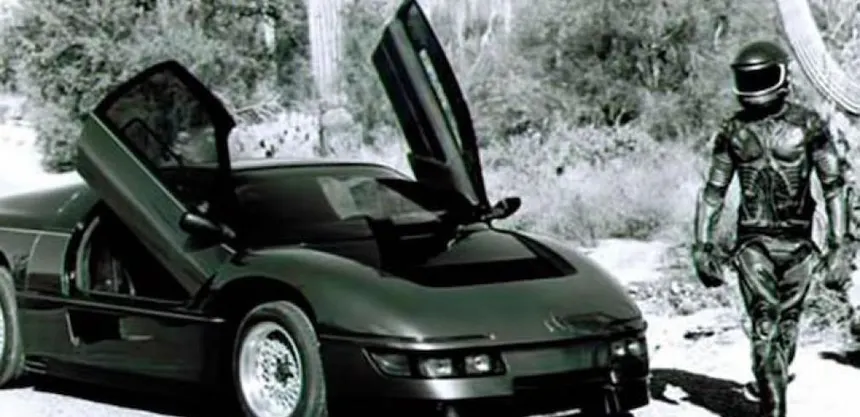
The arrangement was rigid. The original M4S would only be used for static close-ups, detail shots and occasional controlled driving. No stunts. No drifts. The film crew was expressly forbidden from operating it; whenever the original moved on set, it was driven by Joe Pappas, the head technician on Chrysler’s M4S programme, who travelled to Arizona as on-site driver and advisor to the production’s automotive team.
For everything else, the production built a fleet of replicas. According to transport coordinator Gary Hellerstein, a total of seven M4S versions were needed to complete the film: the original hero car, two stunt drivers and four shells for impact scenes.
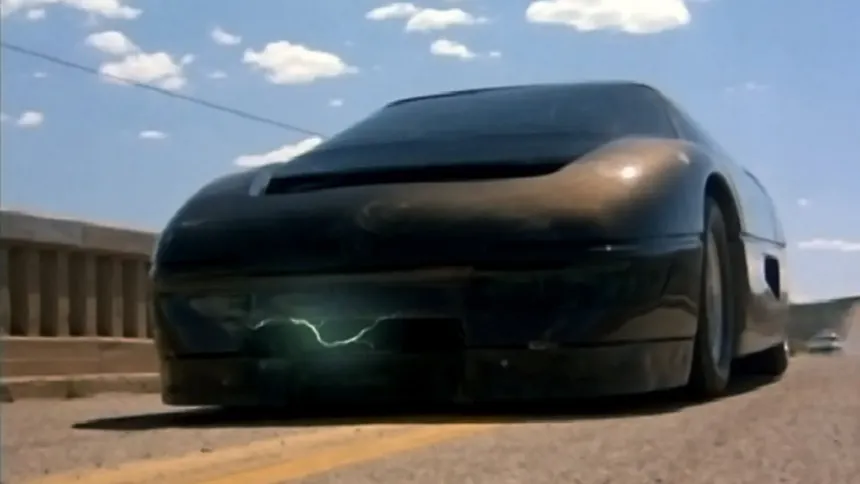
The two stunt drivers were fibreglass bodies moulded directly off the original M4S, sitting on dune-buggy-style tubular chassis with a seat, a steering wheel and not much else in the cabin. And here’s the bit nobody mentions in the nostalgic features: both stunt cars ran air-cooled VW Beetle engines. The car that plays a futuristic supercar avenger in the film was actually being pushed around by the rear-mounted four-cylinder boxer from a Volkswagen Bug. The Pontiac 4.8 V6 swap that occasionally gets cited as the stunt car’s powerplant came later, during a private restoration, well after the cameras had stopped rolling.
The four shells were hollow bodies bolted to towable frames, designed from the start to be wrecked in impact scenes. All four were duly destroyed. One of the two stunt cars was also written off during filming. The other survived.
What wasn’t in the plan was what happened on 2 March 1986 on a mountain road outside Tucson.
The Assistant Cameraman Who Doesn’t Make the Credits Roll
Bruce Ingram was an assistant cameraman, not the head DoP, not the principal camera operator. He was second-unit crew. Before The Wraith his credits included Star 80 and The Grey Fox. A working camera technician, properly experienced.
On 2 March 1986, the unit was shooting a chase sequence on Catalina Highway, a mountain road climbing the slopes of Mount Lemmon north-east of Tucson. The crew was using a camera car, a modified vehicle rigged to carry filming equipment and camera operators while pursuing the action vehicles in the scene. The camera car was overloaded. On a bend, it overturned.
Ingram was killed in the wreck. Seven other crew members were seriously injured. One was left paraplegic. Director Mike Marvin recalled the incident bluntly in a later interview with VHS Revival: “crashed a car on the mountain and one of our guys was killed and the other guy was left a paraplegic.”
The cause was not the M4S going too fast for the chase to follow. The cause was an overloaded camera car on a mountain road, without adequate safety provisions, on a production working with a modest budget and a tight second-unit schedule. The same pattern that killed crew members on The Dukes of Hazzard in 1980, on The Five of Me in 1981, and on Twilight Zone: The Movie in 1982. Camera operators are statistically the most lethally exposed crew category in American filmmaking history, and almost always for the same reason: filming vehicles built and equipped to standards far below the ones applied to stunt drivers in the same shot.
The film was dedicated to Bruce Ingram’s memory in the closing credits. It is the first and almost only time his name appears in any conversation about The Wraith. The rest of the time, everybody talks about the car.
Where the M4S Cars Are Now
The film opened in November 1986, broke even on the modest budget, and disappeared from cinemas to start its real career on rental shelves. Which is where it became a cult object.
The original M4S returned to Chrysler. It was displayed at the Walter P. Chrysler Museum in Auburn Hills, Michigan, until the museum closed to the general public on 31 December 2012. The 65 cars from the museum, including the M4S, remain in Chrysler’s hands and are wheeled out for special events. Bob Ackerman, in a later interview with Allpar, recalled that the M4S held for years the informal distinction of being the fastest car in the museum’s collection, only beaten when a Le Mans-class Viper GTS-R with an 8.0-litre V10 arrived. That’s the designer’s recollection rather than an official ranking, but it gives you the measure of where the M4S sat in Chrysler’s internal pecking order.
The remaining functional pace cars from the production run mostly remain in Chrysler’s care.
The surviving Hollywood stunt car? It ended up in Jeff Dunham’s collection. Important detail: what Dunham owns is not an original M4S — it is one of the two stunt replicas built for the film, restored, re-engined to something more substantial than the original air-cooled VW boxer, and now appearing in public outings such as Jay Leno’s Garage in 2024. Dunham is a serious collector, and the surviving Wraith stunt car is one of his prized pieces, but it carries movie-prop heritage, not PPG pace-car heritage.
Lyle Suhr, a collector from Wichita, Kansas, spent years in the 2000s trying to build his own M4S replica with Ackerman’s personal blessing and even sourced an unfired 2.2 turbo block from Chrysler for the project. He sold it on without finishing in 2015. Its current location is unclear. Fitting, really, for a car called the Wraith.
Why Dodge Never Built It
This is the question that hurts when you sit with it for long enough. They had the car. They had the records. They had the chassis. They had the engine. They had the design.
They didn’t do it.
The internal Chrysler analysis from 1984 concluded that a production M4S would have to retail at around $50,000 to be viable, equivalent to roughly $150,000 today adjusted for inflation. Chrysler’s marketing department decided there was no market for a high-performance Dodge sports car at that price. The brand was K-cars and federal bailouts. Who, the marketing people asked, would pay Porsche 911 money for a Dodge?
The answer came eight years later. It was called the Viper. 8.0-litre V10, 400 bhp, 280 km/h, retailing at about the same money. Same concept of Dodge loses its mind and we sell the thing. And it sold. Properly sold. Two generations later, it sold internationally.
The M4S was the rehearsal for a car Chrysler didn’t dare put into production. The Viper was the version they finally found the nerve to build. In between those two cars sit eight years of a marketing department that saw the future and decided to wait for someone else to invent it first.
The Legacy Lives Nowhere
Walk into a Dodge showroom today and try to find a descendant of the M4S. You won’t. The Hellcat era, the Demon, the Challenger, the Charger, these are front-engined V8 muscle cars in the classical mould. The exact opposite philosophy. The M4S was mid-engined, four-cylinder, aerodynamically optimised. European in concept, American in execution.
The closest Dodge ever came again was the Viper. But the Viper was atmospheric V10, conventional rear-wheel drive, no aerodynamic obsession. Different school of thinking entirely.
The M4S sits in history as an arrow fired at a future that never arrived. An arrow that almost hit the target, lost itself in Chrysler’s finance department, and ended up playing a ghost-car avenger in a Charlie Sheen film where an assistant cameraman died because the chase vehicle was overloaded on a mountain road.
If you ask me which movie car has the densest, most awkward story attached to it, it’s not the DeLorean. It’s not Bullitt’s Mustang. It’s not Bond’s Aston Martin. It’s this Dodge that almost nobody talks about. The one that cost over a million dollars to build. The one that broke real speed records on real circuits. The one that paced real IndyCar fields. And the one whose replicas ended up smashed across the Arizona desert so that a sunglassed phantom could avenge himself on a gang of car thieves.
That’s a film car worth knowing.
Check you’re still alive.