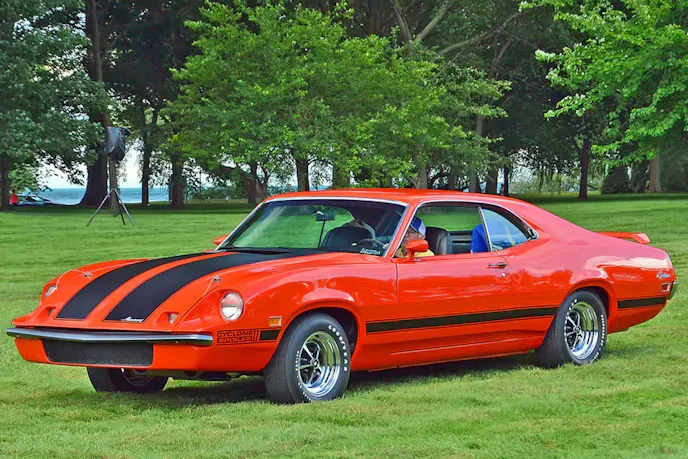
Mercury Cyclone Spoiler II: the NASCAR weapon Ford buried to save its own brand
If you’ve ever watched a David Pearson highlight reel from 1969, you’ve seen the Talladega. If you’ve ever read a paperback history of NASCAR‘s Aero Wars, you’ve seen the Charger Daytona and the Superbird. The shapes are unforgettable. The wings, the noses, the chrome. They live on garage walls and 1:18 die-cast shelves and the kind of motoring retrospectives that mention “muscle car” and immediately cut to a wing.
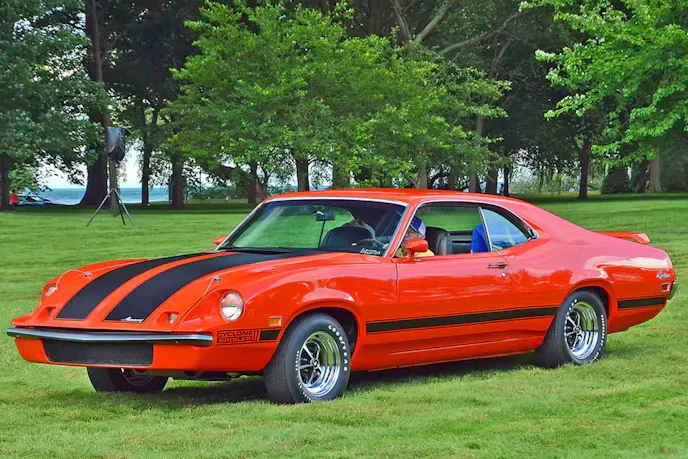
The Mercury Cyclone Spoiler II is none of those reels. The Cyclone Spoiler II was the car that, when timed on the same superspeedway against every other Ford-built shape on the grid, came out two to eight miles per hour clear. That’s the official figure from the Talladega/Spoiler Registry, which is the closest thing American collector culture has to a primary source for these cars.
Two to eight miles per hour faster than the Ford. And Ford parked it.
Not because it didn’t work. Not because the drivers didn’t want it. Because the marque hierarchy demanded it. Mercury was Ford Motor Company’s near-luxury brand, slotted between Ford and Lincoln. Ford the marque needed NASCAR wins to sell Torinos and Mustangs at dealerships across the Midwest. Mercury didn’t. So when Mercury’s homologation special turned out to be the better superspeedway weapon, the corporation made a decision that still reads as deeply, ridiculously American: keep the trophies on the cheaper brand, even if it means leaving the better car in the garage. Bobby Allison and Cale Yarborough on Talladegas at the start of the season. Two — count them, two — Cyclone Spoiler IIs in the field with factory backing. The faster car got the support it didn’t need. The slower car got the support it needed.
In any rational racing organisation, the engineering department would have walked into the boardroom on the Monday after Atlanta and demanded a recount. Ford’s response was to take their best driver out of the better car and put him back in the slower one. That’s not racing. That’s accounting with a steering wheel.
Atlanta 500, March 30 1969: the moment the stopwatch settled the argument
The Cyclone Spoiler II had been homologated late. It missed the Daytona 500 in February — that race went to a Talladega — because Mercury hadn’t built enough cars by then for NASCAR’s inspectors. The Spoiler II’s first legal start was the Atlanta 500 on March 30 1969. First race. First weekend on the grid. Wood Brothers Racing entered car number 21 with Cale Yarborough at the wheel.
Cale led 308 of the 334 laps. That’s 92% of the race. Average speed 132.19 mph. Second place: David Pearson. Pearson, that year’s NASCAR champion, in the Holman & Moody Talladega number 17. Holman & Moody being, just to be clear, the Ford factory team. Ford’s best driver in Ford’s best Talladega, looking at the back end of a Mercury for 308 laps out of 334.
That’s what the Registry’s “2 to 8 mph faster” looks like on a stopwatch. Not a theoretical wind-tunnel advantage. Not a Marti Report footnote. A 92% race-lead percentage in the very first event the car was allowed to enter, against the factory team that had won everything until that Sunday morning. Pearson didn’t get demoted to the slower car after Atlanta. The Mercury that beat him did.
There’s a footnote on the season worth nailing. LeeRoy Yarbrough, who had won the Daytona 500 in a Talladega in February (the Spoiler II being still ineligible), was put behind the wheel of Spoiler IIs for part of the year. According to John Craft in Musclecar Review, Ford moved him back to a Talladega mid-season because the factory was getting nervous about the manufacturers’ championship slipping toward the Mercury column. Faster car, fewer rides. Slower car, more rides. There is no engineering explanation for that. Only an accounting one.
What was actually at stake
NASCAR in 1969 was the Wild West of factory-backed door-to-door racing. The premise was sacred and theoretical: stock cars. Cars you could buy at a dealership. The reality was that Detroit’s engineering departments had figured out how to homologate just about anything by selling 500 nominally street-legal copies of whatever they were building for the track.
Chrysler drew first blood with the Dodge Charger 500, the first NASCAR car designed in a wind tunnel. Flush rear glass, recessed grille, less drag at superspeedway pace. Ford and Mercury responded simultaneously. The Ford Torino Talladega arrived first, with 15.5 inches of new sheet metal grafted onto the front of a Sportsroof. The Mercury Cyclone Spoiler II followed within weeks, longer-nosed, steeper-faced, and hand-built at the Lorain, Ohio assembly plant. Meanwhile Chrysler was already building the heavy artillery for 1970: the wing-equipped Charger Daytona, then the Plymouth Superbird.
NASCAR’s homologation rule for that season required 500 street examples sold to the public. The street car didn’t have to share the racer’s engine — homologation only mandated the bodyshell — but the bodyshell itself had to exist on dealership floors. That’s where the Cyclone Spoiler II’s reputation gets complicated.
The parking-lot legend
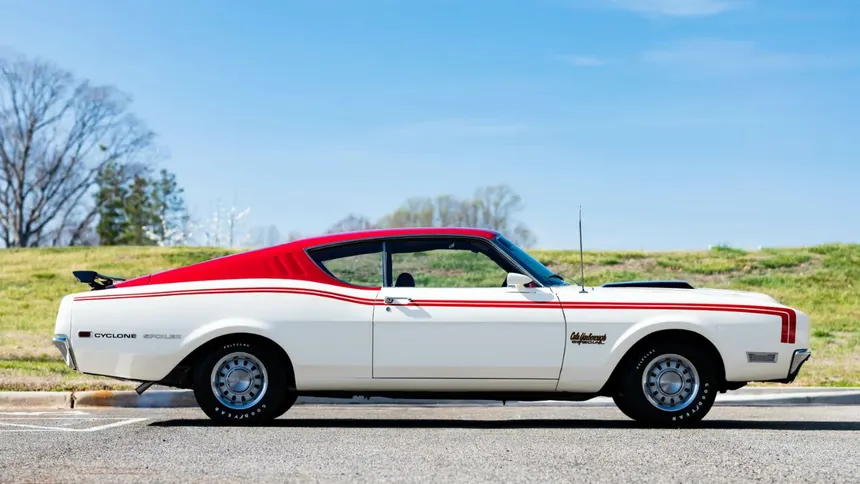
Here’s the story you’ll see repeated on every classic-car blog and every YouTube documentary about the Aero Wars. Mercury, the legend goes, only managed to build 351 actual extended-nose Cyclone Spoiler IIs. To meet NASCAR’s mandated 500, the company painted 152 standard W-nose Cyclone Spoilers in Yarborough or Gurney livery and parked them in the middle of a vast lot, with the genuine D-nose Spoiler IIs ringing the perimeter. NASCAR’s inspectors counted 503 from the fence line and waved through the homologation without bothering to walk the rows. Detroit had played the inspection.
True? Here’s where NEC editorial discipline takes over. The Marti Report — Ford Motor Company’s official production document — lists 503 Cyclone Spoiler IIs built. The Cyclone Spoiler Registry, on the other hand, has stated that a Ford computer search returned only 353 units actually ordered as Spoiler IIs. The arithmetic gap between those two figures is 150 cars — almost exactly the 152 the parking-lot story claims were painted up to bluff the inspection.
Coincidence? Hardly. Documented proof? Not yet. What we can say is that the parking-lot caper is the most persistent legend of the 1969 Aero Wars, and that two independent record sets disagree by an amount that lines up suspiciously with the count of fakes the legend describes. Anyone telling you the story has been “confirmed” or “debunked” hasn’t read the registries.
The street cars
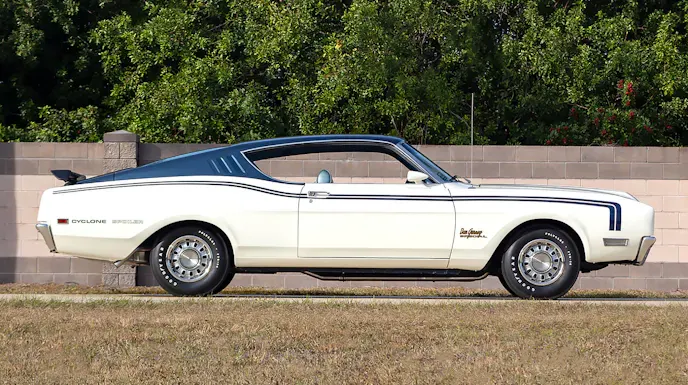
Mercury sold 503 Cyclone Spoiler IIs to the public in 1969 to clear homologation. Two trim packages, both white-bodied: the Cale Yarborough Special with red roof, red interior, red side trim (285 units) and the Dan Gurney Special with blue roof, blue interior, blue side trim (218 units). Bench seat. Column-shifted FMX three-speed automatic. No options. No alternative colours. No bucket seats. You bought one of two cars.
The street engine was the 351 Windsor V8: 290 horsepower, 385 lb-ft of torque, a Ford 9-inch rear with 3.25:1 gearing. Compared to the Talladega — its Ford-badged sibling, which left the Lorain assembly with the 428 Cobra Jet making 335 horsepower — the Mercury was the slower street car. The faster track car had the lesser dealership engine. NASCAR’s rules cared about bodyshell, not what was bolted between the chassis rails. So Mercury satisfied the homologation count with a softer powertrain and saved the heavy artillery for the racing version.
A small subset of Cyclone Spoilers — the regular Spoiler, not the Spoiler II — could be optioned with the 428 Super Cobra Jet making 335 horsepower and 440 lb-ft. Those are now the unicorns within the unicorn herd.
The engineering nobody mentions
The Talladega and the Cyclone Spoiler II are not the same car with different badges. That myth dies right now.
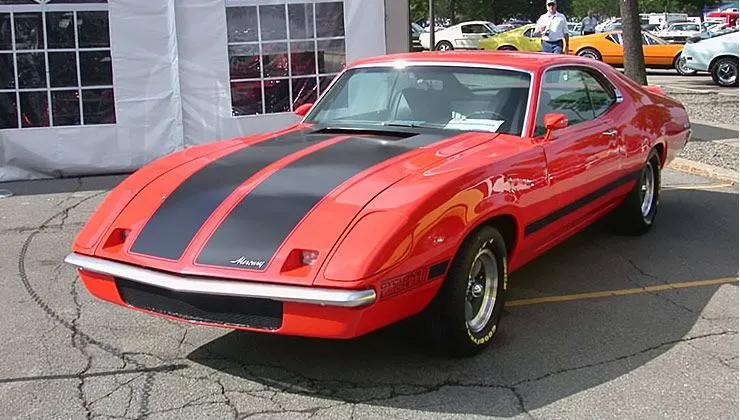
The Talladega added 15.5 inches of nose at a 30-degree slope. The Cyclone Spoiler II added 19.5 inches at a 35-degree slope. Five degrees steeper. Four inches longer. The two cars share doors, bumpers, grilles and turn-signal lenses. Everything else is unique sheet metal, hand-cut and welded onto each individual chassis at Lorain. Each Cyclone Spoiler II was effectively rebuilt from the firewall forward.
Then there’s the rocker-panel trick — a piece of factory cheating elegant enough to deserve framing. Mercury’s engineers reshaped and re-rolled the rocker panels so that race teams could lower the cars approximately one inch closer to the ground while still passing NASCAR’s ride-height inspection. The street version arrived at the dealership looking conventional. The race version, measured by NASCAR’s own ruleset, was an inch lower, with a lower centre of gravity, less drag, and more top end. A homologation loophole hidden inside what the inspectors thought was just trim. American engineering at its most elegantly underhanded.
Anyone who has actually fabricated bodywork understands what 19.5 inches of grafted nose means. You don’t sketch that on a napkin and weld it Friday afternoon. The panel curvature has to match the original fender contour at the cut line, the new front panel has to maintain structural rigidity at speeds north of 170 miles per hour, and 503 of these things had to come out of Lorain inside a few weeks of 1969. That isn’t a production line. That’s an aerospace skunkworks operating as a Ford subsidiary.
The corporate betrayal
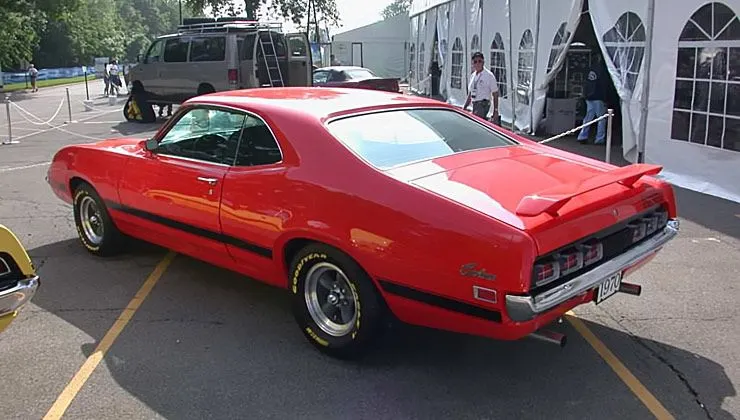
The decision Ford Motor Company made in 1969 reads, with hindsight, as one of the dumbest strategic calls in American motorsport history. The Manufacturers’ Championship is awarded to the marque, not the parent corporation. Ford was the volume brand, the one that needed “Win on Sunday, Sell on Monday” working for it across thousands of dealerships. Mercury sold to a different demographic — older buyers, accountants, people who wanted a Ford with chrome and dignity attached. Mercury didn’t need NASCAR.
So when Mercury’s halo car turned out to be faster than Ford’s, the parent company made the call that protected the marketing arithmetic instead of the racing arithmetic. Factory drivers in Talladegas. Mercury starved. The two factory-backed Cyclone Spoiler IIs that did make the grid were fielded almost as a courtesy.
And here’s the kicker. Ford lost the championship anyway. Bobby Allison and Bobby Isaac, trading wins at the back end of the season in Charger Daytonas, took five of the last six races. The Pearson Talladega title in ’69 happened despite the misallocation, not because of it. If Ford had run Spoiler IIs as primary equipment, the Aero Wars would read very differently in the history books today.
Then Ford walked away from racing entirely
Late 1969 brought congressional hearings into automotive R&D priorities. The committee wanted to know why American manufacturers were spending hundreds of millions on race programmes while fuel economy and safety lagged behind imports. Ford absorbed the criticism, did the political maths, and pulled out. Across the entire 1970 season, Ford had no factory racing programme — not in NASCAR, not in Trans-Am, not anywhere.
The private teams running Mercurys figured out something funny in early 1970. The 1969 Cyclone Spoiler IIs, sitting in their workshops without factory updates or engineering support, were faster than the brand-new 1970 Mercurys that Ford had planned as their replacements. So they kept running the year-old cars. Without a budget. Without development. Without anything except chassis files and accumulated savvy. And they kept winning.
That last detail is what makes the Cyclone Spoiler II story land properly. The car was so good that even when Ford had abandoned it, the privateers couldn’t bring themselves to retire it. They drove it for an additional year against a corporation’s cancellation notice, and they kept beating the cars that corporation had said were better. The Ford boardroom had decided, on paper, that the Spoiler II’s time was over. The stopwatch had a different opinion.
Why nobody talks about it
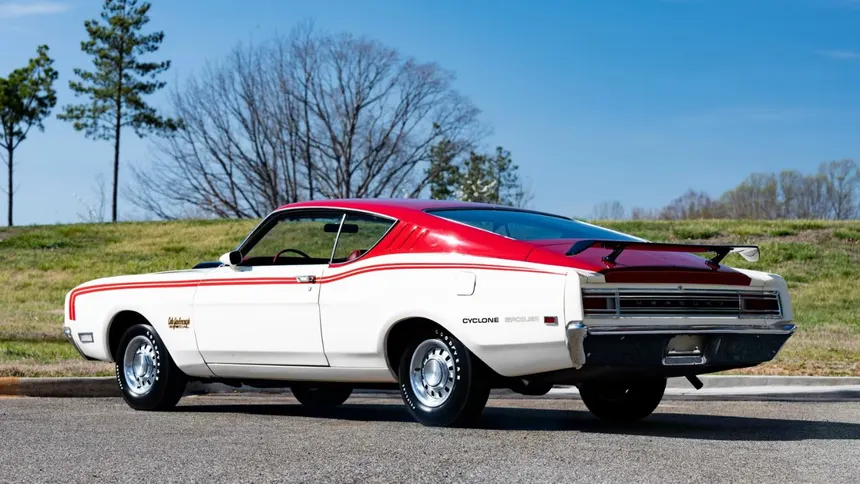
The winged Mopars are visually unforgettable. A Charger Daytona with its rear wing taller than the doors is a poster, a model, a movie cameo waiting to happen. A Cyclone Spoiler II at three-quarter view looks, to a casual observer, exactly like a regular 1969 Cyclone with a slightly longer nose. The aerodynamic edge is invisible until you know what you’re looking at.
Add to that the marque problem. Mercury occupied the awkward middle ground in Detroit’s hierarchy. It wasn’t the cheap performance brand and it wasn’t the luxury statement. The buyers who became collectors thirty years later defaulted to Ford or Mopar nostalgia, and the Cyclone Spoiler II fell through that gap. Today, of the 503 originally built, the Talladega/Spoiler Registry has documented somewhere between 50 and 60 verified survivors. Auction prices reach six figures for clean numbers-matching examples. The winged Mopars still go for double or triple. Cultural memory pricing the cars, not engineering merit.
What the car proves
The Cyclone Spoiler II is the cleanest case study in American motorsport of a corporation choosing brand hierarchy over winning. Ford had two ways to win in 1969. They chose the worse one because the better one carried the wrong logo. They lost the championship anyway. They walked away from racing the next year. And the privateers who kept the year-old Mercurys on the grid — without a corporation behind them — kept winning races that the corporation had decided couldn’t be won by Mercurys.
Fifty-seven years later, the Cyclone Spoiler II is still the fastest Aero War car nobody talks about. The Daytona and Superbird have myth. The Talladega has the championship-winning name. The Spoiler II has 503 hand-built bodyshells, eight Grand National victories collected against the corporation’s wishes, a 308-lap performance in its debut race against Holman & Moody’s best, and a parking-lot story that probably is true even though no one can prove it.
Check you’re still alive.