
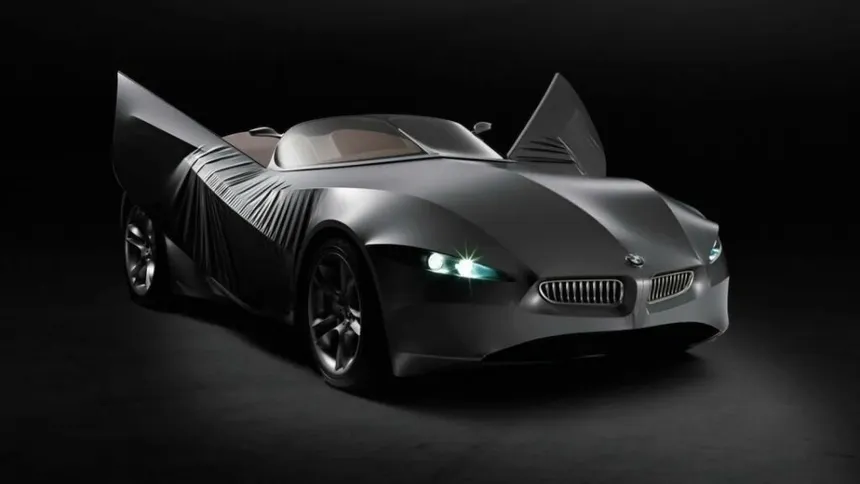
BMW GINA: the fabric-skinned car Chris Bangle spent seven years building in secret to ask one question
Chris Bangle is, depending on who you talk to, either the man who destroyed BMW or the man who saved it. Probably both. If you read any British or American motoring press from the early 2000s, you’ll remember the rage: the E65 7 Series, the E63 6 Series, the Z4, every one of them slated for what critics called “flame surfacing” — tortured surfaces, controversial proportions, deliberate breaks with the clean Bavarian orthogonality BMW had perfected for decades. Bangle became the villain. Top Gear took shots at him. Auto Express ran columns demanding his resignation. Forums turned into battlegrounds.
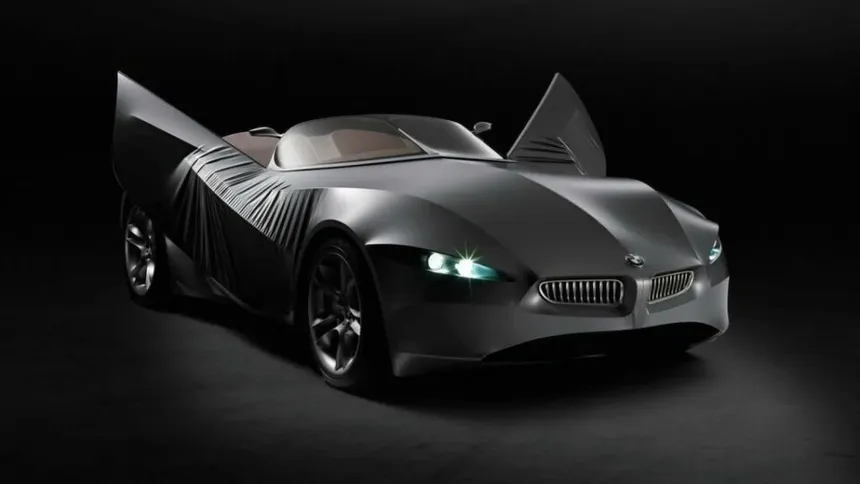
What almost nobody knew, while all of this was happening, was that Bangle had a second project running in parallel. He had started it in 2001, the same year the loathed E65 7 Series went on sale. He worked on it inside BMW’s design studio, in secret, for seven years. And in June 2008 he finally unveiled it to a small group of journalists in Munich. What appeared from under the cover wasn’t a car in any sense the audience recognised. It was a fabric-skinned roadster. Its headlights opened like eyelids. Its doors hinged Lamborghini-style and the skin crumpled when they opened. Its bonnet split down the centre like open-heart surgery. A rear spoiler emerged out of the bodywork itself, reshaping the back of the car as it came out.
GINA. Geometry and functions In ‘N’ Adaptions. The Light Visionary Model. The strangest concept car BMW has ever made. And possibly the most important one, because what stood on that podium in June 2008 was not a car. It was a question.
Why Bangle needed to build this in the dark
To understand the GINA you have to understand what Bangle was carrying on his back when he started it. American, BMW design director from 1992 to 2009, the most controversial man in automotive design in his era. Architect of the visual language British and American press came to call “flame surfacing” — the E65 7 Series, the Z4, the E63 6 Series — that split the industry in two. For half the world he was the man killing BMW’s visual language. For the other half, the only one with the courage to evolve it instead of recycling it. Bangle absorbed the abuse for years. And in parallel, quietly, inside the Munich studio, he ran a project that almost nobody talked about. He started in 2001. He would finish it seven years later.
For seven years the car existed physically — built, functional, filmed in the studio — and the world’s automotive press had no idea. Why so much secrecy? Because the GINA couldn’t be defended in front of a board. It wasn’t a feasibility study. It wasn’t a preview of a production model. It wasn’t a marketing tool. It was a thinking machine. And to get an answer out of a thinking machine you have to build it in silence, away from quarterly reviews and product planning meetings.
The question Bangle had been turning over in his head for years was this: why does a car’s body have to be rigid?
What’s actually under the skin
Before the philosophy, the mechanics, because anyone who has only seen the GINA in photographs tends to imagine something simpler than what it actually is.
The mechanical platform is the BMW Z8 Roadster. Aluminium space frame, S62 4.9-litre V8 (the same engine as the E39 M5 of the period, around 400 horsepower), rear-wheel drive, classical BMW front-engine layout. Everything below the waistline is conventional. What makes the GINA the GINA sits above that.
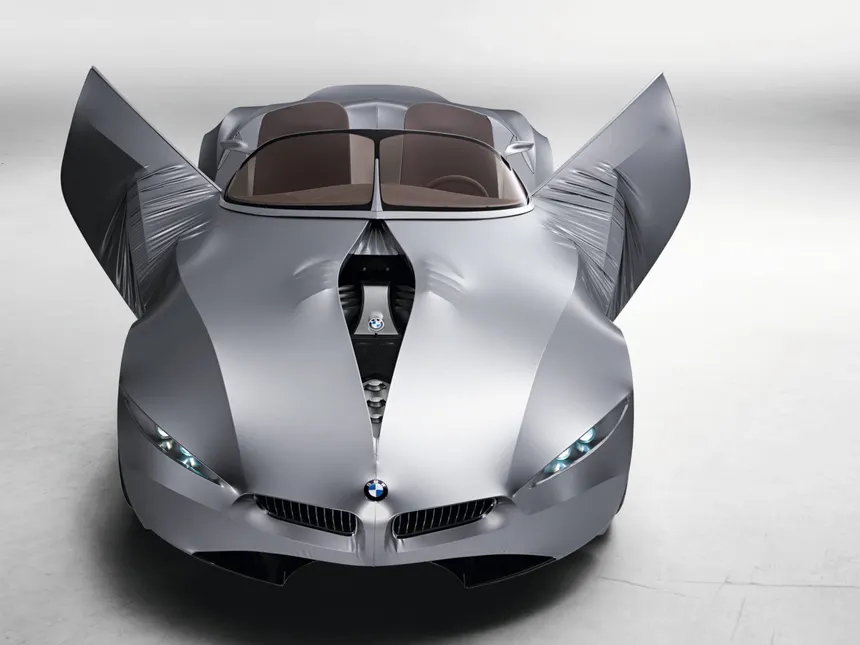
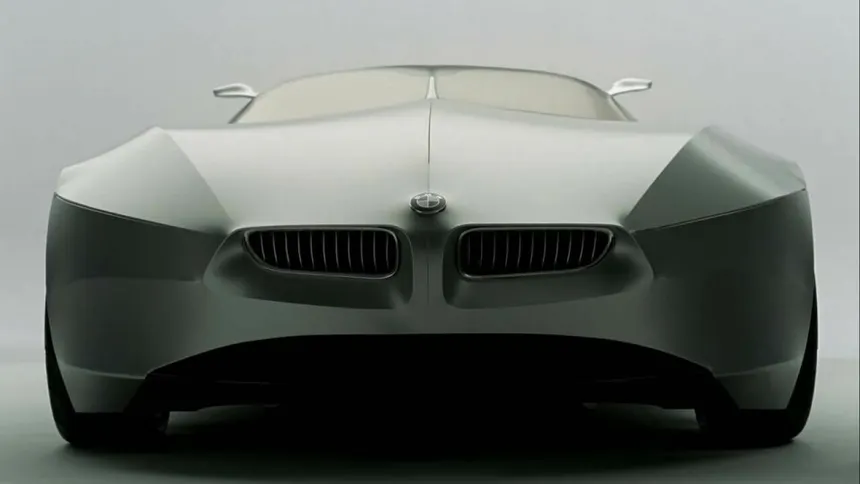
On top of the platform Bangle’s team built a complex inner structure of aluminium wire reinforced with flexible carbon fibre struts. This structure is not rigid in the conventional sense. It’s a deformable cage. Over that cage, stretched and tensioned, sits the skin: a layer of Lycra coated with polyurethane, waterproof and resistant to temperature extremes. The entire bodywork consists of four panels of fabric. Four. Where a normal car carries dozens of pressed steel or composite panels, the GINA wears four pieces of cloth.
And under the skin, distributed along the cage, sit electric and hydraulic actuators. Small motors and pistons that pull on the aluminium frame from inside. When one of these actuators moves, the wire structure changes shape, and the fabric — which is tensioned over it — changes shape with it. That simple. That radical.
This is the part that stops anyone who has ever built a chassis cold. Because it means the bodywork isn’t a passive shell. It’s an organ. It reacts. It deforms. It adapts. The car does not have a final shape. It has possible shapes.
Eyelids, crumpling doors and a bonnet that opens in the middle
The spectacular side of the GINA, the part you see in any demonstration video BMW released afterwards, is what all those actuators actually do when you switch the car on.
The headlights, first. With the car off, you can’t see them. The fabric covers the front of the car completely, no interruptions, no holes. When the car comes alive, two small motors pull the fabric upwards in a very specific area of the nose, and the skin separates, opening two eyelid-shaped slots. The headlights appear behind them. Switch them off and the eyelids close, the fabric returns to position. The nose is smooth again. No seams. No clue that anything was there.
The doors. They open Lamborghini-style, upwards and forward. But because they’re made of the same continuous fabric as the rest of the body, when the door rises the skin physically crumples and folds along the hinge line. There’s no rubber seal. There’s no rigid separation between panel and frame. The fabric yields, then tensions back into place when the door closes. The acoustic signature of a closing GINA door is unlike anything else.
The bonnet. This is the part Bangle most liked to demonstrate. The bonnet doesn’t hinge from one side. It opens from the middle. A seam runs down the longitudinal centreline of the bonnet, and when you want engine access the actuators pull both sides outward, peeling the fabric open like a surgical incision. Bangle openly called it “open-heart surgery”. The image works because when you see the V8 exposed there, with the fabric retracted to either side, that’s exactly what it looks like.
The rear spoiler. At low speeds, it doesn’t exist. The back of the car is smooth. When aerodynamic downforce is needed, the actuators push outward from inside and the bodywork itself reshapes. There’s no spoiler that emerges as a separate piece — the body becomes the spoiler. The form of the car changes to produce the effect.
And the detail nobody mentions enough: the driver could trigger all of this from inside the cabin, while moving. With buttons. The GINA’s bodywork was reconfigurable on the move.
What it feels like to sit inside
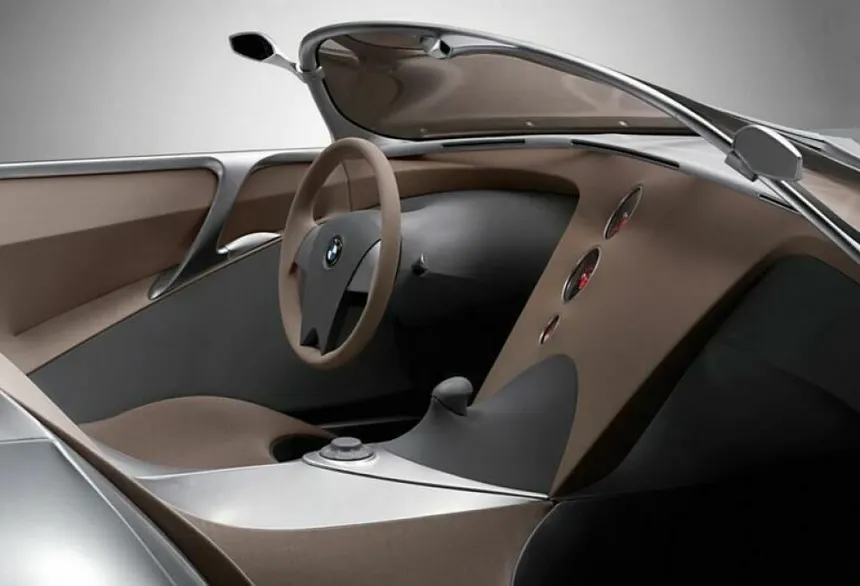
This is the part almost no GINA article covers, and the one that anyone who understands what’s happening above the waistline is most curious about. What does it feel like to sit inside a car whose bodywork deforms?
A caveat first: the GINA was never driven in the open. No journalist road-tested it. The single unit existed throughout its life as a controlled demonstration object, inside the Munich studio or on closed circuits under BMW supervision. What is documented, in video and in Bangle’s own words, are the demonstration sessions with the car switched on and the actuators running — material anyone can watch today on Jay Leno’s Garage, where Bangle himself spends forty minutes in front of the camera walking through each movement of the skin.
From that material and from the handful of journalists present at the June 2008 unveiling, three details are worth pulling out.
The first is the sound. When the actuators move, there’s no mechanical click, no electric whirr you associate with a convertible roof. The fabric tensioning over the structure produces a muffled, soft, almost organic sound. Bangle described it in one interview as “the sound of an animal stretching.” The doors opening, with the skin crumpling along the fold, make a sound closer to a leather coat than to a car.
The second is the touch. Bangle insisted that the GINA’s skin, compared with the steel of a conventional car, transmits a completely different tactile sensation. Where a normal BMW’s metal bodywork is always cold to the touch, returning ambient temperature with the hardness of steel, the GINA’s skin is warm, slightly flexible under the fingers, almost alive. Running a hand along the nose is an experience no other car offers. It’s the difference between touching a cupboard door and touching the back of your own hand.
The third is what happens to the actuators when the car is switched on and stationary. There’s a constant micro-vibration, almost imperceptible, as the pistons hold the structure tensioned in position. The skin moves minutely, millimetres at a time, breathing. Witnesses who saw the car in person in Munich in 2008 converged on a single phrase that recurred in several reports afterwards: the GINA looks like it’s breathing. It isn’t a metaphor. It’s what physically happens when a structure tensioned by hydraulic actuators balances itself in real time.

The question nobody had asked out loud
This is where the engineering exercise stops being an engineering exercise and becomes something else. Because when you stack all of that up and step back, what you’re looking at isn’t a car. It’s a question.
Why does a car have to have rigid bodywork?
We’ve been building them this way for over a hundred years. The bodywork is a given. Fixed. Frozen at the moment it leaves the production line. If your car has a shape at nine in the morning sitting in the garage, it has exactly that shape at seven in the evening crawling through rush hour, at eleven at night on the motorway, and the following morning when you park it again. The shape of a car is a fixed datum. Nobody questions it. We accept it the way we accept that doors hinge on hinges or that steering wheels are round.
Bangle spent seven years building a car that questioned exactly that. And the answer the GINA was offering wasn’t “let’s build cars out of fabric.” That’s what the press got wrong in 2008. The GINA’s answer was much more uncomfortable: the things we take for granted about a car are not technical truths. They are conventions. And conventions can be broken if you take the time to look them in the face.
Bangle put it in his own words at the unveiling: GINA let him “challenge existing principles and conventional processes.” It’s an executive sentence, designed to be quoted in a press release. But underneath there’s something more serious. The idea that the formal language of a car, what we call “automotive design,” is built on assumptions we never stop to examine. The GINA is the instrument Bangle built to examine them.
What the GINA did after it stopped moving
The GINA never went into production. It was never meant to. It was a pure exercise. But its consequences turn up in places almost nobody looks for them.
First, in BMW’s own design language. The flame surfacing that infuriated half the motoring press during the Bangle years — those tensioned surfaces, those lines that seemed to be in motion, those forms no BMW had carried before — was directly fed by what Bangle learned building the GINA. When you work with a fabric skin stretched over a deformable structure, you discover behaviours of the surface that you don’t discover drawing steel panels. You learn how a form tensions, how it folds, how it flows. And then, when you go back to drawing conventional cars, those lessons appear in the surfaces you draw. The E65, the Z4, the E63 — all of them carry traces of the GINA even though their bodywork is steel.
Second, and this is the part almost nobody knows: BMW Designworks, BMW’s industrial design studio, used the GINA experience to design a PUMA running shoe. The model was called X-Cat and it used an improved version of the same Lycra-and-polyurethane skin that covered the GINA, tensioned over an internal structure. A trainer whose technology came directly from a concept car. That’s the strangest and most beautiful proof that the GINA wasn’t a closed exercise. It was a learning tool, and BMW spent years extracting what they had learned from building it.
Where it lives and why it matters
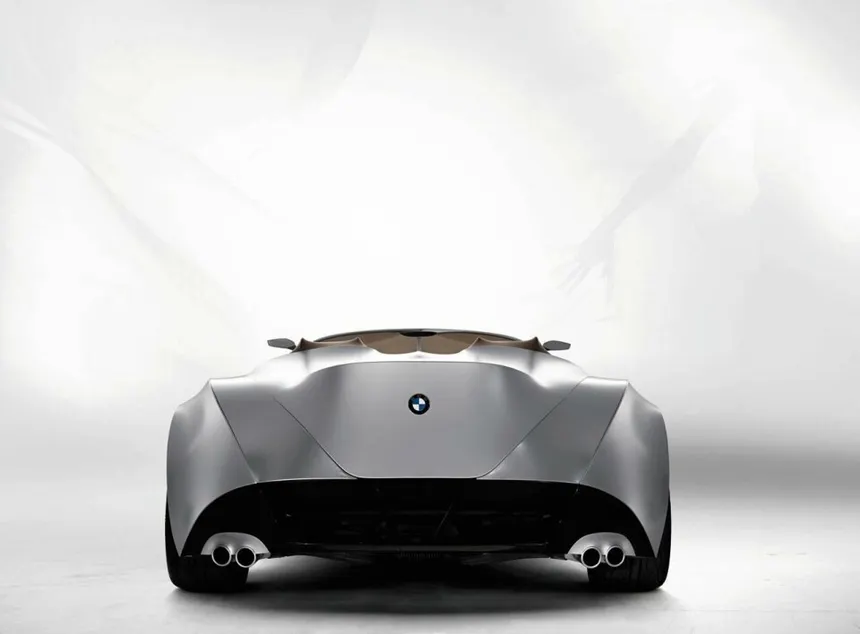
The original GINA is at the BMW Museum in Munich. It has been part of the permanent collection since 2009, the year Bangle left BMW. Anyone passing through the city can walk in and see it. It sits there, on display, alongside cars that did reach production and alongside other prototypes from the brand’s history. But the GINA is recognisable instantly. It’s the only one that looks alive.
The interesting bit is that the car is still operational. It isn’t a static object. At specific events — museum anniversaries, press days, exhibitions on Bangle’s work — the GINA is switched on, the actuators are activated, the eyelids open, the doors lift. The car still works eighteen years later. The Lycra-and-polyurethane skin, the aluminium wire structure, the hydraulic pistons: everything continues to respond. BMW maintains it as a working piece, not a relic.
The most complete public record of the GINA in motion is still Jay Leno’s video, filmed when the car was first unveiled. Bangle stands in front of it and walks through each function in turn, explaining what is happening under the fabric. It’s probably the most useful document that exists for understanding the GINA in motion — because the explanation comes from the man who spent seven years building it, and the car performs in front of the camera while he talks.
Bangle left BMW in 2009, a year after unveiling it, to set up his own studio. Some people read the GINA as his farewell — his last statement before walking out. That reading is probably right. Bangle spent seven years building, in secret, a car whose only function was to ask a question. When the question had been asked in public, he walked out of the door.
And the question is still there. Eighteen years after the GINA’s unveiling, nobody has seriously tried again. No manufacturer has picked up the baton. Bodywork is still rigid. Forms are still final. What we take for granted about a car is still taken for granted, unexamined, unchallenged. As if the GINA had never existed.
But it did. It still does. It sits in Munich, breathing slowly in one room of the museum, waiting for somebody to stand in front of it and finally understand what Chris Bangle was trying to say all along: the shape of a car isn’t a fact. It’s a decision. And like any decision, it could have been a different one.
Check you’re still alive.