
Adaptive Car Body: Inside Aeromorph and the Question the Industry Has Dodged for a Century
Watch a hawk hold itself steady in a crosswind sometime.
The wings don’t flap. They adjust. Thousands of feathers pivot a fraction of an inch each, no change to the overall shape of the wing, and that quiet army of micro-corrections is what keeps the bird stable while the air shifts underneath it. Nature almost never solves a moving problem with a fixed surface. We’ve spent more than a hundred years building cars that do exactly the opposite: bodywork that doesn’t budge while the whole world moves around it.
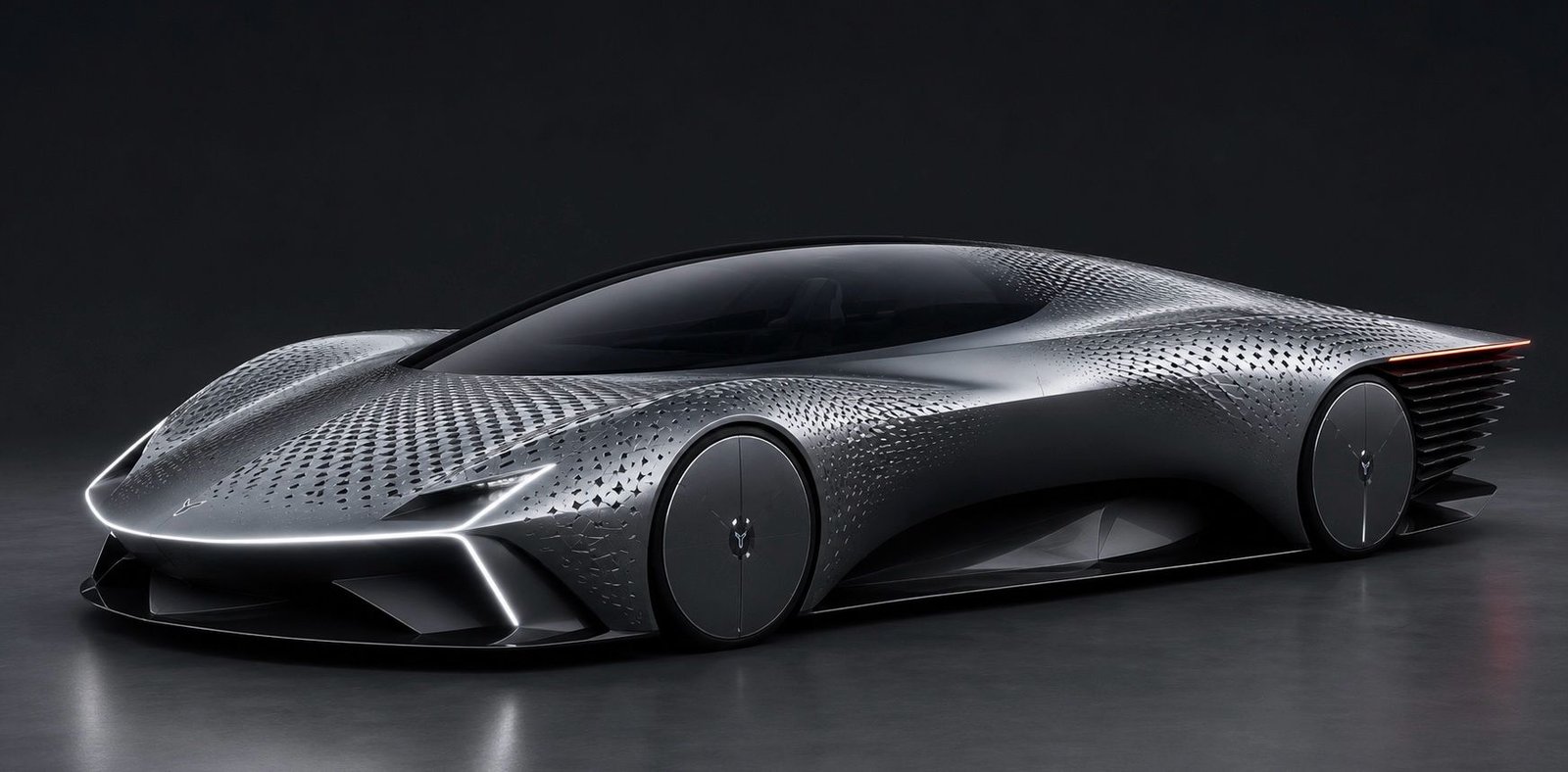
That contradiction is the seed of Aeromorph — Active Airflow Body, a concept from vehicle designer Youssef Hamdany. And before you read another line, one thing needs saying plainly: this isn’t a car. It’s a question shaped like a car. The distinction matters, and we’re going to treat it with the respect it deserves and the rigor it demands.
What Aeromorph proposes, in his own words
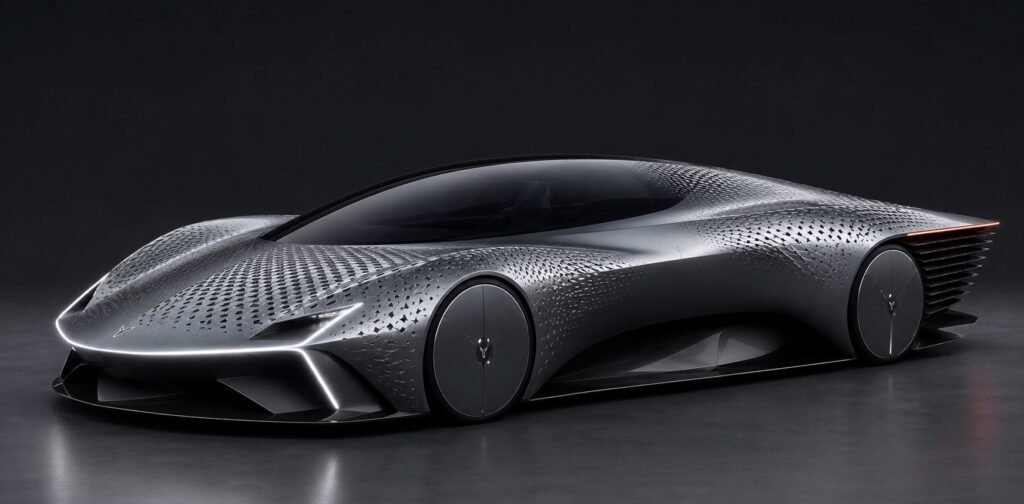
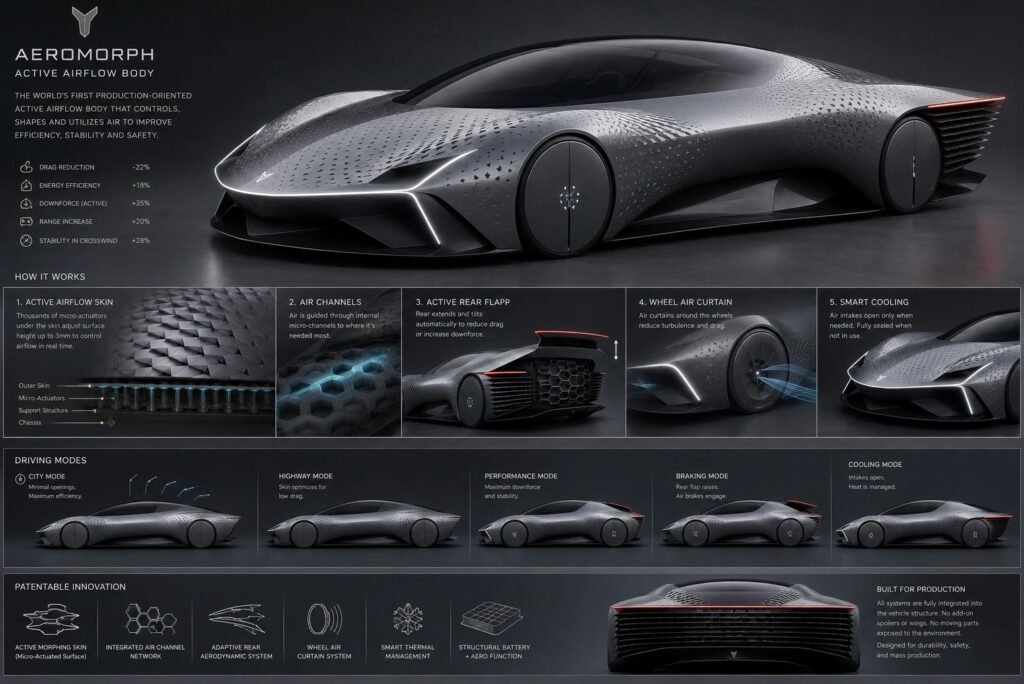
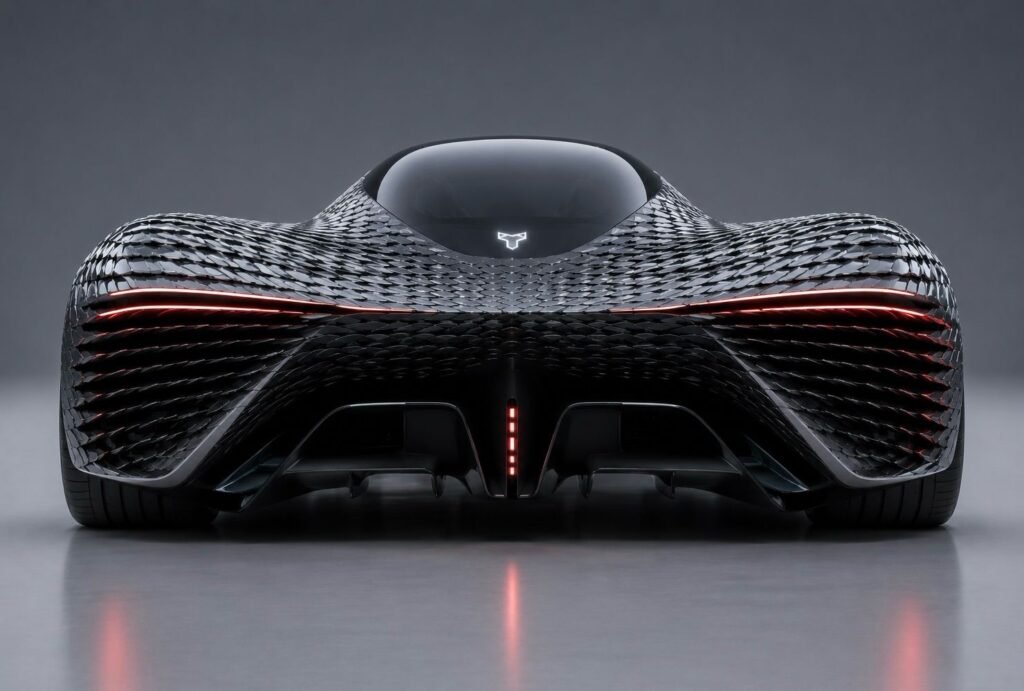
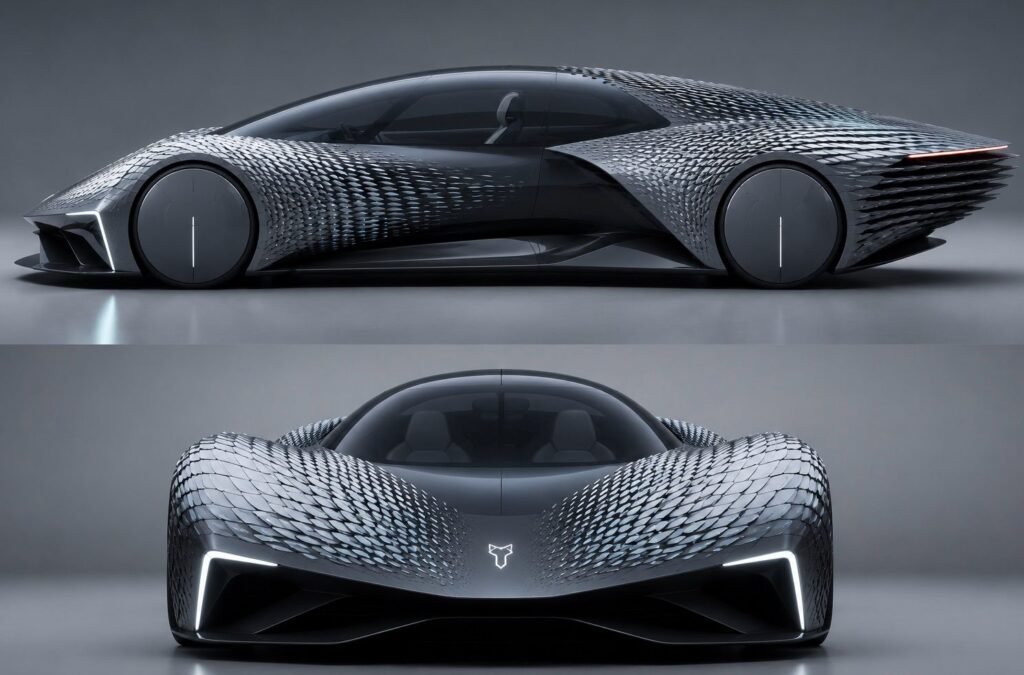
The core idea is an active skin. Instead of a static body with moving parts bolted on — wings, flaps, intakes that open and shut — Aeromorph imagines the vehicle’s own surface taking part in managing the air. Beneath that skin lives a mesh of micro-actuators able to adjust the surface height by up to three millimeters in real time, responding to speed, crosswinds, and cornering loads.
Hamdany lays it out without embellishment. “Today’s active aerodynamic systems are effective, but they all follow the same principle: they add moving aerodynamic devices onto an otherwise fixed body,” he told us. “Aeromorph explores a different philosophy. Rather than creating one large aerodynamic event, the concept distributes many subtle adjustments across the vehicle’s surface.” Aerodynamics, in his vision, would stop being a handful of discrete parts and become something continuous, distributed, woven into the architecture of the car.
The concept arrives with a headline set of numbers: 22% less drag, 35% more active downforce, 18% better energy efficiency, 20% more range, 28% more stability in crosswinds.
And here Hamdany earns his first credibility, because when we asked where those figures came from, he didn’t dodge. “The performance figures shown with the concept are design objectives, not validated engineering results,” he said. “At this stage they are not based on wind tunnel testing or validated CFD simulations, and I want to be transparent about that.” They represent, in his words, the level of improvement worth investigating if the concept ever grows into a formal engineering program.
Let’s be clear, because at NEC this is non-negotiable: those numbers are not data. They’re aspirations. And a designer who tells you that to your face — instead of selling the percentage as though he measured it in a tunnel — has earned the benefit of the doubt precisely for it. Honesty about what you don’t yet know is almost always the surest sign that someone knows what they’re talking about.
Where the idea comes from
The origin, as we said, is biological. “I was fascinated by how birds continuously adjust the position of their feathers during flight,” Hamdany explains. “These movements are extremely small, yet together they allow the bird to adapt to changing airflow, improve stability and maintain efficiency without changing the entire wing. That made me ask a simple question: if nature rarely relies on static surfaces in dynamic environments, why are vehicle bodies still almost entirely static?”
It’s a good question. It’s the question, and it has the virtue of being uncomfortable for an industry that has poured a century into perfecting exactly that: the fixed surface. Biomimicry itself isn’t new to the car — Mercedes built a whole concept around the boxfish back in 2005 — but Hamdany isn’t talking about copying a shape from nature. He’s talking about copying a behavior: distributed, continuous adaptation. That’s a different kind of leap.
The precedent you already know
Anyone with a memory for design will think immediately of the BMW GINA from 2008 — that fabric skin stretched over a moving frame. The comparison is unavoidable, and Hamdany embraces it without flinching.
But the real difference is worth drawing, because it isn’t the same idea. GINA changed the vehicle’s overall shape by moving an electro-hydraulic metal structure beneath a cloth skin. Aeromorph proposes something else: localized surface adaptation over a conventional structural body that stays put underneath. “GINA explored changing the overall shape of the vehicle using a flexible outer skin,” Hamdany summarizes. “Aeromorph explores localized surface adaptation to influence airflow while maintaining a conventional structural body underneath. The intention is not to transform the appearance of the vehicle but to create a body capable of continuously adapting its aerodynamic behavior.”
Put simply: GINA wanted the car to change silhouette. Aeromorph wants the car to change skin without changing silhouette. It’s a more modest ambition visually and, in theory, a more aggressive one aerodynamically.
The honest counterpoint: what already works
Time for a reality check, because active aerodynamics is not science fiction. It exists, it works, and it’s bolted to cars you can buy today.
The McLaren P1 carried a Prodrive-developed system with an electro-hydraulic rear wing and electromechanical front flaps, able to add downforce through corners and shed it on the straights, DRS-style, like a Formula 1 car. The Pagani Huayra deploys four independent aircraft-style flaps that work downforce wheel by wheel. The Bugatti Chiron folds a rear wing that doubles as an airbrake. Further down the price ladder, the electric Porsche Macan uses active aero that translates into a handful of extra miles of range. Even Formula 1 is ditching DRS in 2026 for two-mode active aerodynamics — high-drag and low-drag configurations on front and rear wings.
In other words: the industry already knows how to move air with moving parts, and it does it well. So the question Aeromorph has to answer — the one its render doesn’t — is brutally simple. If this already exists, what does a skin of thousands of micro-actuators offer that a wing which already works does not?
To answer it, you have to understand where drag actually lives.
The physics of three millimeters
Let’s take the problem by the part that counts. On a car, aerodynamic drag splits between pressure drag — the drag the shape creates, the turbulent wake trailing off the back — and skin-friction drag. And here’s the figure that reframes everything: roughly 80 to 90% of a passenger car’s drag comes from the pressure component, thanks to a car’s inherently blunt shape. Skin friction accounts for only about 5 to 10% of the total. The underbody clutter, gaps, and appendages — the bin where those famous panel seams belong — run around 10 to 15%.
Sit with that a second. Most of the aerodynamic battle is fought over the vehicle’s shape and how the air separates at the rear. Not the surface. Not the seams.
So what does that mean for a skin that moves three millimeters? That its ability to matter depends entirely on where and how it acts. Three millimeters can matter a great deal if they’re used for what aerodynamicists call boundary-layer control: tripping the flow, generating controlled vortices, sealing a gap that was feeding turbulence. A fighter jet’s vortex generator measures exactly that — millimeters — and does its job. But three millimeters do not re-profile the overall shape of the car, which is where 80 to 90% of the problem sits. They don’t extend a tail. They don’t close a wake. They don’t turn a two-box into a fastback.
Take the strongest case the concept has: sealing every body gap and discontinuity on the move. It’s the most defensible thing an active skin could do. How much would it buy? Optimistically, it would attack a fraction of that 10-to-15% parasitic slice — because much of the low-hanging fruit is already picked by carmakers today with passive fixes: flush trim, flush glass, underbody paneling. What’s left to seal dynamically are the functional gaps — doors, hood, tailgate, wheel arches — and there we’re talking about shaving points off the drag coefficient, not double digits. For a sense of scale: in aviation, cutting skin friction by 1% lowers fuel burn by roughly 0.45%. In a car the ratio is the same small order of magnitude, and it only bites at highway speed, because drag rises with the square of velocity and in town it’s almost irrelevant.
When we put this physics question to Hamdany, he stayed consistent with his earlier transparency. “The effectiveness of the concept does not come from a single actuator moving by 3 mm,” he answered. “It comes from thousands of coordinated micro-adjustments working together as one adaptive surface, particularly around the wheel arches, side surfaces and rear section, where separation and turbulence naturally occur. Exactly how much movement is required can only be determined through CFD analysis and experimental validation.”
That’s an honest answer. It’s also, read closely, an admission that the key question stays open. The concept aims at the right zones — the rear, where flow separates, is exactly where there’s drag to win — but whether it can actually move that drag, and by how much, is something nobody has measured yet. He doesn’t hide it.
None of the figures we’ve used here, worth underscoring, is a measurement of Aeromorph. They’re orders of magnitude accepted across automotive engineering — the physical frame any system like this would have to prove itself inside.
Where the project actually stands
Let’s be straight about the state of play, because Hamdany is too. Aeromorph today is a concept in the research-and-design phase. No physical prototype. No patent filed. What exists is a render, a well-articulated idea, and the attention of part of the automotive community — engineers, designers, and now a journalist or two. He frames it as an open invitation to collaborate with manufacturers, research institutions, and engineering teams.
The biggest obstacle? Not aerodynamics, by his own diagnosis, but industrialization. “Creating an adaptive surface is one thing,” he says. “Producing one that is reliable, lightweight, weather-resistant, repairable and economically viable is another.” It would demand advances in smart materials, compact actuators, flexible structures, and manufacturing methods able to build all of it at automotive scale. “In my opinion, aerodynamics is not the limiting factor. Industrialization is.”
He’s dead right there, and it may be the sharpest line in the whole exchange. As for which car gets it first, his bet is the premium EV, because in an electric car every point of drag converts directly into range, and range is where the market pays for aerodynamics. Hypercars, he adds, would serve as the demonstration platform they’ve always been for new technology.
The NEC verdict
Here’s where we have to be fair in both directions at once, which is the hard part.
Aeromorph, as it stands today, is not validated engineering. It’s a design study with numbers its own author calls aspirations, no prototype, no patent, and the central physics question — do those three millimeters move anything where the drag actually lives? — still unanswered. Anyone selling it as the car that cracked adaptive aerodynamics would be lying, and Hamdany, to his credit, doesn’t sell it that way.
But the question underneath is legitimate, and genuinely uncomfortable. We’ve spent a century perfecting fixed surfaces. We’ve made them lighter, stiffer, slipperier. And they stay static while the air hitting them changes a hundred times a second. Nature solved that problem millions of years ago with distributed adaptation, and we’re still riveting sheet metal that doesn’t move. That Aeromorph’s specific answer is unproven doesn’t invalidate the question. Innovation almost always starts like this: someone points at an assumption nobody had touched in decades.
Aeromorph doesn’t have to be the solution to be worth it. It only has to make an engineer stop for a second and ask why we assume the body has to stay still.
So we’ll hand you the question Hamdany threw at the world, and it’s yours now: what if the body of a car were no longer static, but adaptive? Is the living skin the next big step — or an elegant distraction from the work that really moves the needle, which is still the shape and the wake?
Think about it next time you watch that hawk hang in the crosswind, trimming a thousand feathers at once without moving the wing.
Check you’re still alive.