
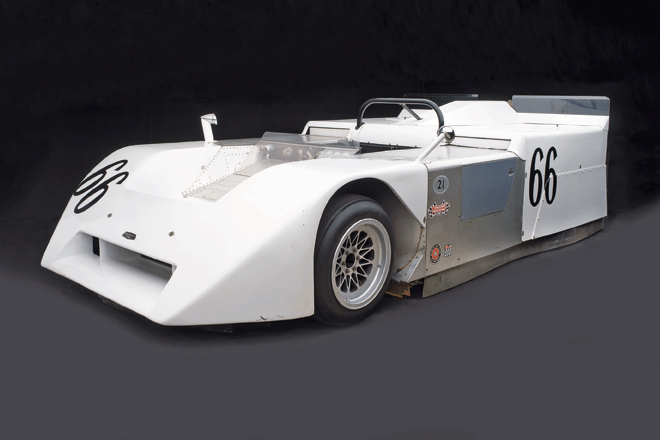
Chaparral 2J: the car that made downforce while standing still
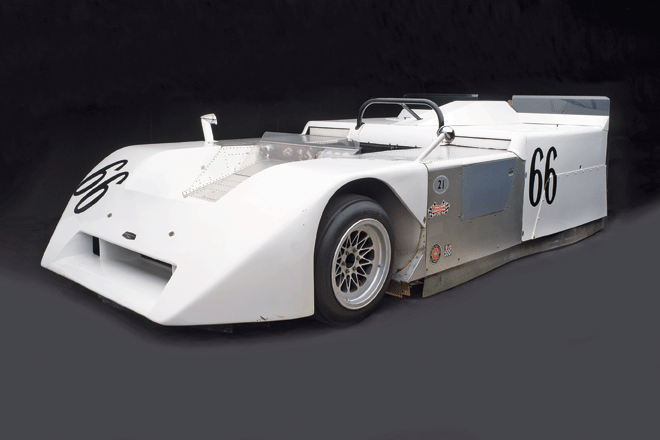
In June 2022 a small British electric car called the McMurtry Spéirling drove up the Goodwood hill in 39.08 seconds and broke the all-time Festival of Speed record that had stood since 1999. Most of the British press described it as a revolution. Two huge electric fans on the underbody, flexible polycarbonate skirts sealing the floor, suction-based downforce that didn’t depend on speed. A British team had cracked the holy grail of motorsport aerodynamics. Goodwood applauded. The mainstream press wrote about the future of EV performance.
Almost nobody pointed out that the same trick had been done — better, in fact — by a Texan team in 1970. With a Chevrolet big-block V8, a snowmobile auxiliary engine, polycarbonate skirts and twin 17-inch fans. Same physics. Same skirts. Same air-evacuation principle. The only differences are what powers the fans (electric motor in 2022, two-stroke snowmobile engine in 1970) and what powers the wheels (battery vs cast-iron petrol). The underbody concept is identical. The McMurtry isn’t a revolution. The McMurtry is a Chaparral 2J reissued for the EV era, fifty-two years late, in a venue where the FIA and the SCCA can’t ban it.
This is the story of the original. The Chaparral 2J. Built in West Texas in 1970 by Jim Hall, Hap Sharp and the secret hand of General Motors R&D. Banned after a single Can-Am season despite running zero wins, four pole positions out of three completed qualifying sessions, and lap times two to three seconds clear of the works McLarens. The fastest racing car nobody could finish a race with. The car that fundamentally changed how the world thinks about generating downforce, and that the rule book has been trying to outlaw for half a century.
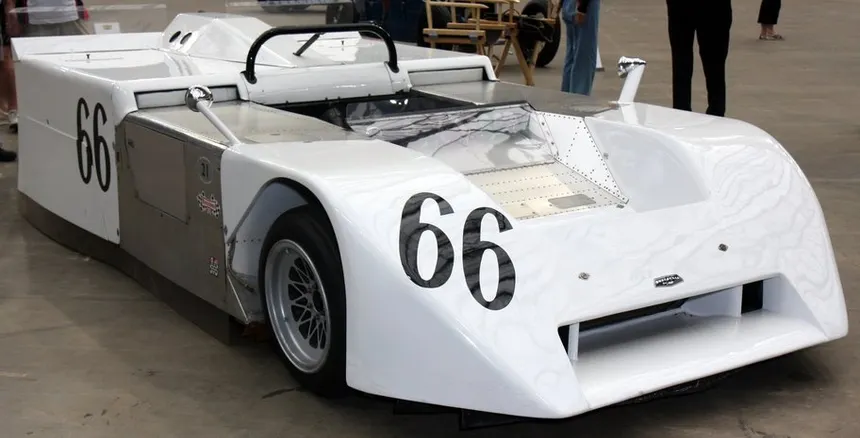
Where the idea actually came from
The 2J wasn’t dreamed up in Hall‘s notebook one morning. It was dreamed up in Warren, Michigan, by GM’s R&D department in 1968, before Hall was even involved.
The context: the FIA had banned high movable wings in Formula 1 after the catastrophic failures at the 1969 Spanish Grand Prix at Barcelona, when both works Lotus 49s broke their wing struts and crashed in essentially identical accidents within laps of each other. The SCCA hadn’t banned high wings in Can-Am yet, but the writing was on the wall. In Warren, Michigan, the engineers under GM R&D chief Charlie Simmons started asking a different question. If wings are going away, is there another way to generate downforce that doesn’t rely on movable parts mounted above the bodywork?
The answer they came up with is conceptually radical. Instead of pushing the car down by turning a wing against moving air, suck the air out from underneath the car and create an active low-pressure zone that doesn’t depend on forward speed. The difference between trying to keep a leaf on the floor by blowing on top of it, and keeping the leaf on the floor by sucking air from underneath. Physically both work. Mechanically they are different universes.
GM built a test car called the STV — Suspension Test Vehicle — that’s been described as looking like a cigar box with a Chevrolet V8 in the middle and a seat at the front, with provision to bolt different suspension geometries onto the corners. They started running it in November 1969. The downforce was real. The handling was a horror show: with the fans off the car ran natural understeer, and with the fans on it oversteered uncontrollably. The suction worked. The car was unraceable.
GM needed someone who could turn an experiment into a racing car. They called Hall.
Hall took the project, brought it home to Midland, and started rebuilding it from scratch. The number 2I was skipped — too easy to misread as 21 — and the project became the 2J. Hall was coming off the failure of his 2H, an extremely low-profile car that the press had nicknamed “the Yellow Submarine” for being chronically slow and unreliable. He needed a comeback, and he needed it to be different.
How the thing actually works
Two engines, not one
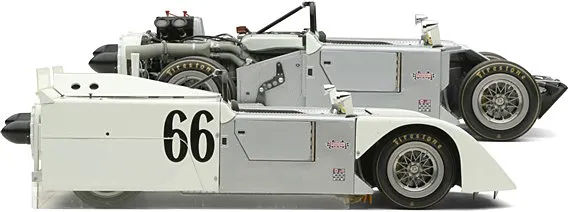
The 2J runs two completely separate engines. The main one is a Chevrolet aluminium big-block, 7.6 litres (465 cubic inches), Lucas fuel injection, 680 horsepower at 7,000 rpm. Standard Can-Am fare for 1970, nothing exotic about it. The transmission is the in-house Chaparral three-speed semi-auto with a torque converter and no clutch pedal — the same family of transmission you’ve already read about in the Jim Hall and Chaparral 2E articles.
The second engine is what changes everything. A two-cylinder, two-stroke JLO unit (pronounced “ee-lo”) of 274cc, originally designed for snowmobiles, air-cooled, producing about 45 to 55 horsepower depending on the source. Mounted between the V8 and the fans, with a single dedicated job: to spin the two suction fans at a constant 5,000 rpm. It has nothing to do with driving the wheels. It’s a completely separate system.
Why a separate engine? Because if you geared the fans to the main transmission, suction would vary with engine rpm. Wind it up, more suction. Lift off, less suction. That would destroy the consistency of the car under braking and through corners — exactly what you’re trying to avoid. With an auxiliary engine spinning at constant rpm, the suction is the same at 50km/h and at 250km/h. Aerodynamic load decoupled from forward velocity. That single idea, in one sentence, is the revolutionary insight of the 2J.
The team did consider an alternative: drive the fans off the main gearbox via a snowmobile-style variable-ratio belt. They rejected it precisely because it would have reintroduced the variability they were trying to engineer out. The conceptual elegance of the car lay in the total decoupling.
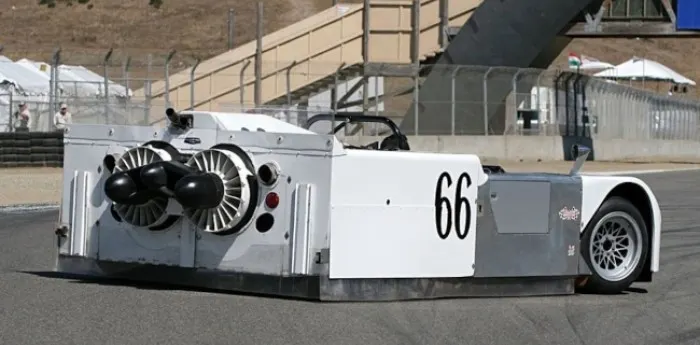
The fans
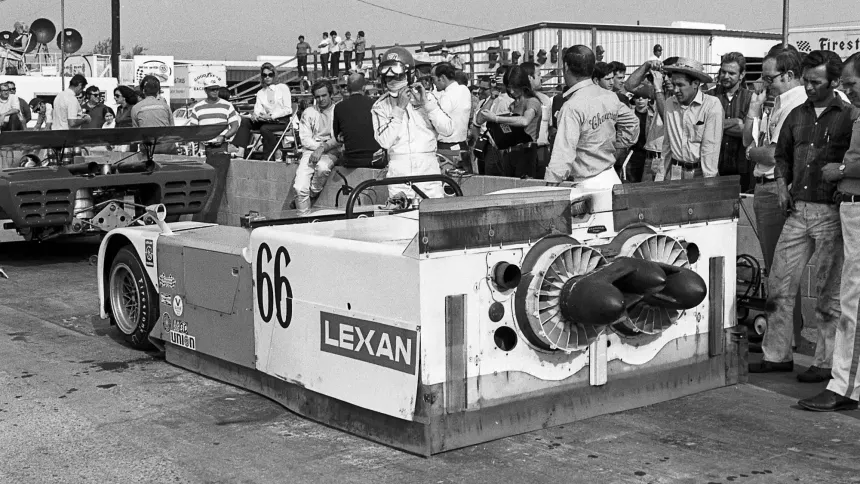
Two 17-inch (43cm) fans mounted at the rear, derived from cooling fans used in military tank engines. That isn’t poetic licence: the actual rotors came from the army surplus world, because the only place anyone had built fans capable of moving large volumes of air at constant rpm for sustained periods was the military cooling industry.
They run at constant 5,000 rpm, suck air from underneath the car, and exhaust it rearward. The mass airflow is enormous: with the car parked and the fans alone running, jet thrust from the exhausted air would actually move the car forward at around 65km/h. But that propulsive thrust isn’t the point. The point is the negative pressure those fans create directly under the floor.
The Lexan skirts
Sucking air from beneath the car only works if the volume underneath is sealed. If the sides of the car are open, ambient air rushes in to replace the extracted air and your suction collapses. You need to seal all four sides of that volume against the road.
The problem: the road isn’t flat. It has bumps, expansion joints, ripples, patches. The car’s suspension cycles up and down by several centimetres over every irregularity. If your skirts are rigid, they’ll shatter on the first bump. If they’re soft, they’ll fail to seal properly.
The answer came from General Electric. Lexan, the polycarbonate thermoplastic GE had originally developed as electrical wire insulation in 1953, and which became famous a few years later as the material NASA used for the visors of the Apollo astronauts’ helmets. Extraordinarily tough plastic, flexible without shattering, abrasion-resistant, temperature-stable. The 2J got Lexan skirts on all four sides: two long laterals running from behind the front wheels to the tail, one rear skirt across the back, and two short laterals just behind the front wheels.
The clever part isn’t the material. The clever part is how the skirts maintain a constant gap to the ground. Hall did one of those things only a mechanic-engineer comes up with. The skirts are mechanically coupled to the suspension through a system of bell-cranks, push-pull Bowden cables and linkages. When the chassis compresses on a bump, the skirt moves up proportionally. When it extends, the skirt drops. The gap between the bottom of the skirt and the tarmac stays at roughly one inch (2.5cm) regardless of suspension state, lateral G or surface irregularity. One inch, constant, all the time.
That linkage system was described in one period article as “Rube Goldberg” — meaning baroque, over-engineered. That’s unfair. Anyone who has ever had to design a mechanical actuator to maintain a constant gap between a sprung mass and an unsprung surface knows the problem is non-trivial. Solving it without electronics, using only cables, levers and bell-cranks, in 1970, is a serious piece of work. The fact that it’s mechanical isn’t a sign of crudeness. It’s a sign that Hall and his team had the workshop discipline to solve a complex dynamic problem with deterministic, fail-predictable hardware. No electronics to glitch. Just metal and cable doing exactly what physics says they should do.
The starting procedure
Starting the 2J does not work like starting any other car you’ve ever encountered. The sequence runs as follows. You climb in. You stamp on the brake pedal hard. You hit the starter for the JLO snowmobile engine. The little engine fires up, spins to 5,000 rpm, the fans start drawing air, and you can physically feel the car squat down on its springs as the suction pulls the chassis toward the ground. While you’re feeling it sink, you hit the starter for the V8 big-block, which roars into life. You release the brake. You drive.
If you start the V8 first and then start the JLO, the car is sitting at normal ride height, no suction, and when you fire the auxiliary engine the suspension drops in front of the entire pit lane with everyone watching. So the order matters. Hall’s mechanics had a specific sequence drilled into them.
On the track: Watkins Glen, 12 July 1970
The 2J wasn’t ready for the opening Can-Am rounds at Mosport or St. Jovite. Its debut came at round three, Watkins Glen, on a weekend that doubled with the World Sportscar Championship. Hall couldn’t drive any longer — the 1968 Stardust accident had ended his career — so he called Jackie Stewart, the reigning Formula 1 World Champion with Tyrrell.
Stewart qualified the 2J third behind the two works McLaren M8Ds of Denny Hulme and Dan Gurney. For a debut, on a complex car that nobody including the driver had time to set up properly, P3 wasn’t a bad place to start. In the race, the JLO snowmobile engine suffered vapour lock, suction dropped, and the brakes — sized for a conventional car, not for one carrying 1.25 to 1.5G of permanent downforce — gave up about a quarter of the way through the race. Stewart parked it. He told the press he was fascinated by the car, finished the weekend in his Tyrrell, and went back to the F1 circus.
For the rest of the 1970 Can-Am season Hall hired Vic Elford, the British veteran who had just driven the Porsche 917 at the same Watkins Glen weekend. Elford ran three races in the 2J. The pattern is brutal:
- Road Atlanta, September 1970: pole position by 1.26 seconds over Hulme’s McLaren. In the race, ignition trouble in the JLO meant the suction dropped and the car finished sixth. The 2J’s only finish.
- Laguna Seca: pole by 1.8 seconds. Engine blew in the warm-up lap. Did not start.
- Riverside, season finale: pole by 2.2 seconds. DNF.
Four races entered. Three pole positions on flying laps and one P3 grid spot for Stewart. One finish. Zero wins.
The numbers are misleading. The car was two to three seconds per lap faster than the rest of the field. In 1970 racing terms that isn’t an advantage. That’s another category of vehicle. McLaren kept winning races precisely because the 2J kept breaking. The mechanical complexity of the 2J — two engines, two cooling systems, two fuel systems, suspension-coupled skirts, an aerodynamic geometry that didn’t resemble anything that had come before — meant that when something went wrong, it had twice as many places to go wrong as a conventional car. Hall said it best afterwards: working on the 2J was like having two cars inside the space of one car. The reliability problems were the reliability problems of a car with double the systems.
Hall wanted to keep the 2J in the workshop through 1970 and debut it for the 1971 season after a year of development. General Motors pushed him to race it in 1970, fearful that the concept would leak and someone else would beat them to it. The result: a phenomenally fast car, chronically broken.
The ban
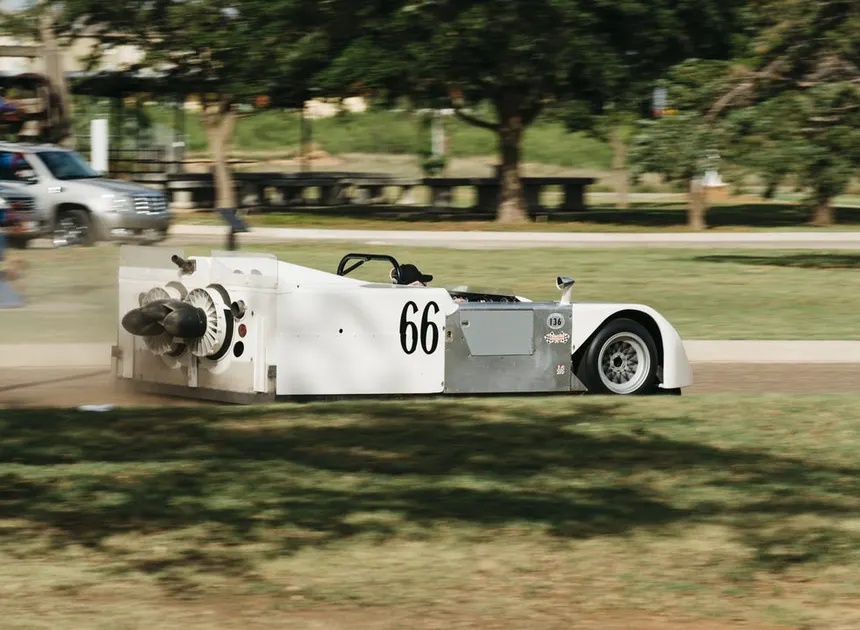
By late 1970, before the season had even ended, the rival teams had started lobbying the SCCA to outlaw the 2J. McLaren led the charge. Bruce McLaren himself was already dead — killed in June 1970 testing the M8D at Goodwood — and the team, now run by Teddy Mayer, couldn’t afford to lose its dominance of Can-Am to a Texan with twin fans.
The official argument was that the suspension-coupled Lexan skirts and the rotating fans constituted “movable aerodynamic devices” — a category the FIA had banned the previous year for the high wings of Formula 1. Stretch the language a little, and it covered the 2J. The real argument was simpler: with two seconds a lap in hand, if the 2J’s reliability ever caught up with its speed, McLaren was finished and Can-Am was over. McLaren had been dominating since 1967, and the irony of arguing that a single car winning would “kill the series” wasn’t lost on anyone in the paddock.
A secondary complaint also surfaced: drivers running behind the 2J reported that the fans were spitting stones, dirt and rubber back at their cars, the way a road sweeper showers debris behind itself. That complaint was technically valid but easily fixable with mesh screens and deflectors. The real issue was the speed.
By the end of 1970 the SCCA caved. Movable aerodynamic devices were formally banned in Can-Am from 1971 onwards. The 2J never raced again.
In October 1970, with the lobbying gathering momentum, Hall said something that defines his entire 30-year design philosophy: “If I can come up with a better mousetrap that is within the regulations, I ought to be allowed to use it.” What Hall was pointing out was straightforward. The rules didn’t ban suction. The rules didn’t ban auxiliary fans driving cooling devices. The “movable aerodynamic device” wording had been written specifically for the high wings of F1. Stretching it to cover the 2J was a political decision, not a regulatory one. It was, ultimately, what Hall already knew from the 2E days: when you apply your brain instead of horsepower, regulators cannot keep pace, and they always slam the door on a problem they don’t know how to solve another way.
What survived
The 2J idea didn’t die in 1970. It went underground and surfaced in three different places.
1978. Gordon Murray, chief designer at Brabham, looks at the Formula 1 rule book and realises he has the same open door the SCCA had in 1970. He designs the Brabham BT46B with one giant rear fan, ostensibly justified as a “cooling device” for the Alfa Romeo flat-12 engine. Niki Lauda wins the Swedish Grand Prix with it. Bernie Ecclestone, then both Brabham team principal and the rising power broker of F1, voluntarily withdraws the car before it can be formally banned. One race, one win, tactical retreat. The withdrawal was pure politics: by pulling the car himself instead of fighting the protest, Ecclestone preserved Brabham’s standing inside the F1 establishment at the cost of the technical inheritance of the BT46B. Make of that what you will. The point is that the principle Hall established at Rattlesnake Raceway in 1970 had won a Formula 1 Grand Prix eight years later.
The early 1980s, Lotus 78 and Lotus 79. The passive ground effect branch. No fans, just floor geometry and rigid side skirts creating a Venturi tunnel under the car. The effect is similar to the 2J but it only works at speed — no static downforce, no decoupling from velocity. The FIA eventually banned rigid sliding skirts at the end of the 1982 season, but mild passive ground effect lives on in every modern Formula 1 car running today.
2022, Goodwood. McMurtry Spéirling, 39.08 seconds up the hill. Twin electric fans on the underbody, flexible polycarbonate skirts, active suction. The same physics. Fifty-two years on. The only differences: electric drive instead of petrol, batteries instead of fuel tank, and a venue (Goodwood) where no FIA technical inspector has the authority to outlaw the design.
The FIA and the SCCA banned in 1970 what is fundamentally the most efficient method of generating aerodynamic downforce that has ever been demonstrated. They are still banning it today in F1 and in Can-Am. But McMurtry can do it at Goodwood because Goodwood isn’t governed by a sanctioning body. And the next generation of electric hypercars — the heirs of the Spéirling — will use this principle to do things wings have never been able to do.
What Hall figured out with a snowmobile engine and Lexan skirts in 1970 was the right answer. The FIA decided the right answer was illegal, and gave us DRS and ever-more-complex regulations instead. The next time you see a Formula 1 driver activate his rear wing flap on a straight, remember that the car which understood all of this fifty-five years earlier won a single race. It was sitting in the pit lane already generating more downforce than any current race car in the world. And on the day they banned it, the reason wasn’t safety. It was what the reason always is.
Check you’re still alive.