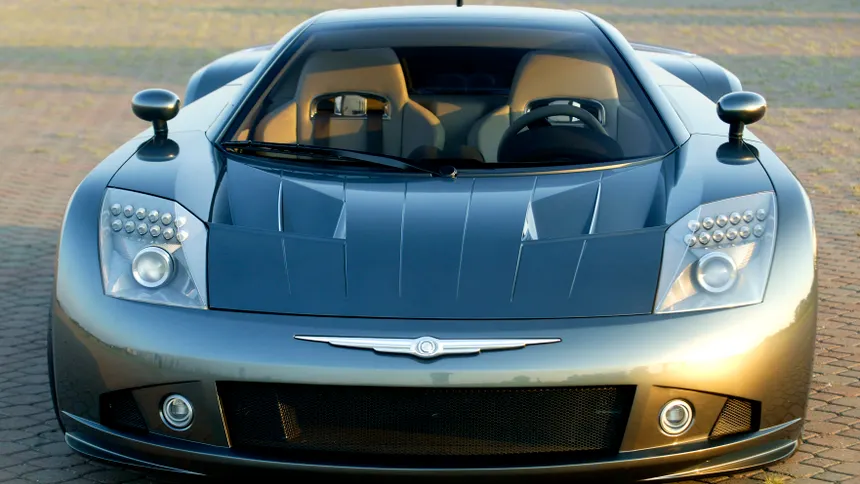
CHRYSLER ME FOUR-TWELVE: THE AMERICAN SUPERCAR MERCEDES MURDERED
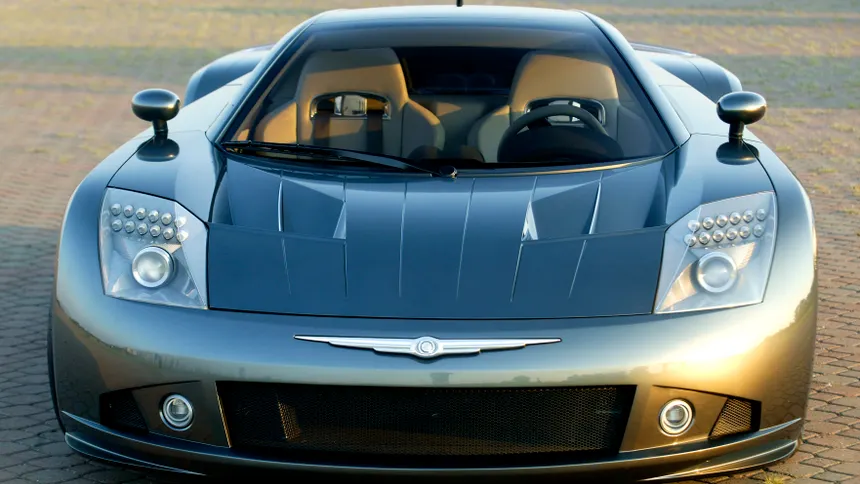
A 248 mph American hypercar, born inside the wrong corporation
McLaren F1Before the Bugatti Veyron set a new bar at 253 mph. Before the Ferrari Enzo was fully digested by the collector market. Before the McLaren F1 looked replaceable. Detroit had a car ready to leave them all behind.
It had 850 brake horsepower from a six-litre V12 with four turbochargers. It weighed 2,880 pounds dry. It had a seven-speed dual-clutch gearbox shifting in under 200 milliseconds. It had a projected top speed of 248 miles per hour. And it had been engineered, built and made to run by a team of eleven Chrysler employees in less than twelve months.
It was called the ME Four-Twelve, and at the 2004 Detroit Motor Show it walked into the supercar room like Mike Tyson walking into a chess tournament. Within twelve months of that debut, it was officially dead.
This is the story of a car that nobody in America wanted to cancel, and that Stuttgart could not allow to live.
A name that spells out the architecture
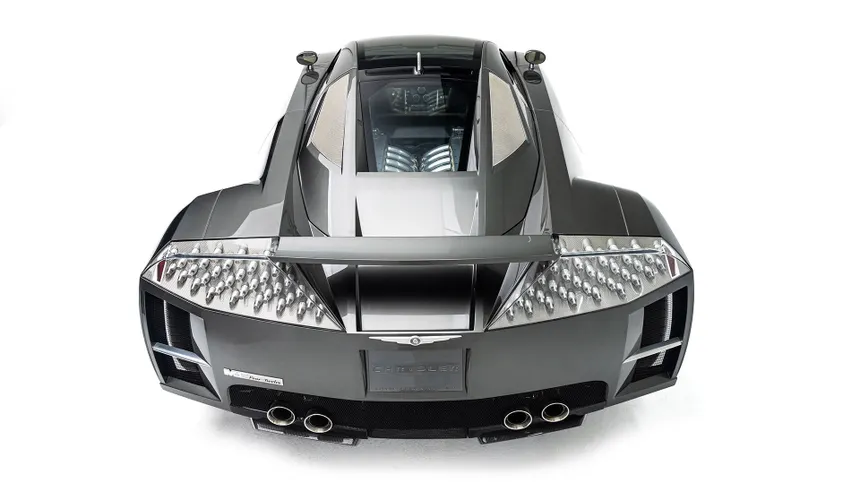
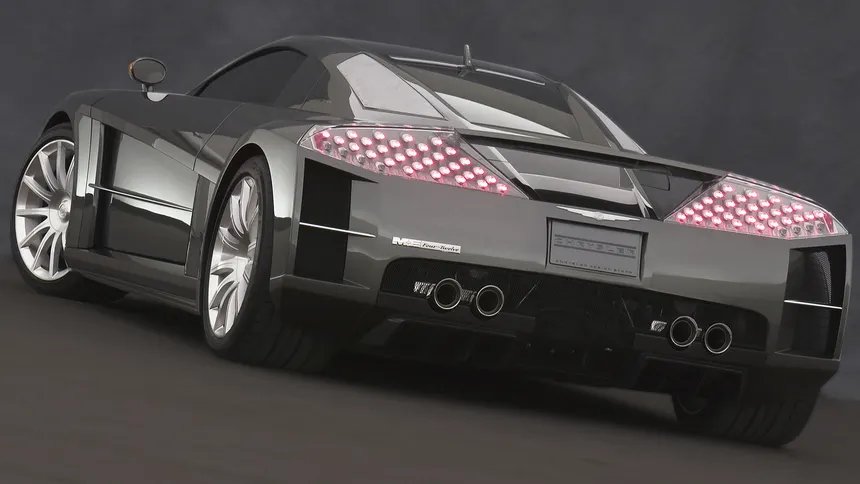
ME stands for Mid-Engine. Four refers to the four turbochargers strapped to the V12. Twelve is the cylinder count. Read the name and you have the entire engineering layout of the car. There was no marketing flourish to it: just the engineering spec written out in capital letters across the rear bodywork.
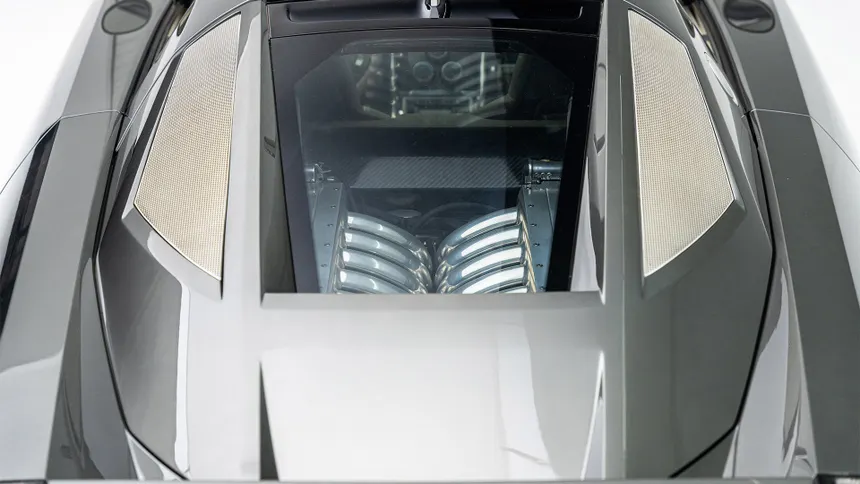
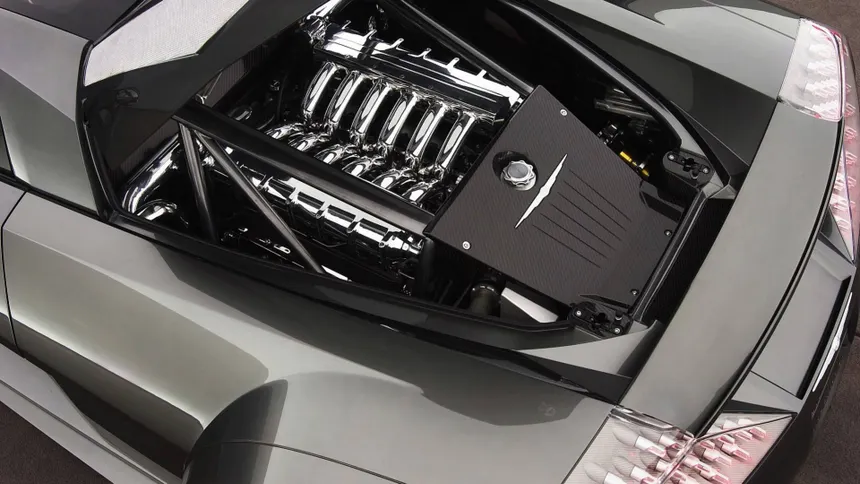
The engine was the Mercedes-Benz M120, the 6.0-litre all-aluminium V12 that first appeared in the 1991 S 600 and SL 600, was tuned by AMG in various forms, and most famously gave the Pagani Zonda its voice. AMG worked on the ME Four-Twelve unit with the Chrysler team, fitting four turbochargers in parallel, redesigning cylinder heads, intake and exhaust manifolds, pistons and crankshaft, keeping the compression ratio at 9.0:1, and ending up with 850 hp at 5,750 rpm and 1,150 Nm of torque available across a flat plateau between 2,500 and 4,500 rpm.
Specific output: 142 hp per litre. In 2004 that was a number nothing on a public road could match. The Pagani Zonda C12 S of the same year, on the same engine block, made 555 hp. The ME Four-Twelve made 295 hp more from the same architecture.
Transmission was a seven-speed dual-clutch unit designed and patented by Chrysler in partnership with Ricardo. Rear-wheel drive only. No hybrid system, no electric assistance, no traction wizardry to mask the engine. Just a V12, four turbochargers, two clutches, and a pair of rear tyres.
Eleven engineers, twelve months, one supercar
This is the detail that British and American magazines have spent twenty years finding hard to believe. The internal Chrysler team dedicated to the ME Four-Twelve was eleven people. Eleven. Working in secrecy from early 2003 under the direction of Dan Knott, head of Chrysler’s Street and Racing Technology (SRT) group, with Louis Rhodes as lead chassis engineer and Brian Nielander handling exterior design.
Secrecy was so tight that Rhodes used multiple code names for the project to identify the source of any leak. If something appeared in the press, he could trace which code name had been used and therefore which supplier or staff member had talked. Fewer than ten external suppliers were involved in core development, with Ricardo providing the bulk of the technical workforce under direct Chrysler supervision.
By January 2004 there was a presentable car on the Detroit stand and a functional running prototype already on test. By August 2004, Chrysler was ready to put a journalist in the driver’s seat.
For context, Ferrari took three years to develop the Enzo. McLaren took five for the F1. Mercedes had spent half a decade on the SLR McLaren and was still tuning it when Chrysler walked into Detroit with this. The development pace was, by any historical measure of the supercar industry, impossible. Chrysler did it anyway.
That speed of execution would become, paradoxically, the project’s biggest problem.
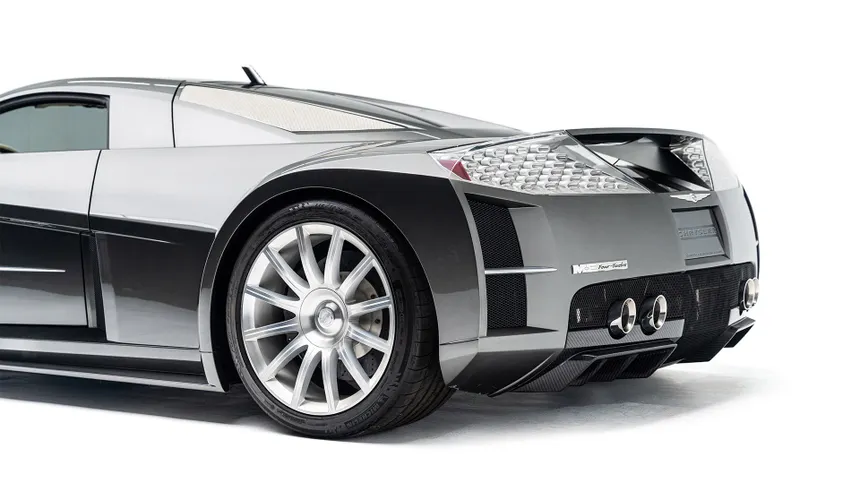
A textbook hypercar chassis
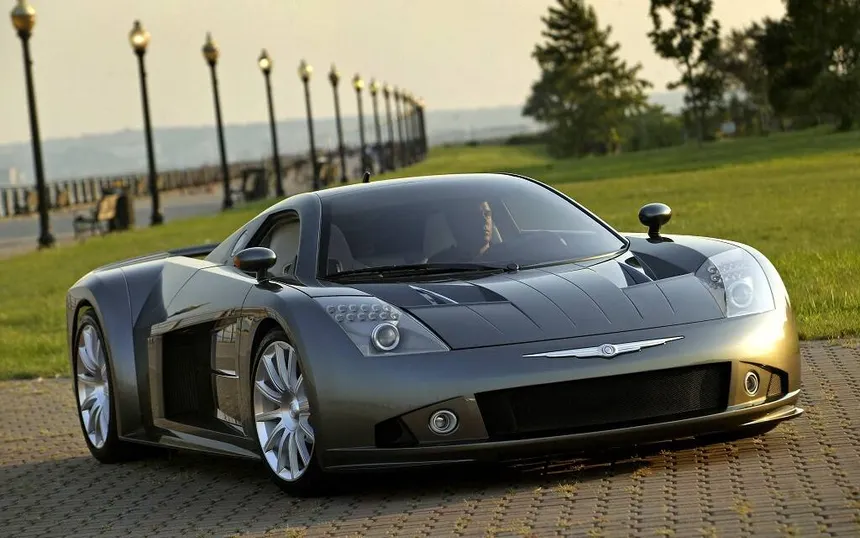
Aluminium honeycomb monocoque, clad in carbon-fibre panels. Rear subframe in 4130 chromoly steel, the same material used in competition tube frames. Full carbon-fibre body skin. Kerb weight: 1,310 kg (2,888 lb).
To place that number in context against the cars it would have launched alongside: the Ferrari Enzo weighed 1,365 kg with 650 hp. The Porsche Carrera GT weighed 1,380 kg with 612 hp. The Mercedes-Benz SLR McLaren weighed 1,768 kg with 626 hp. The Chrysler was lighter than all three and more powerful than all three. The arithmetic speaks for itself.
Double-wishbone suspension all round, AP Racing ceramic discs with six-piston front calipers, active aerodynamics generating 924 lb (420 kg) of rear downforce at 186 mph. Piece by piece, a textbook modern hypercar. Not a re-badged Mercedes. Not a Viper with extra cylinders. A clean-sheet architecture, built on American soil by Metalcrafters under Chrysler engineering supervision, with the only major imported component being the AMG V12 itself.
What the road testers said
In August 2004, eight months after Detroit, Chrysler invited several American magazines to Laguna Seca. Angus MacKenzie from Motor Trend and Kevin A. Wilson from AutoWeek were among the journalists handed the keys. MacKenzie filed in November 2004 with the line that captured the moment: Move over, Ferrari, here comes… Chrysler. Wilson, writing for AutoWeek, opened his piece with a verdict that was just as direct: this was not only a real car, it was the real deal.
Both reports agreed on the basics. The car was clearly unfinished. The Ricardo dual-clutch transmission still had calibration issues. The engine was running below its full claimed output. The electronic torque mapping needed more development. But the car ran. The chassis felt right. The acceleration was real.
And this is the detail every technical write-up since has glossed over. Wilson described the sound of that quad-turbo V12 on a hot lap, and the description is the most useful single sentence ever published about how the ME Four-Twelve felt to drive. The engine, he wrote, had the low-pitched growl of a monster, completely unlike the high-pitched shriek of a Ferrari Enzo with the same cylinder count and displacement. Four turbos eating the exhaust gases before they reached the four tailpipes flattened the note, thickened it, dropped it an octave. It did not sing like an Italian V12. It muttered like a heavyweight.
Dieter Zetsche, then in charge of Chrysler, gave Wilson the line that ended up defining the project’s internal momentum. Over dinner before the test, Zetsche admitted that calling the Detroit show car a prototype had been, in his own words, a little bit of bragging. Building a real running prototype with that much performance had been far harder than they had anticipated, and the car parked at Laguna Seca that week was the first that was genuinely functional.
In Auburn Hills that admission read as a statement of intent. Chrysler wanted this car in production and Zetsche was saying so on the record. In Stuttgart, the same line was read as a declaration of internal war.
The SLR McLaren problem
In 2003 Mercedes had launched the SLR McLaren. Five years of joint development with McLaren. Heavy multimillion investment. The supposed flagship of the entire Mercedes-Benz group. 626 hp, 0-60 mph in 3.6 seconds, top speed 207 mph. Sticker price around 450,000 dollars.
The ME Four-Twelve made 850 hp, hit 60 mph in 2.9 seconds, projected 248 mph, and according to Chrysler’s own internal accounting cost less to develop than the SLR. Eleven people in Auburn Hills had, in twelve months, built a car that was faster, lighter and potentially cheaper than the car Stuttgart had spent half a decade and a small army on.
And the worst part for German morale: the Chrysler did it with the Mercedes engine. The M120 V12 belonged to Mercedes. AMG belonged to Mercedes. The American team had taken Mercedes parts, modified them with Mercedes engineers, and beaten the Mercedes flagship using the result. That, in Stuttgart, was not a concept car. It was a public corporate humiliation.
Allpar reported, and Jalopnik and The Drive later repeated, that the SLR McLaren development team protested formally against the ME Four-Twelve programme reaching production. Wolfgang Bernhard, the Chrysler executive most actively pushing the supercar through the boardroom and reportedly in line for the head Mercedes-Benz job, was de-selected from that promotion shortly afterwards (per Allpar’s account, picked up by the wider anglophone press).
The official cancellation, announced in January 2005, gave a different reason. Developing the car for production would cost hundreds of millions of dollars. Chrysler was still consolidating after the launch of the 300 and the Magnum. The ME Four-Twelve was reframed as a distraction from the core commercial priorities of the moment.
The unofficial reason, the one that every American Chrysler watcher believes and that the British and American press have repeated for two decades, is the one your gut already knows. Mercedes did not want a Chrysler with a Mercedes engine outrunning the SLR McLaren. Mercedes ran DaimlerChrysler. The 1998 deal had been called a merger of equals; in practice it was a Stuttgart takeover dressed up in legal niceties, a $38 billion transaction that left the centre of corporate gravity firmly in Germany. Mercedes won the argument that mattered.
What sits in the museum
Two units were built. One was the auto show car with limited operational capability, the one the public saw under the lights in Detroit. The other was the fully functional prototype that MacKenzie and Wilson drove at Laguna Seca, that ran, that accelerated, that probably would have hit its projected 248 mph if anybody at Chrysler had been given clearance to put it on a high-speed test track.
One of the two is currently displayed on rotation at the Petersen Automotive Museum in Los Angeles, in its Modern Concepts exhibit. But ownership remains with Stellantis North America: the car is on loan, not sold. The second unit lives at the Conner Center in Detroit, the former Dodge Viper assembly plant on Conner Avenue, repurposed after the closure of the Walter P. Chrysler Museum in 2016 into the central storage facility for Stellantis North America’s historical collection. The site houses roughly 400 vehicles between concept cars and significant production models, with about 85 on rotating display. The ME Four-Twelve is one of them, although access to the Conner Center is restricted to company employees and private events.
Neither car is driven today. Neither is being restored. Nobody fires up that quad-turbo V12 for a public demonstration the way Mercedes occasionally fires up a C111 at a heritage event. The ME Four-Twelve, plainly, is parked.
Three years after the cancellation, in 2007, DaimlerChrysler split. Cerberus Capital bought Chrysler. The 2008 financial crisis put Chrysler into bankruptcy. Fiat rescued it in 2009. Today the group is Stellantis and Chrysler sells essentially two cars in North America, a minivan and an ageing sedan, with the sedan being phased out.
Had the ME Four-Twelve reached customers in 2005, the McLaren F1 would have lost its top-speed record two years before the Veyron arrived to claim it. The Ferrari Enzo would have been beaten on every metric by a car wearing an American badge. Chrysler would have had a halo product significant enough to potentially carry the brand through the crisis that arrived three years later.
But Stuttgart could not let that happen. And so it did not happen.
What we are left with
Was there ever a real production window? Yes. Between the Detroit debut in January 2004 and the Motor Trend road test published in November 2004, there was a credible internal path to a low-volume production run, with Zetsche publicly supportive, Bernhard pushing hard internally, and Knott’s SRT team operationally ready.
But in a company with two heads, the German head and the American head, the deciding vote does not go to whoever has the better numbers. It goes to whoever has the bigger seat in the boardroom. At DaimlerChrysler, that boardroom answered to Stuttgart, not to Auburn Hills.
The Chrysler ME Four-Twelve was not killed by physics, by engineering, by market research, or by the laws of finance. It was killed because somebody with enough authority decided that a Chrysler was not allowed to be better than a Mercedes. Even if it was. Especially if it was.
Check you’re still alive.