
Mercedes-Benz SLR McLaren: The $455,000 Argument Between Stuttgart and Woking
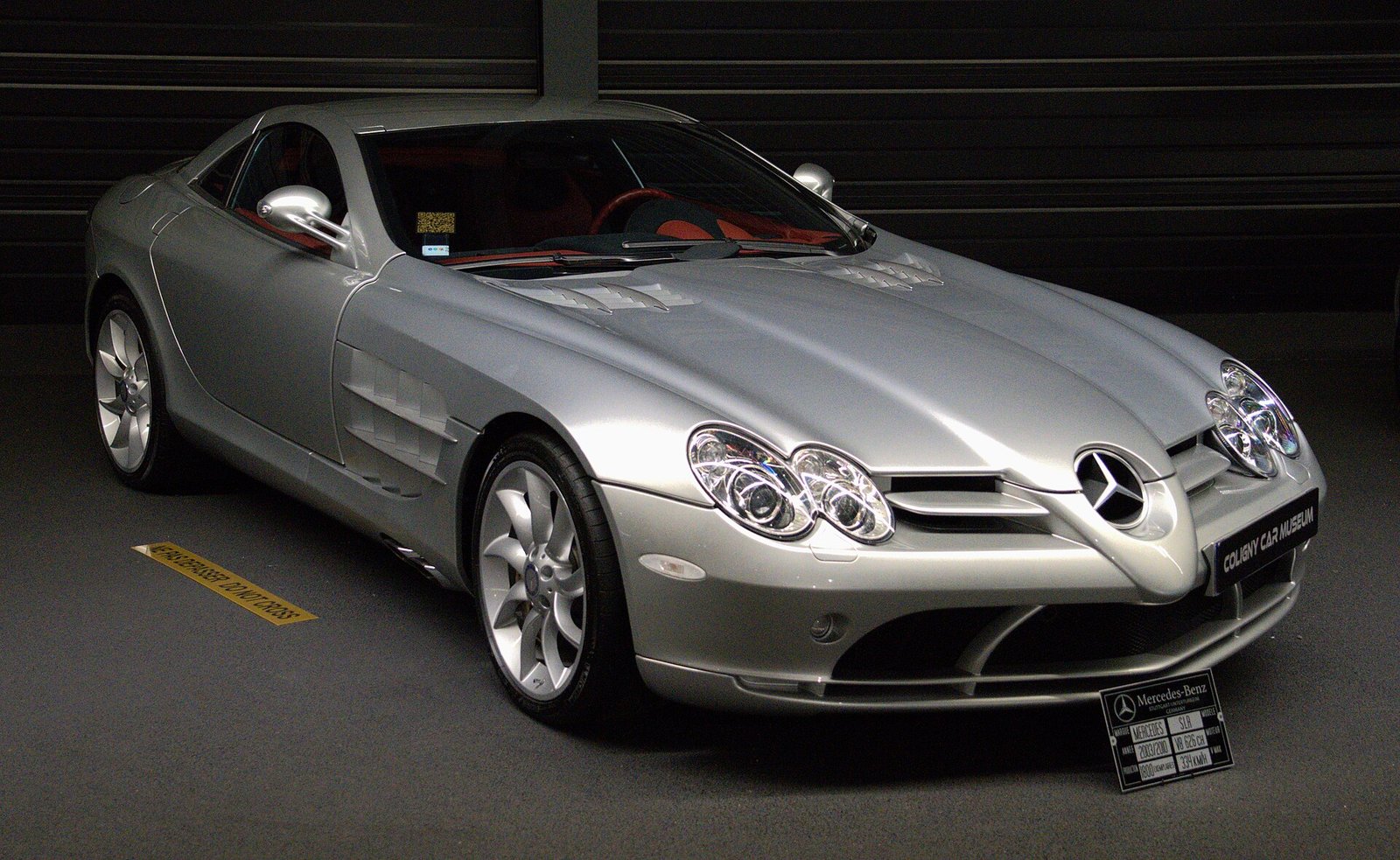
It made its debut in Detroit, in January 1999, as a silver concept called the Vision SLR, and the crowd at Cobo Hall loved it. Four years later, the production car cost more than twice what Mercedes had planned, sold well under half of what the company expected, and helped break up one of the most successful partnerships in motorsport. Two decades on, it’s one of the most interesting cars of its era, and the people who were rude about it at the time have gone quiet. The Mercedes-Benz SLR McLaren is what happens when two companies with very different ideas about what a fast car is for are made to build one together.
In short: the Mercedes-Benz SLR McLaren started as the 1999 Vision SLR concept and reached customers late in 2003, built by McLaren in Woking with a supercharged 5.4-litre V8. Mercedes wanted a grand tourer and McLaren, under Gordon Murray, a race car with plates, and the price more than doubled to about $455,000 in the US. Five versions followed, ending with the 2009 SLR Stirling Moss.
The concept that sold itself
The Vision SLR was a nod to the most romantic chapter in Mercedes history. Its inspiration was the 300 SLR of 1955, and in particular the two Uhlenhaut Coupés, closed versions of the W196S race car built for the company’s engineering chief, Rudolf Uhlenhaut, who reportedly used one to commute. Those cars never went on sale. In May 2022, one sold privately for 135 million euros plus fees, which made it the most expensive car ever sold.
The concept had a 5.0-liter supercharged V8 with 557 hp. It was long, low, wide and looked as if it had been machined from a single silver billet. Reaction was good enough that Mercedes green-lit production. For that it went to its partner in Formula 1, McLaren, in which Mercedes then held a 40 percent stake.
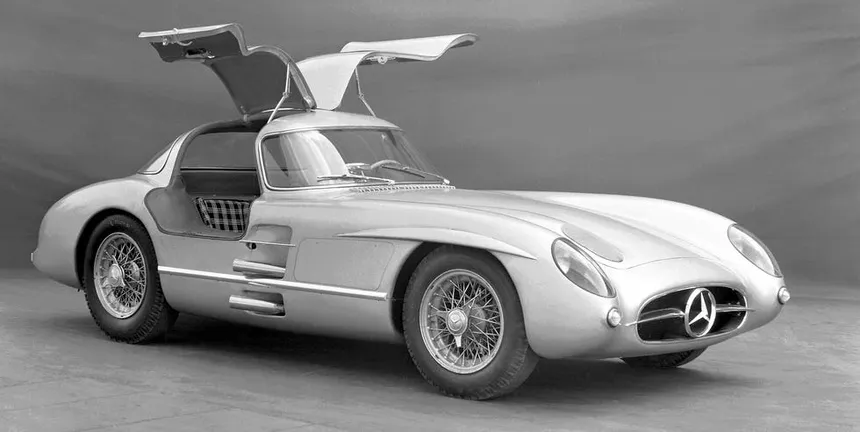
The name carried a lot of baggage, in both directions. In May 1955, Stirling Moss and the journalist Denis Jenkinson won the Mille Miglia in a 300 SLR, covering roughly 1,000 miles of Italian public roads in 10 hours, 7 minutes and 48 seconds, at an average of almost 98 mph. Jenkinson read a roll of pace notes from a homemade aluminum box, and the record was never beaten. Six weeks later, at Le Mans, Pierre Levegh’s 300 SLR was launched into the crowd, killing the driver and more than 80 spectators in the worst crash in racing history. By the end of the season, Mercedes had withdrawn from motor racing, and it didn’t come back as a works team for more than thirty years. Calling a new car SLR meant borrowing all of that.
Two companies, one car, no agreement
You can guess what followed. Mercedes wanted a grand tourer: comfortable, plush, full of gadgets, a car for crossing Europe at 155 mph on leather seats with perfect climate control and a usable trunk. McLaren wanted a race car with plates. The man at the center of the technical side was Gordon Murray, the engineer behind the McLaren F1 and the head of McLaren Cars, and his view of comfort was that it added weight.
The tug of war lasted almost four years. The original price target of about $200,000 more than doubled. When the SLR reached customers late in 2003, it cost about $455,000 in the U.S. That put it alongside the Ferrari Enzo, the Porsche Carrera GT and the Pagani Zonda, cars it had never been designed to fight. The intended rivals had been the Ferrari F430, the Bentley Continental GT and the Aston Martin DB9, all far cheaper. For American buyers the comparison was even harder to swallow, because Ford’s own GT, the retro supercar from the same years, cost about a third of the price and was quicker around a track.
What Woking built
Whatever was going on in the meetings, the car that came out of McLaren’s Woking factory was technically remarkable. Its structure was a carbon-fiber reinforced plastic monocoque, bonded to an aluminum subframe that carried the drivetrain. It was one of the first production cars with a front crash structure made entirely of carbon fiber, built to crumple progressively and absorb energy like a race car’s nose cone.
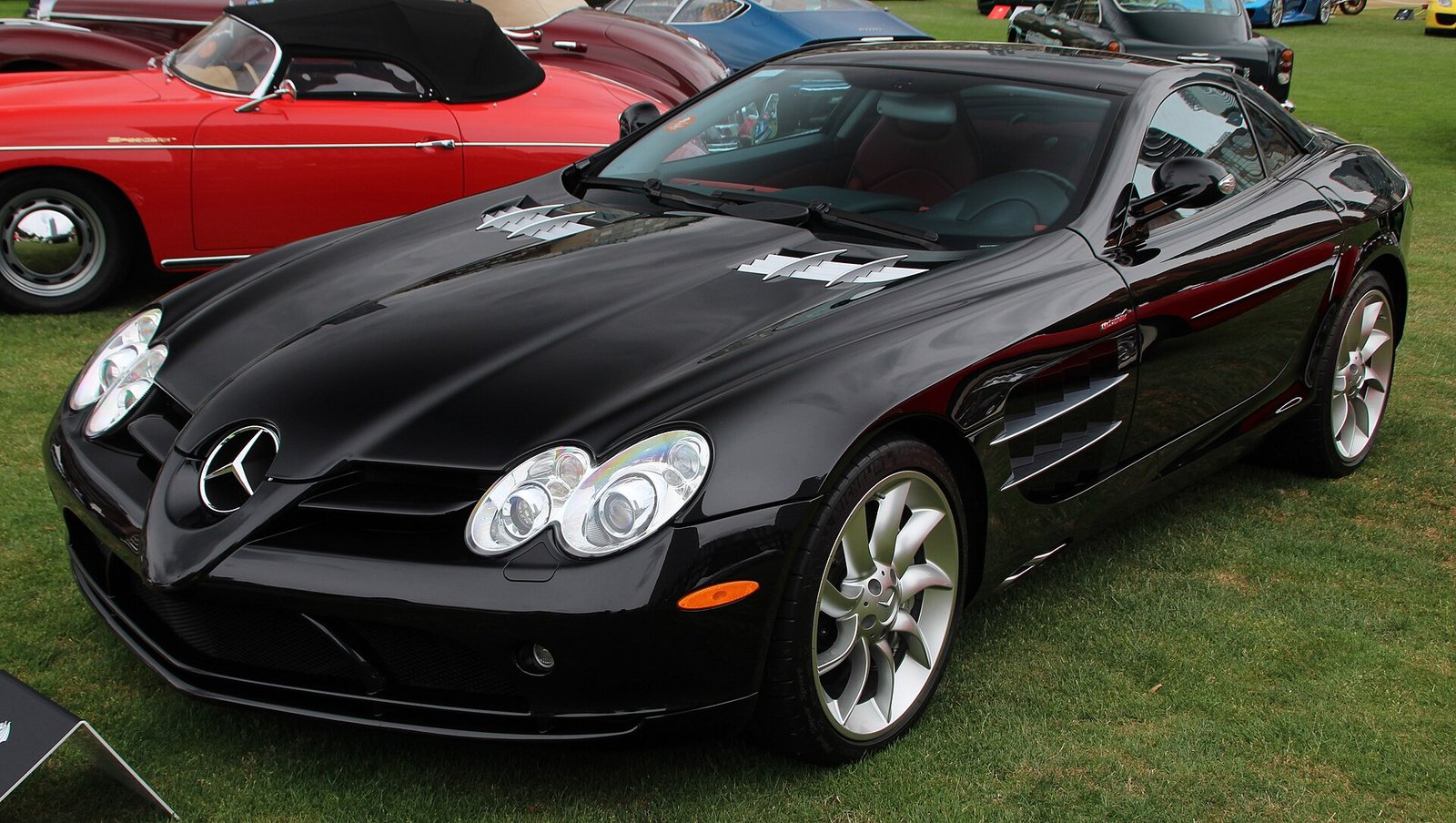
The engine, the AMG M155, was a supercharged 5.4-liter V8, all aluminum, with a twin-screw supercharger at about 13 psi. It made 626 PS, or 617 hp, at 6,500 rpm, and 575 lb-ft at 3,250 rpm. Mercedes’ only automatic able to take that torque was a five-speed with a torque converter, given special AMG software, which made the SLR the fastest torque-converter automatic car of its time. Purists found that odd on a supercar. Owners found that it made 600-plus hp usable in traffic.
To get an acceptable weight distribution, the engine went behind the front axle in a front-mid layout. That explains the absurd length of the hood: it’s what happens when engineering has to push the engine back toward the cabin. And because McLaren wanted a smooth, flat underbody to manage the airflow, the exhaust couldn’t run underneath to the rear. The outlets exit through the sides, just behind the front wheels and ahead of the doors. Under hard acceleration you can see flames coming out next to your knees. It’s theater, but it’s also a neat answer to an aerodynamic problem.
The rear wing that brakes
The SLR had one of the most sophisticated active aero systems of its time. The rear spoiler had three settings. At normal speeds it stayed retracted to cut drag, at high speed it rose automatically to make downforce, and under emergency braking it went up to a steep angle and worked as an air brake, increasing the aerodynamic braking surface by about 60 percent, according to Mercedes. Together with carbon-ceramic brakes, 370 mm up front and 360 mm in back, the car could shed speed brutally. Mercedes said the ceramic discs held up to 1,200 degrees Celsius without fading, and the whole brake system weighed 6 kg less than an equivalent conventional one.
The claimed numbers: 0 to 62 mph in 3.8 seconds, 0 to 124 in 10.6, a quarter mile in 11.2 seconds at about 130 mph, and a top speed of 208 mph. It weighed 1,768 kg, about 3,900 pounds, in coupe form, which wasn’t light even then, and the suspension used conventional springs and dampers at a time when rivals were moving to adaptive systems. The ride was firmer than most people expected from a half-million-dollar GT.
Five versions, each wilder
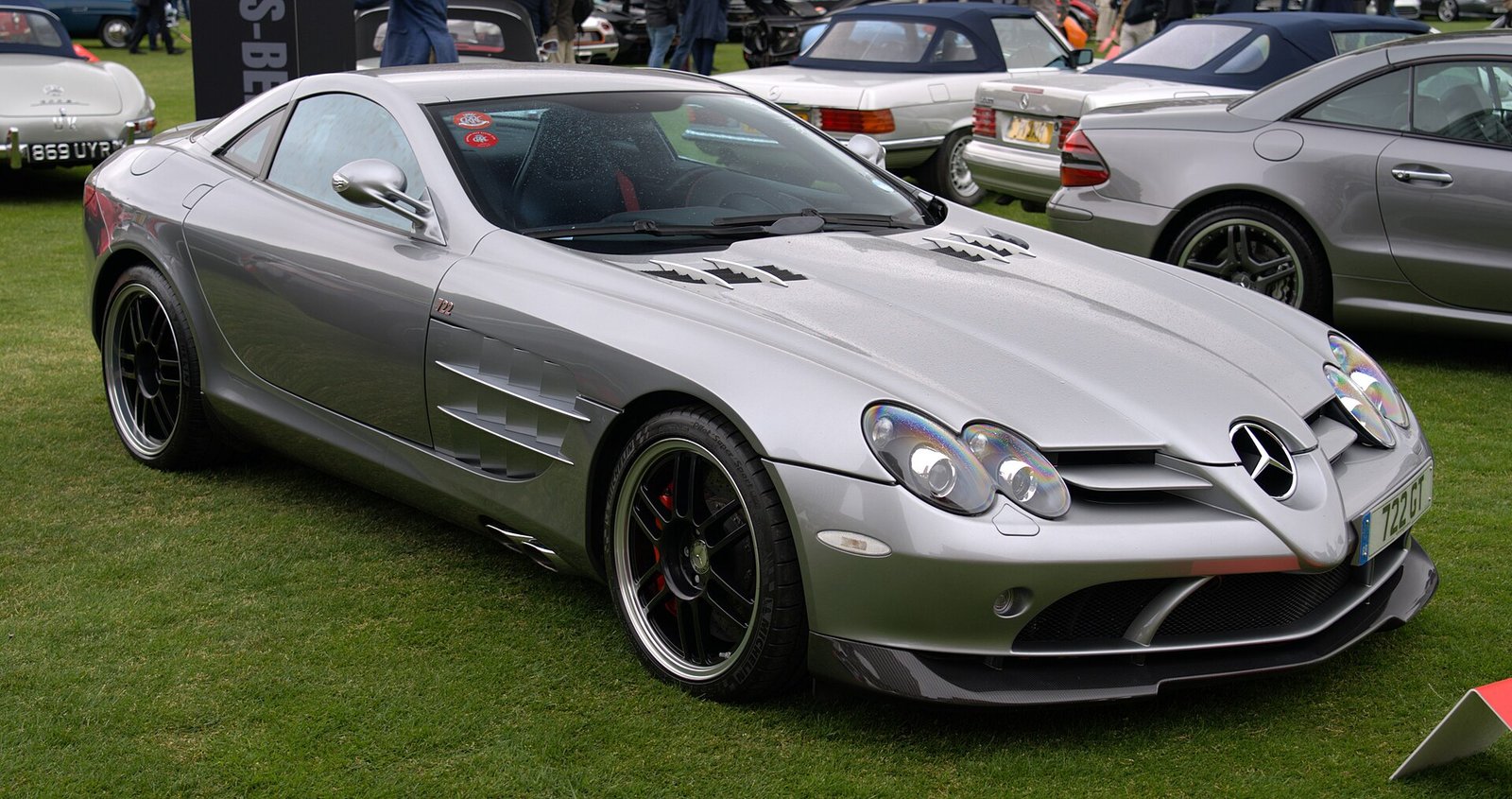
The SLR evolved over six years. The Coupe of 2003 to 2007 accounted for most of the 2,157 cars built. The 722 Edition of 2006 was named for the start number Stirling Moss carried when he won the 1955 Mille Miglia with Denis Jenkinson, a number that meant he left Brescia at 7:22 in the morning. It got 650 PS, 820 Nm, firmer suspension, a 10 mm drop, 390 mm front discs and red and black detailing, in a run of 150.
The Roadster of 2007 to 2009 had a triple-layer fabric roof that could open in under 10 seconds, even on the move at low speed. The 722 S Roadster added the 650 PS engine to the open car, in another 150 units. And the SLR Stirling Moss of 2009 dropped the roof and the windshield altogether, with redesigned body panels and the 650 PS engine. Only 75 were built, sold only to existing SLR owners, at around a million euros each. It sold out before the first one was made.
The part that didn’t work
Mercedes had planned on 500 cars a year and 3,500 in total. The real figures were rough: 615 in 2005, 261 in 2006 and 275 in 2007, and 2,157 overall. The price and the car’s split personality, neither pure supercar nor normal GT, held sales back.
The disagreements behind the SLR went well beyond one car. By 2007, the relationship between the two companies was under strain in Formula 1 too. That was the year of the spy scandal, when McLaren was found to have Ferrari technical data, was fined $100 million and thrown out of the constructors’ championship. It was also the season when its two drivers, Fernando Alonso and the rookie Lewis Hamilton, fought each other so hard that both lost the title to Kimi Räikkönen’s Ferrari by a single point. Mercedes began selling its stake in McLaren in 2009, bought Brawn GP to create its own works team, and put its road-car performance energy into AMG, which it already owned. The SLS AMG of 2010, a gullwing tribute to the 300 SL, was 100 percent Stuttgart.
Was it any good?
The SLR has had a perception problem since day one. It cost as much as an Enzo but wasn’t an Enzo. It wore the McLaren name, but it wasn’t a pure McLaren. It was a GT that accelerated like a supercar, and a supercar with a trunk and luxury climate control. Back then that confused critics and buyers. Today it’s the reason the car is fascinating. You could do 600 miles of interstate without wrecking your back and then attack a mountain road with 626 PS going to the rear wheels while the side pipes spat fire. Few cars from that era were capable of both, and none did it with this much drama.
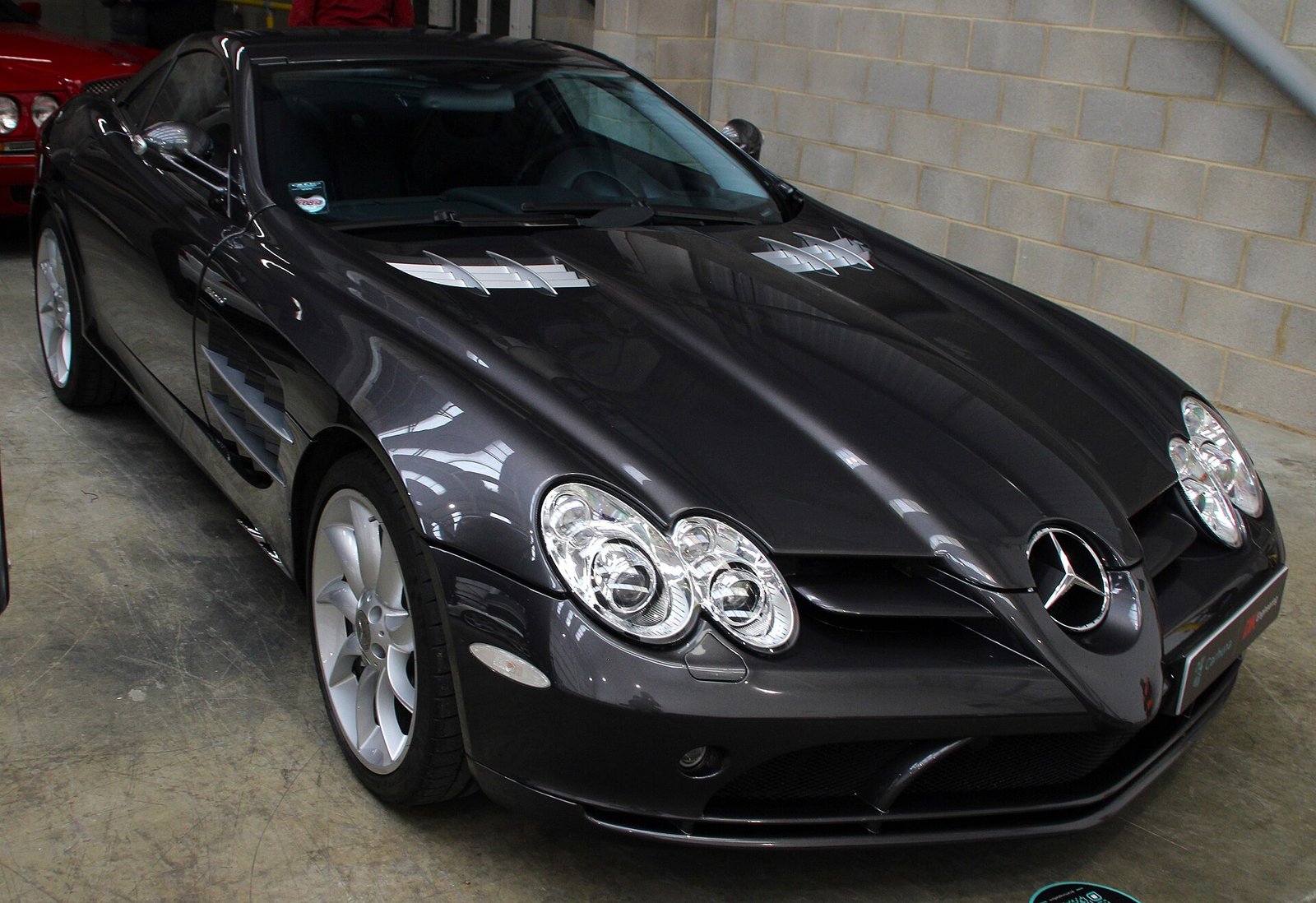
There was even a racing version. The 722 GT, prepared with the British specialist Ray Mallock, was a track-only car for a one-make series, with more power, less weight and a fixed rear wing, built in a small run of around twenty. It was the closest the SLR ever got to the race car with plates that McLaren had wanted from the start.
Values have risen steadily, and the market today runs from about $250,000 to well over $800,000 for the special editions. McLaren Special Operations offered upgrade programs for existing cars. The SLR also turned up in an unexpected place: a metal 3D printing project for restoring classic cars, because parts for a car built in such small numbers by two companies that stopped speaking to each other are not something you buy off the shelf.
There’s another detail from the development stage that gets repeated a lot. Mercedes is said to have run early mechanical mules under bodies borrowed from a TVR Cerbera, a British cult car disguising a German-British supercar. We haven’t been able to confirm it with a primary source, but it’s a good story, and it fits the spirit of the project.
What was lost
The SLR is a reminder of something the industry doesn’t do much any more. Today, joint ventures between brands tend to produce shared SUVs and generic platforms. In 2003, one produced a carbon-fiber GT with side exhausts, a pop-up air brake and a 2-meter hood, built by a Formula 1 team for a company that wanted a Mercedes. The two partners couldn’t agree on what they were making, and the car that resulted carries both sides of that argument.
SLR stood for Sport Leicht Rennsport: sporting, light, racing. Only the first and last were ever quite true.
Mercedes-Benz SLR McLaren FAQ
How much did the Mercedes SLR McLaren cost?
About $455,000 in the US when it reached customers late in 2003, more than double the original target of around $200,000.
Who built the Mercedes SLR McLaren?
McLaren, in Woking, England, under a partnership with Mercedes-Benz, which then held a 40 percent stake in McLaren. Gordon Murray led the technical side.
What was the inspiration for the SLR McLaren?
The 1955 Mercedes 300 SLR, especially the two Uhlenhaut Coupés. One of them sold privately in May 2022 for 135 million euros, the most expensive car ever sold.
How many versions of the SLR McLaren were there?
Five, each wilder than the last, from the original coupé to the roofless, windscreen-less SLR Stirling Moss of 2009.
Check you’re still alive.
Photos: Mercedes-Benz SLR McLaren, MrWalkr (CC BY-SA 4.0); 300 SLR Uhlenhaut Coupé, Guywelch2000 (CC BY 4.0). Via Wikimedia Commons.