Metal 3D Printing: How a Spanish Multinational Became the Turning Point for Classic Car Restoration
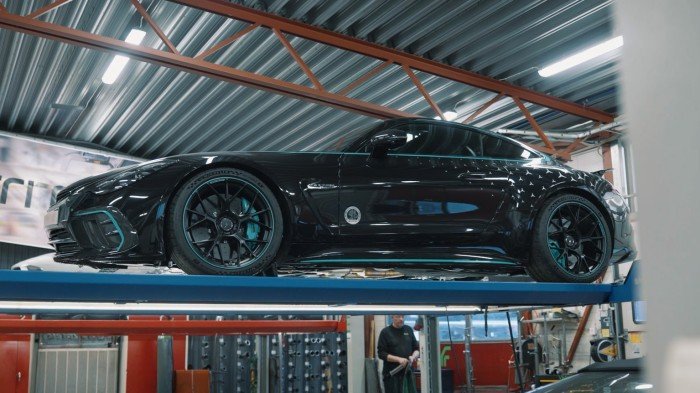
There’s a factory on an industrial estate in Linares, a mid-sized city in southern Spain nobody outside the country has ever heard of, that ships more than 95% of what it builds to over sixty countries. Almost no one in Spain knows its name. Sweden knew it well enough that a shop in Köping, a small town that’s been building exhaust systems since 1991, bought the machine before it had a single job that needed it. The job came later, and it came with the keys to a 2003 Mercedes-Benz SLR McLaren.
The factory is Meltio. The shop is Ferrita Sweden AB. The distance between them, roughly 1,740 miles as the crow flies, is a decent measure of how far metal additive manufacturing has come in the last decade: far enough that a Spanish company most gearheads have never heard of ends up solving, from the other end of Europe, the problem of a car nobody builds parts for anymore.
The Job Nobody Wanted to Touch by Hand
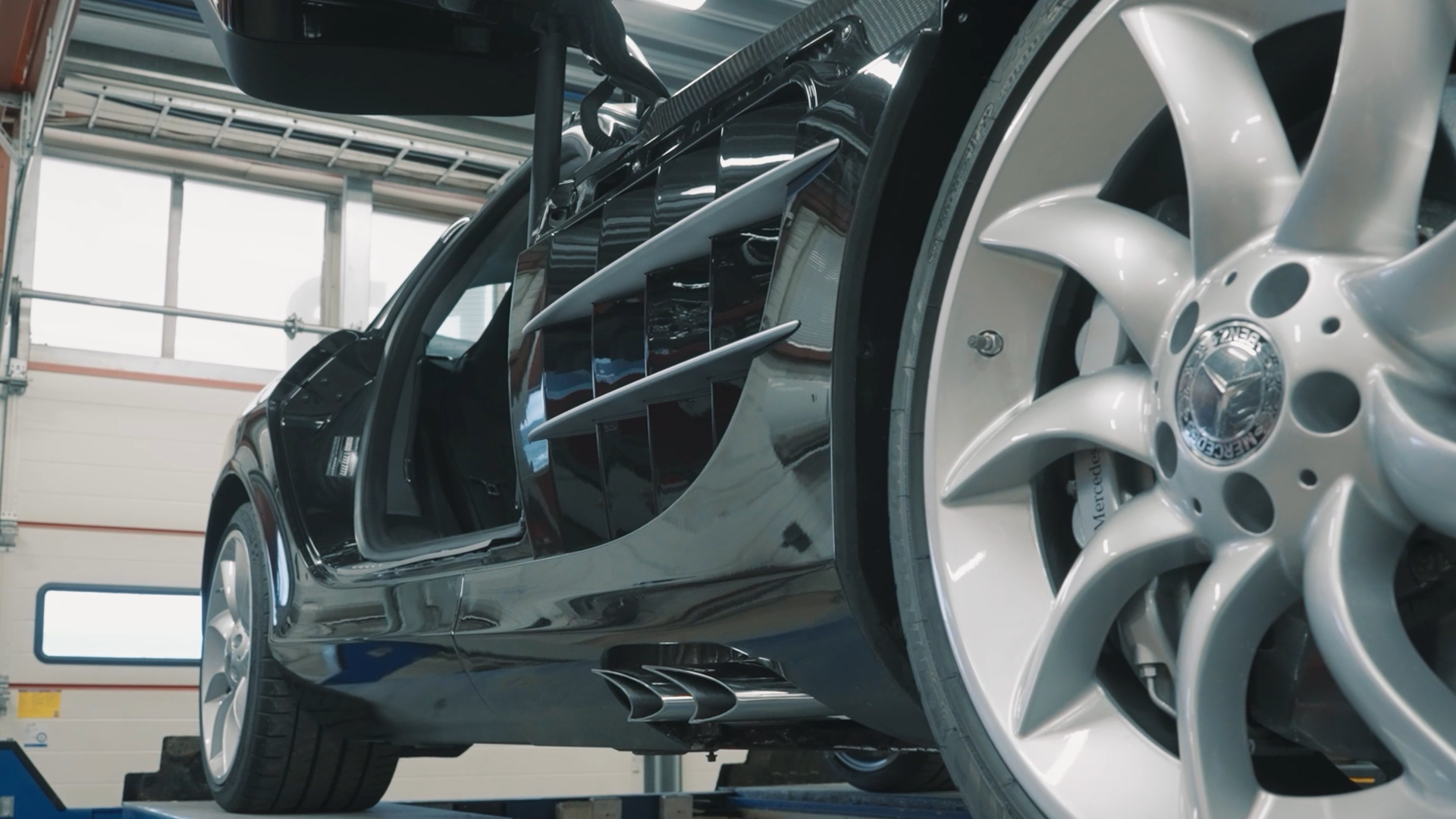
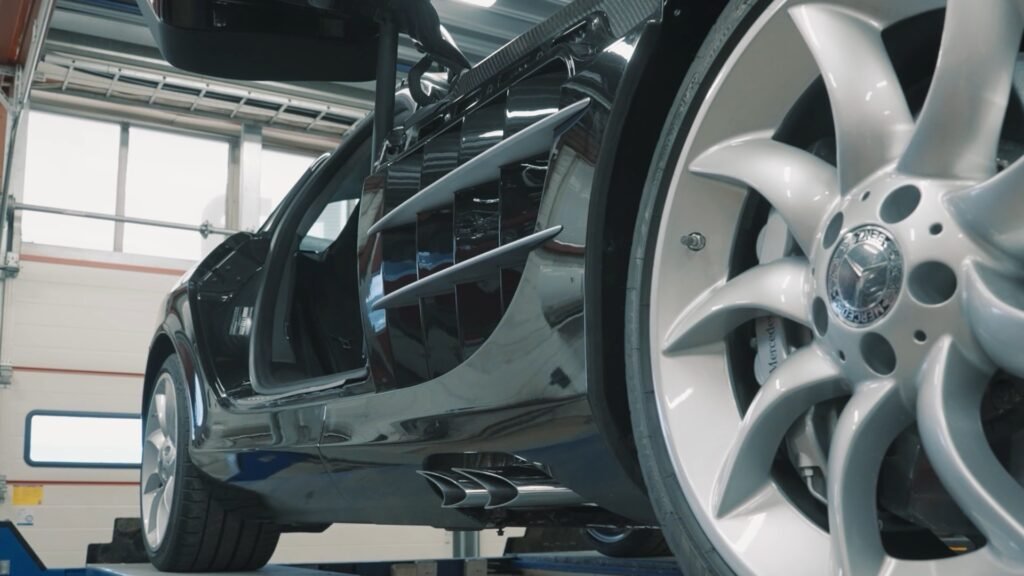
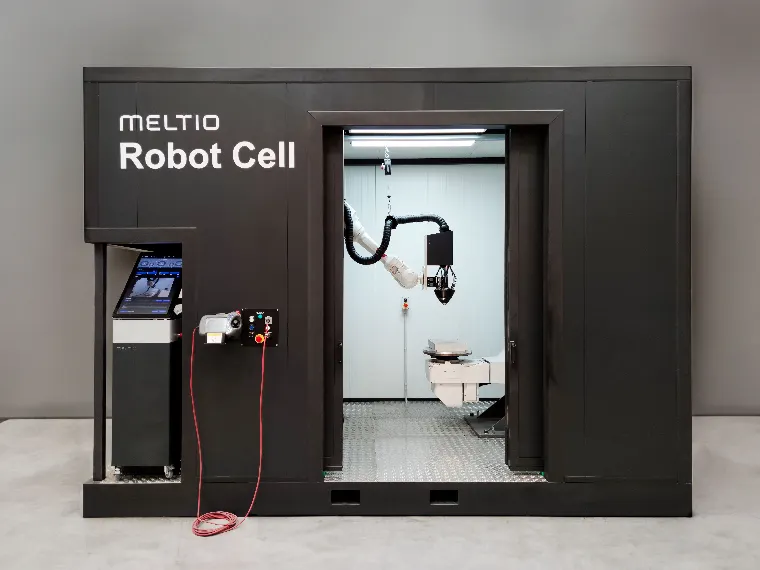
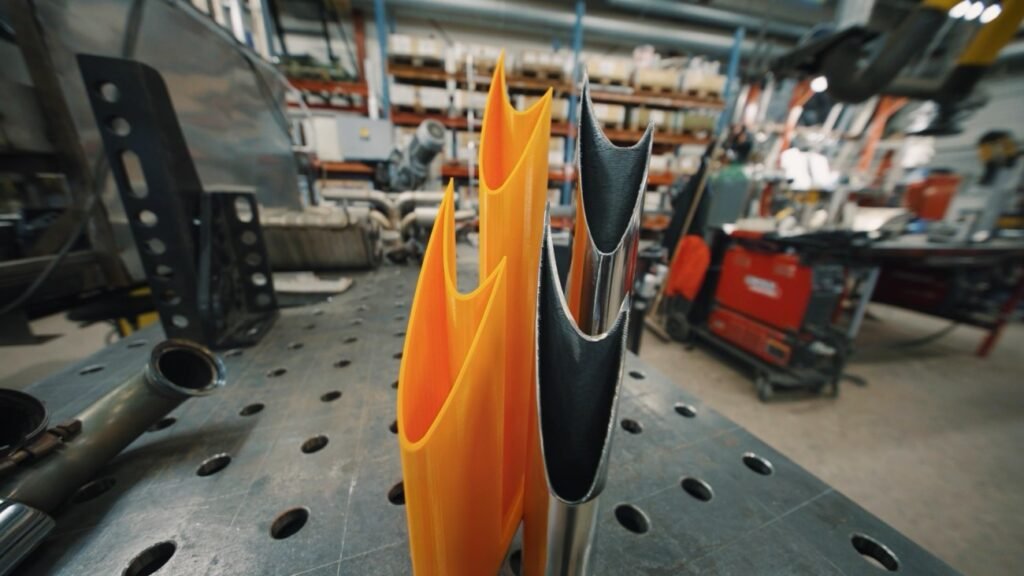
You don’t call just anyone when the exhaust on an SLR McLaren fails. It’s a supercharged V8 with a hand-assembled body, and a replacement part through conventional channels means months of waiting and an invoice that stings. Ferrita Sweden already had a Meltio Robot Cell installed, an ABB robotic arm with Meltio’s metal 3D print head bolted on, when the Mercedes’ owner came looking for someone who could print in metal what nobody wanted to fabricate by hand. There was no corporate partnership behind it, no innovation department deciding to bet on additive manufacturing. There was a customer with a real problem and a shop that already had the right tool sitting on the floor.
Worth clearing something up before going further, because otherwise the headline lies by omission: 3D printing hasn’t just arrived in classic car restoration. It’s been there since roughly 2020, with shops churning out badges, trim pieces, carburetor mounts, and cooling brackets in plastic or composite via SLA, SLS, or FDM. What’s different about the Ferrita case isn’t the concept, it’s the material: a structural part, under constant heat and vibration, made in actual metal. That’s the line that hadn’t been crossed as a matter of routine, and it’s the one starting to move now.
The process, according to Meltio’s press and communications lead, started with scanning the underside of the car to build a digital model, which fed into CAM design software that mapped out the part before sending every parameter to the robotic arm. The print head melts metal welding wire layer by layer through Wire Laser Metal Deposition (Wire-LMD), a variant of directed energy deposition (DED) that never touches metal powder at any stage. That’s not a minor technical footnote: it means zero waste from unmelted material, unlike the leftover powder that has to be managed and recycled in powder bed fusion, and it means no risk of the operator inhaling metal particulate. It’s welding, programmed layer by layer. Meltio’s press lead summed up how the robotic cell that made this part actually works: “Meltio’s industrial metal 3D printing solutions let any industry, automotive included, manufacture and repair metal parts while cutting costs and build times. They install directly on the production line and run twenty-four hours a day, seven days a week.”
The final part was built in 316 stainless steel, in four to five hours, at roughly a 50% savings over conventional manufacturing. The new system also replaced the original muffler and shaved about 44 pounds off the total assembly. On the acoustics, let’s be straight, because there’s no room for romance here: there wasn’t any. Meltio confirms the design brief was strictly about fluid dynamics, not exhaust note. If you were hoping for a story about tuning the sound of that V8 down to the millimeter, this isn’t that story. It’s a story about solving a manufacturing problem with a tool that, eight years ago, didn’t exist in a commercial form a shop this size could afford.
The material choice wasn’t arbitrary either. Meltio’s datasheet for 316LSi (version 9, revised July 2026) documents low carbon content that reduces the risk of intergranular corrosion, exactly the kind of failure an exhaust exposed to constant thermal cycling is prone to. Fatigue resistance on the printed material, with no post-print heat treatment, holds up to 220 MPa of stress range at five million cycles. Tensile strength on the printed part, 643 MPa on one axis and 655 on another, beats the forged steel reference under ASTM A351, which tops out at 550 MPa. Porosity measured by CT scan sits below 0.25% by volume, meeting the NASA-STD-6030 standard for additive manufacturing in flight-critical aerospace applications. A street exhaust demands a lot less than that.
What This Isn’t: Neither First, Nor Only
Worth placing the Ferrita case where it actually belongs, because metal additive manufacturing in the automotive world didn’t start in Linares. Bugatti built what was then the largest functional titanium part ever 3D printed for the auto industry back in 2018: an eight-piston brake caliper for the Chiron, 2,213 layers, 45 hours of print time, developed with the Laser Zentrum Nord in Hamburg. That caliper came out of powder bed fusion, not wire deposition, and needed heat treatment plus five-axis machining afterward. Porsche builds the pistons for the 911 GT2 RS with that same powder-based family of tech, alongside Mahle and Trumpf, taking advantage of the fact that powder fusion can create a closed internal cooling channel in the piston crown, something no conventional machining process can touch.
That distinction matters because Meltio’s Wire-LMD sits on a different branch of the additive manufacturing tree: wire deposition, of which WAAM (wire arc additive manufacturing) is the oldest variant, with patents dating back to 1925 and serious academic work at Cranfield University since the 1990s, including a shaped metal deposition project for Rolls-Royce between 1994 and 2001. BMW has already invested in a WAAM machine at its additive manufacturing campus in Munich, aimed specifically at engine components and exhaust systems. Wire deposits faster than powder and with no waste, but with coarser resolution: tolerances of roughly ±0.012 to ±0.02 inches and surface finishes of 50 to 100 microns Ra, compared to the fine detail powder can achieve on complex internal geometry. That’s why a piston cooling channel is powder’s territory, and a generously sized exhaust tube is wire’s.
Meltio’s own materials datasheet spells this out with a clarity worth appreciating: steel, nickel, and titanium sit at the top of its internal technology readiness classification (TRL 7 to 9, validated in real industrial settings), while aluminum and copper remain at TRL 3-4, still experimental. If anyone tells you cylinder heads or engine blocks in aluminum are already being series-produced with this tech, ask them to show the data, because the company that makes the equipment doesn’t back that claim yet. What does exist, documented with real figures from Meltio, is hybrid manufacturing (additive plus machining) of structural steel parts for racing: a stub axle for a hillclimb race car prototype, developed with Hirudi, a Meltio commercial partner, in ER70S6 steel. Result: 62.5% less weight than traditional machining, 35.7% lower cost, 33% faster delivery. That case, not the SLR, is the one that best shows where this is actually headed for moving parts in real competition use.

The Spanish Industry Growing By Exporting What Nobody Sees
Here’s the real point of this piece. Meltio was founded in 2019 in Linares, a city that watched Santana Motor shut its doors in 2011 after decades building off-roaders (worth mentioning only to place the city on the map, not as part of this story: there’s no documented connection between the two companies, and we’re not going to invent one). What does exist is a company launched with capital from its own parent, Grupo Sicnova, without leaning on a traditional venture capital round, that in just a few years has grown into a Spanish multinational: today it exports more than 95% of its output, with over 600 systems installed across more than 45 countries and revenue that jumped from €13 million to €19 million in its last published fiscal year, a 50% increase. Since early 2025, day-to-day operations have been run by José Luis Sánchez Román, whose stated priority for 2026 isn’t proving what’s technically possible with this technology, it’s proving what runs reliably in real production. The Ferrita case, modest as it is on a revenue scale, fits exactly into that phase: not a trade-show client, not a lab proof of concept, but a Swedish shop building a real part for a real car, with a machine that shipped out of Linares and that Ferrita already owned and had installed before the job ever came in.
That’s the number that actually matters for high-end automotive and restoration: metal additive manufacturing has spent a decade being the playground of giants — Bugatti, Porsche, BMW, all running in-house R&D departments and budgets no independent shop will ever see. What Meltio has pulled off, headquartered in a Spanish city that doesn’t show up on anyone’s innovation map, is bringing that same technology down to the scale of a twelve-person shop in a Swedish town. That’s the real revolution, and it has nothing to do with the sound of an exhaust pipe.
The Thermometer Isn’t Just in the Automotive Sector
If the Ferrita case were an isolated one, it would just be a footnote. It isn’t, and the rest of the validations Meltio has racked up over the past two years serve as a useful yardstick for how far metal additive manufacturing has moved past the demo phase and into real production. In 2025, the technology earned a second validation from the US Navy and its first validation from the South Korean Marine Corps, which for the first time integrated metal additive manufacturing to produce spare parts on demand. That same year, Meltio signed a deal with Advanced Engineering Consulting (AEC) as a commercial partner and industrial integrator in the United States, a market that already accounts for roughly 40% of the company’s global activity, and on October 14, 2025, Meltio opened its first international reference center in Danville, Virginia, in partnership with local firm Fastech, as a showcase for defense, marine, and oil & gas clients across North America. The company itself now describes itself as a Spanish multinational: alongside the Linares plant, it maintains its own offices in the United States, India, and Italy, with a commercial footprint in about 40 countries. In parallel, Meltio is working with GDELS-Santa Bárbara Sistemas and fellow Jaén company Novaindef on an Advanced Manufacturing Center of Excellence focused on defense, with a stated goal of improving the operational response capacity of in-service military vehicles by up to 50% through on-demand part manufacturing and repair.
None of that has anything to do with cars, but all of it points to the same pattern: a technology that five years ago was a trade-show curiosity is now installed on warships, in defense plants, and in Swedish exhaust shops, running the same print head, the same process, the same Spanish company behind all of it. The 2023 National SME of the Year Award, presented at a ceremony chaired by King Felipe VI, and the Best Industrial Metal 3D Printer award for the M600 at the 2024 3D Printing Industry Awards aren’t the headline of this story, but they’re proof the recognition hasn’t stayed in Linares.
Where This Leaves Things
Metal 3D printing isn’t replacing machining or forging tomorrow. It’s going to keep carving out the space neither one handles well: the one-off part, the one nobody makes anymore, the one that needs complex geometry and a run of exactly one unit. The Ferrita case isn’t the revolution by itself. It’s proof that the revolution, made in Jaén, is already something you can buy, install in a normal-sized shop, and run without needing a German manufacturer’s R&D department behind you. In an industry used to real innovation only trickling down from the brands’ own labs, that’s already a lot. The question left hanging is how long it’ll take corner shops, the ones patching up classics on Saturday afternoons, to have one of these machines parked next to the lathe, building custom exhausts for whatever a gearhead with a one-of-a-kind car dreams up next.
Check you’re still alive.