Tramontana: the Spanish supercar built by the man who turned down Star Wars
A designer once got the kind of offer most people would frame on a wall: come to the United States and design for the Star Wars movies. He said no. He didn’t want to build spaceships for the screen. He wanted to build real machines, with real engines, that touched real asphalt. His name was Josep Rubau, he was from Girona, and instead of Hollywood he went home to a windswept farmhouse in northeastern Spain and built one of the strangest supercars on earth.
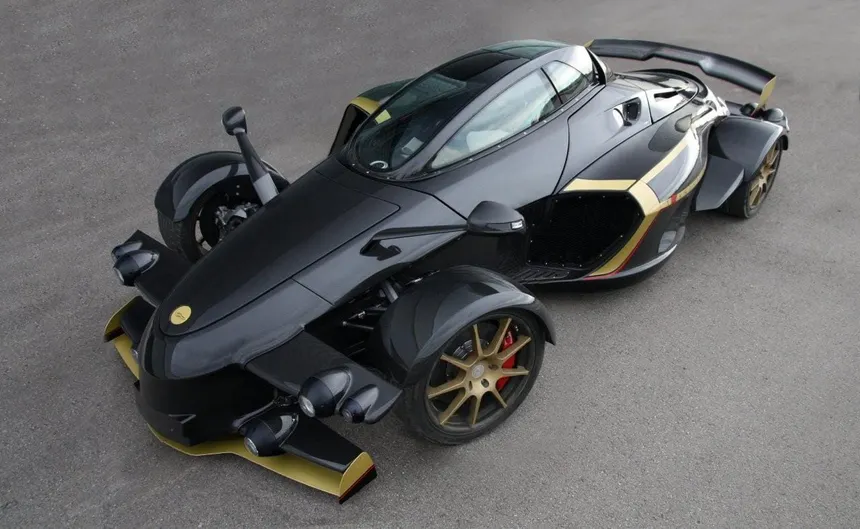
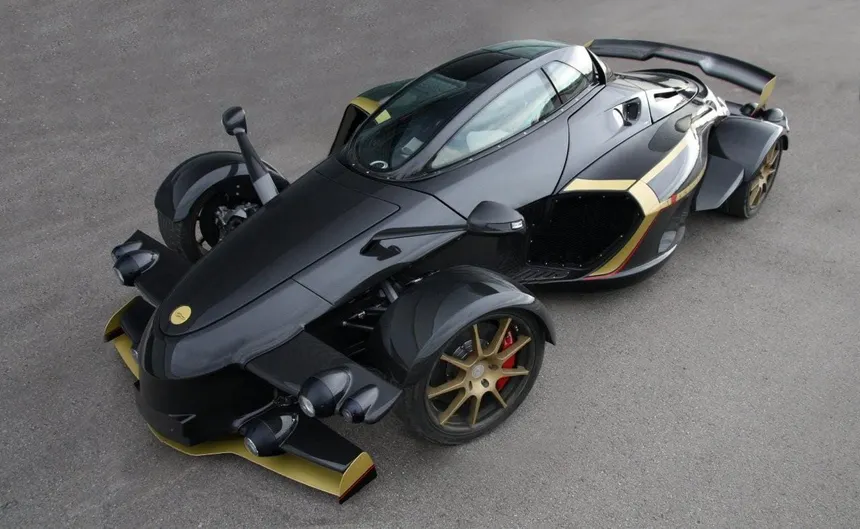
The Tramontana looks like nothing else. Half Formula 1 car, half fighter jet, with driver and passenger seated in a row under a jet canopy, hand-built in the Catalan countryside at a rate of about twelve cars a year. A 720-to-888-horsepower Spanish monster made in a village of under a thousand people. And behind it, a man who chose the road over the galaxy.
The man who said no to a galaxy
Rubau isn’t a rich hobbyist who started a car brand on a whim. He’s a serious designer. He trained in Barcelona, then went to London, to the Royal College of Art — the school that has produced many of the world’s great automotive stylists. His graduation project was a concept motorcycle called the Miura, inspired by the shape of a bull, an award-winner exhibited across Europe and requested by London’s Design Museum. No relation to the Lamborghini of the same name, but just as fierce, and just as Spanish in spirit: a bull turned into a machine.
That talent opened enormous doors. Volkswagen hired him for its advanced design studio in Germany, where he penned, among other things, the New Beetle Dune 4×4 that toured the Los Angeles, Detroit, Geneva and Paris shows. And among the offers that rained down on him was one most people would never refuse: designing for the Star Wars films in America. Rubau turned it down. He wanted to make cars — real cars, not fictional ships for the cinema. Hold onto that, because it tells you everything about the man: someone capable of turning down Hollywood and the entire galaxy because his thing was metal, engines and tarmac.
A complaint that became a mission
The origin of the Tramontana is so specific it sounds made up. In 1996, a British car collector remarked to Rubau that it was a shame cars were no longer made the way they used to be — with real craftsmanship, by hand, piece by piece. A dinner-table line that would have gone in one ear and out the other for anyone else. It lodged in Rubau. He took it as a commission, though nobody had commissioned it, and gave it the next decade of his life.
He didn’t do it alone, and that’s worth saying, because the legend of the lone genius tends to erase the people standing beside him. At Volkswagen’s technical center in Wolfsburg, Rubau met Xavi López, a surface-development expert with credits at VW, BMW and Lamborghini. The two shared the same obsession, and López became a key figure in the project. And there was one decision that says a lot about the kind of people who built this: they chose to set up on the Costa Brava, in a rural corner of the Empordà, partly to bring work to the local industry, which was dying as offshoring shipped factories to other countries. They didn’t put the workshop where it was cheap. They put it where it was needed.
A land-bound jet
When the Tramontana debuted as a concept at the 2005 Geneva Motor Show, it didn’t go unnoticed for a second. But the version that truly matters arrived in 2009: the Tramontana R, the closed model, and with it the move nobody else had the nerve to bring to a road car.
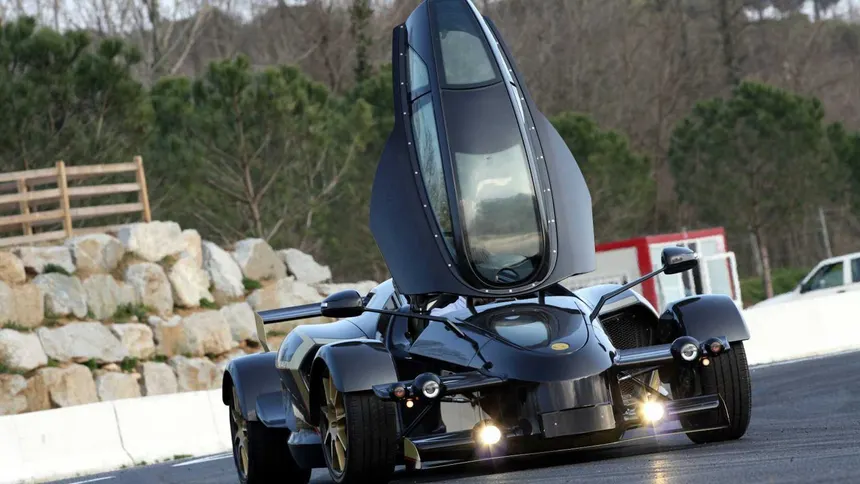
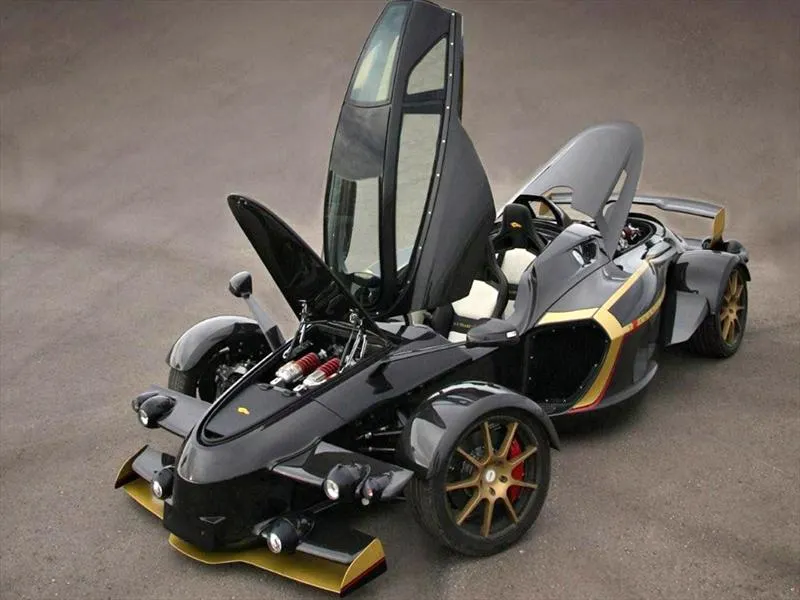
The R seated its two occupants in tandem, one behind the other, on the car’s centerline, under a glass canopy that swung upward like a fighter cockpit. Not two seats side by side, as in every other car on the planet since the automobile was invented, but single file, like a combat aircraft. You climbed in from above. You sat high, over the nose. And you fired up something that, according to those who’ve driven it, feels like riding a hot, dry motorcycle at 190 mph. Someone wrote that the Tramontana made about as much visual sense as a Salvador Dalí painting. It wasn’t an insult. It was the Empordà’s other strange genius recognizing his own kind.
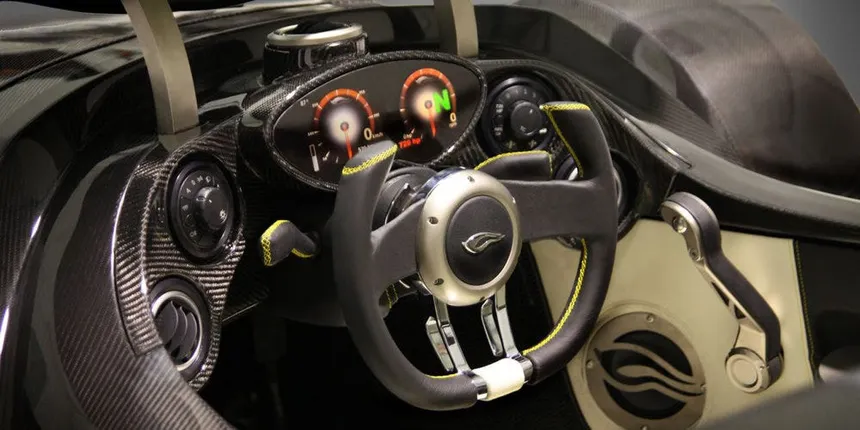
Beneath that Martian bodywork was real engineering, not just theater. A carbon-fiber monocoque, with the engine bolted in as a load-bearing structural member, exactly as in a Formula 1 car, rather than simply resting on mounts. Suspension with a hydraulic lift system to clear speed bumps, that eternal enemy of low cars. In the center, a 5.5-liter twin-turbo Mercedes-AMG V12, making 720 horsepower and 1,100 Nm of torque in the R, shoving barely 1,268 kilograms. Zero to 100 km/h in 3.6 seconds. And a top speed sources place between 325 and 344 km/h, depending on the version and who’s measuring. The Tramontana R was also the first small production series to gain European road-legal homologation with that dressed-single-seater architecture. A track car with a license plate.
From 720 to 925: the storm escalates
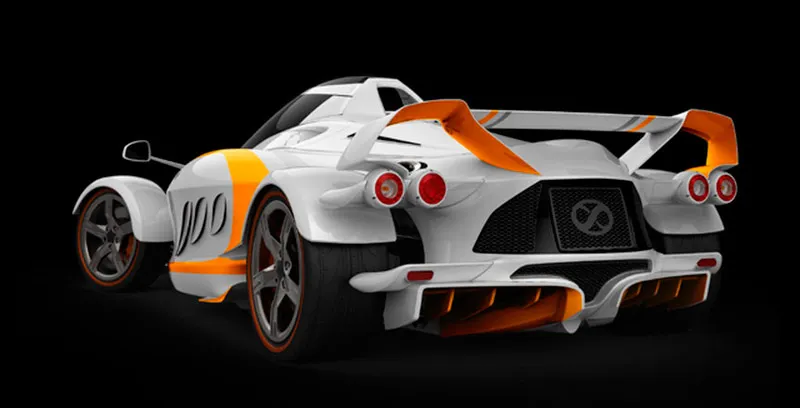
And it wasn’t enough for Rubau. In 2012 came the Tramontana XTR, and here things got genuinely serious. New pistons, new camshaft, new engine management, a reinforced competition gearbox, more radical aerodynamics. The number: 888 horsepower. A hundred and sixty-eight more than the R. A leap that put this hand-built car, born in a Girona farmhouse, on the level of the most powerful supercars on the planet at that moment. It cost around half a million euros and weighed roughly 1,300 kilograms.
And it still didn’t stop there. In 2015 came an evolution pushing output to 925 horsepower, using materials as cutting-edge as graphene, topping 370 km/h, in a strictly limited run of 99 units. From 720 to 925 horsepower in six years. A manufacturer building twelve cars a year, escalating power as if it had Stuttgart’s R&D behind it. It didn’t. It had Rubau, López and a handful of Catalan craftsmen.
The customers were what you’d expect: men between 35 and 70, collectors and enthusiasts from Europe, Asia and Africa, willing to pay between €680,000 and a million for a car of which no two were alike — not even the same color, because Rubau refused to repeat a body shade. The only woman in the order book, the story goes, was a German who had inherited her father’s car collection. The first delivery took place on September 28, 2007, eleven years after that line at a lunch.
Picking up Pegaso’s baton, and the neighbor with 888 horsepower
To grasp what Rubau really did, you have to look at the gap he filled. Spain had once, long ago, been a power in extraordinary cars. Hispano-Suiza built some of the most luxurious and advanced automobiles in the world before the war. Pegaso, out of a state-owned truck factory, conjured up sports cars in the 1950s capable of looking Ferrari in the eye, through the sheer stubbornness of its engineers. And then, half a century of silence. Spain vanished from the supercar map as if it had never been there.
Rubau was one of those who broke that silence. And he wasn’t alone in the effort, which makes the story even better. At almost the same time the Tramontana was growing in Girona, another Spanish supercar was being cooked up in secret in Valencia: the GTA Spano, from Spania GTA, unveiled in 2012 with output that also hovered around 888 horsepower, and openly described as reclaiming the forgotten baton of Hispano-Suiza and Pegaso. Two cars. Two regions. Almost the same impossible horsepower figure. Born at the same time, without coordinating, from the same stubborn urge to prove that we could do this here too. It wasn’t an isolated manufacturer having a delusion. It was an entire country remembering, all at once, that it once knew how to do this.
What vanished, what shrank, and what was reborn
Careful with the easy ending, the “another brave Spaniard eaten alive by Ferrari” one. Because that’s not quite what happened.
It’s true the Tramontana never reached the volume or the global fame of the legendary marques. Convincing the buying elite to put their money into a new, strange, Spanish brand instead of the established prestige of a prancing horse was a near-impossible mountain, and Rubau climbed it as far as one man can climb alone. The brand stayed a cult object, respected by those who know, discreet to everyone else. That specific dream — seating Spain at the big table of series-production supercars — was left half-finished.
But the man didn’t stop, and that’s the difference from almost every similar story. Rubau reinvented himself with Red Shark Bikes, water bicycles now sold in more than 72 countries, on which he crossed the frozen waters of Antarctica under pedal power, setting a world record. And in 2025 he returned to where he began: he launched Rubau Cars, a new hypercar under his own surname, this time with his children beside him — Iu as engineer, Júlia in strategy. A car that, in his own words, doesn’t chase Nürburgring times or count USB ports, but the heartbeat of the person at the wheel.
So the disappearance here is a mirage. The Tramontana as a series stayed small, yes. But the impulse that created it didn’t die: it went to the water, crossed Antarctica, and returned to the road with the creator’s surname on the hood and the next generation pushing. Few Spanish automotive dreams get to tell a third act.
A country that remembered it knew how
Rubau is driven by an idea that runs against almost everything the industry does today. In a world where supercars look more and more alike, obsessed with the same figures and the same lap times, he hand-built a car nobody would ever mistake for another, and did it in a village, to feed the industry of his own county, under the name of the wind that raised him. That’s not a business plan. It’s a statement of identity on wheels.
And it cost him. Building the best possible car isn’t enough to win when you’re not called Ferrari, and Rubau learned it the hard way: 888 horsepower doesn’t buy the legend a century of history hands you. Prestige weighs more than torque when someone signs a million-euro check. It’s unfair and it’s true. But look at what remains: a country that had gone half a century without building supercars started building them again, almost simultaneously, in Girona and in Valencia, because a handful of stubborn people refused to accept that this was a job only for Italians and Germans. Rubau was one of those stubborn people. And stubborn people, even when they don’t sell thousands, change what a country believes it can do.
Ask yourself something next time someone claims Spain only knows bulls and paella: in a farmhouse swept by the north wind, a man who turned down Hollywood has spent twenty years hand-building thousand-horsepower land-jets with his family’s name on the body. He didn’t get rich like the Italians. But he dug up an idea this country had buried: that here, too, we know how to build machines that steal your breath. And that idea, once unearthed, doesn’t die again.
Check you’re still alive.