The Ferrari Luce Debate: Three Stories Nobody Has Told Together
There is a particular kind of silence that falls over a room full of car people when something genuinely divides them. Not the easy noise of “it’s ugly” or “it’s brilliant,” but the harder, quieter business of not actually knowing what you think. The Ferrari Luce has produced exactly that silence. And the reason is that everyone has been served this car in pieces.
One outlet hands you the design firestorm. Another hands you Montezemolo’s verdict. A third runs the spec sheet. Each story sits in its own corner, as if the styling, the engineering and the boardroom civil war had nothing to do with one another. They have everything to do with one another. Stack the three and you finally get the whole argument. That is what we are doing here, and as far as I can tell, nobody else has bothered.
When the markets reviewed a paint job
Start with the part that stings.
Ferrari unveiled the Luce in Rome with all the institutional theatre Maranello does so well. The morning after, the share price fell off a cliff. Down as much as 8.4% in Milan, off 5.1% in New York. Anthony Dick at Oddo BHF put it in words that lodge in your head: by some distance, the strongest reaction they had ever seen to the design of a car. Not to a profit warning. Not to a scandal. To how a car looks.
Sit with that. The market put a number on aesthetic disappointment, and the number ran to billions in a single session. Jeremy Clarkson built an entire career on the idea that a car is an emotional object before it is a rational one. Here is the stock market, the least sentimental institution on earth, agreeing with him in the bluntest possible terms.
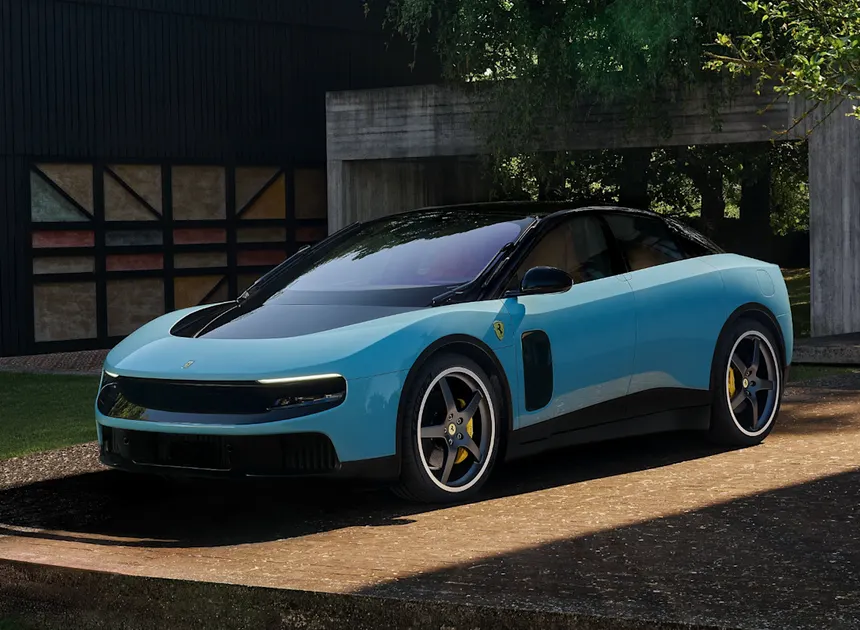
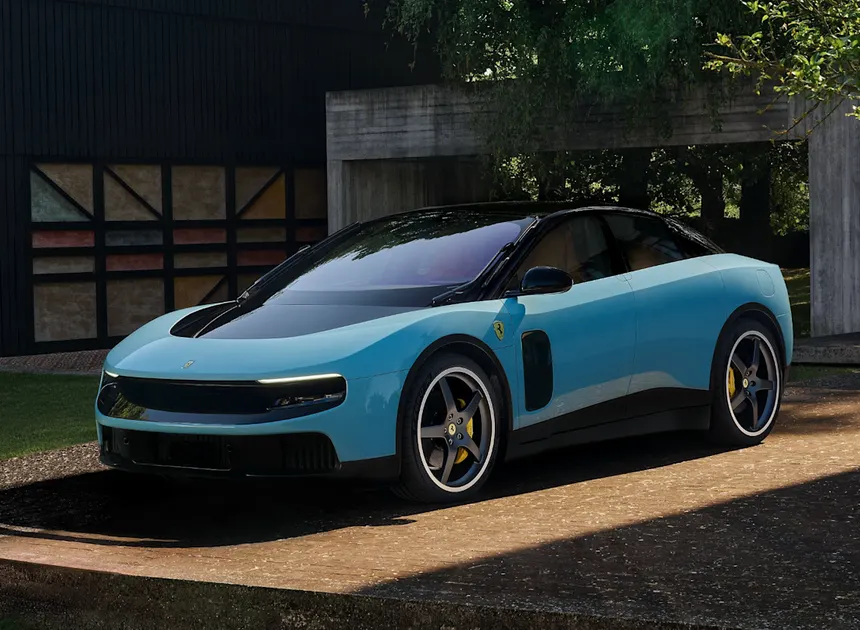
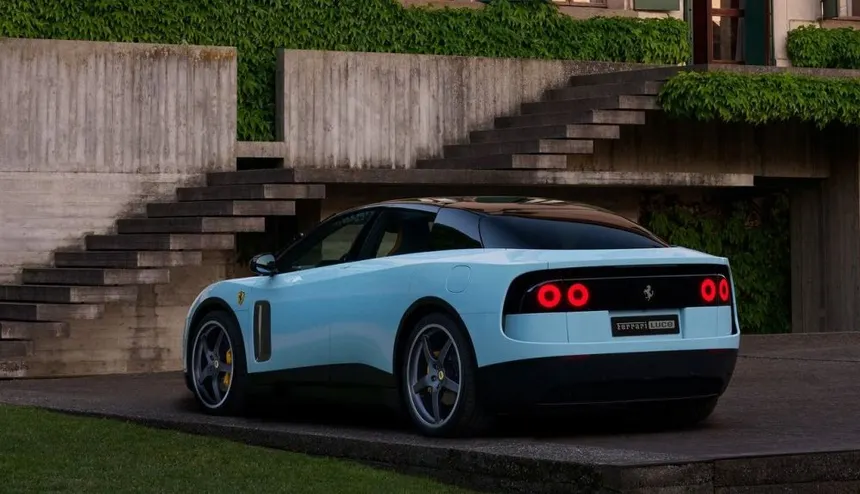
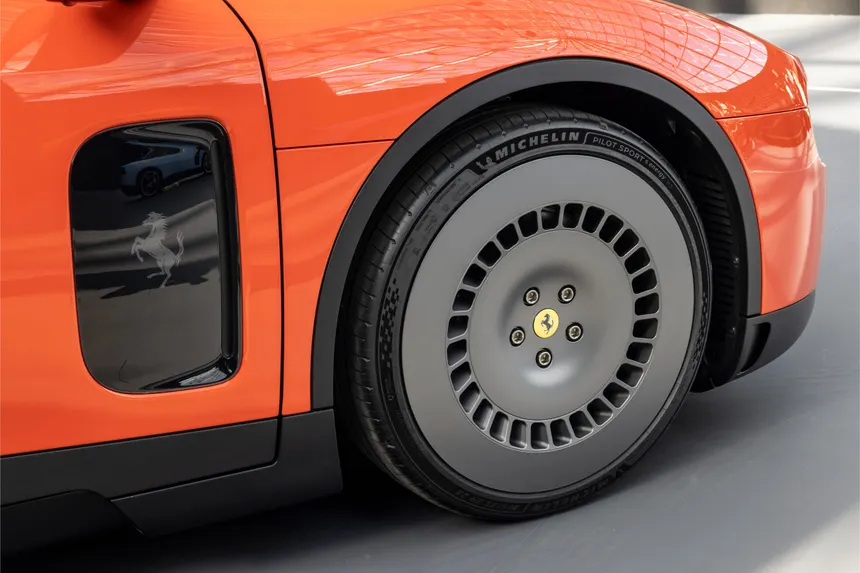
So what is on the body? A near-five-metre saloon. Four doors, five real seats, north of two tonnes. Minimalist surfacing, a great deal of glass, and a pale blue that the internet immediately filed alongside Tesla, Lucid and, most wounding of all, the Chinese luxury saloons Ferrari is supposed to be fighting in Asia. The cruellest post going around called it less a supercar than a budget Nissan.
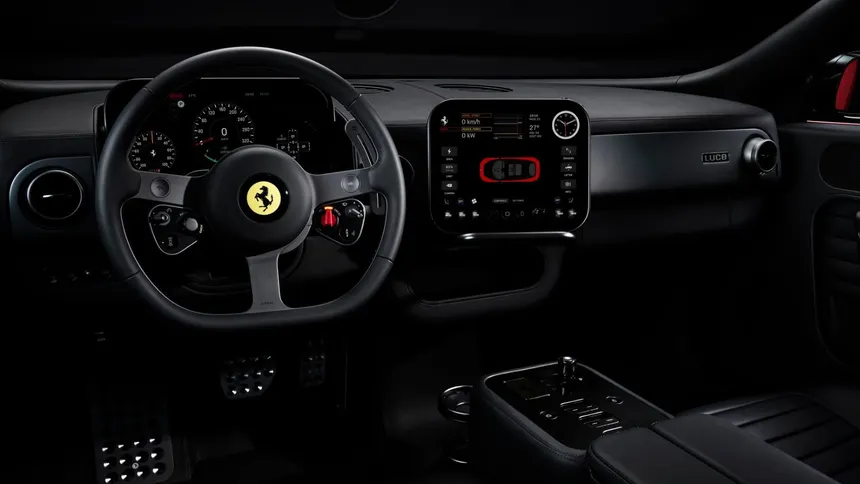
The detail almost nobody flags is the one that matters most. The interior is the work of LoveFrom, Jony Ive’s studio. And the cabin, with its genuine physical buttons, its glass gear selector and brushed steel, mostly went down well. It was the sheet metal outside that drew blood. Read that carefully: the Luce’s problem is not that it feels like an Apple product inside. It is that it does not feel like a Ferrari outside.
The half of the story that lives under the skin
Now turn away from the photo, because if the photo is all you have, you are no better than the comments section.
Get underneath it. There are four permanent-magnet synchronous motors here, one per wheel, derived from the F80 hypercar. Halbach-array layout, lifted straight from Formula 1. The fronts spin to 30,000 rpm. Over a thousand horsepower, 0-62 mph in 2.5 seconds, and a drag coefficient of 0.254 that, for a car this size, belongs in a different decade.
But forget the headline numbers. Any high-end Chinese EV will hand you something similar today for a tenth of the money. Raw figures no longer separate anyone. What separates the Luce, the part that is actually Maranello engineering rather than catalogue shopping, comes down to three things almost nobody has explained.
First, the wheel control. Each corner gets its own actuators for traction, regeneration, steering angle and vertical movement, with a control unit coordinating chassis and powertrain together and updating its targets two hundred times a second. This is not the software torque-split that every crossover now advertises. This is genuine corner-by-corner control at a resolution no mechanical limited-slip diff can touch. The thing rotates, settles and fires out of a corner with a precision an old-school plate diff cannot dream of.
Second, and this is the most Ferrari idea on the whole car, the paddles do not change gear, because there are no gears. They do something else, and it is patented. The right one raises available torque while preserving the sense of progressive acceleration; the left raises regeneration and the sense of braking. It is an almost stubborn attempt to give your hands a job again. To keep the driver in charge when there is no clutch, no gearbox, nothing mechanical left to operate.
Third, the one that gets me. Sound. Most EVs pipe a synthesised drone through the speakers, an MP3 of an engine to fool you. The Luce does not. A precision accelerometer on the axle reads the real vibrations of the drivetrain, and an in-house, patented system filters, equalises and amplifies them in real time. It is not a fake noise. It is the car’s own mechanical reality, turned up. Chris Harris has spent years arguing that the noise is half the point of a performance car; this is Ferrari quietly agreeing and then engineering a way to keep it without a combustion engine.
There is a wider point hiding in all of this, and it is worth saying plainly. The 800-volt architecture, the figure people keep waving around as proof of how advanced the car is, separates Ferrari from precisely nobody. NIO has been running a 900-volt system since 2023, and BYD already sells the world’s first mass-produced 1000-volt platform on cars that cost a fraction of this one. China put more than seventy 800-volt models on the road by the middle of last year, some of them genuinely affordable. So when you hear that the Luce runs 800 volts, understand what that actually means: it means the voltage is not the story. The voltage is table stakes. The story is the three things above, the parts you cannot buy off a shelf, the parts that took Ferrari’s own engineers to invent.
More than sixty new patents in the project, and they are not vapour. There is Litz wire inherited from Formula 1, a 48-volt active suspension that draws straight from the high-voltage pack with no separate 12-volt or 48-volt battery, the largest single-piece hollow casting Maranello has ever produced, and the first elastically-mounted rear subframe in the company’s seventy-nine-year history. None of that makes a headline, but all of it tells you how far down into the detail these engineers went.
The battery deserves a word too. It is 122 kWh, a big number for a big, heavy car, but the cleverness is that it does not hang there as dead weight. It is structural, part of the chassis, and it lifts bending stiffness by more than 25% and torsional stiffness by 35% over the brand’s earlier four-door models. That drops the centre of gravity and gives the car something solid to work against. Claimed range tops 530 km, which for a two-tonne-plus thousand-horsepower machine is sensible rather than spectacular, neither embarrassing nor worth bragging about.
This is not a car built in a hurry. It is the precise opposite: Ferrari emptying its toolbox to prove an electric one of theirs can move you almost like a combustion car. And the deeper you go, the clearer the intent becomes: every one of these solutions exists to answer a single accusation, the one every petrolhead throws at every EV, that the thing has no soul. Ferrari did not shrug at that accusation. It went to war with it, patent by patent.
Almost. Hold that word. It comes back.
The war at home
Here is the third layer, the one that turns a car launch into something bigger. Because the real fight is not on social media. It is inside Maranello.
In one corner, Luca Cordero di Montezemolo. President of Ferrari from 1991 to 2014. The architect of the golden run, the Schumacher years, the most emotional and hand-built version of the brand many people carry around in their heads. Not an angry man on the internet. The man who built a large slice of the modern myth. At the Confindustria assembly he tried to hold his tongue and failed: if he said what he really thought, he said, he would damage Ferrari, that there was a risk of destroying a legend, and that they should at least take the prancing horse off the thing. Then he landed the finest blade of the year, noting that this, at least, is a car the Chinese will not copy.
When the man who raised the legend asks you to peel the badge off the new one, that is not a review. It is a sentence.
Across from him, John Elkann. The current chairman, the man who has staked the brand’s face on this project. His defence runs the other way and it is not foolish: Ferrari has to read tomorrow with nerve, do what has not been done, and the Luce will reach people who would never otherwise have considered the marque. At the launch itself, half the guests were new to Ferrari. That is his case, and it holds water.
Two definitions of what Ferrari is, colliding head-on. One says Ferrari sells emotion and scarcity. The other says Ferrari has to survive the future. Neither is entirely wrong, which is exactly why this is a real argument and not a tantrum.
A footnote almost nobody has joined up: while the press was busy savaging the Luce, Ferrari used the noise to register ten trademarks for future models. Among them, the return of the Challenge Stradale name for the 296, a cult badge unused since the 360. Read it again. They hold the EV up in front of your face so you stare at it, while quietly locking down the radical combustion jewels that will actually make you salivate. Whether that is strategy or coincidence, it is straight out of the playbook.
And let us bury a rumour while we are here, because it travelled far this week: the idea that you will be forced to buy a Luce to earn access to a future Stradale or Pista. Untrue. CEO Benedetto Vigna killed it himself on the earnings call. The loyalty test that does apply to the limited series does not apply to the Luce. In his own words, you should not force customers to buy something they do not like. If someone tells you otherwise down the pub, you now know better.
So what?
This is where the three layers come together, because apart they say nothing and together they say everything.
The design proves the public wants a Ferrari to look like a Ferrari, and will punish the share price when it does not. The engineering proves Maranello can pour its best minds into making an EV feel, steer and even sound alive. And the civil war proves that Ferrari itself does not have a settled answer to the question we started with.
My reading, after turning it over plenty and with a lifetime of grease under the nails, is this: it all fits. The V12 fits and the EV fits. Montezemolo fits and Elkann fits. The mistake is thinking you have to pick a side. You do not. The Luce is not here to kill the petrol berlinetta; it is here to open another door, which is exactly why the Challenge Stradale gets registered on the same day. Ferrari’s future is not electric or combustion. It is both at once, and anyone who cannot see that is stuck staring at the photo.
But there is one line that sixty patents do not cross. Ferrari has amplified the real vibration of an axle so the car sounds like something. It has made the paddles deliver torque instead of gears. It has made every wheel think for itself two hundred times a second. It has cracked almost everything.
The only thing it has not cracked, the only thing you cannot patent, is the knot in your stomach before you turn the key. And as long as Maranello knows that knot matters more than any figure on a sheet, the colour of the bodywork is a footnote. You do not earn the prancing horse with horsepower. You earn it with the thing you feel before you even move. That, in the end, is the only debate worth having.