
Mercedes-Benz 300 SL Gullwing: the German supercar that exists because a car dealer on Park Avenue asked for it

The most famous postwar Mercedes was not born in a boardroom in Stuttgart. It was born in a showroom in New York. In the early 1950s Max Hoffman, the importer who sold European cars to wealthy Americans, told Daimler-Benz that if it built a road version of its new race car, he could sell it in the United States. Mercedes listened. In February 1954 the 300 SL was unveiled not in Germany but at the International Motor Sports Show in New York, and most of the 1,400 Gullwing coupes built went to American buyers.
It was the fastest production car of its day, the first production car with gasoline direct injection, and it had doors that opened like wings because the chassis left no room for anything else. Seventy years later it is still one of the most valuable and recognizable cars in the world.
A race car to rebuild a reputation
To understand why the 300 SL existed at all, you have to start with Germany after 1945. Mercedes-Benz had been one of the most prestigious carmakers in the world before the war. By the late 1940s its factories had been heavily damaged and its name was tied to the regime it had served. Racing was the fastest way to put the three-pointed star back on the world stage.
Racing manager Alfred Neubauer and engineer Rudolf Uhlenhaut, one of the rare chief engineers who could lap a circuit as fast as his drivers, led the effort. Uhlenhaut was an unusual figure: born in London to a German father and an English mother, he was an engineer who tested his own designs at racing speed, and Mercedes’ drivers often found that the man in the white coat could match their lap times. His feel for how a chassis behaved at the limit shaped every Mercedes sports car of the era. With no budget for an all-new engine, they took the 3.0-liter inline-six from the big 300 sedan, the "Adenauer" Mercedes, and built a lightweight race car around it. The result was the W194, the first 300 SL, which raced in 1952.
It was an immediate success. In its first season the W194 finished first and second at the 24 Hours of Le Mans, won the Carrera Panamericana in Mexico and the sports car race at the Bern Grand Prix. Mercedes was back.

The Mexican win came with one of the great racing anecdotes. During the 1952 Carrera Panamericana, a vulture smashed through the windshield of Karl Kling’s car at speed, hitting his co-driver Hans Klenk. They kept going, and Mercedes fitted vertical steel bars in front of the windshields for the rest of the race. Kling and Klenk won anyway. It was the kind of story that made American newspapers, and it helped plant the 300 SL name in the minds of the very buyers Max Hoffman was about to target.
The chassis that made the doors
The key to the W194, and to everything about the 300 SL that followed, was its frame. Instead of a conventional chassis, Uhlenhaut’s team built a spaceframe: a cage of thin steel tubes welded into triangles, a technique borrowed from aircraft construction. Triangles don’t flex, so the structure was very stiff for its weight.
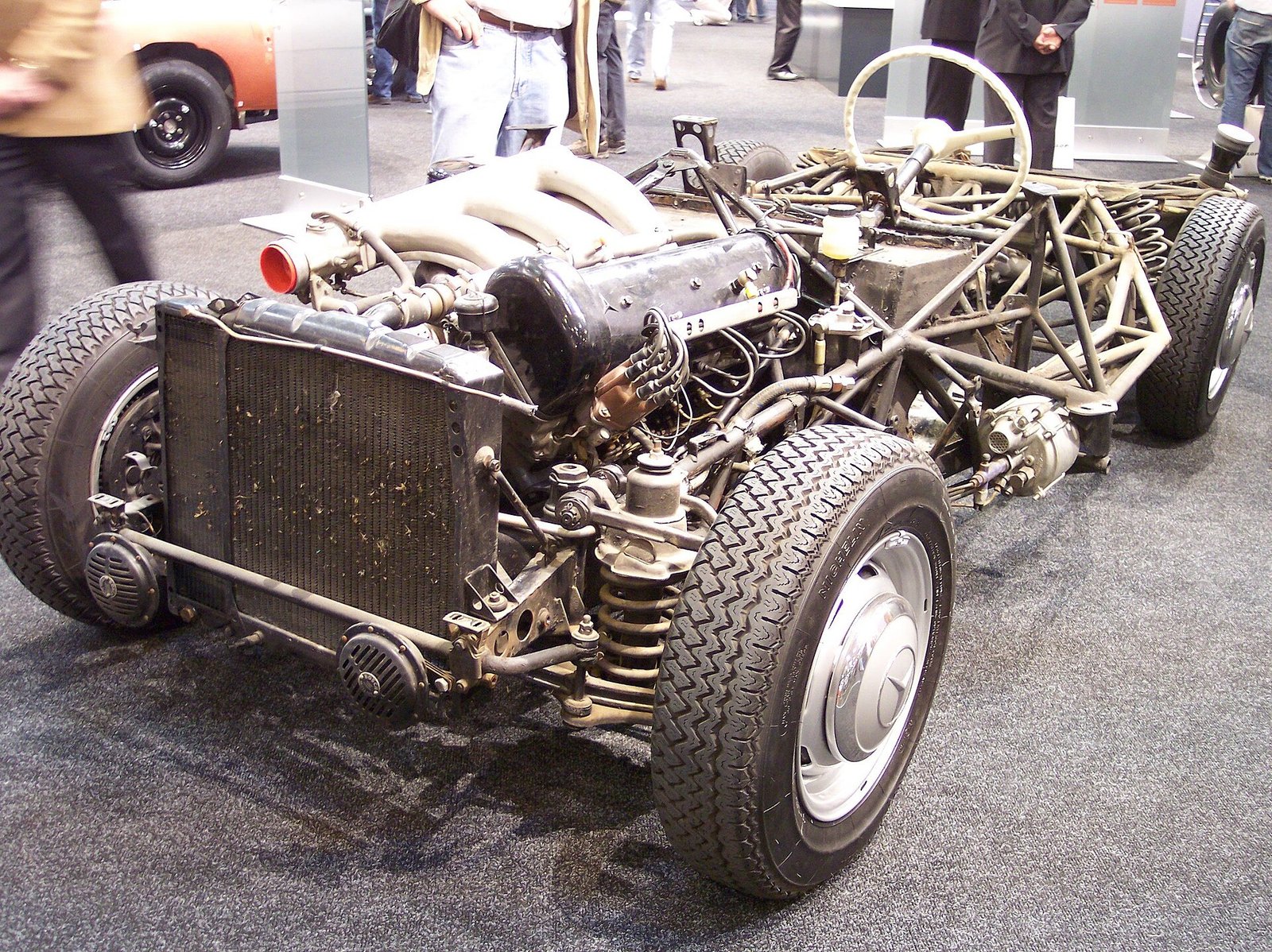
The catch was that the tubes ran high along the sides of the cockpit. There was no room for a normal door. The engineers’ answer was to hinge the doors in the roof, so they swung upward, and the car’s nickname followed instantly: Gullwing. Climbing in still meant stepping over a wide, tall sill, which is why the production car got a steering wheel that tilted out of the way to make entry possible. And because the side windows couldn’t drop into doors that had no room for them, they were removable.
What started as an engineering compromise became the most famous design feature of any Mercedes ever built.
Max Hoffman’s bet
Mercedes had no plans to sell the W194 to the public. The race car had done its job. Hoffman changed that. Austrian-born and based in New York, he had a showroom on Park Avenue and an unusual talent for knowing what wealthy American buyers wanted. He had already helped build the American market for brands like Porsche and Volkswagen, and he would later push BMW toward the cars that made it big in the U.S.
His pitch to Stuttgart was simple: build a road car based on the racing 300 SL and he would sell it. The often-repeated version is that he committed to around 1,000 cars. Mercedes agreed, and the production 300 SL, code-named W198, got the green light. A car dealer on Park Avenue had just changed the history of the German sports car.
Fuel injection decades ahead of Detroit
The production car’s engine, the M198, kept the 3.0-liter inline-six layout with an overhead camshaft but added something no production car had used before: mechanical direct fuel injection, developed with Bosch. Instead of a carburetor mixing fuel and air before they entered the engine, the system sprayed fuel directly into each cylinder at precisely the right moment. The technology came from German aircraft engines of the war years.

There was a practical reason for it. The engine was tilted about 50 degrees to the side so the hood could stay low, and carburetors don’t like being tilted. Injection didn’t care. The result was 215 metric horsepower at 5,800 rpm, rated at 240 hp under the American SAE system of the time, at a moment when the Jaguar XK120 made 160 hp and a Chevrolet Corvette had a 150 hp six.
Detroit came to fuel injection later, and with port injection rather than direct injection. Chevrolet offered its "Ramjet" fuel injection on the Corvette for 1957. Direct injection on gasoline engines would only become mainstream in American cars in the 2000s, half a century after the 300 SL.
Living with that injection system took some learning. The mechanical pump kept squirting fuel for a moment after the engine was switched off, and an engine shut down hot and then restarted carelessly could wash oil from the cylinder walls or foul the plugs. Owners developed routines for starting and stopping the car, and specialist mechanics still teach them today. It was a race-bred system in a road car, and it expected its driver to understand that.
The fastest car you could buy
With the tallest available axle ratio, the 300 SL could reach about 160 mph, and Mercedes tested a pre-production car on the autobahn near Munich at roughly that speed. That made it the fastest production car in the world in its time. American magazines that tested it recorded 0-60 times in the seven-second range with the right gearing, at a time when most family sedans needed well over fifteen.
The car’s swing-axle rear suspension, a simple design in which each half-shaft pivots near the differential, could make the tail step out suddenly at the limit, especially when lifting off the throttle mid-corner. Experienced drivers learned to respect it. It was one of the few real weaknesses of the Gullwing, and the later Roadster addressed it.
Built by hand, sold to the famous
Each Gullwing was essentially hand-built at Sindelfingen, and it was priced accordingly. In the U.S. it cost around $7,000 in the mid-1950s, well above the price of the most expensive Cadillac of the day. A small number, 29 cars, were built with all-aluminum bodies, about 80 kilograms lighter than the steel ones, and today they are the most valuable of all.

The owners’ list read like a guide to 1950s celebrity. Clark Gable drove his around Hollywood. Sophia Loren had one. Conductor Herbert von Karajan owned one, and so did the playboy diplomat Porfirio Rubirosa. Juan Manuel Fangio, who won Formula 1 titles for Mercedes, was given one. Owning a 300 SL meant joining a very small club, and in America it also meant owning the car every sports-car magazine wanted on its cover. Hoffman’s bet had paid off: the United States, not Germany, was where the Gullwing found most of its buyers.
Gullwings on American tracks
Many owners raced them. The Gullwing was a production car, but a remarkably capable one, and in American amateur racing it was hard to beat. Paul O’Shea won the Sports Car Club of America’s production championship in a 300 SL in 1955 and 1956, and went on to win again in 1957. In Europe, Olivier Gendebien won the grueling Liège-Rome-Liège rally in a 300 SL in 1955.
For American enthusiasts of the era, a 300 SL at an SCCA race was the closest they could get to the Mercedes works team that had dominated Le Mans and Formula 1.
The Roadster that replaced it
In 1957 Mercedes replaced the coupe with the 300 SL Roadster. A redesigned frame with lower sills allowed conventional doors, the soft top opened the car to the sky, and a new low-pivot rear suspension made it much more predictable at the limit. Disc brakes arrived in 1961. The Roadster was the better car to drive and sold more, 1,858 between 1957 and 1963, compared with 1,400 Gullwings built from 1954 to 1957.

Collectors, though, have never doubted which one is the icon. The doors that were born from a structural problem became the defining feature of the car, and the Roadster, superb as it is, doesn’t have them.
From $7,000 to millions
The Gullwing’s market path tells its own story. A car that sold for about $7,000 new is now routinely worth well over a million dollars in good condition, and the rare aluminum-bodied cars change hands for several times that. Few objects of any kind have appreciated like it over seven decades.
Part of that is rarity and beauty. Part of it is that the 300 SL is one of those cars that marks a clear before and after. Before it, the fastest road cars were usually race cars with license plates, hard to live with. After it, the idea of a car that could win on Sunday and take you to the opera on Monday became a category of its own.
The race car it led to
The 300 SL’s racing story didn’t stop with the W194. In 1955 Mercedes raced the 300 SLR, a pure sports racer built around the straight-eight engine of its W196 Formula 1 car. Stirling Moss and journalist Denis Jenkinson drove the SLR numbered 722 to victory in that year’s Mille Miglia in Italy at a record average speed of nearly 98 mph. The name was so tied to the Gullwing’s family that Mercedes revived it fifty years later for the SLR McLaren, and the 722 number for its sharpest version, a story we tell in our history of the Mercedes-Benz SLR McLaren.
The 1955 season ended in tragedy at Le Mans, where a 300 SLR was involved in the crash that killed driver Pierre Levegh and more than 80 spectators. Mercedes withdrew from racing at the end of that year and stayed away for decades. That gives the road-going 300 SL an extra layer of meaning: it is the surviving civilian face of a racing program that ended abruptly.
The template for every supercar
The word "supercar" didn’t exist in 1954, but the 300 SL set the pattern. Extreme performance, cutting-edge technology, luxury and drama, all in one car you could buy. The Lamborghini Miura, the Ferrari Daytona and the McLaren F1 all follow the path it opened, and Mercedes paid tribute to it directly with the gullwing-doored SLS AMG in 2010, the starting point for the Black Series car that ended up as one of the most valuable modern Mercedes. Even the DeLorean borrowed the doors.
It all started with a race car that needed a stiff frame, a 3.0-liter sedan engine tilted on its side, and a Park Avenue dealer who knew his customers. The racing program that produced it, from the W194’s 1952 Le Mans one-two onward, is the reason the Gullwing has the soul it does.
Check you’re still alive.
Photos via Wikimedia Commons: 1956 300 SL Gullwing, Sicnag (CC BY 2.0); 1952 300 SL W194, MrWalkr (CC BY-SA 4.0); 300 SL spaceframe chassis, Stahlkocher (CC BY-SA 3.0); M198 engine, Herranderssvensson (CC BY-SA 3.0); 300 SL interior, Jiří Sedláček (CC BY-SA 4.0); 300 SL Roadster, Ermell (CC BY-SA 4.0).