
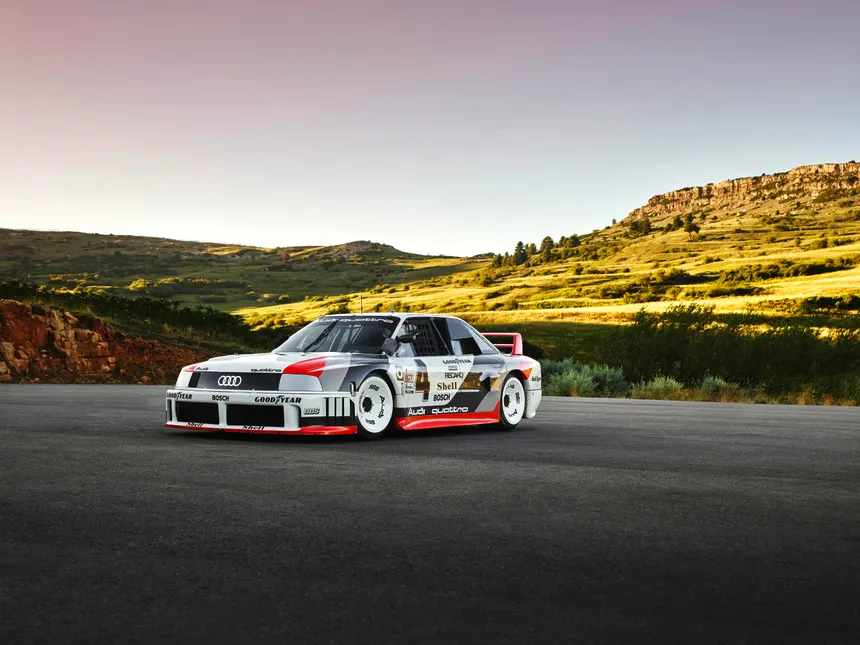
Audi 90 quattro IMSA GTO: The Car They Changed the Rules to Stop
Most race cars lose because something breaks, or because the driver lifts, or because the thing in front is simply quicker. The 1989 Audi 90 quattro IMSA GTO managed something rarer and far more telling. It lost a championship while being the fastest, most dominant car on the grid. And the season before that, in a different series, its predecessor won so convincingly that the rulebook itself was rewritten to make sure it never happened again.
Two American championships. Two German cars. The same pattern, twice. Audi shows up where it isn’t wanted, wins everything in sight, and walks away before anyone can land a counterpunch. If you only know this car from a Top Gear retrospective or a grainy clip of it howling out of a corner, you know the spectacle. You probably don’t know how cleverly the whole thing was set up, or why seven wins still wasn’t enough. Let’s fix that. But to understand the 90, you have to start with the 200.
First, the 200 walked into Trans-Am and embarrassed everyone
Before IMSA, there was Trans-Am, and the 1988 season is where this story really begins.
Audi rolled into America’s premier road-racing support series with a big saloon, the 200 quattro, and a plan the locals found borderline laughable. Ford and Chevrolet were running big-displacement, naturally aspirated V8s pushing well past 600 horsepower. Audi turned up with a turbocharged five-cylinder of barely 2.1 litres, lifted from its rally programme, tuned to around 510 bhp. Less power. Fewer cylinders. And, worst of all in the eyes of the paddock, a heresy no one had ever brought to Trans-Am: all-wheel drive.
The grid laughed. The grid stopped laughing very quickly.
Second on debut at Long Beach. A win at Dallas. Then the floodgates. The 200 quattro never had the most powerful engine out there, not even close, but it had the one thing that matters more than peak horsepower over a full race distance: traction where everyone else was lighting up their tyres, and tyre wear so gentle that rivals were falling apart by mid-stint while the Audi just kept going. Eight wins from thirteen rounds. Hurley Haywood took the drivers’ title, Audi took the manufacturers’ crown, all in its debut year.
That was the problem. To the people running Trans-Am, it was too much. So the rulebook came out. Weight penalties. Restrictors. And finally the decision that changed the whole direction of the story: for 1989, all-wheel drive was banned from Trans-Am outright.
Here’s the bit that gets muddled constantly, so let’s nail it down. That AWD ban belonged to Trans-Am and to the 200 quattro in 1988. It had nothing to do with IMSA or with the 90. These are two linked chapters, not the same story told twice. And the second chapter opens with Audi heading for the exit.
The answer was a silhouette racer wearing a saloon’s clothes
Audi could have stayed and fought with a defanged saloon, stripped of the very thing that made it special, dragged down to everyone else’s level. It did the opposite. It walked over to the rival championship — the IMSA GT Championship, GTO class — precisely because the regulations there were far more relaxed. In GTO you could keep all-wheel drive. You could keep the European engine. You could, in practice, build almost anything you liked as long as the silhouette vaguely resembled a road car.
So Audi built almost anything it liked.
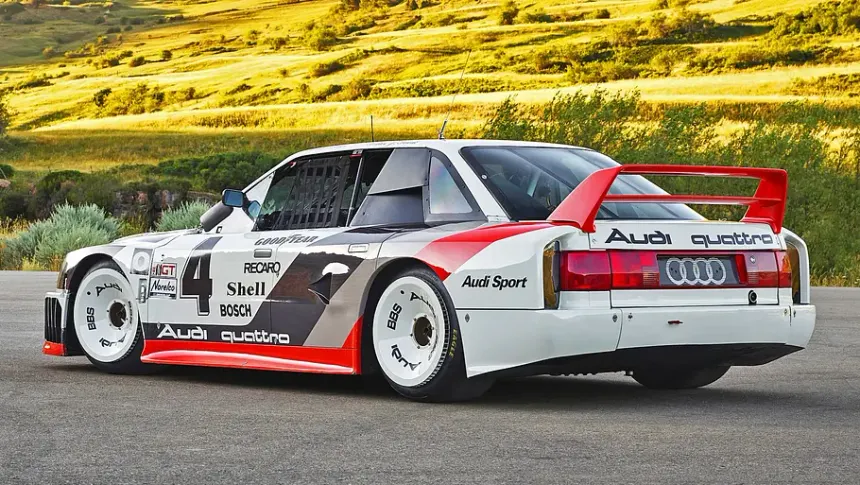
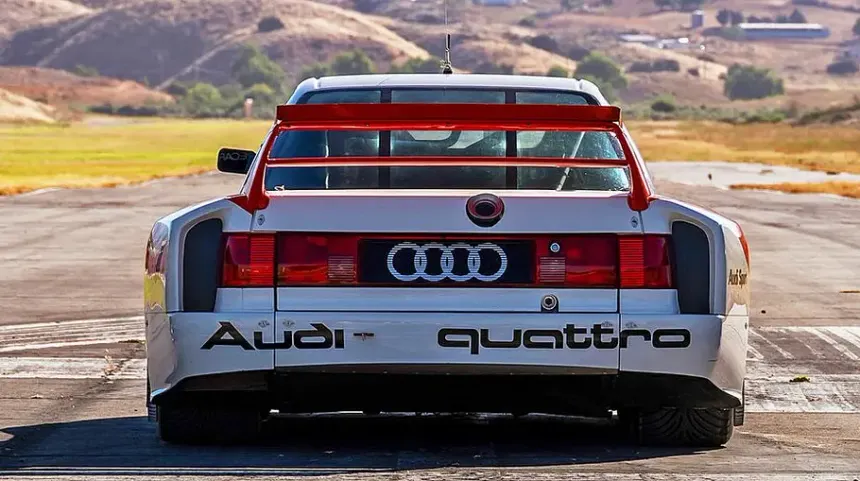
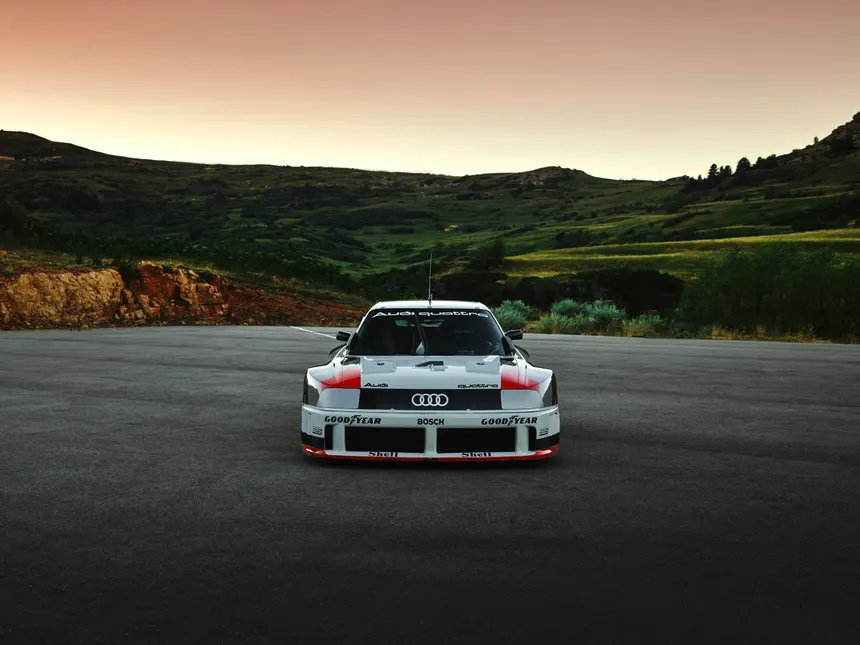
The 90 quattro IMSA GTO is not a modified Audi 90. It’s a purpose-built race car wearing a shell shaped like a 90. Under that absurdly wide composite bodywork sits a tubular spaceframe built from scratch. At a touch over 4.4 metres long but more than two metres wide, it had one of the widest bodies of its era — squat, planted, almost cartoonishly broad in the metal. Almost nothing is shared with the showroom car — IMSA’s loose rules meant little more than the roof carried over. Everything else is unrestricted competition engineering.
The heart was still Audi’s turbocharged five-cylinder, the same bloodline that traced back to the rally quattros, but pushed into another dimension. Per Audi’s own figures, this 2.2-litre aluminium unit with a four-valve head produced 720 hp at 7,500 rpm and 720 Nm of torque at 6,000 rpm. These are official factory numbers, crank output rather than wheel estimates. Audi describes it as the most powerful works five-cylinder it had ever taken racing. And all of it, once again, fed to all four wheels through the quattro system.
And we have to talk about the noise, because that engine sounded like nothing else on the grid. The Audi five-cylinder runs an unusual firing order, 1-2-4-5-3, with a combustion pulse every 144 degrees of crank rotation. That odd cadence is what produces the famous “warble” — a rough, undulating burble sitting somewhere between a regular five and an Italian V10. Picture a high-revving V10 that picked up some tattoos and a criminal record along the way. At 7,500 rpm with the turbo on song, that burble sharpened into a hard, metallic shriek, the upper harmonics biting the air. While the American V8s rumbled with their familiar deep bellow, the Audi sang in a different language entirely. And once you’d heard it, you never mistook it for anything else.
Sit with the context for a second. In a class literally called GTO — where the “O” stood for “Over,” as in over 2.5 litres — Audi was racing 2.2 litres. On paper, undersized. On track, untouchable. The Trans-Am playbook again, just turned up: less displacement, more power per litre, and traction doing the rest.
Why all-wheel drive felt so unfair (and was so clever)
It’s worth pausing here, because this is the engine room of the whole story. How does a car with less power and less displacement beat machines packing 600-plus horsepower?
The answer isn’t romantic, it’s physics. A rear-drive car with 600 naturally aspirated horses has one enormous headache: getting all of it to the ground through two wheels. Bury the throttle on corner exit and the rears light up, traction vanishes, time bleeds away, and the tyre cooks itself in the process. The quattro spread the load across all four contact patches. Each tyre did less work to transmit the same force. The upshot: less wheelspin, cleaner corner exits, and — most devastating over a full race — far gentler tyre wear than anyone else could manage.
People who watched these cars in period tell it the same way. Commentators kept hammering the point that the Audi was easy on its rubber while the competition struggled to keep tyres alive across a stint. In the dry, the quattro was already better. In the wet, it was simply playing a different sport. When the rain came down, the corners that were a lottery for everyone else were a stroll for the Audi.
That’s the “unfair advantage” the rivals kept muttering about. It wasn’t unfair in the cheating sense. It was unfair in the sense that Audi had understood something the others hadn’t, and brought it to the track first. The unfairness lived in the heads of the people who didn’t have it.
A driver line-up that reads like a hall of fame
If the car was serious, the line-up was the stuff of fantasy. Hans-Joachim Stuck in the number 4. Hurley Haywood, the reigning Trans-Am champion, in the number 5. For selected rounds the squad added names like Walter Röhrl — a genuine rally legend — and Scott Goodyear. You don’t assemble a roster like that to make up the numbers. You assemble it to win.
And win they did.
The season: a shambles, then a steamroller
It’s worth being straight about the start, because the truth is better than the legend. 1989 began badly. The engine came from a rally and hillclimb heritage, designed to last fifteen or twenty minutes flat out, not a full road-race distance. Making it endure took work. Audi deliberately skipped the season-opening enduros, Daytona and Sebring, because the car simply wasn’t ready. And when it debuted at Miami, gearbox trouble masked its real pace.
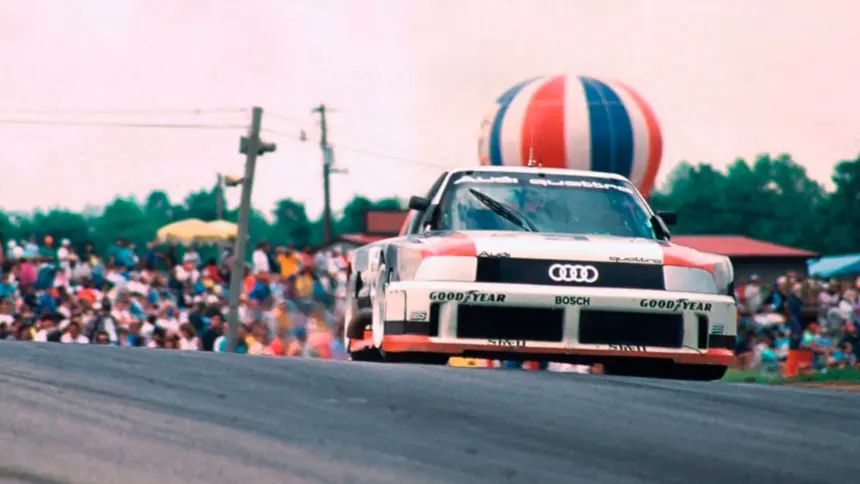
But you know how Ingolstadt operates. Once the car came good, the steamroller started. Stuck and Haywood scored a 1-2 at Summit Point. Stuck won again at Mid-Ohio. Then Topeka, Sears Point, Watkins Glen, Lime Rock, Laguna Seca. Seven wins from thirteen races, Haywood shadowing Stuck with a fistful of second places. The chirp of that wastegate became the soundtrack to other people’s afternoons being ruined.
And here’s the twist that lifts this above a simple list of victories: with seven wins, Audi did not win the championship.
Why seven wins wasn’t enough
It sounds like a joke. It isn’t. The explanation lies in those two races Audi chose to sit out. Daytona and Sebring were the big endurance openers, and they paid out serious points. Audi missed them because the car wasn’t ready. That entirely sensible decision cost it the title.
When the dust settled, the drivers’ championship went to Jack Roush’s Mercury Cougar XR-7 effort, with Pete Halsmer leading the points. Stuck finished third in the drivers’ standings. Audi was runner-up among the manufacturers. Seven wins, and still beaten. Championship arithmetic doesn’t reward the car that wins most — it rewards the car that scores most, and the points Audi left on a Florida beach in February outweighed everything it won afterwards.
There’s something almost cruel in that. The quickest car, the most dominant on track, the one that left rivals watching it vanish, lost the crown over a decision made before its engine was even sorted. It didn’t lose on the circuit. It lost on the spreadsheet.
And then, once again, it walked away
This is the part that closes the loop. The IMSA programme was originally planned to run for two years. Audi quit after one.
Mind the distinction, because plenty of people get it wrong. Audi was not pushed out of IMSA. There was no AWD ban hounding it from the series, the way there had been in Trans-Am. Audi left of its own accord. It packed up, looked back toward Europe, and decided the next challenge lay in the DTM, Germany’s touring car championship, where it would campaign its V8 luxury saloon.
And the DTM? Same old story. Audi won the title at the first attempt, in 1990, Stuck behind the wheel again. The year after, a young Frank Biela did it once more. Quattro tech kept on winning, different series, different car, as if it were the easiest thing in the world.
What this car actually means
The 90 quattro IMSA GTO is probably one of the most revered race cars Audi has ever built, and it isn’t because of the win tally. It’s because of what it stands for. It’s the physical proof of a way of racing that played out twice, almost beat for beat: Audi arrives in an American series, brings an idea the locals deem unworkable or unfair, wins at a canter, and leaves — or gets thrown out — before the establishment can stomach what it just watched.
In Trans-Am they legislated its all-wheel drive away. In IMSA it left on its own terms, leaving behind a car that dominated but that the maths denied a title. Both times, the feeling it left behind was identical: this car was too good for the context it was racing in.
That impossibly wide body. That five-cylinder singing on every upshift. That traction turning wet corners into a stroll while everyone else scrabbled for grip. Everything about this car says the same thing. Proper engineering doesn’t ask permission. And sometimes the highest compliment a championship can pay you is to change the rules so you’ll stop winning.
Stuck’s number 4 sleeps today at Audi Tradition, near Ingolstadt. A monster at rest. If you ever stand in front of it, take in how wide it is, how little of it is road car, how much of it is a statement.
Then check you’re still alive.