Brabus Spent 50 Years Tearing Mercedes Apart. For Its Masterpiece, the Bodo, It Picked an Aston Martin
For half a century the formula never changed. You take a Mercedes — ideally one already breathed on by AMG — and you hand it to Brabus, the Bottrop firm that exists to take something fast and make it faintly unreasonable. More power, more carbon, more menace, more everything. If Top Gear ever needed a Mercedes that looked like it had wandered out of a Bond villain’s garage, Brabus was the address. Mercedes was the canvas. Mercedes was the faith.
Which is exactly why the company’s latest move lands the way it does — equal parts heresy and inevitability.
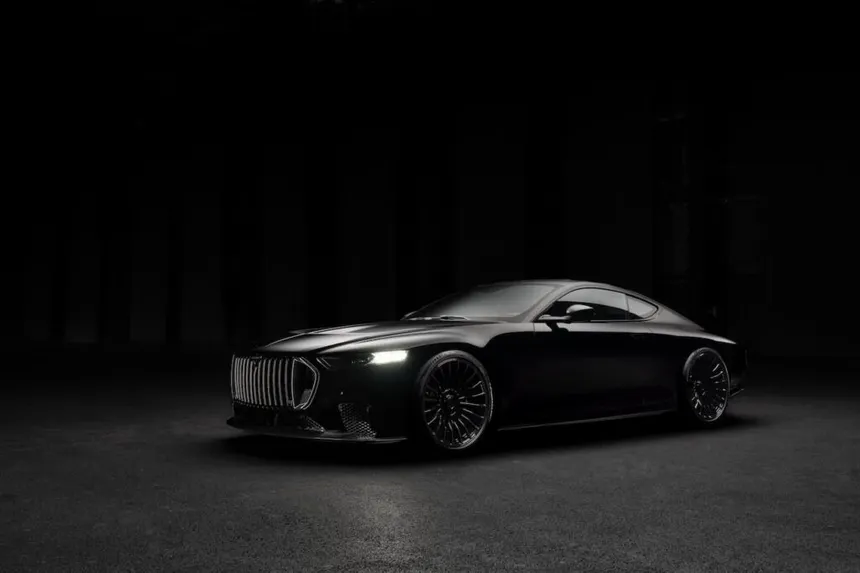
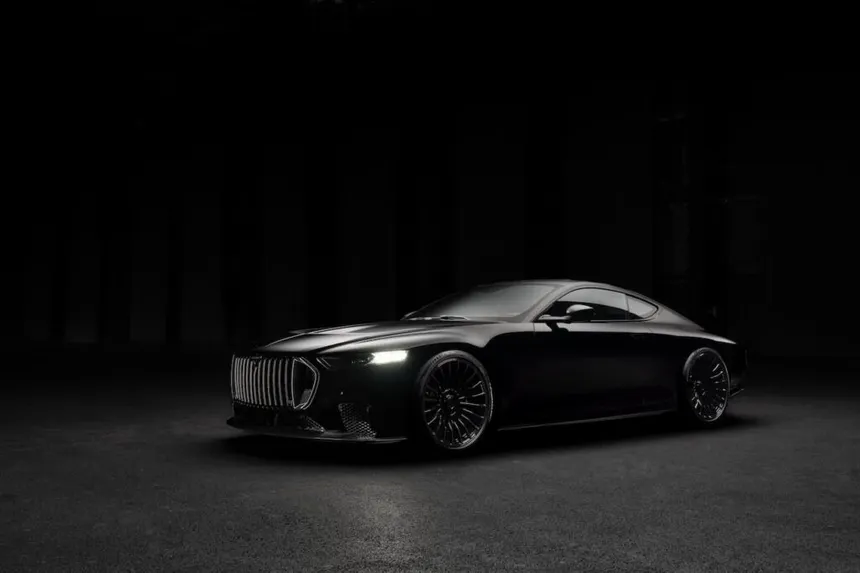
To mark its upcoming 50th anniversary, to build the most personal car in its history, the one carrying the name of its late founder, Brabus did not reach for a Mercedes. It reached for an Aston Martin Vanquish. And then it skinned it alive.
It’s called the Bodo. Before you picture another Mercedes with extra badges and darker glass, stop — this is something else entirely. This is Brabus stepping outside its own script.
Who Bodo was
The car is named after Bodo Buschmann, the man who founded Brabus in 1977 and died in 2018. His son Constantin runs the company now. So the Bodo isn’t just another catalogue entry. It’s a tribute, a memorial in the shape of a grand tourer, the car its founder would have nodded at approvingly. That framing explains a lot of the decisions that follow, because when you build something to honour a person, you don’t chase sensible. You chase maximum.
The production run says it all: 77 units. For 1977, the year it all began. Not one more.
What it actually is underneath
Precision matters here, because this is the crux of the whole thing, and plenty of people are going to get it wrong.
The Bodo is not a “100% Brabus” car drawn on a blank sheet. It has no bespoke chassis. It begins life as an Aston Martin Vanquish: the Aston’s aluminium monocoque, the Aston’s double-wishbone front and multi-link rear suspension, the Aston’s cabin architecture, and above all the Aston’s monster of an engine — that 5.2-litre twin-turbo V12.
What Brabus does is what the luxury world calls coachbuilding: the old craft of taking existing mechanicals and clothing them in a new body, a new character and, ideally, a new reason to exist. This is not bolt-on aero and a set of black wheels. It’s throwing away nearly the entire body and building another from scratch.
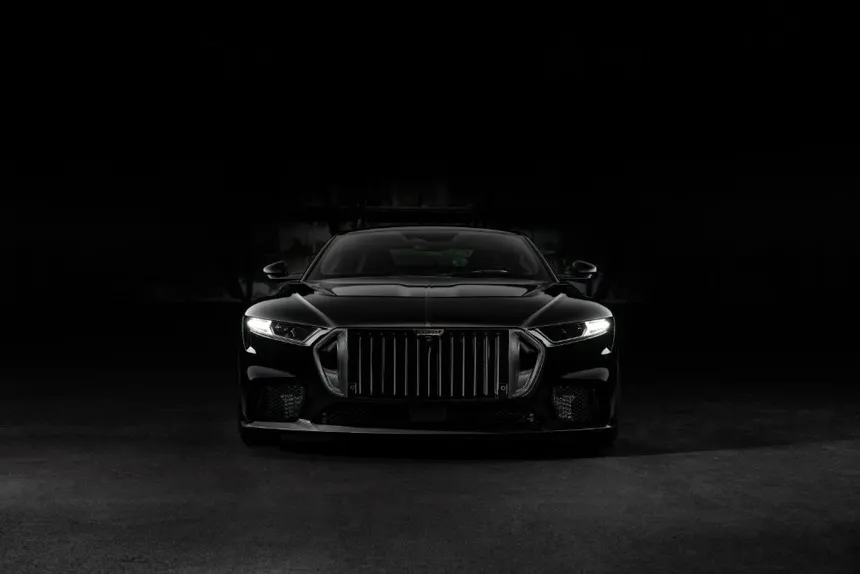
And that’s precisely what’s happened. Brabus kept the Vanquish’s roof and little else. Everything else is a new body in pre-preg, autoclave-cured carbon fibre — the proper stuff. The result is a shape that only betrays its British origins if you study the roofline and the 2+2 interior. From the outside, the Aston has vanished.
The beast, by the numbers
Coachbuilt doesn’t mean Brabus left the mechanicals alone. Perish the thought. This is Brabus.
The Vanquish’s 5.2 twin-turbo V12, which leaves the factory at around 823 hp, here climbs to 1,000 PS and 1,200 Nm of torque. Note the unit: Brabus quotes PS, the European metric horsepower, and 1,000 PS works out to roughly 986 hp — so be wary of anyone casually rounding it to “1,000 horsepower,” because that’s not the same figure. Rear-wheel drive, no all-wheel-drive safety net, old-school. Eight-speed automatic. Brabus claims 0–100 km/h in 3.0 seconds, 0–200 in 8.5, and a 360 km/h top end.
A thousand PS to the rear wheels of a carbon grand tourer. There’s something gloriously antiquated about that choice, as if Brabus wanted the car to keep a streak of ungovernable menace in an age when everyone splits power across four wheels so nothing ever gets out of hand.
And there’s a bigger anomaly still. At a moment when the entire industry is sprinting toward hybridisation and electric motors, when every new launch arrives with batteries and efficiency sermons, the Bodo plants a V12 at its heart — twin-turbo, combustion only, not a single electron lending a hand. Twelve pure cylinders hauling five metres of carbon. It’s almost a political gesture. A raised finger to the spirit of the age. And precisely for that reason, to a certain kind of buyer, it’s worth every cent: because they know there won’t be many more cars like this.
The exhaust runs four titanium tailpipes made by 3D metal printing, electronic sound management, four metal catalytic converters and particulate filters. Yes, you read that right: 1,000 PS, a V12 at heart, and still Euro 6e compliant. Carbon-ceramic brakes with six-piston calipers. Brabus Monoblock 21-inch wheels. Continental tyres developed specifically for this car.
The carbon body sits over the Aston’s aluminium chassis with a 50.2/49.8 front-to-rear weight split. It stretches past five metres long — longer than the Vanquish itself — an elongated beast with a boat-tail rear that seems to carry on into infinity.
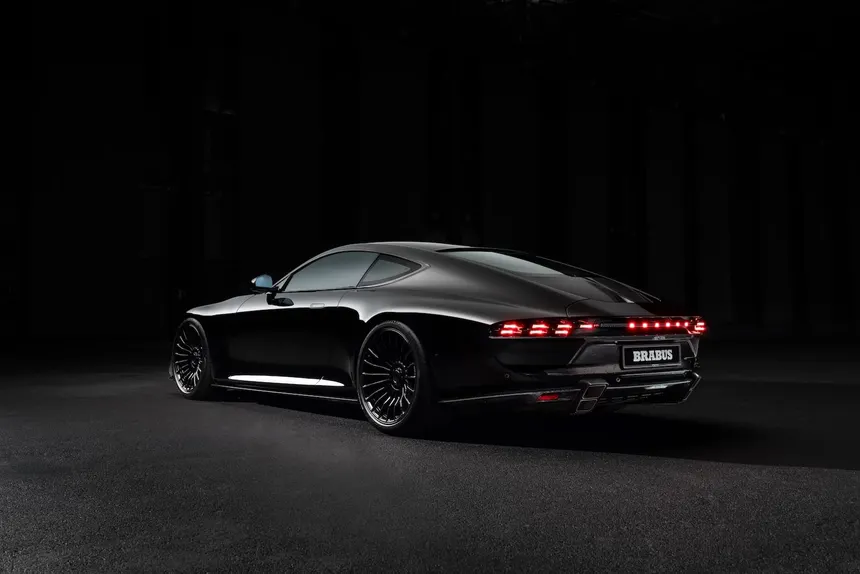
The detail that tells you everything: the black
Chassis number one came out black. And stayed black. You can spec your Bodo in whatever colour you fancy, but the launch car went as dark as physically possible and never came back. Black carbon body. Black carbon interior. Black wheels. Even parts of the engine in black carbon — with real gold flecks woven into the weave, purely because someone could.
This is a car engineered to drop jaws. They unveiled it at FuoriConcorso, on the shores of Lake Como, about the most elegant stage available, and the gamble paid off: a theatrical, almost comic-book object, a million-euro Batmobile that leaves nobody indifferent when it rolls into view.
The question nobody wants to ask out loud
And here’s what really stings. Is a carbon-clad Aston Martin Vanquish worth a million euros?
Let’s turn it over, because the answer is less obvious than it first looks. The donor Vanquish is not a cheap car to begin with. It’s a prestige grand tourer with proven mechanicals. What Brabus adds isn’t just bodywork: it’s genuine rarity (77 cars worldwide), engineering that goes far beyond a kit, and the feeling of owning a commissioned, one-off object — haute couture on wheels. Framed that way, a million for something you’ll never see in a car park starts to look less ridiculous.
But there’s a but, and it’s a big one. At its deepest core, it remains an Aston Martin. The brain, the bones, the engine, the electronics, the infotainment with Apple CarPlay — all British. Brabus has done staggering reinterpretation work, no question. But it’s neither an entirely in-house car nor does it pretend to be. It’s a hybrid that resists definition: not tuning, not a full manufacturer. Something in between that the car world itself struggles to label.
And that’s the juiciest part of all. Brabus, which built its legend improving other people’s cars, has built its most expensive and personal piece on someone else’s car once again. Only this time the “someone else” isn’t Mercedes. It’s Aston Martin. And plenty will argue, rightly or not, that the Bodo makes the standard Vanquish look almost restrained, almost insufficient by comparison. The star pupil dressing the master — and rather showing him up.
There’s a delicious irony buried in that, too. Aston Martin has spent its recent history fighting to be taken seriously as a maker of proper supercars, clawing its way up against Ferrari and McLaren. And here comes a German tuner, builds something on Aston’s own bones, and arguably out-Astons Aston — more dramatic, more extreme, more of an event than anything Gaydon currently sells. Whether that’s a compliment to the Vanquish’s engineering or a quiet embarrassment for its design depends entirely on which side of the showroom you’re standing.
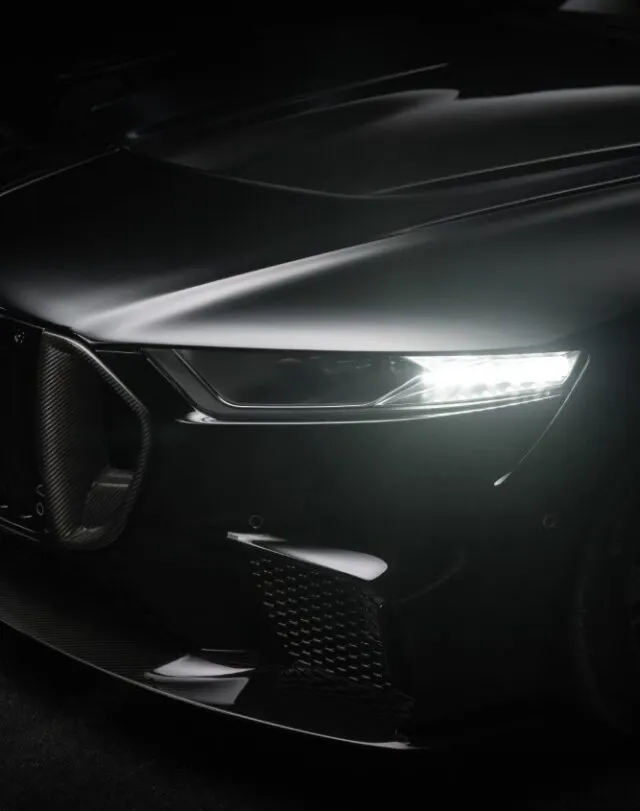
The context: why everyone suddenly wants to be a coachbuilder
It’s no accident the Bodo lands now. There’s an undercurrent running through the luxury car world, a revival of coachbuilding that had been half-asleep for decades. Marques and tuning houses that spent years content with kits and special editions are rediscovering the old trade of taking proven mechanicals and building them a bespoke body from scratch.
Why? Money and exclusivity, two sides of the same coin. Coachbuilding lets you charge hypercar money without designing a car from a blank sheet, without homologating a new engine, without swallowing the astronomical cost of developing a platform. You take something that already works, already passes the crash tests, already meets emissions, and you drape the dream over it. The customer pays for the rarity and the theatre. And because the run is tiny, each car appreciates on its own.
Brabus had hinted at this with the GTS Coupe, that full carbon-bodied reworking of the Mercedes SL63 E-Performance, which also nudged a thousand PS by pairing combustion with electric shove. But the GTS, brutal as it was, never had the Bodo’s theatrical charge. The Bodo is a different league of drama. And it is, precisely, because for the first time Brabus dared to step out from under the Mercedes umbrella to do it.
That’s the detail separating real craft from carbon stickers. Brabus didn’t just dress the Vanquish. It rewrote the suspension — double-wishbone and multi-link developed with KW — comprehensively recalibrated the engine management for injection, ignition and boost, and developed bespoke tyres. It’s a mechanical reinterpretation, not just a cosmetic one. Which is why calling it a “body kit” would insult the work. And why, at the same time, calling it “pure Brabus” would be a lie.
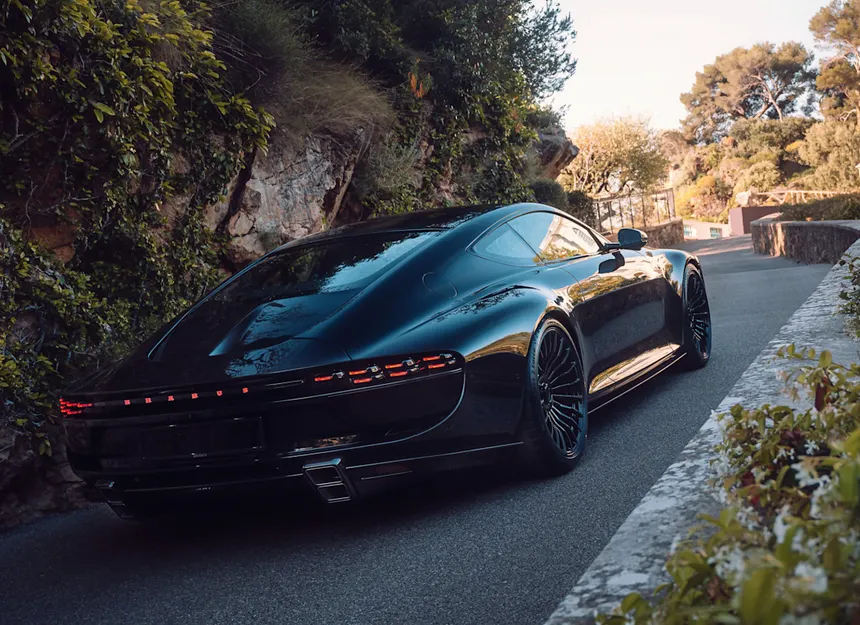
What this car means
The Bodo is proof that Brabus has shed a skin. It’s no longer just the workshop that fettles Mercedes. It’s a house that does real coachbuilding, taking excellent foreign mechanicals and turning them into new objects with a character of their own. It had hinted as much with the GTS Coupe, a full carbon-bodied reworking of the SL63. But the Bodo pushes it to the extreme, and does so carrying the emotional weight of the founder’s name.
That for this leap, this statement, Brabus chose an Aston Martin and not a Mercedes says a great deal. It says brand loyalty, in the end, matters less than the ambition to build the perfect car for a specific idea. Buschmann senior wanted unapologetic grand tourers — vast, brutal, comfortable enough to cross continents flat out. The Vanquish was the ideal base for that. That it happened to be British was beside the point.
It’s a contradictory car. Brutal and debatable at once. First-rate engineering and bodywork built on someone else’s bones. A thousand PS to the rear wheels in an era that runs from exactly that. A million euros for something sharing DNA with a car that costs considerably less. Hard to swallow for some, irresistible for others.
But one thing brooks no argument. When that long, black, theatrical carbon body comes down a road, boat-tail trailing and a thousand horses singing through four titanium pipes, there isn’t a head that doesn’t turn. Aston badge or not, it stops the street cold.
Then check you’re still alive.