
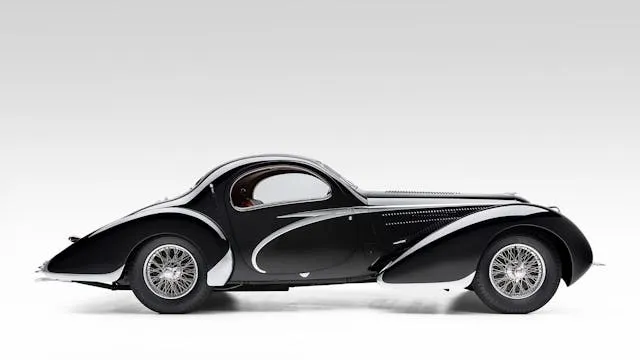
The Goutte d’Eau. The Most Beautiful Car Nobody Remembers
Ask anyone who knows cars which is the most beautiful ever built, and you’ll get a predictable list. The E-Type. The 250 GTO. The Miura. The DB5. All of them deserve to be there. All of them also have the cultural weight to make the conversation easy — everyone knows what you’re talking about.
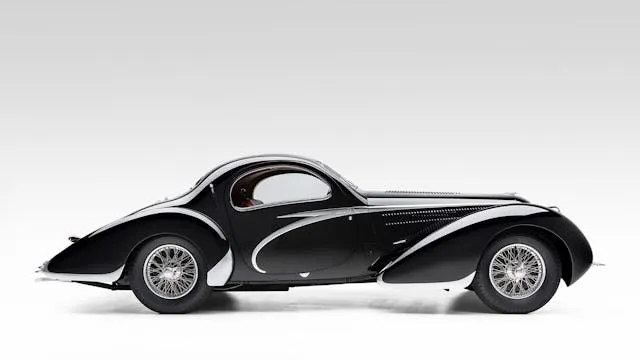
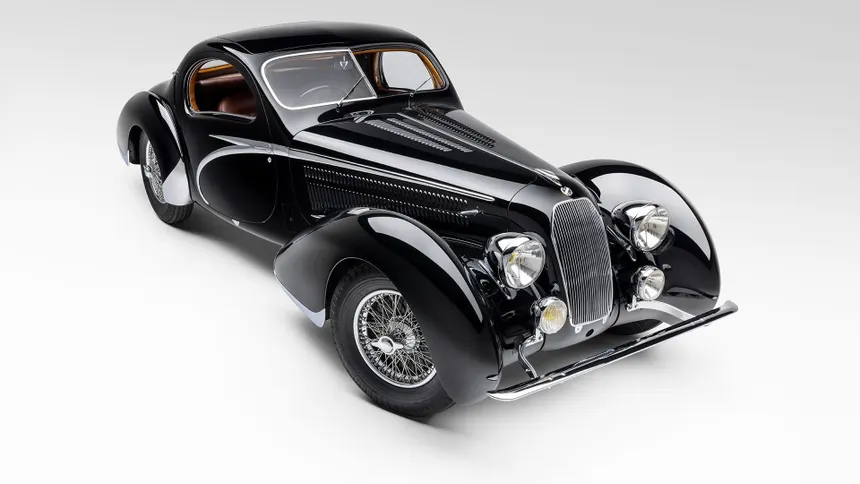
And then there’s the Talbot-Lago T150C SS Teardrop Coupé, which almost never appears in spontaneous answers but which lives in art museums around the world.
Not automotive museums. Art museums. There’s a difference, and in the case of the Teardrop, that difference is the entire argument.
Three Italians in Paris
The story of the Teardrop is the story of three men who weren’t French building the most French thing ever put on four wheels.
Antonio Franco Lago was born in Venice on 28 March 1893. He spent the 1920s in London working in the car business, learned English well enough to pass for British when it suited him, and in 1933 spotted an opportunity in Paris. Automobiles Talbot S.A. was technically bankrupt — a subsidiary of the Anglo-French Sunbeam-Talbot-Darracq conglomerate, haemorrhaging money while its British shareholders argued about what to do. Lago told the board he could turn it around in 18 months. They put him on salary to try.
By 1936 he had completed a management buyout from the receiver. A Venetian, running a French company, in a Paris suburb, with a British lord’s name on the cars. It worked.
Giuseppe Figoni was from Piacenza. Born in 1894, moved to Paris as a child, apprenticed to a carriage builder at 14, went to war, came back, opened his own bodywork shop in Boulogne-sur-Seine. Through the twenties and thirties he built a reputation on Bugatti, Alfa Romeo, Delage and Delahaye chassis. In 1932, an Alfa Romeo 8C 2300 wearing his coachwork won Le Mans. In 1935, Italian businessman Ovidio Falaschi became his partner, and Figoni et Falaschi was registered as a firm.
Falaschi ran the numbers. Figoni ran the ideas. It worked because both of them knew exactly what the arrangement was.
The third Italian is Walter Becchia, the engineer Lago hired to redesign the Talbot engines from scratch. Becchia started from an existing three-litre straight-six, evolved it to four litres, and designed a new cylinder head with hemispherical combustion chambers and inclined valves operated by crossed pushrods controlled by a single camshaft mounted high in the block. For 1935, the architecture was advanced.
That engine became the T150C. The T150C, wearing Figoni’s coachwork, became the Teardrop.
What Figoni Did With the Chassis
The T150C arrived in 1937 in two chassis configurations: the SS, on a short 2.65-metre wheelbase intended for performance, and the Lago Speciale, longer, for heavier luxury coachwork. Figoni et Falaschi worked with the SS.
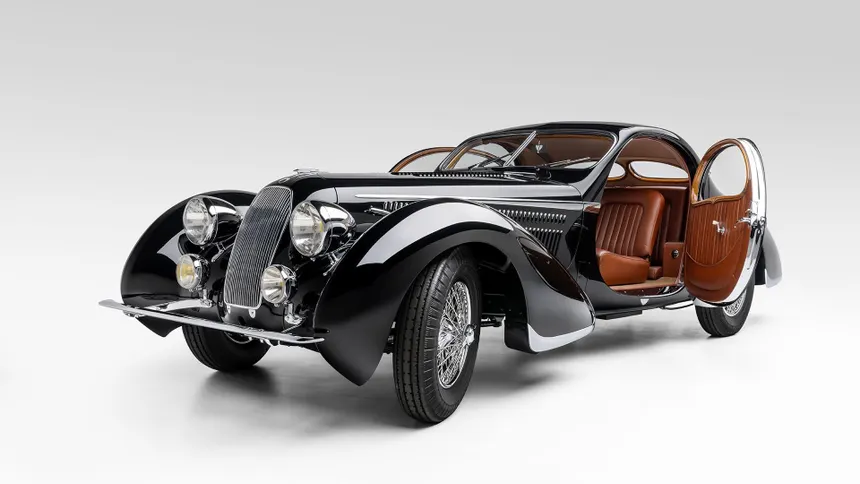
The design language Figoni had spent years developing had its own name: enveloppantes. Enveloping fenders — integrated into the body rather than standing out from it as separate elements. He’d first shown the idea on a Delahaye 135 at the 1936 Paris Motor Show, and the response had been immediate. The concept was simple and the execution was extraordinarily difficult: eliminate every visual discontinuity between fender, door, bonnet and roof. Make the car look like a single flowing piece, as if it had been sculpted rather than assembled.
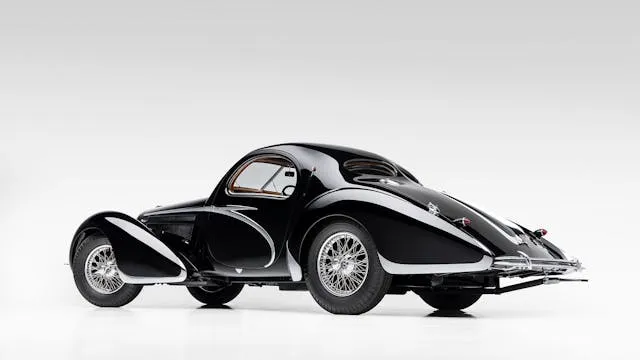
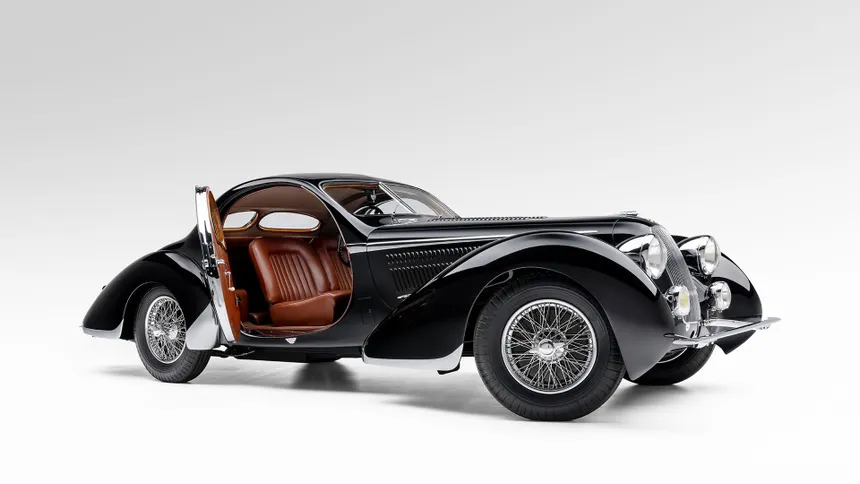
The Teardrop was that idea taken to its limit. Not a single straight line anywhere. A rounded nose, fenders melting into doors, a roofline descending in a continuous curve to the tail, an oval rear window framed in chrome. Figoni called the shape goutte d’eau — water drop. The English-speaking press translated it as teardrop. Both images work. Neither one is quite sufficient.
Every body was formed by hand over ash wood bucks that Figoni built himself. Chassis were assembled, disassembled, reassembled — sometimes two or three times — until the lines matched what he had in his sketches. There were no production tolerances because there was no production. There was singular craft. The time it took to build one body had no relationship to any known industrial process.
Then you opened the door. Oxblood leather on seats and door trims, polished wood surrounds on the steering wheel and window frames, window winders mounted at the centre of the door panel rather than the side — because Figoni had designed the door shape around the mechanism, not the other way around. A sliding metal sunroof, fitted as standard at a time when most cars didn’t have one at all. Room for two people, no more. The car wasn’t designed to carry anyone else. Just the driver and one passenger, surrounded by leather and wood while a four-litre straight-six pushed from the front. There were worse ways to cover France.
Two distinct body families exist, distinguishable by detail. The first five cars, known as Jeancart after the name of the first buyer, had a slightly notchbacked roofline — a subtle break in the profile before the rear window. The remaining eleven, called New York style because the first example debuted at the 1937 New York Auto Show, had a cleaner fastback tail and a rounded nose with a vertical oval grille. Sixteen Teardrops in total on Talbot-Lago chassis. One exception on a longer T23 frame, but the canonical family is those sixteen.
The Engine That Won Races on the Way to the Coachbuilder
Becchia’s four-litre was not a salon engine. The 3,996cc straight-six with its hemispherical head breathed through triple Zenith-Stromberg carburettors, ran a compression ratio of 7.4:1 in standard road specification, and produced approximately 140 horsepower. With the high-compression pistons from the factory racing specification, the figure rose to 165. The gearbox was the Wilson pre-selector — a device in which the driver chose the next gear in advance using a lever, then dipped the clutch to execute the change. Complex to explain, intuitive to use, rapid in practice. Front suspension used a transverse leaf spring on independent geometry. Rear: live axle with longitudinal leaves. Not sophisticated by current standards. Appropriate for the weight and expectations of a pre-war grand tourer.
And here is the figure that captures what the T150C SS actually was: at the 1938 24 Hours of Le Mans, a standard production Teardrop Coupé — unmodified, bought from the dealer — finished third overall. Not a factory prototype. Not a specially homologated racing version. A road car, driven by Jean Prenant and André Morel, one of four Talbot-Lagos entered by Luigi Chinetti as the brand’s Paris agent. Third overall at Le Mans in a production grand tourer. In 1938.
That result was not a calendar accident. The T150C had already won the Grand Prix de Tunis, won at Montlhéry, won the British Tourist Trophy. Figoni’s body was beautiful, but the chassis underneath it was a serious instrument.
What the War Did
The T150C SS had a production window from 1937 to 1939. Two years before the Second World War closed Figoni’s workshops, emptied the showrooms, and ended the belle époque of French pre-war coachbuilding.
Of the sixteen Teardrops built, the war dispersed and destroyed several. Two survivors have histories worth telling separately.
Chassis 90117 raced at Le Mans in 1939, driven by Philippe Régnier de Massa and Norbert-Jean Mahé. After that it vanished into East Germany. When the Wall came down in 1989, a West German named Peter Schmitz bought it and began a restoration he never finished. By 1995 he had sold it, still incomplete, to the Automuseum Deventer in the Netherlands. The original engine had been lost somewhere in those decades — a correct-type unit was eventually located in the United Kingdom and fitted. A separate racing bonnet accompanied the car, cut with access holes for oil and coolant filler that testify to its time at the Circuit de la Sarthe. That car went on to win Best of Show at the 2010 Villa d’Este Concorso d’Eleganza and the 2011 Louis Vuitton Classic Concours Award.
Chassis 90107 had a completely different life. It arrived in the United States in 1939 through Luigi Chinetti, was bought by a collector named Tommy Lee who ran it on the dry lake beds of the Mojave Desert, then passed to Lindley Locke, who kept it in a Santa Monica garage for nearly fifty years without it being seen by anyone. In 2004, Locke’s widow donated it to the Nethercutt Collection. After a ground-up restoration it debuted at Pebble Beach 2005 with a class win. In March 2022, Gooding & Company sold it at Amelia Island for $13,485,480 including buyer’s premium — the highest price ever paid for a French car at auction. There is no accessible Teardrop market because there is almost no Teardrop market at all. When one appears, it appears at Gooding, RM Sotheby’s, or Artcurial. And no opening estimate is a surprise.
The Problem With Beauty as the Only Argument
There’s something worth examining honestly about the Teardrop’s reputation. It is a car that justifies itself almost entirely on its appearance. The engine is good but not exceptional. The chassis is capable but not revolutionary. The Wilson gearbox was interesting but available on other cars of the period. Strip away Figoni’s coachwork and what remains is a well-performing French pre-war grand tourer with limited production numbers. Notable, not singular.
What makes it singular is precisely the coachwork. Which raises a question worth asking: is the Teardrop an achievement of the automobile, or an achievement of sculpture applied to the automobile?
The honest answer is that it’s both, and the distinction matters less than it seems. Figoni understood aerodynamics as well as aesthetics — the enveloppantes weren’t merely decorative, they meaningfully reduced drag for their era. And Lago understood that selling luxury cars in the 1930s required more than technical specifications. It required making the customer feel they were buying something unrepeatable.
The unrepeatable thing was those sixteen chassis. Unrepeatable from the factory, unrepeatable because of what history did, unrepeatable because when the war ended the world that had produced them was gone. The artisan coachbuilders of interwar Paris never again had the market, the time, or the money they’d had in the 1930s. Figoni et Falaschi kept working into the 1950s but never produced anything approaching the Teardrop again.
That’s part of the answer. The goutte d’eau is a work of art partly because it cannot be repeated, and it cannot be repeated partly because the world that made it possible lasted exactly as long as it lasted. 1937 to 1939. Sixteen units. Antonio Lago lived another thirty-two years after that, dying in Paris in December 1960. And a car that, eighty years later, still appears on lists of the most beautiful ever made — without anyone being entirely sure that car is the right word for it.
Check you’re still alive.