Rolls-Royce spent 120 years selling silence. A $40,000 Tesla now gives it away free
There’s a line Rolls-Royce has repeated for a century, the kind of line Jeremy Clarkson could recite in his sleep: at sixty miles an hour, the loudest thing inside a Rolls is the dashboard clock. It was the whole pitch. The promise. Silence as the final luxury — the one thing real money could buy that ordinary money couldn’t.
On that single idea Rolls built an empire. Hand-assembled V12s, isolated from the world with a level of obsession that bordered on the unwell, so the owner could float above the noise as if reality were everyone else’s problem. A hundred and twenty years of making the engine disappear.
Then came the Spectre. And it turns out there’s no engine left to silence.
We’re not here to call the Spectre a bad car — it isn’t. We’re going to do something more interesting: put it on the table and ask what’s left for Rolls-Royce when technology has handed the entire world, for free, the exact thing the marque charged a fortune to build by hand.
The prophecy, where the trouble begins
Rolls didn’t launch the Spectre as a car. They launched it as a prophecy fulfilled, and I’m not editorialising — it’s their word. In 1900, before he’d even met Henry Royce, Charles Rolls drove an electric carriage called the Columbia and declared the electric car “perfectly noiseless and clean, with no smell or vibration,” useful the day charging stations existed. A hundred and twenty-two years later, Rolls rolls out the Spectre and tells us: the founder’s prophecy has come true.
It sounds like destiny. It sounds like fate. And that’s exactly where you catch the sleight of hand.
Because if Charles Rolls’s prophecy was that the car of the future would be silent and clean, that prophecy hasn’t come true for Rolls-Royce. It’s come true for everyone. A $40,000 Tesla Model 3 has it. An electric Renault has it. A BYD that costs less than the Spectre’s wheels has it. Perfect silence, no smell, no vibration — the thing Rolls chased for a century with lead-lined V12s and pathological attention to detail — now comes as standard at any dealership on earth for the price of a hatchback.
For 120 years Rolls sold the absence of noise as its greatest engineering achievement. Electrification has just turned that achievement into the floor. The baseline. The thing every plug-in car on the planet already has. The prophecy wasn’t a blessing for Rolls. It was a time bomb that took a century to go off in their hands.
What it is, before we keep cutting
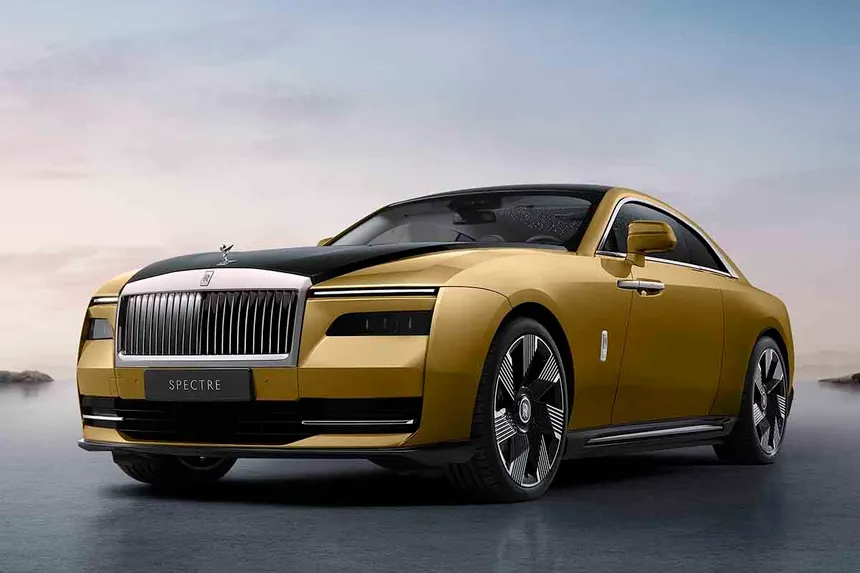
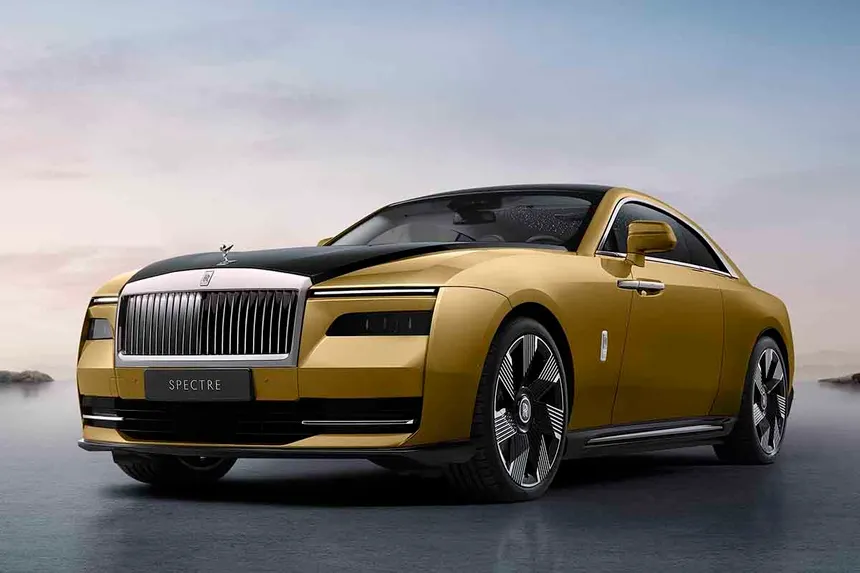
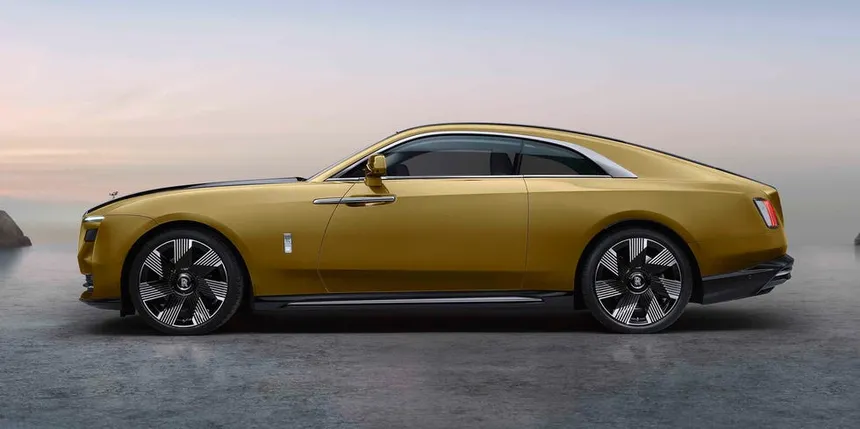
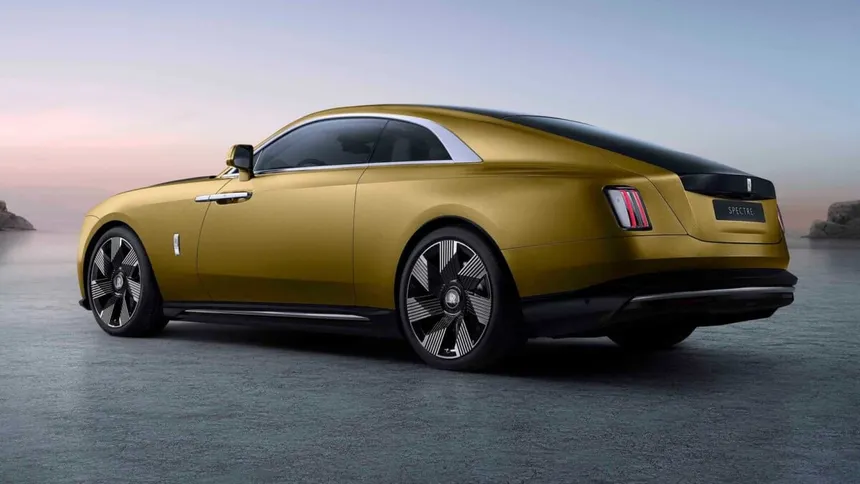
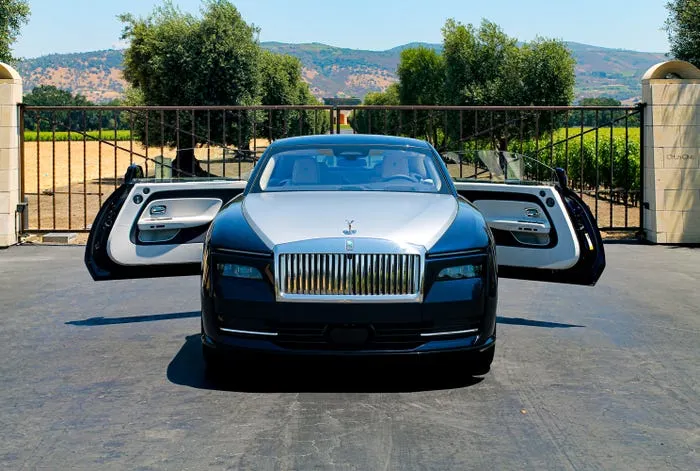
Fair’s fair, and this is NEC, where the numbers go before the bile. As an object, the Spectre is a monster of engineering. A near-5.5-metre electric super-coupé, twin motors producing 577 to 585 hp and around 900 Nm, all-wheel drive, zero to sixty in 4.4 seconds. Just over 100 usable kWh on the brand’s own aluminium “Architecture of Luxury,” shared with the Phantom and Cullinan. Real-world range around 290 miles. Starting near £330,000, climbing well past half a million once the Black Badge and the options list get involved.
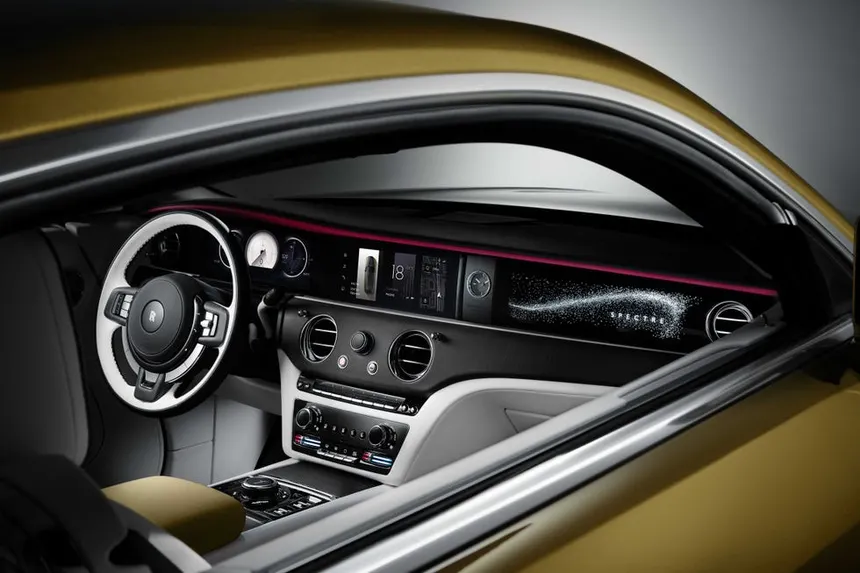
And the quality is real. Doors that close themselves at the touch of a button, a starlight headliner with thousands of fibre-optic points, the materials, the assembly, suspension that reads the road by satellite and primes the dampers before the bump arrives. Rolls put the Spectre through a 2.5-million-kilometre test programme, the equivalent of 400 years of use. That’s not theatre. That’s a company that knows how to build cars and builds them brilliantly.
The problem isn’t the car. The problem is the promise the car can no longer keep.
When every Rolls runs the same motor
Here’s a question Goodwood would rather you didn’t ask. By 2030, Rolls-Royce will be entirely electric — Phantom, Cullinan, Ghost, all of it, every model running fundamentally the same kind of motor as a Hyundai. For a century, part of the hierarchy inside the range came from the machinery: a Phantom’s V12 was a different beast from a Ghost’s, and you paid for the difference. Electrification flattens that. An electric motor is an electric motor. The performance gaps become software decisions, numbers a manager picks in a meeting, not metal you can feel.
So the differentiation has to migrate entirely to the things that aren’t mechanical — the length of the bonnet, the depth of the lambswool, the headliner, the name. Which is fine for now, because Rolls is brilliant at exactly those things. But it puts enormous weight on perception, and perception is the one asset that can collapse without warning. A V12 is a fact. An aura is a consensus, and consensus is fragile. The day enough people decide a silent electric luxury car is a silent electric luxury car regardless of the badge, the whole edifice wobbles. Rolls is betting, correctly for the moment, that day is far off. But they’re betting the company on a feeling, where they used to bet it on an engine.
The engine was the enemy. It was also the soul
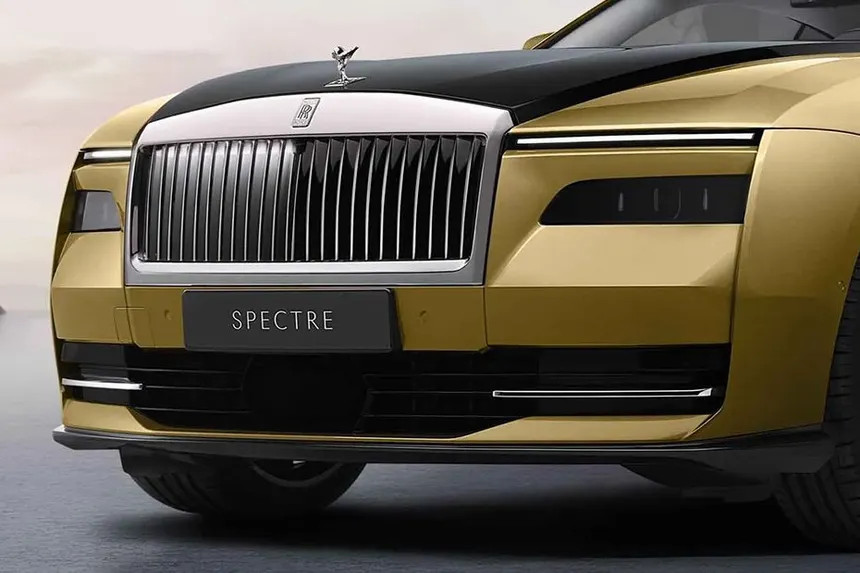
Here’s the paradox that actually bites. For a century, the combustion engine was the enemy Rolls-Royce existed to defeat. The noise, the vibration, the heat, the gearchanges — all of it the adversary their engineers fought to hand you absolute calm. But that same engine was also the soul of the car. A silent Rolls V12 wasn’t silent by accident. It was silent because there was a twelve-cylinder monster up front that they’d tamed. The calm had merit because it concealed a beast.
The Spectre conceals no beast. There’s nothing to tame. The Spectre’s silence isn’t a victory over noise, it’s simply the absence of something that no longer exists. And that changes the nature of what you’re buying. You’re no longer buying a team of craftsmen who managed to silence a V12. You’re buying an electric motor that came quiet from the factory, like all of them. The merit has evaporated. The result remains, but the result is now everyone’s.
It’s as if a winery had spent a century perfecting the art of stripping the alcohol from wine without losing the flavour, charging a fortune for the privilege, and then someone invented a machine that makes perfect alcohol-free wine for pennies. The achievement is still an achievement. But it’s no longer yours. No longer special. No longer paid for.
So what does Rolls actually sell now?
This is the £330,000 question, and the answer is more interesting than it looks.
Because Rolls isn’t stupid. They know perfectly well that silence no longer belongs to them. In fact they’ve known it since long before the Spectre, which is why they spent the better part of a decade preparing the ground. The shift wasn’t sudden, it was an orderly retreat: the 2017 Phantom VIII quietly stopped being sold as “the best car in the world” and started being sold as a piece of art on wheels, and the 2018 Cullinan didn’t conquer the market by being the most capable or the fastest SUV — it conquered it for one reason, because it was a Rolls-Royce shaped like an SUV. Years before any EV arrived, Rolls was already moving the weight of the argument away from what the car does and toward what the car is. The Spectre doesn’t begin that journey. It finishes it. And the fact they started so early says something they’d rather not admit: they knew silence was running out before anyone else noticed.
Worth killing one lazy idea before some pedant raises it: that an electric motor is just silent, for free. It isn’t, quite. An EV has its own noises — that high-frequency whine, the hiss of the power electronics, drivetrain sounds a petrol engine used to mask. Rolls had to work hard to hush those new noises. So yes, there is engineering behind the Spectre’s silence. But it’s a different engineering, one of damping and disguise, not the grand opera of taming a V12. And crucially, it’s engineering every serious manufacturer is doing too. The Spectre’s silence is real and hard-won. It just isn’t exclusive any more, and exclusive was the only thing that ever mattered.
Which is why, if you read their pitch closely, they’ve stopped selling silence and started selling something else: presence. The name “Spectre” wasn’t a random choice. They explained it themselves — a spectre is a being that dominates the space it occupies, forces the world to pause, then dissipates. They’ve swapped “you won’t hear me” for “you can’t ignore me.”
And there, credit where it’s due, they still hold a card worth playing. Because presence, aura, the symbolic weight of the Spirit of Ecstasy on the bonnet, 120 years of mythology — no Tesla gives you that. It’s the one thing technology can’t democratise. A BYD will be just as silent as a Spectre, but it will never carry the century of history, the lineage, the aura. It’s the very aura the Cadillac Celestiq tries to buy with a chequebook without having inherited it, while Mercedes, with the Vision EQXX, plays an entirely different game of luxury: intelligence. Rolls’s luxury no longer lives in what the car does, because anyone can do that now. It lives in what the car means.
The trouble is that’s far slipperier ground. Silence was measurable. It was engineering, an objective advantage that justified the price. Presence is pure perception. It’s brand. It’s telling a story well enough that someone pays half a million for an aura. Rolls has moved from selling a fact to selling a feeling. And selling feelings is far more fragile than selling silence, because the day the story stops being believed, there’s no engineering left underneath to hold it up.
The contradiction Rolls won’t resolve
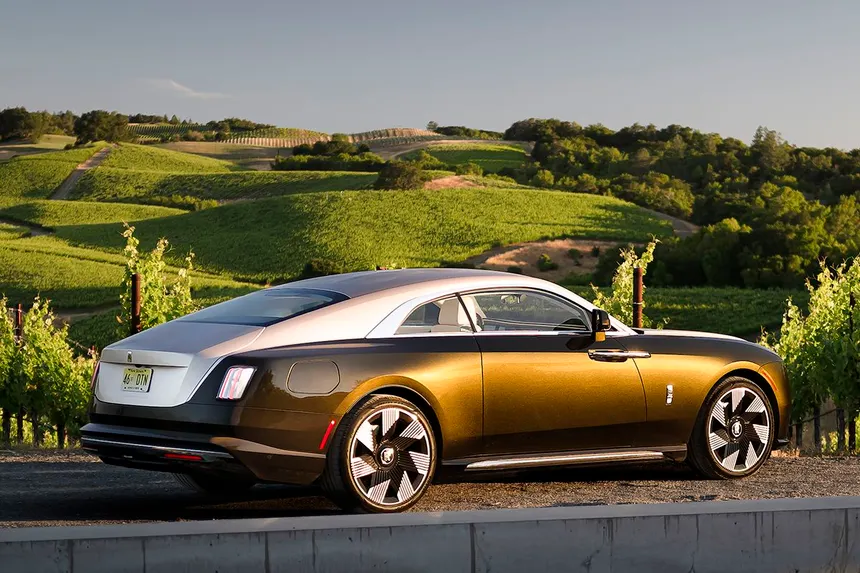
Rolls keeps insisting the Spectre is “a Rolls-Royce first and an electric car second.” It’s their favourite line, trotted out in every interview. And it sounds great until you think about it for two seconds.
If the Spectre is a Rolls first and electric second, then what makes it a Rolls isn’t the engine. It never was. It’s everything else — the presence, the finish, the aura. Fine. But then why have they spent a century telling us the engine’s silence was the essence of the marque? Either the engine mattered, in which case removing it changes what a Rolls is, or it didn’t, in which case they’ve been selling us acoustically-insulated smoke for a hundred years.
They can’t have both. You can’t spend a century saying your obsession with silencing the engine is what makes you unique, and then, when the engine vanishes, announce the engine was never the point. That contradiction is the true portrait of the Spectre: a brand that won its own war and discovered, too late, that victory stripped away its reason to exist.
Is it luxury? And is it the future of Rolls?
Two questions, separated as always.
Is it luxury? Yes, but a different luxury. No longer the luxury of engineering that silences the impossible, but the luxury of the symbol, the belonging, the name. It’s the luxury of a Patek Philippe in the age of the Apple Watch: the quartz watch keeps better time, but nobody inherits an Apple Watch. Rolls has moved from “we make the best car” to “we make the object that says who you are.” It’s luxury, but a luxury no longer defended with data. It’s defended with narrative.
Is it the future of Rolls? Probably yes, and there’s no sarcasm here. Unlike others who improvise, Rolls has had full electrification planned for 2030 for years, the Spectre is only the first step, and the marque owns the one thing that truly matters once the engine stops being the argument: a mythology nobody else can buy or build. The Spectre isn’t the car that best shows what Rolls can do. It’s the car that proves Rolls knew, long ago, that the engine was expendable and the myth was not.
Which leaves us a delicious conclusion. The Spectre is, simultaneously, the most Rolls-Royce car in history and the one that destroys the idea of Rolls we were sold. It’s both. It fulfils the founder’s prophecy and, in fulfilling it, proves the prophecy applied to everybody. It dominates the space it occupies, as its name promised, and at the same time dissipates into a sea of equally silent EVs.
Charles Rolls was right in 1900. The electric car was the future, silent and clean. What he didn’t see, couldn’t see, is that this silent future wouldn’t be a privilege. It would be the air everyone breathes. And when the luxury you sell becomes the air everyone breathes, you’re left with one thing to sell: the name written on the bonnet. Rolls knows it. Which is why the Spectre, inside, is perfect. And why, outside, it shouts its name louder than ever.
Check you’re still alive.
1 thought on “ROLLS-ROYCE SPECTRE”