
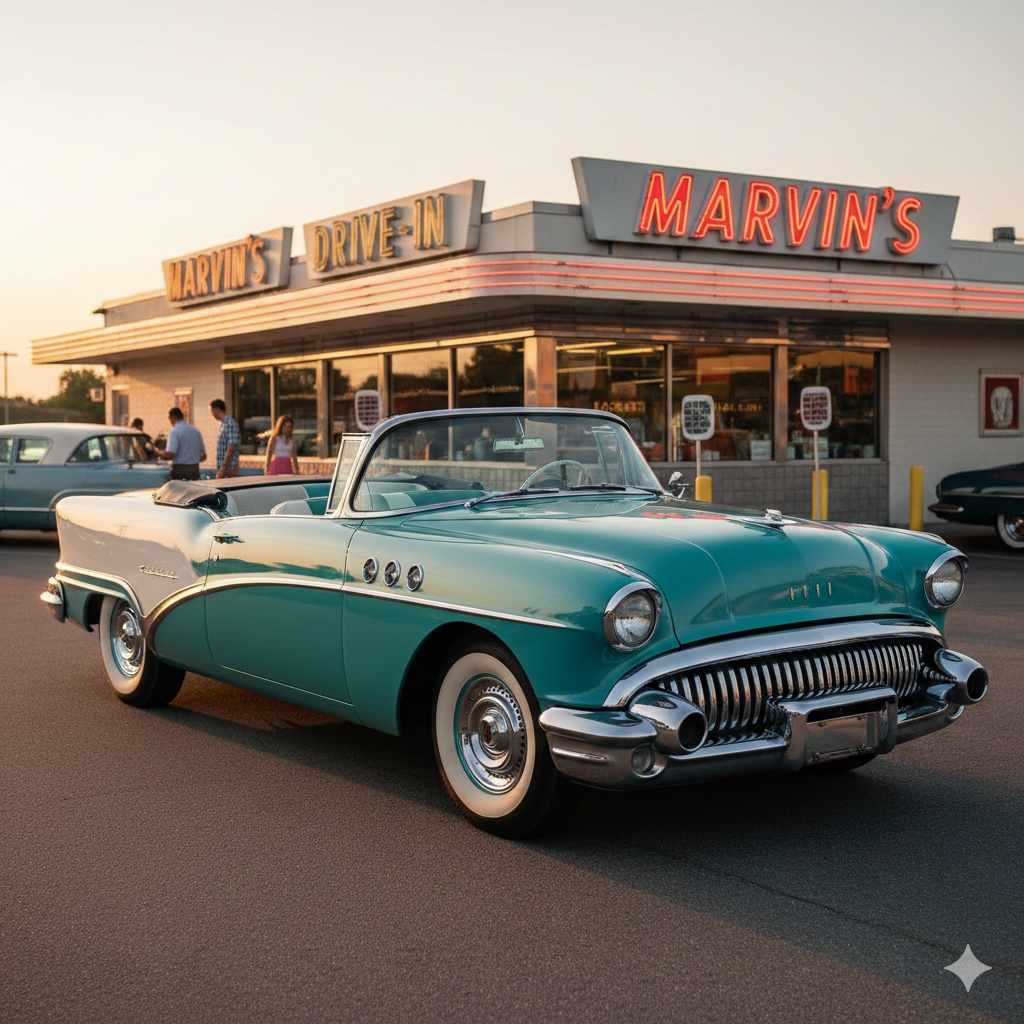
1950s Buicks: The Chrome Harbingers of the American Dream

The Golden Decade of the American Automobile
If you had to choose one decade to represent the essence of the American car, it would be the 1950s. And if you had to pick one brand that encapsulated that era, it would be Buick.
It wasn’t the top seller (that was Chevrolet). It wasn’t the pinnacle of luxury (that was Cadillac). It wasn’t the sportiest (perhaps Pontiac held that title).
Buick was something harder to define: it was the car for people who had arrived.
The town doctor drove a Buick. The successful attorney drove a Buick. The entrepreneur who started with nothing and now managed a crew drove a Buick. It was the ultimate badge of the American upper-middle class—a reward for those who worked hard and made it.
Buick’s 1955 slogan said it all: “When better automobiles are built, Buick will build them.”
The “Portholes”: A House Mark
Before diving into specific models, we must discuss the “VentiPorts”—or as everyone called them, portholes.
Those four (or three, on lesser models) oval openings on the front fenders are perhaps the most recognizable design element of any American car from that era.
First appearing in 1949, they became Buick’s visual signature. Originally, they were meant to be functional, supposedly venting the engine compartment. In practice, they rarely served a purpose. They were pure design, pure presence, pure style.
Fun Fact: Top-tier models (Roadmaster, Limited) sported four portholes. Entry-level models (Special) had three. It was a subtle way of signaling exactly how much you had spent without saying a word.
The Fireball V8: Heart of the Beast
In 1953, Buick introduced the “Nailhead V8″—officially branded the Fireball V8—which would define the brand for a decade.
Why “Nailhead”? Because the valves were smaller than vertical, giving the engine a “nail head” appearance when viewed from above.
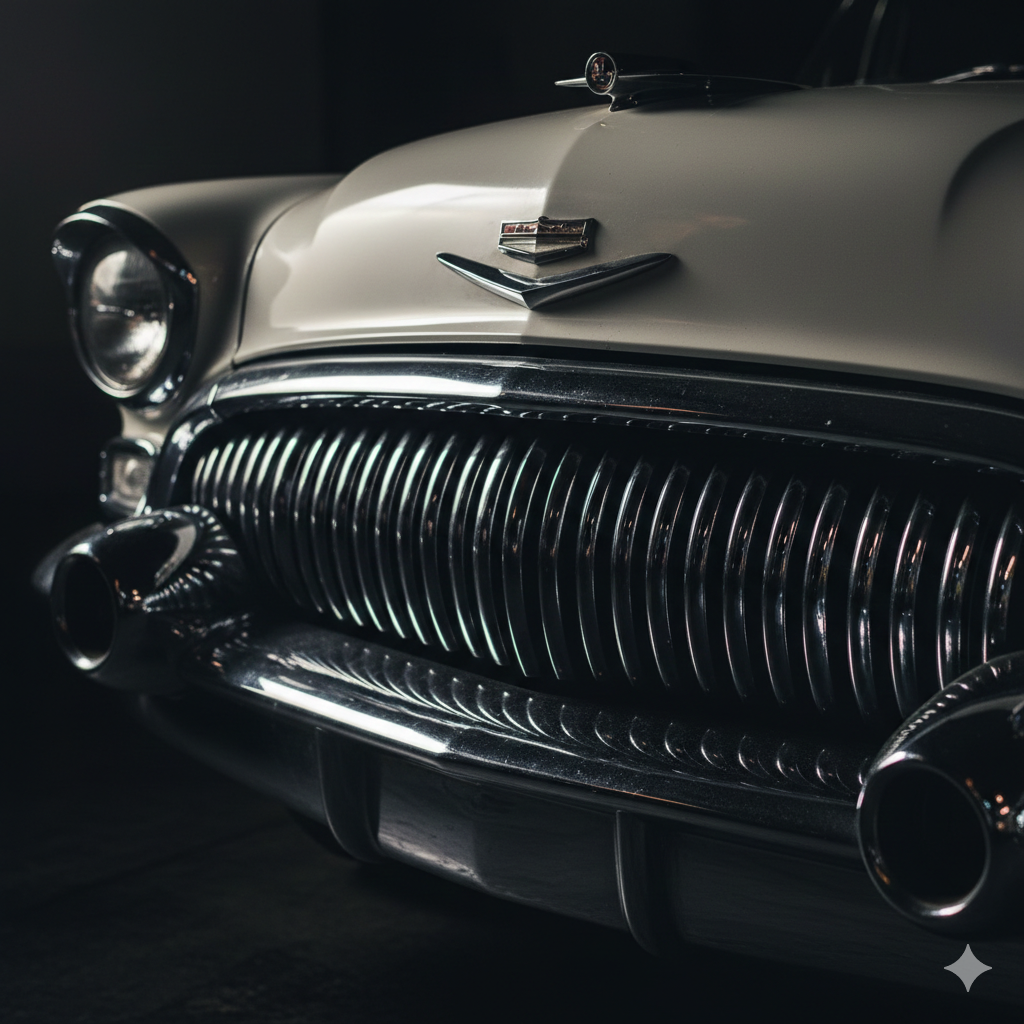
Fireball 322 Specs (1953-1956):
- Displacement: 322 ci (5.3 liters)
- Horsepower: 188-255 HP (depending on year/config)
- Torque: 300+ lb-ft
- Special Characteristic: Peak torque at very low RPM
The Nailhead wasn’t a high-revving engine like a Chevy. It was an engine of THRUST. From idle, you felt the car’s urge to move. It provided the perfect sensation for American drivers of the time: effortless power, like piloting an ocean liner.
By 1957, the engine grew to 364 ci (6.0 liters) with up to 300 HP. In 1959, the epic 401 ci (6.6 liters) arrived, churning out 325 HP.
The Models: A Clear Hierarchy
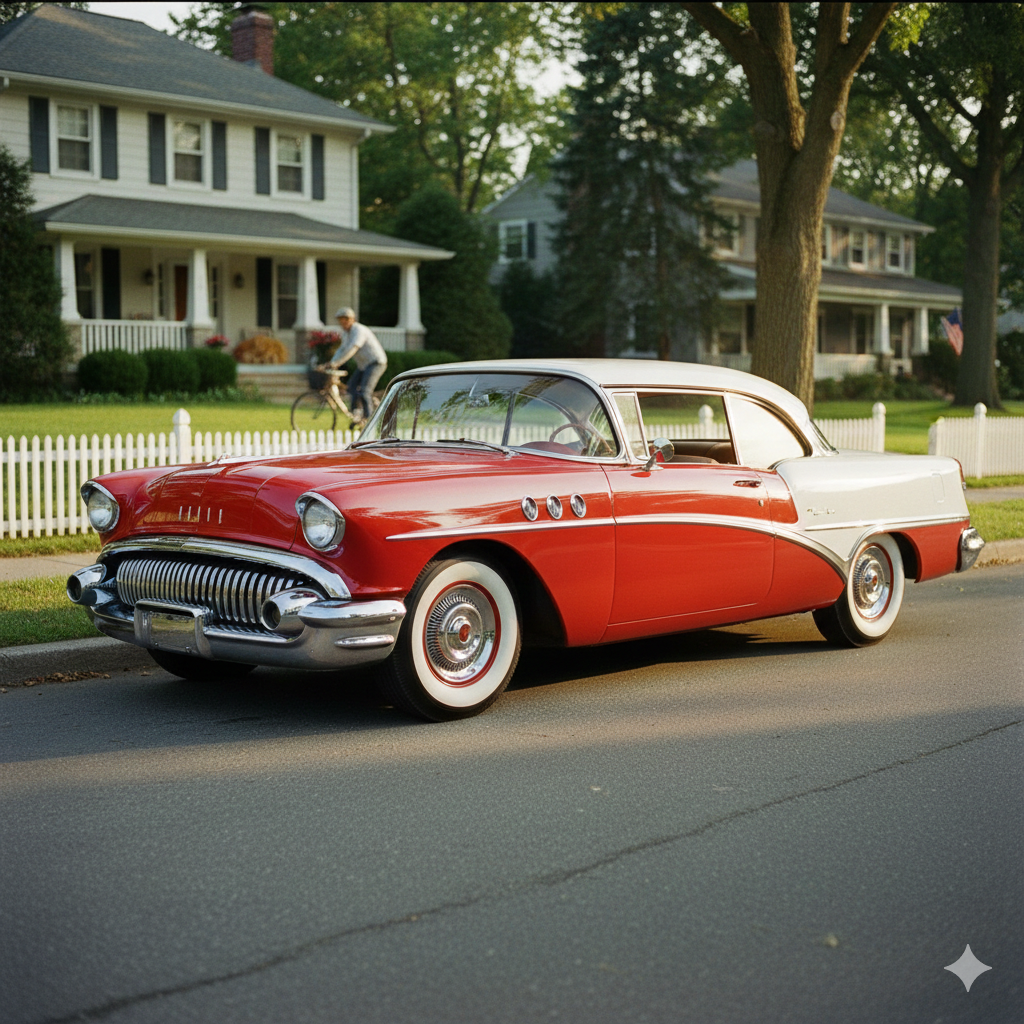
- Special (1950-1959): The entry-level Buick. Initially featuring a straight-8, then a V8. 3 portholes. Aimed at young professionals and upwardly mobile families.
- Century (1954-1958): Buick’s “hot rod.” It put a big engine in a small body. Known as the “banker’s hot rod,” it combined the Roadmaster engine with the Special chassis. Aimed at dentists with a need for speed.
- Super (1950-1958): The literal middle ground. Full engine, full trim. The backbone of the American middle class.
- Roadmaster (1950-1958): The flagship. The best of everything: engine, interior, and dimensions. 4 portholes and chrome everywhere. For those who had definitively “arrived.”
- Limited (1958): Only one year of production. The longest Buick ever made at 18.8 feet (5.74 meters). More exclusive than a base Cadillac. For executives seeking something different.
1957: The Definitive Design Year
If one year defined Buick, it was 1957. The design—the work of Harley Earl and the GM Styling team—is considered by many to be the pinnacle of American automotive aesthetics.
Key 1957 Buick Elements:
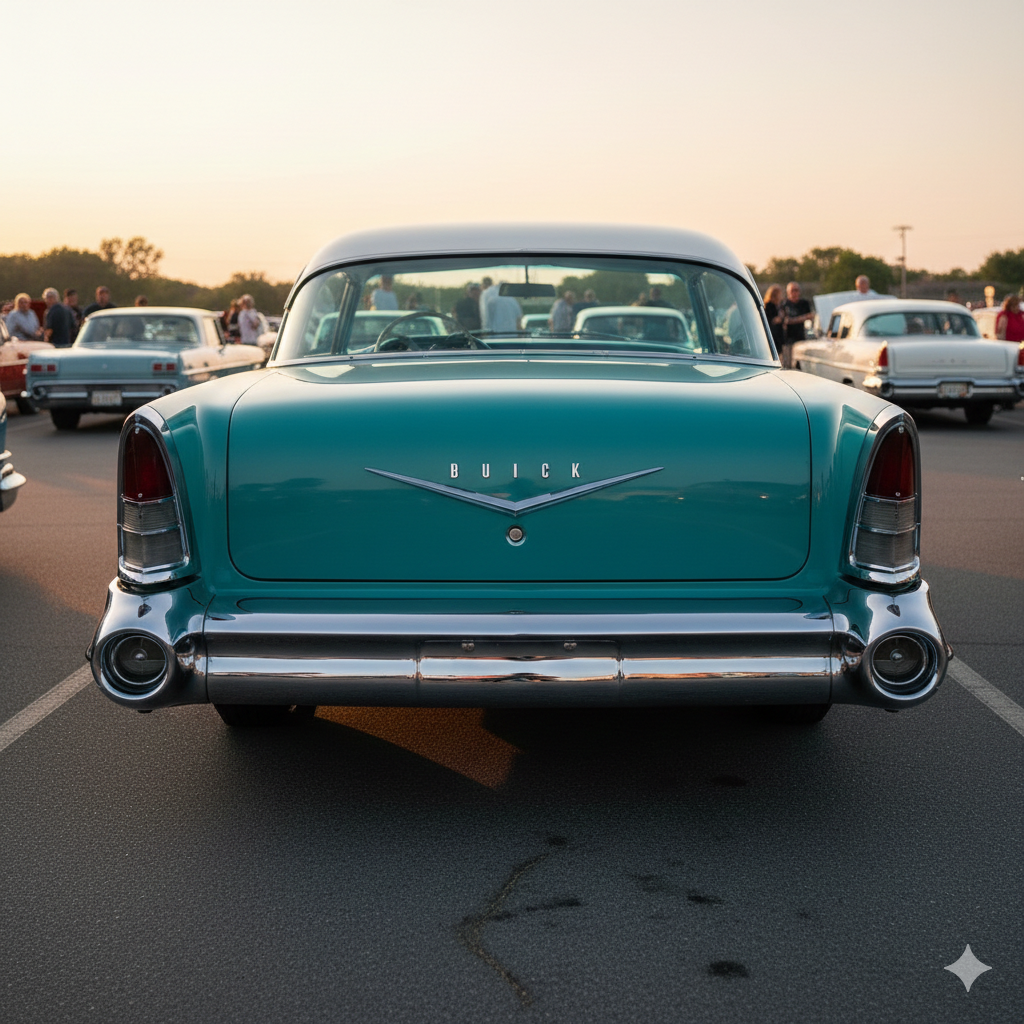
- Pronounced but elegant tailfins (less extreme than Cadillac).
- “Dagmar” front grille with chrome bumper guards.
- The side “Sweepspear”: a chrome line running the length of the car.
- Two-tone colors: Turquoise/White, Pink/Black, Green/Cream.
- Geometric pattern upholstery.
The 1957 Roadmaster Convertible in turquoise and white is perhaps the quintessential American classic. Every movie or ad needing to represent “1950s America” uses a car that looks like this Buick.
Vintage Pricing (and What It Meant)
| 1957 Model | Price | 2026 Inflation Equivalent |
| Special 4-door | $2,596 | ~$28,000 |
| Century 2-door | $3,206 | ~$34,000 |
| Super 4-door | $3,516 | ~$38,000 |
| Roadmaster 4-door | $3,830 | ~$41,000 |
| Roadmaster Conv. | $4,066 | ~$44,000 |
For context, a Chevrolet Bel Air cost $2,290, while a Cadillac Series 62 cost $4,781. Buick occupied the perfect “sweet spot”: expensive enough to be aspirational, yet accessible enough to be attainable.
The Dynaflow: Smooth as Silk
If the Fireball engine was the heart, the Dynaflow was the soul. This torque-converter automatic transmission offered a truly smooth ride. There were no “shift shocks” because, technically, there were no shifts. The original Dynaflow was a single-speed unit that functioned entirely through the torque converter.
Critics hated it, calling it sluggish and inefficient. Customers loved it—it felt like floating on asphalt. Buick marketed “Dynaflow smoothness” as a premium feature, and the public bought in.
Curiosities and Trivia
- Eisenhower’s Buick: President Dwight D. Eisenhower used a Roadmaster as his personal car. When asked why not a Cadillac, he reportedly said: “A Cadillac looks like you’re showing off. A Buick looks like you earned it.”
- The “Bomber Nose”: The 1950 grille was inspired by B-52 bomber aesthetics. GM designers had worked on aircraft during the war and brought that “jet age” look to the streets.
- “Mandarin Red”: This 1957 color was so popular that the pigment supply ran out mid-year. Cars produced after May 1957 have a slightly different red hue.
- The Censored Ad: In 1955, Buick filmed a Century hitting 110 mph. Networks refused to air it for “promoting dangerous driving.” The ad became an urban legend.
- Nailhead Hot Rods: Ironically, the engine GM designed for refinement became a hot rod favorite. Its low center of gravity and massive torque made it perfect for drag racing.
1958: The “Horrible Year”
1958 was disastrous for the entire industry, but especially for Buick. An economic recession hit just as GM released its most extreme redesign. The new Buicks were BIGGER, MORE chromed, and MORE expensive—exactly what the market no longer wanted.
Sales plummeted from 404,048 units in 1957 to 240,659 in 1958—a 40% drop. The design was so poorly received it lasted only one year. By 1959, Buick pivoted to cleaner lines and less chrome.
The Legacy: Why 1950s Buicks Matter
These cars represent more than just transportation; they are symbols of:
- Post-War Optimism: America was the world’s powerhouse, and anything felt possible.
- Middle-Class Prosperity: For the first time, millions could afford luxury-tier vehicles.
- Unfettered Design: Without safety or fuel regulations, designers created monsters of chrome and color.
- The Tangible American Dream: A Buick in the driveway was proof of success.
Current Market: Surprisingly Accessible
Unlike 1960s muscle cars or European sports cars, 1950s Buicks remain relatively affordable.
2026 Estimated Prices:
- Special Sedan: $30K (Concours) | $15K (Driver) | $5K (Project)
- Century 2-door: $50K (Concours) | $25K (Driver) | $10K (Project)
- Roadmaster Conv.: $120K (Concours) | $70K (Driver) | $40K (Project)
Because many collectors prefer 60s muscle, 1950s Buicks are often perceived as “grandpa cars.” This is an opportunity: for the price of a mediocre ’68 Mustang, you can own a show-quality ’57 Roadmaster.
Debate: Timeless Art or Kitsch Excess?
- The Fans: Call them Jet Age masterpieces. They argue the chrome is an intentional, honest celebration of optimism.
- The Critics: See them as symbols of waste and gaudy consumerism, glorifying an era of exclusion.
The Verdict: They are products of their time. Judging them by modern sustainability standards is anachronistic; enjoying them as time capsules is appropriate.
Driving a 1950s Buick Today
- The Size: A ’57 Roadmaster is 18 feet long—longer than a modern Mercedes S-Class. Parking is an act of faith.
- The Steering: Very light (especially with power steering), but disconnected. You turn the wheel, and the car responds a half-second later.
- The Braking: Requires anticipation. Plan your stops 300 feet in advance.
- The Comfort: Like driving a sofa. The suspension swallows every bump. You don’t drive; you float.
Conclusion: Rolling Monuments to a Lost Era
The Buicks of the 1950s are time machines. They embody a moment when America believed the future would be bigger, brighter, and more chromed than the present.
That vision was naive and unsustainable, but it was also glorious. They remind us of a time when designers dreamed without limits and excess was a celebration, not a sin.
For Discussion: If modern designers had the same freedom—no safety regulations, no emission limits—would they create something this bold? Or has the era of visual excess passed forever?
4 thoughts on “BUICK ’50”