The shopping car that beat everyone: what the Ford Escort Mk1 still teaches us
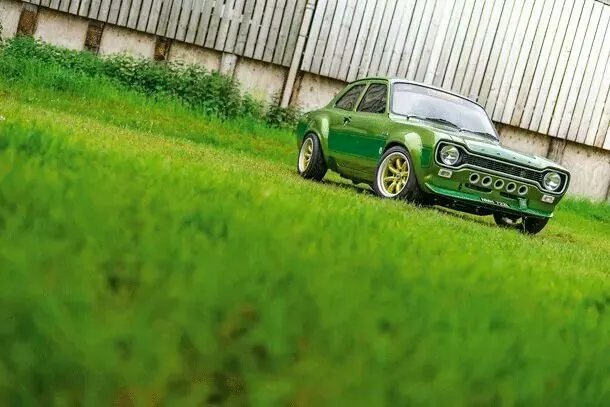
Ask any rally fan of a certain age to name the car that defines the sport, and a startling number will skip the supercharged monsters and the all-wheel-drive Group B fire-breathers entirely. They’ll say Escort. A two-door saloon designed to take a family to the shops, in production from 1968. And they’ll say it with the kind of reverence usually reserved for Ferraris.
Why? Because the Mk1 Escort answered a question that still matters more than almost any other in performance engineering: how does a cheap, simple, light car beat machinery that is more powerful, more expensive, and better funded?
The answer was never about power. It was about what the car didn’t have.
Born without pretensions
The Escort broke cover at the 1968 Brussels Motor Show. On paper, unremarkable: a small two-door saloon to replace the Anglia, built to sell in huge numbers to ordinary families. Engine up front, drive to the rear, a leaf-sprung live axle behind, MacPherson struts ahead. None of it was cutting-edge even in 1968.
But two things about that ordinary package changed everything. It was extraordinarily light. And it was disarmingly simple.
The numbers tell the story. A road Escort weighed around 745kg dry. The RS1600, fully kitted with its competition hardware, came in near 785kg. For context, a small, basic hatchback today weighs roughly double that. That missing mass is the secret behind everything that follows. A light car stops sooner, turns better, eats less rubber, breaks fewer parts, and forgives the driver more. No trickery. Just physics.
Ford knew it. The competition department had spent all of 1967 developing a racing Escort before the standard car had even reached showrooms. They could see the Cortina was in the autumn of its competition life and needed an heir. The Escort was that heir from day one.
The Twin Cam: a Lotus engine in a shopping car
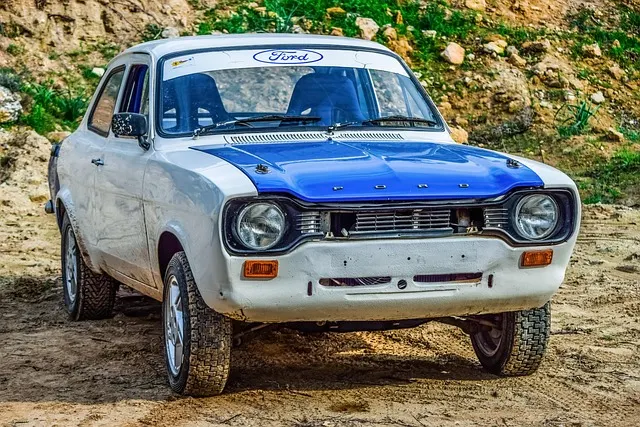
The first shot was the Escort Twin Cam, and the move was as simple as it was brilliant: take the Escort’s light shell and drop in the 1,558cc twin-cam engine Lotus had developed — the same unit from the Lotus Cortina.
Suddenly you had a sub-800kg car with an engine that genuinely breathed. To clear wider tyres, Ford flared the arches, and the “bubble arches” were born — the swollen wheel arches that became the signature of every fast Escort, and which, half a century later, Boreham still copies on its 2026 Mk1 RS.
The Twin Cam started winning in 1968, the year it launched. But the Lotus engine had a flaw: complex, costly to maintain, not especially reliable when worked hard. And here Ford made a decision that defines the whole philosophy of the car.
The RS1600 and the birth of a legend: the BDA
Rather than persist with the Lotus unit, Ford commissioned Cosworth to design a new head. Cosworth took the humble cast-iron Kent block — the same one from shopping-trolley Escorts — and crowned it with a light-alloy, twin-cam, 16-valve head. The result was the BDA: Belt Drive, Series A, after the toothed belt driving its camshafts.
From a family-car block and a competition head came one of the most legendary engines in Ford’s history. The BDA made around 120bhp from 1.6 litres — startling for the era — and in the car it became the RS1600. The first example left Halewood on 11 January 1970.
There’s a lovely technical detail here. The BDA displaced exactly 1,601cc, and not by accident: exploiting production tolerances, that figure let the engine be enlarged to two litres in competition without leaving its class. The last RS1600s also gained an all-alloy block designed by Brian Hart, lighter still. Every decision pushed the same way: less weight, more revs, more cunning.
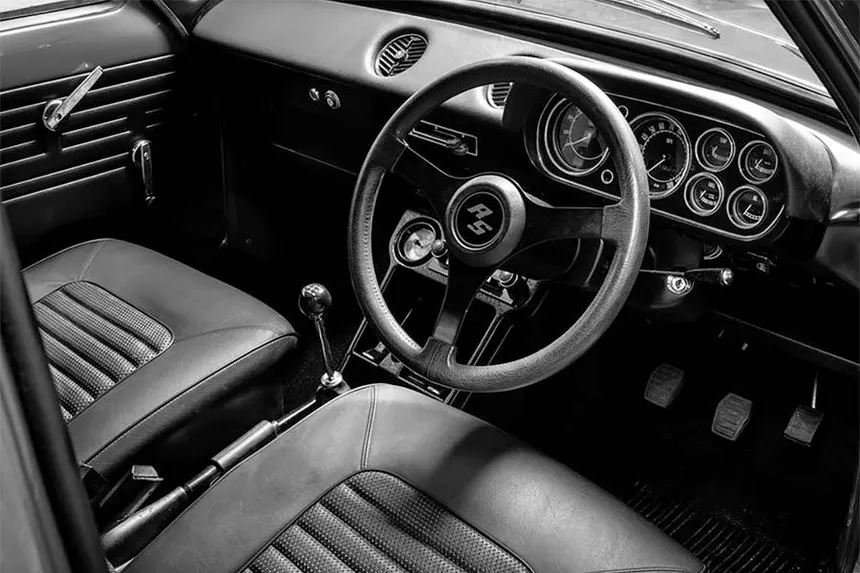
The RS1600 was built at Ford’s new AVO plant at Aveley, Essex. Advanced Vehicle Operations — a factory dedicated solely to the sporting Escorts. Strengthened “Type 49” bodyshells, Rallye Sport suspension and brakes. This was the division that turned a shopping car into a homologated weapon.
Mexico: the day simplicity beat power
And now the episode that, for me, captures the entire essence of the Escort.
In 1970 came the London to Mexico World Cup Rally: 16,000 miles from Wembley to Mexico City, 38 days, 96 crews at the start. A monstrous thing. A test of endurance far more than speed.
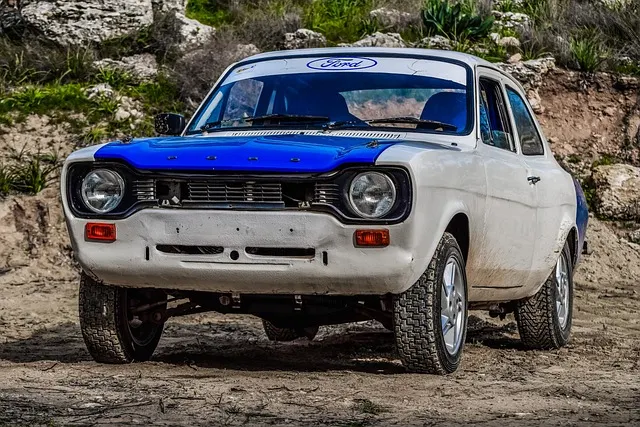
Ford had two sporting Escorts in the range: the Lotus-powered Twin Cam and the Cosworth-BDA RS1600. The obvious move was to send the most powerful cars. But driver Roger Clark, after recceing the terrain, argued the opposite: use the strengthened Type 49 shell and swap the sophisticated engines for the old, simple Kent crossflow, enlarged to 1,834-1,850cc. His reasoning was a mechanic’s, not a marketer’s: a 16,000-mile rally is won on reliability and ease of service, not peak power.
He was dead right. Hannu Mikkola and Gunnar Palm won in an Escort 1850 GT running the bombproof Kent engine. And not just won — five Escorts finished in the top eight. The humble, everyday engine destroyed more powerful, more expensive rivals because it simply didn’t break.
Sit with that, because it’s the thesis of the whole car. At the moment of truth, in the hardest test, Ford won by giving up power and sophistication and betting on simplicity. Stuart Turner, the competitions boss, once praised that Kent engine for “bombproof reliability.” Those two words are the entire Escort.
The Mexico: turning a win into a best-seller
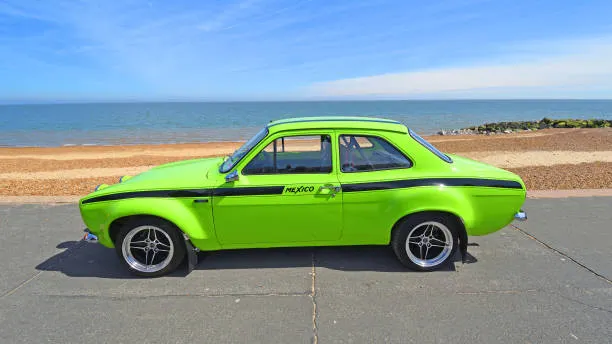
Ford didn’t waste the marketing open goal. Six months after winning, it launched the Escort Mexico: a road car celebrating the victory, with the RS1600’s strengthened Type 49 shell but the simple 1,600cc Kent crossflow in place of the costly, temperamental BDA.
And here’s the business lesson riding alongside the engineering one. The Mexico was a runaway hit. 10,352 Mk1s were built, outselling the RS1600 by nearly ten to one. Why? Because it was everything the enthusiast wanted: genuinely quick, easy to maintain, relatively cheap to insure, and a joy to drive. A homologated competition car a working bloke could afford and fix himself in his own garage.
In 1971 a one-make Escort Mexico race series was even launched, and it became fiercely popular and competitive. The Escort didn’t just win at the top — it democratised the sport. Anyone with one and a bit of nous could go racing.
The RS2000 and the end of an era
Before we close, the last of the Mk1 sporting line deserves a name: the RS2000. Ford launched it as a more manageable, more reliable alternative to the temperamental RS1600, fitting the 2.0-litre overhead-cam Pinto engine in place of the exotic BDA. Less sophisticated, more usable, just as much fun. The same recipe as ever: take something simple and tough, drop it in a light shell, and let physics do the rest. The RS2000 pre-empted the affordable performance car concept we’d later call the hot hatch.
This whole family — Mexico, RS1600, RS2000 — came from the same AVO plant at Aveley. And it all ended together, when AVO closed its doors in January 1975 and the Mk1 gave way to the Mk2. In 1972 Ford had even launched the AVO Special Build programme, letting customers pick from the full catalogue of competition upgrades direct from the factory to build their own International Rally, Club Rally or Hi-Series street car. It was, in effect, a competition car à la carte. Hard to imagine a mainstream brand offering that today.
How it measured up against its rivals
To grasp the achievement you have to place it among its contemporaries. In the late 1960s and early ’70s, the Escort’s competition rivals were cars like the Mini Cooper S, the Alpine A110, the Saab 96, and in touring car racing, heavier and more powerful machinery. The Alpine, with its glassfibre body and rear-mid engine, was a purer piece of engineering. The Mini was brilliant but small and engine-limited. The big touring cars had power but hauled the weight to match.
The Escort wasn’t the fastest in a straight line in any of those groups. It was the one that combined everything best: enough power, low weight, the toughness to finish, and the ease of fixing it between stages. In the 1970 Mexico marathon, British Leyland’s Triumph 2.5 PIs were more powerful than the Fords but significantly heavier, and the scales tipped toward light reliability. Again and again, the same story: the Escort won on balance, not on superiority in any single number.
Why it worked: the physics of a live axle, properly understood
Time to dismantle a prejudice. Many people, hearing “live rear axle,” picture old technology, something inferior to independent suspension. And broadly, a well-designed independent setup is superior. But in the Escort’s context, the live axle was a virtue, not a fault.
A live axle is simple, tough and cheap to repair. On a rally stage, where you break things and fix them by hand at the roadside, that simplicity is gold. It also keeps the tyre more perpendicular to the ground over big hits, which matters enormously on gravel and over jumps. Combined with the car’s low weight and front engine, it gave a magical balance: a car that moved on the throttle, oversteered controllably, let the driver be brave knowing the car would talk to them before it ever let go.
That’s the key word: balance. The Escort didn’t dominate any single figure. It dominated in how all its modest figures worked together. Low weight to spare the brakes and tyres. Front engine, rear drive to split the labour between axles. Live axle to take the beating. Simple mechanicals to fix anywhere. No part was exotic. The combination was unbeatable.
Compare what came later. Ford itself built the Escort Cosworth and, by the 1990s, an Escort WRC weighing 1,230kg with over 300 turbocharged horsepower and four-wheel drive. Cars infinitely more capable on paper. Yet none generated the affection or the mythology of the Mk1. Because the Mk1 won by being accessible. It won by being the bloke-next-door’s car, only better driven. You can’t manufacture that closeness with horsepower.
The inheritance: from 745kg in 1968 to 895kg in 2026
And here the circle closes. Fifty-five years on, Boreham Motorworks has built a brand-new Mk1 Escort, officially licensed by Ford, chasing precisely what the original chased: low weight. Its target is 895kg. Heavier than the 1968 car, yes — modern safety has mass — but with the same obsession with lightness as the central philosophy. Even the bubble arches are still there.
It’s no coincidence. The lesson of the Mk1 hasn’t expired. In an age when every new car weighs more than the last — stuffed with screens, batteries and assists — the Mk1 stands there reminding us of a truth the industry would rather forget: that weight is the enemy. That simplicity, properly understood, isn’t poverty — it’s intelligence. And that the car which beat everyone did so not by having more, but by needing less.
A shopping car that became a legend by subtracting, not adding. That’s the story of the Escort Mk1. And today, more than ever, it remains one of the finest engineering lessons a car can give you.