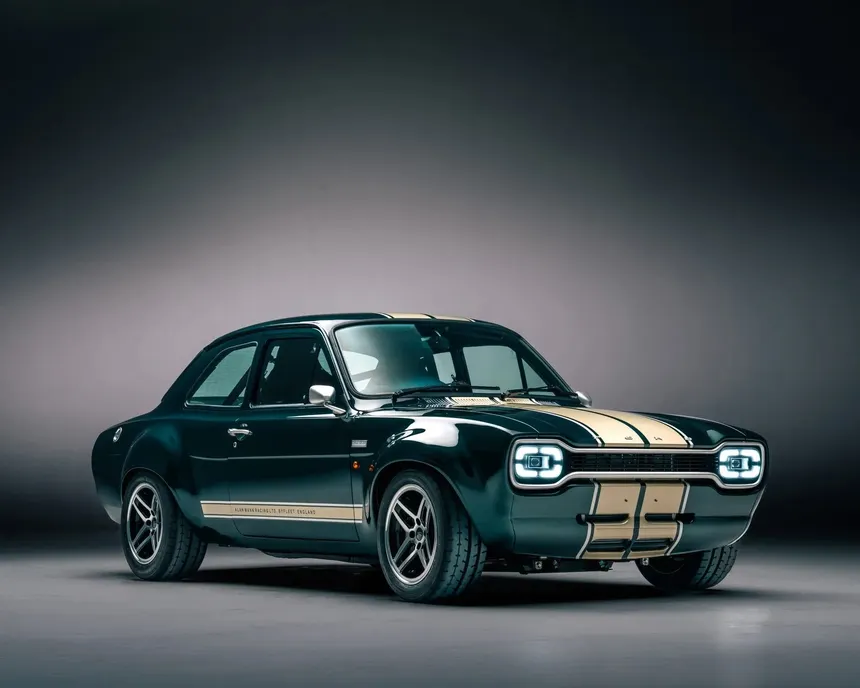
Boreham built a brand-new Ford Escort Mk1 in 2026 — and “restomod” is the wrong word for it
Chris Harris has a theory about old fast Fords: the magic was never the power. It was the lack of weight, the live rear axle stepping out on command, the sense that the car was conspiring with you rather than babysitting you. Watch any onboard of an Escort on a wet stage and you understand it in three corners.
Now imagine someone built that feeling again. From scratch. In 2026. With Ford’s signature on the paperwork.
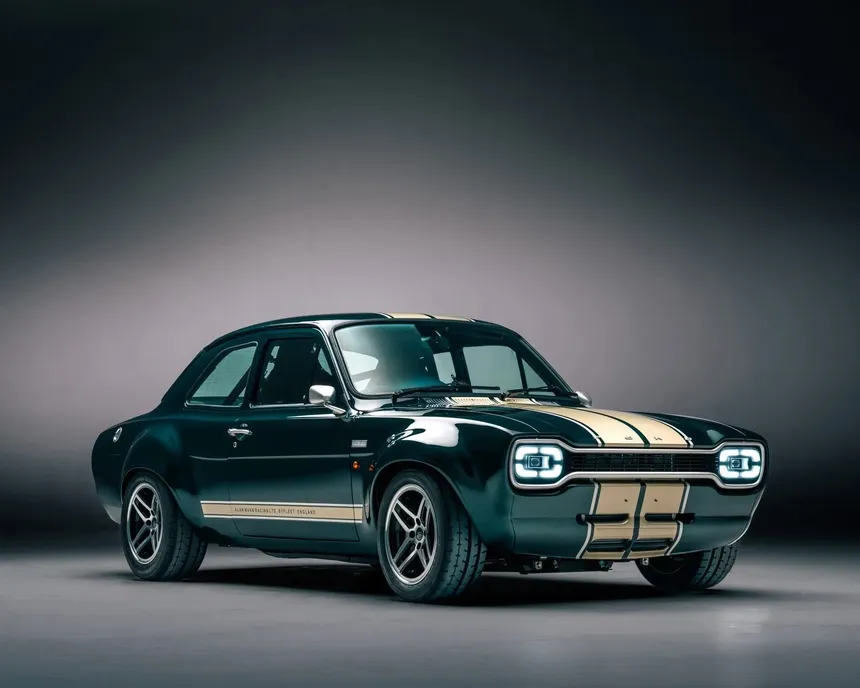
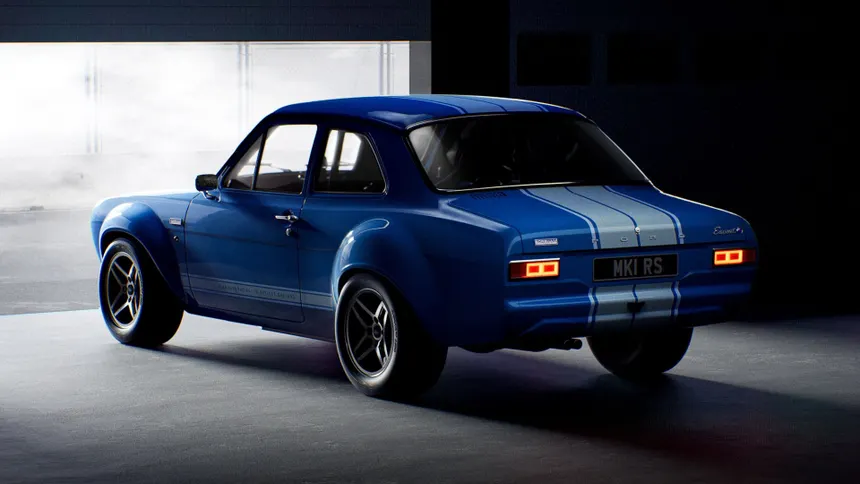
That’s the Boreham Motorworks Escort Mk1 RS, revealed in full at London Concours. And the lazy word for it — restomod — is exactly the word that misses the point.
Why this isn’t a restomod (and barely a continuation)
A restomod starts with a car that already exists. You strip a survivor to its shell and modernise it. However good the result, there’s an old car underneath. Rust, history, a previous life.
There is no old car underneath this one. No donor.
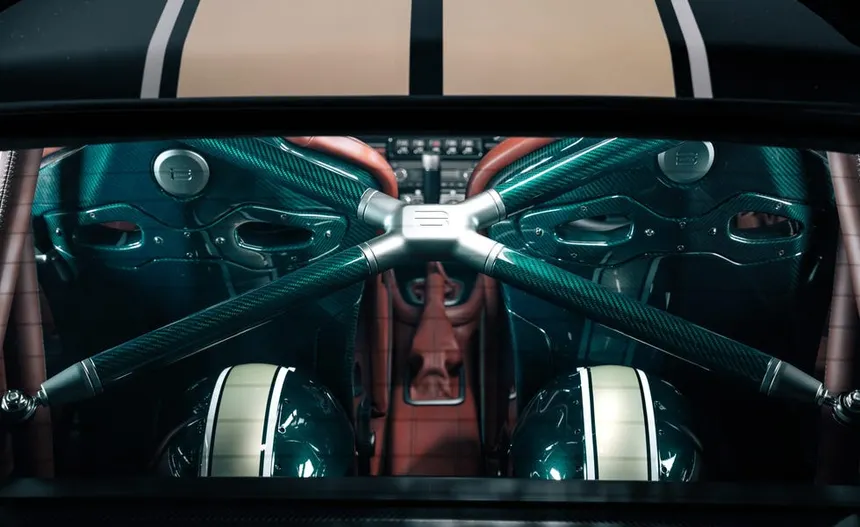
Boreham scanned original Mk1 shells, digitised them, and used CAE analysis to engineer an entirely new steel body — stiffer where it needed to be, lighter where it could be, with a claimed 50 percent gain in torsional rigidity over the factory original. Carbon bonnet and boot. A fresh shell pressed for every single car off precision jigs.
Boreham calls it a “Continumod.” It’s a coined, trademarked word, and it’s marketing — but it’s pointing at something real. Even Top Gear threw up its hands trying to classify the thing, landing on the idea that you could tie yourself in knots over the definition and might as well just enjoy it. Fair enough.
The two letters Ford won’t lend to anyone else
Here’s the detail that separates this from every other workshop Escort you’ve ever drooled over.
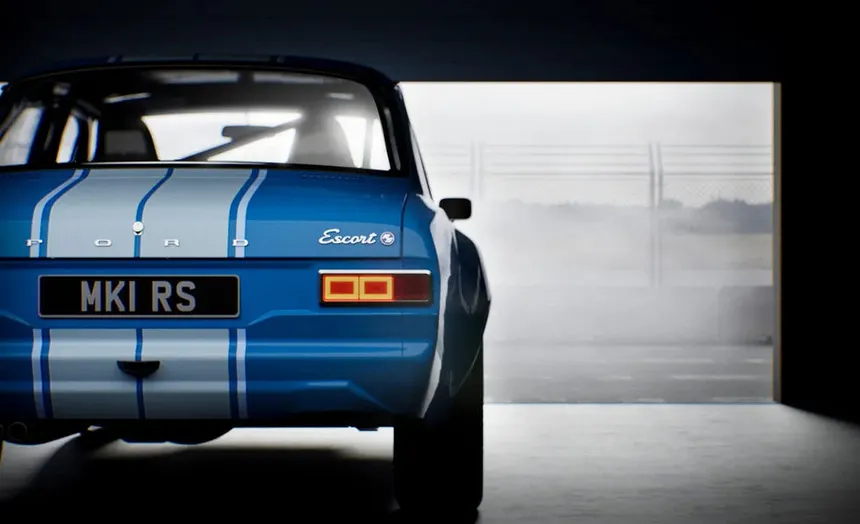
Boreham is allowed to call it RS.
Sounds trivial until you sit with it. RS is Ford’s. A century of motorsport sits behind those two letters and Ford guards them ferociously. Look at MST — they build some of the finest Mk1 and Mk2 Escorts on the planet, genuinely brilliant cars, and they can’t go anywhere near “RS.” They call them Mk1 and Mk2 and leave it there.
The gap between Boreham and MST isn’t build quality. It’s a licence. Boreham is an official Ford brand-licence partner, with chassis numbers approved by Ford itself — continuation numbers, as though the Escort production line never closed. That’s the thing being sold on top of the car: the right to stamp RS on the back of an Escort, with the blue oval’s blessing.
Replica or continuation. Both can be magnificent. Only one carries the family name.
Why an Escort, of all cars
Worth pausing here, because the choice isn’t random. The Mk1 Escort isn’t just some car Boreham spotted a margin in. It’s arguably the most successful competition car ever to wear a mainstream badge. Rally stages, touring car grids, hillclimbs — the Escort won everywhere through the 1970s. And it won for exactly the reasons this new car chases: low weight, rear drive, a live axle out back, and a balance that forgave the driver just enough to let them be brave.
The specific inspiration is the Group 5 Alan Mann Racing Escort that took the 1968 British Saloon Car Championship. That’s where the bubble arches come from — acknowledged as the first of their kind — and the forward-set front axle. Boreham had already built a bolt-for-bolt recreation of that race car, track-only, with a period Twin Cam. This new road-going Mk1 RS starts there and folds in modern thinking.
So this isn’t reinventing an icon on a whim. It’s taking the car that taught Ford how to win and asking what it would be if you built it today — with everything we now know, and none of the budget limits of a 1968 family saloon. This car is the answer.
A 10,000rpm naturally aspirated four
Now the heart of it.
There are two engines. The entry point is a reborn Twin Cam — a nod to the 1960s competition unit — bored out from 1,558cc to 1,845cc, Webers swapped for injection, good for around 185hp and happy to spin past 8,000rpm through a straight-cut four-speed “Ford bullet” box. Pure period theatre.
Nobody’s ordering that one.
Every advance order has gone to the other engine. The TEN-K.
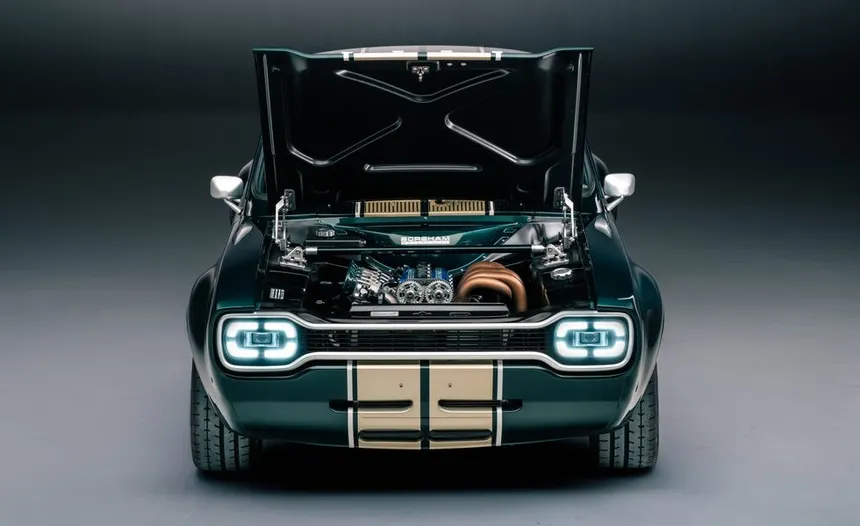
A 2,152cc naturally aspirated four, developed in-house by parent firm DRVN, that revs to 10,000rpm. The name isn’t poetry — it’s the redline. It makes around 330hp (figures float between 296 and 330 depending on source and conversion) and weighs just 85kg.
Sit with that. A four-cylinder engine lighter than a sack of cement that screams like a superbike. Car and Driver clocked the demo unit spinning to an indicated 10,200rpm and compared its appetite for revs to a Lamborghini’s.
How? Engineering that would have read as science fiction in 1968. A 3D-printed block formed tightly around the engine’s own internal architecture. A billet crank. Forged rods. A single-mass flywheel. A 16-valve head with F1-derived port and valve geometry. Individual throttle bodies, one per cylinder. A carbon airbox. Dry sump. A titanium exhaust voiced as carefully as it’s flowed.
The headline number is the power. The number that matters is 85kg. You don’t get there with boost. You get there by deleting mass from everything that spins or reciprocates, gram by gram, until the engine breathes on its own.
Where it sits in the restomod world
Worth placing, because it doesn’t arrive in a vacuum. The restomod has spent a decade climbing from lock-up hobby to luxury industry. Singer rebuilding 911s for eye-watering sums. Alfaholics turning the GTA Junior into a weapon. Kimera, Eccentrica, Totem — each taking a classic somewhere the price stops bearing any relation to the donor.
Boreham crashes that party through the front door, but from a different angle. Singer starts with a real 911. Alfaholics starts with a real Alfa. Boreham doesn’t. Boreham builds the whole car, with the factory’s blessing — and that hands it an argument none of the others have: legitimacy. Not “a classic improved by a third party,” but “a new Ford, built with Ford’s permission.” In a market where the buyer pays as much for the story as the steel, that signature is worth real money.
Is it a sustainable business? 150 cars from £295,000 is over £44 million in base price alone, before options. For a limited run with a brand contract behind it, the numbers work. And if the RS200 that follows lands the same way, Boreham won’t have built a car — it’ll have built a Ford continuation factory. That’s the real play. The Escort is just the first card on the table.
895kg — the figure that actually lands
Horsepower grabs the headline. Weight throws the punch.
895kg. That’s the target for the whole car. Run that against the TEN-K’s output and you’re north of 360hp per tonne.
A 911 GT3 sits below that ratio.
Read it again. An Escort. More power-per-tonne than a GT3.
It won’t beat a GT3 — the Porsche has aero, electronics and gearing from another galaxy. But the Boreham plays a lightness game almost nobody builds for anymore. The American press reached straight for the Mazda Miata comparison: an NA Miata with 500-odd pounds removed and 66 more horsepower added. That’s the recipe. Fast through absence of weight, not excess of force.
And that rewrites how it drives. No ABS unless you ask. No power steering. No traction control as standard. Boreham promises “controllable oversteer” — a car that talks back, rotates on the throttle, lets you in. The opposite of a modern supercar doing the thinking for you. The giant-killer hall of fame already has the Alfaholics GTA-R in it. This is aiming for the next plinth along.
The chassis: stiff where it counts, stripped where it can be
The hardware underneath is just as considered.
Up front, a bespoke four-point tubular steel subframe pushes the front axle line 30mm forward — exactly as the 1968 Alan Mann race car did — lengthening the wheelbase, sharpening the proportions, and crucially freeing up geometry the original sacrificed to cost: scrub radius, caster, camber. It keeps the era-correct MacPherson struts but adds proper lower wishbones in place of the factory car’s penny-pinching single track-control arm.
At the rear, where the real graft shows: a live axle (because an Escort like this should have one), but none of the old cast-iron-and-tube heft. An alloy diff case, titanium axle tubes, 50kg all in — half the original. Limited-slip diff. Fully floating.
The TEN-K’s gearbox is a five-speed with a dog-leg first, built in partnership with Holinger Engineering — the Australian motorsport transmission house that knows precisely what it’s doing. That Holinger detail is one almost nobody is reporting, and it tells you where the money went: not into chrome, into the bits that move the car.
Beefed-up brakes, a traditional cable handbrake, 15-inch alloys, 55:45 weight distribution. All of it consistent with one idea — an analogue car you drive with hands and feet, not menus.
Inside: where the money also went
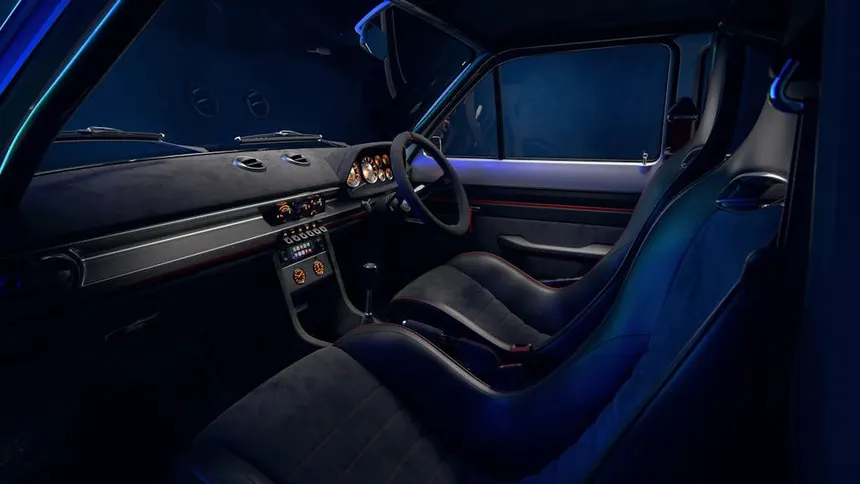
The cabin was the last piece anyone saw, and it confirms the theme. Designer Wayne Burgess — and that name matters, this is a man with serious form in production car design — built the interior around “driver engagement and lightweight functionality.” Carbon fibre runs through the dashboard, door cards and rear panels. New analogue dials keep the link to the original honest. There’s even an optional racing-helmet storage compartment behind the seats, which tells you exactly who this car is for.
But it isn’t a stripped-out shell pretending to be a road car. The window and door mechanisms have been engineered for genuine tactile quality — a novel thing in an old Ford, where the switchgear traditionally felt like an afterthought. There’s a discreetly integrated stereo that talks to your phone. Seat and wheel tailored to the individual. The clocks, on the show car, are Breitling. At £300k-plus, personalisation inside and out is the whole game, and Boreham knows it.
That cable handbrake, though, is the detail I keep coming back to. In a car this exotically engineered, they kept a mechanical, cable-operated handbrake. That’s not nostalgia. That’s a company that understands its customer will, at some point, want to yank the back end loose on a wet roundabout — and electronics would only get in the way.
The price, and the monster waiting behind it
Now the number that changes the whole conversation.
From £295,000 before tax. Around £354,000 with UK VAT on top. A fully specced TEN-K sails past that. Just 150 cars worldwide, left- or right-hand drive. Two-year, 20,000-mile warranty.
Three-hundred-grand-plus for an Escort. Say it out loud and watch your own face.
It’s mad money. It is. Nobody sane will tell you an Escort is worth that for being an Escort. But you’re not buying an Escort anymore. You’re buying a CAE-engineered new steel shell, an 85kg engine that hits five figures on the tacho, a Holinger box, a titanium axle, and two letters with Ford’s signature behind them. Read the bill of materials and the maths starts to make a different kind of sense. Still daft money. No longer dumb money.
And the best bit is still coming.
Boreham isn’t stopping here. The Ford contract runs deeper, and the next project is already announced. If you grew up watching Group B, put the coffee down: an RS200. Mid-engined, four-wheel-drive, the homologation monster, reborn.
When an 895kg Escort that revs to 10,000rpm is merely the warm-up act, you know exactly what moment we’re in. Somebody decided Ford’s industrial history shouldn’t be restored. It should be built again. And that might be the most interesting thing to happen to fast Fords in a generation.