
Pickups: The Unnecessary Necessity

The Truck That Rules a Continent
The best-selling vehicle in the United States isn’t a fuel-sipping sedan, a soccer-mom SUV, or a Tesla with a minimalist tablet. It’s a pickup. The Ford F-150 has held the title of the best-selling vehicle in the country for over four consecutive decades. Not the best-selling “truck”—the best-selling anything with four wheels and a combustion engine.
In Europe, the throne belongs to the Volkswagen Golf. A sensible, front-wheel-drive hatchback. Efficient, quiet, and designed to blend into a gray parking lot.
These two stats reveal a fundamental truth about two different worlds. But if you dig deeper, they also expose the massive gap between American honesty and European pretension.
A Pickup Isn’t a Vehicle; It’s a Declaration
To understand why nearly a million Americans drop serious money on an F-Series every year, you have to realize they aren’t just buying a tool. They are buying a piece of the American Dream.
The American pickup is the logical evolution of a country built on massive distances, three-lane highways, and gas that costs less than a latte. In that landscape, a truck isn’t “too big.” It’s just enough.
The executive commuting to a skyscraper in Dallas in a $85,000 F-150 Limited or a RAM 1500 TRX isn’t hauling gravel. The bed is pristine. They’ve never even seen a hitch ball. But that’s irrelevant. The modern pickup is a luxury land-yacht with an open bed that serves as a psychological fortress. It’s ego, status, and raw capability wrapped in military-grade aluminum and high-strength steel. And in the States, there’s no shame in that game.
The European Superiority Complex
This is where the irony gets thick.
The average European loves to look down their nose at American trucks. “It’s overkill,” they say while sipping an espresso. “It’s a gas guzzler. It’s unnecessary.” And then? They go out and buy a Volkswagen Tiguan, a BMW X3, or a Hyundai Tucson—vehicles that weigh nearly as much as a half-ton truck but have none of the soul.
The difference is honesty. The American buys a truck because they want a truck. The European buys a crossover and justifies it with “safety,” “the high driving position,” or “the kids.”
Newsflash: Your kids fit in a hatchback. Your ego, however, does not. We act scandalized by a V8 Raptor while double-parking a 1.2-liter crossover in a bike lane. At least the pickup can actually tow a house if it needs to.
The Fiscal Hand of God: Why Europe is “Small”
Europeans don’t drive F-150s not because they lack taste, but because the government makes it impossible.
In countries like Spain, the Registration Tax is a progressive hammer. A 5.0L Coyote V8 would trigger a tax of 14.75% on top of a 21% VAT. Add in the “Circulation Tax” based on horsepower and the fact that gas is $6–$8 a gallon, and that $55,000 F-150 becomes a $100,000 liability.
The VW Golf isn’t the king of Europe because it’s the best car; it’s the king because it’s the most successful escape from a tax system designed to kill anything fun. It’s not a choice; it’s a compromise.
The Golden Era: Classic Iron (C10, F-100, D100)
Sociology aside, there is one category where the American pickup is undisputed king: The Classics.
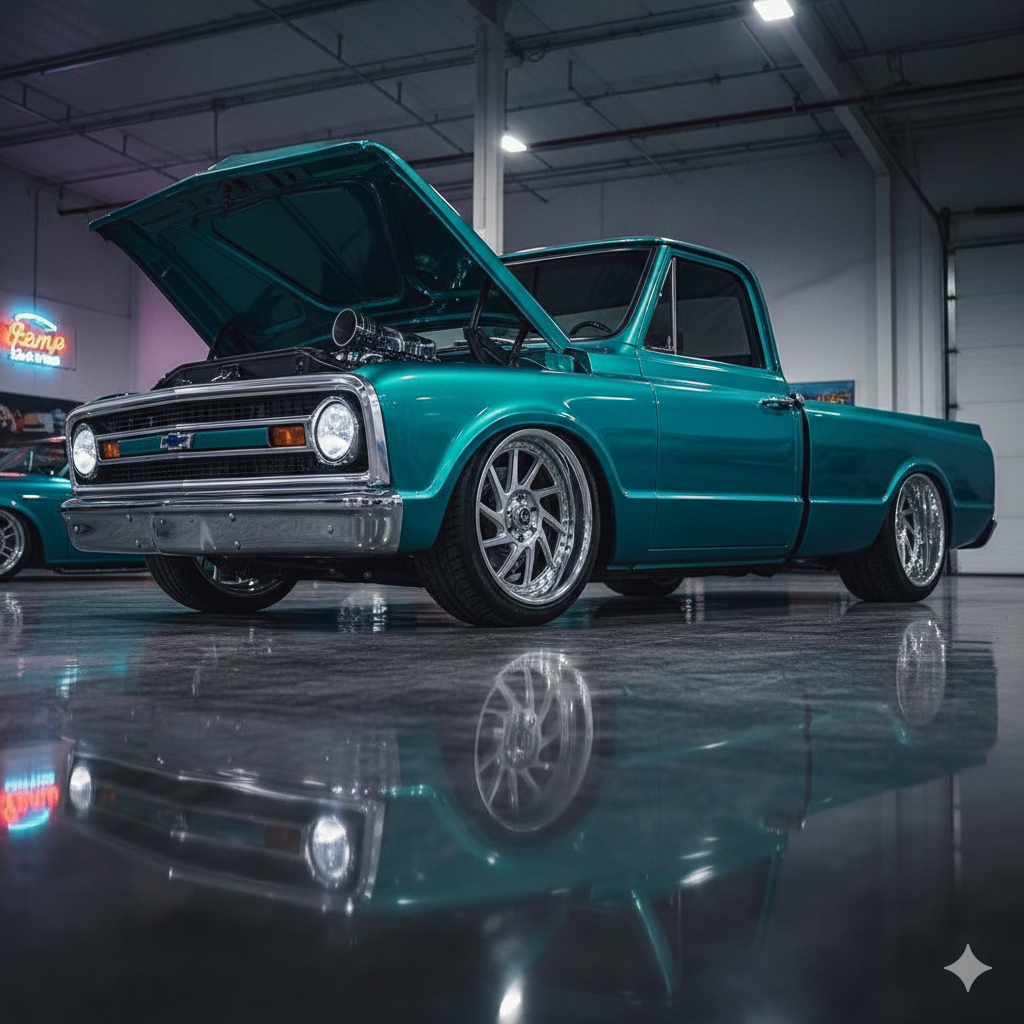
If a 1972 Chevrolet C10, a 1966 Ford F-100, or a 1968 Dodge D100 doesn’t give you chills, you might be legally dead. These trucks represent a marriage of mechanical brutality and accidental art. Nobody in 1965 was trying to make a “lifestyle vehicle.” They were making a mule.
The Mechanics of Pure Grit
These weren’t “cars.” They were tools built with:
- Heavy-duty ladder frames that could survive a nuclear blast.
- Small-block V8s (Chevy 350, Ford 302) that were simple, loud, and could be rebuilt with a flathead screwdriver and a prayer.
- Solid axles and leaf springs that prioritized payload over spinal health.
Driving one is a visceral, analog experience. You feel every gear change in the “three-on-the-tree” or the heavy throw of a four-speed. You smell the unburnt fuel. You fight the manual steering. It is the absolute antithesis of a modern “numb” driving experience.
The Restomod Explosion: 1970 Meets 2026
This is the ultimate evolution. The classic American truck has become the premier canvas for the Restomod movement.
Builders like Roadster Shop, Ringbrothers, and SpeedKore are taking these workhorses and turning them into supercars with beds. We’re talking:
- Chassis Swaps: Fully boxed, independent front and rear suspension (IRS) setups.
- Crate Engines: Dropping in a 650 HP LT4 or a Godzilla 7.3L Ford engine.
- Luxury Interiors: Custom distressed leather, Dakota Digital gauges, and Alpine sound systems hidden in vintage dashes.
A high-end C10 Restomod today can easily command $150,000 to $250,000 at auctions like Barrett-Jackson. It’s a market that is exploding because people want the silhouette of 1972 with the reliability and A/C of 2026.
Conclusion: The Unnecessary Necessity
The modern American pickup is, for most people, a “want,” not a “need.” It’s an oversized, over-engineered piece of rolling sculpture. It’s a statement.
But the classic pickup is the reverse. It was born from pure, unadulterated necessity and has evolved into a global object of desire. Your grandad used his F-100 to feed the cattle; today, that same truck (lowered and LS-swapped) is a rolling masterpiece of American engineering.
Meanwhile, Europe keeps buying crossovers that are “fine.” They aren’t trucks, they aren’t sports cars, and they aren’t particularly efficient. They are the worst of both worlds.
The pickup is an unnecessary necessity, and that is exactly why it’s the most fascinating vehicle on the planet.
What’s your take? Would you trade your modern SUV for a clean ’72 C10 with a modern V8 swap? Let’s talk about it in the comments.
— Not Enough Cylinders
1 thought on “PICKUPS”