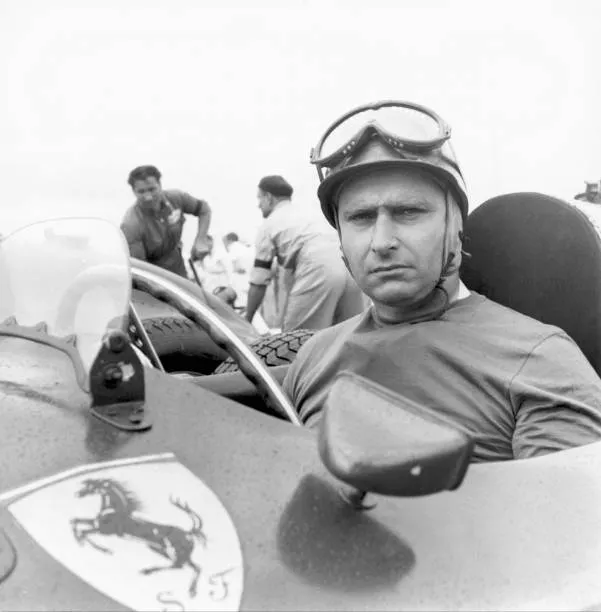
Fangio: The Man Who Won With His Head
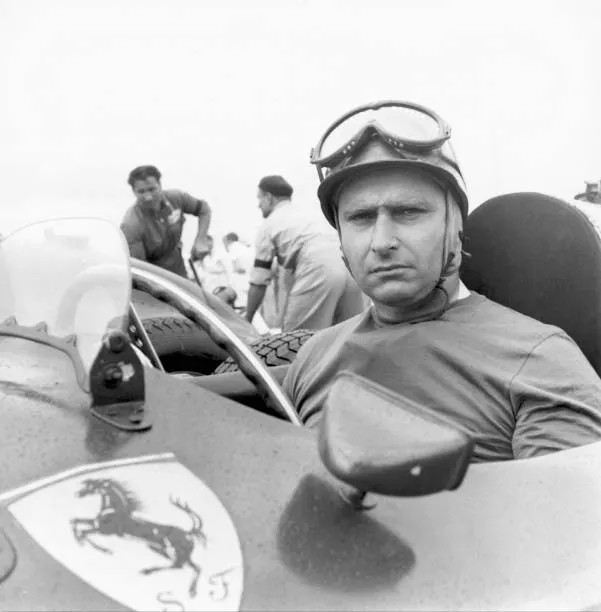
When the BBC or Sky pundits reach for a yardstick of greatness, they tend to say a modern champion is “the best since Fangio.” Not since Senna, not since Clark. Since Fangio. The name has become the floor of the conversation, the bedrock figure every other great is measured against. And that’s strange, because most people who use it couldn’t tell you a single thing he actually did.
This site already told the story of Stirling Moss, the greatest driver never to win a title. The gentleman. The man who gave a championship away out of sheer fair play. The heart. Now comes the other one. The man who did win. Who won almost always. And you can’t truly understand Moss without understanding Fangio, because they’re two sides of the same coin. Moss was the heart. Fangio was the head. And in that brutal era, the head won championships.
Juan Manuel Fangio. El Chueco, they called him in Argentina, for his bandy legs. El Maestro, they called him in Europe, for everything else.
Five crowns in seven years
Start with what he did, which is hard to believe even with the numbers in front of you.
Fangio won five Formula 1 World Championships: 1951, 1954, 1955, 1956 and 1957. Five. In seven seasons. That record of five titles stood for forty-six years until Michael Schumacher equalled it. Forty-six years as the absolute ceiling of the sport.
But the figure that really tells you who he was isn’t that one. It’s this: he won those five titles with four different teams. Alfa Romeo in ’51, Mercedes in ’54 and ’55, Ferrari in ’56, Maserati in ’54 and ’57. Four different manufacturers. Nobody has done it since. Not once. Not Schumacher, not Hamilton, not Senna, none of the ones who came later with all the technology in the world on their side.
Before the first title came his first Mille Miglia, in 1950, in a hand-built Alfa Romeo 6C 2500 Competizione. He finished third.
Why does the four-teams thing matter so much? Because it proves Fangio didn’t depend on the car. Today a driver wins because he has the best machinery, and when he switches teams he usually sinks. Fangio was the reverse: he made the car good. He’d arrive, understand it, wring it out and win. The badge didn’t matter. The talent lived in him, not in the machine. And in an era when cars differed wildly from one another, that is almost impossible to explain.
He racked up 24 wins in 52 races. Nearly one in two. And a pole-position rate that makes your eyes water. But Fangio was never a numbers driver. He was a thinking driver.
The chess player at the wheel
Here’s the difference from Moss, and here’s the soul of the man.
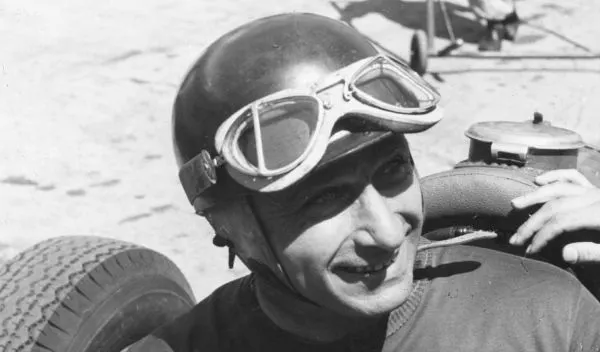
Moss raced with his heart. He attacked, he gambled, he put on a show, and sometimes it cost him. Fangio raced with his head. Cold. Calculating. Like a chess player who’s already seen the game three moves ahead. He wasn’t the most thrilling to watch. He was the one still there at the finish, when the thrilling ones had already broken or crashed.
And in the 1950s, that wasn’t just a way of winning. It was a way of staying alive.
Because you can’t forget what world Fangio raced in. It was the deadliest era in the history of motorsport. No barriers, no real belts, no helmets worth the name, no run-off, no medical teams. People died every season. Team-mates, friends, rivals. In the years Fangio shone, dozens of drivers were killed. He put it without drama: you had to go fast, yes, but you also had to finish. Calculate how hard you could push without crossing the line that killed you. That coldness of his, that chess-player’s head, wasn’t a lack of passion. It was pure intelligence applied to surviving while you won.
Fangio understood before anyone that in that sport the bravest man wasn’t the one who went fastest. It was the one who knew exactly when to go fast and when not to.
Humble hands
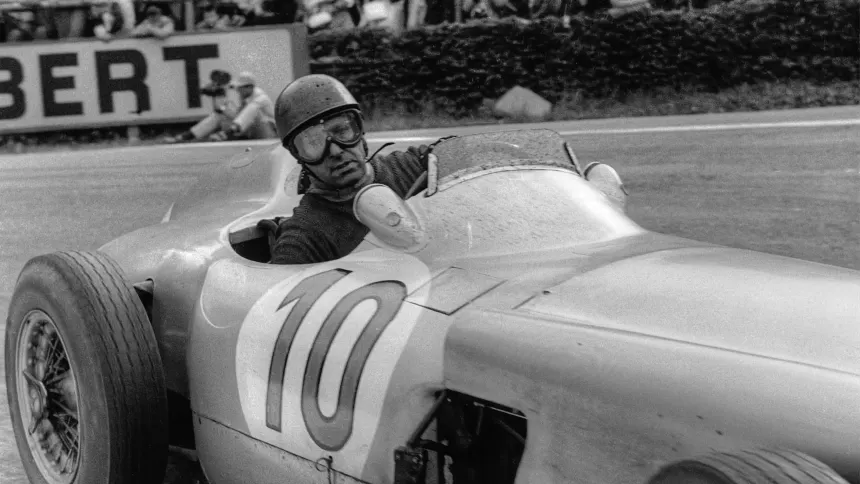
And you should know where all that wisdom came from, because it didn’t fall from the sky. Fangio was no rich kid arriving in racing on his father’s account. He was born in Balcarce, a town out on the Argentine pampa, the son of Italian immigrants. He left school at eleven to work as a mechanic’s assistant. He learned about cars with his hands covered in grease, stripping and rebuilding engines in a village workshop before he ever dreamed of driving them seriously. He started out racing tuned road cars on the dirt roads of South America, in events thousands of kilometres long that were more about endurance and brains than outright speed. By the time he reached Europe in 1947 he was nearly forty, with a whole lifetime of mechanical knowledge behind him.
That’s the foundation of everything. Fangio understood the car as a mechanic before he piloted it as a champion. He knew what to ask of the machine because he knew exactly how it was built inside. While the gentlemen racers felt the car, Fangio read it like a workshop manual he’d written himself.
The day he frightened himself
But don’t picture Fangio as some bloodless calculator. Because he had one day, just one, when he let the head go and let out everything he carried inside. And it was the greatest race of his life.
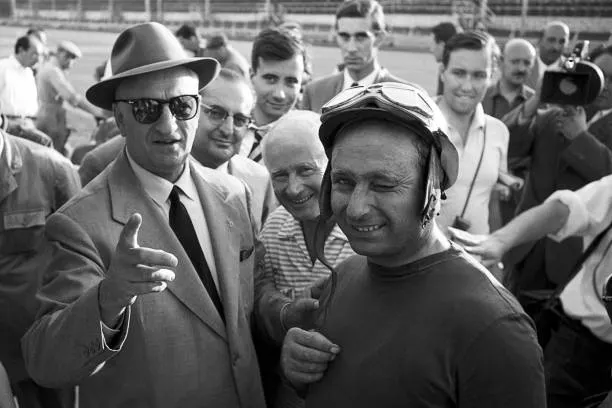
Nürburgring, 1957. German Grand Prix. Fangio was 46, an age at which nearly every modern driver is long retired. He was driving a Maserati against the younger, faster Ferraris of Mike Hawthorn and Peter Collins. His plan was to pit mid-race for fuel and fresh tyres while the Ferraris ran non-stop.
The plan fell apart. The pit stop was a shambles, the mechanics taking nearly a minute, an eternity, and Fangio rejoined with the two Ferraris almost a minute up the road. The race looked lost. At 46, against two young men in better cars, a minute down with ten laps to go. Impossible.
And then the Maestro did something he’d never done. He let off the brake on his own head. Over those ten laps he broke the circuit’s lap record ten times in a row. Ten. His fastest lap was eight seconds quicker than the one that had taken him pole, a figure with no logical explanation. He was running over the hedges, brushing the ditches, the car at the absolute limit of grip and beyond it. He hunted down both Ferraris and passed them on the penultimate lap. He won the race. And with it, his fifth and final title.
But the thing that really matters about that day is what he said afterward. Fangio admitted he had never driven so fast in his life and knew he would never do it again. He said he couldn’t sleep for two nights. That he had peered over the edge of the precipice and seen a side of the sport, and of himself, that he never wanted to explore again.
Read that slowly. The coldest, most calculating driver in history, the chess player, had one day where he let go completely. And what he saw inside himself frightened him so much that he never wanted to repeat it. That’s the difference between a reckless brave man and a genius: Fangio went to the edge, looked down, and had the intelligence to know it couldn’t be sustained. He won beyond his own limit once, and knew once was enough.
Kidnapped at gunpoint
And then there’s the story that paints the man outside the car. A story like a film that actually happened.
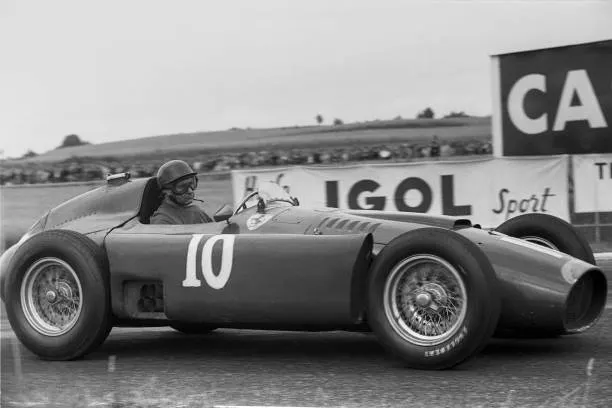
February 1958. Fangio is in Havana for the Cuban Grand Prix. He’s the favourite, fastest in practice. The night before the race, two armed men of Fidel Castro’s 26th of July Movement walk into the Hotel Lincoln, press a pistol to his ribs and take him.
The kidnapping was a propaganda stroke. Castro wanted to humiliate dictator Batista’s government by showing it couldn’t protect even the most famous man in the world. And it worked: the news went round the planet, the international press stopped covering the party Batista wanted to sell and started covering the Cuban revolution instead.
But the interesting part isn’t the kidnapping. It’s what happened inside it. The captors treated Fangio with absolute respect. They set up a radio so he could listen to the race he was missing. They brought him a television. They explained their cause. And Fangio, instead of enduring the worst moment of his life, ended up understanding them. They released him unharmed a few hours after the race.
And here’s what defines the man: Fangio never pressed charges against his kidnappers. Never. More than that, in time he became friends with some of them. He said they’d treated him well, that he understood why they’d done it, and that he held no grudge. Years later he’d joke that it was ironic he got invited onto American television for the kidnapping and not for his five world titles.
That’s the measure of the man. Someone kidnapped at gunpoint who came out of it without hatred, with understanding, and making friends. The same cold head that won him races served him to understand people, even the ones pointing a gun at him.
The master and the gentleman
Fangio retired that same year, 1958. He said the cars had become too fast, too dangerous. The same head as always: he knew when to stop, just as he knew when to push. He died in 1995, in his native Argentina, an absolute legend, with a museum dedicated to him in his home town of Balcarce.
And here I close the circle I opened with Moss.
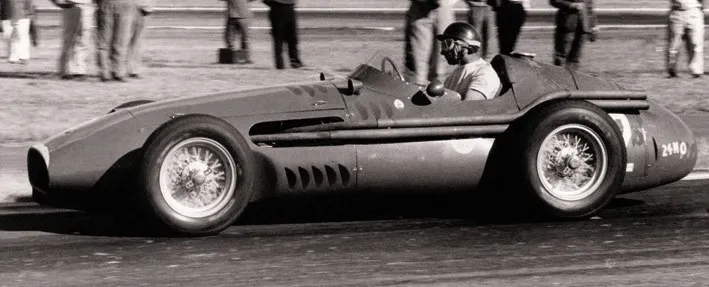
They were Mercedes team-mates in 1955 and rivals for life. Moss admired Fangio above all others, called him the true master with no irony at all. Between them they tell the complete story of that golden era: Fangio, the cold Argentine who won by thinking, who calculated, who survived; and Moss, the passionate Englishman who lost by being stubborn and noble. The one who won nearly always and the one who never quite won.
If you ask me which was better, I’ll tell you it’s the wrong question. Because you can’t understand one without the other. Fangio is the proof that in motor racing intelligence beats courage. Moss is the proof that sometimes losing well is worth more than winning. They’re both right. They’re both immense.
But if I had to keep a single image, I’d keep Fangio at the Nürburgring, 46 years old, finally letting his head go for one whole day, winning beyond his own limit, and then having the wisdom never to want to do it again.
Because that’s the secret of the Maestro. He wasn’t the fastest. He was the smartest. And in that sport that killed, being the smartest was the only way to grow old as a legend.
1 thought on “JUAN MANUEL FANGIO”