
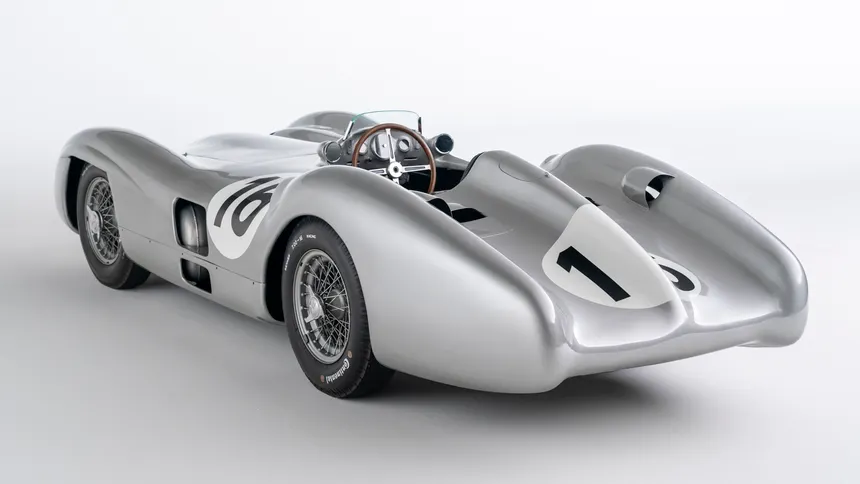
Mercedes W196: The Machine That Thought Like Fangio
This site told you about the man. Now it’s time for the machine.
When this site covered Fangio, the line was that he made the car good, that he didn’t depend on the machine, that the talent lived in him. And it’s true. But it would be unfair, and sloppy, not to tell you the other half of the story. Because in 1954 and 1955 Fangio had in his hands one of the most advanced racing cars ever built. A car that thought the way he did. Cold, precise, calculated down to the last bolt. The Mercedes W196.
And when you pair a driver who wins with his head with a car that wins through engineering, you get exactly what happened: nine victories in twelve races, two straight titles, and a legend that, nearly seventy years on, is still the most expensive racing car in history.
Let’s take it apart. Piece by piece, the way Fangio would have liked.
The return of a giant
First, the context, because without it you can’t grasp the scale of what Mercedes did.
It’s 1954. Formula 1 has a new rulebook: naturally aspirated engines up to 2.5 litres, or supercharged ones of just 0.75. Until then, Ferrari had dominated with cars that were essentially upgraded Formula 2 machines. The organisers hoped the new rules would lure more manufacturers in. One of them showed up with a vengeance.
Mercedes had been out of Grand Prix racing for twenty years. Twenty. But the marque carried a frightening tradition: every time it returned to racing, it returned to win, exactly as its pre-war Silver Arrows had done. They set up a competition department under Rudolf Uhlenhaut, an engineer who also drove like a proper racing driver, and put the legendary Alfred Neubauer, the most feared team manager in the paddock, in charge. They weren’t there to try their luck. They were there to crush.
And to crush, they needed a car that looked like nothing else. So they invented one.
The heart: eight cylinders that breathed differently
Here’s the good part. Here’s the bit that gets people like me going.
The W196’s engine, the M196R, was a 2.5-litre straight-eight. So far, normal for the period. From there on, everything was different.
First: direct fuel injection. Bosch developed a system that injected petrol straight into the cylinders, just like a wartime fighter plane. Every other car on the grid was still running carburettors. Every one. The Mercedes was the only car with direct injection, and that gave it a brutal advantage: it metered fuel with a precision a carburettor couldn’t dream of, which meant more power, sharper response and lower consumption. While the rivals guessed, the Mercedes calculated.
And second, the thing that truly sets this engine apart from everything else: desmodromic valves.
Let me explain it simply, because it’s a stroke of genius. In a normal engine, the valves are pushed open by the camshaft and closed by a spring. The trouble is that at high revs the spring can’t close the valve fast enough and it starts to “float,” to lose the rhythm. That puts a ceiling on how high the engine can rev. Mercedes’ solution was radical: get rid of the springs. In a desmodromic system the valves aren’t closed by a spring, they’re closed mechanically, pushed shut by the camshaft with the same force that opens them. No spring means no float. And no float means the engine can rev higher and freer than any rival.
It was a hugely expensive solution, fiendishly hard to build and to set up, the kind only a German engineer obsessed with squeezing out the last horsepower would come up with. Pure cold reasoning applied to metal. Exactly the philosophy Fangio drove with.
And there was one more touch of genius: the engine was laid on its side. Tilted 53 degrees, almost flat. Why? For two reasons. One, to lower the bonnet line and improve aerodynamics. And two, so the driveshaft could run alongside the driver rather than under his seat. That let the driver sit lower, gave the car less height and dropped the centre of gravity. All deliberate. Nothing left to chance.
The whole thing made around 257 horsepower. That’ll sound modest today, but in 1954, with that precision and that reliability, it was enough to win nearly everything.
Don’t be fooled by “easy reliability,” though, because getting that car to the track cost blood. During pre-debut testing the engineers found the engine drinking forty litres per thousand kilometres instead of the expected thirty-five. Translated: the car would have coasted to a halt out of fuel nearly fifty kilometres short of the finish. Uhlenhaut had to dash back to Stuttgart to oversee the building of supplementary fuel tanks in time for Sunday. That’s the flip side of brilliance: every clever solution brought a fresh problem, and the team hammered them out against the clock. The W196’s perfection wasn’t a gift. It was savage work by a group of obsessives who would settle for nothing short of winning.
The two-faced car
Now the part that makes the W196 unique in Formula 1 history: it had two different bodies.
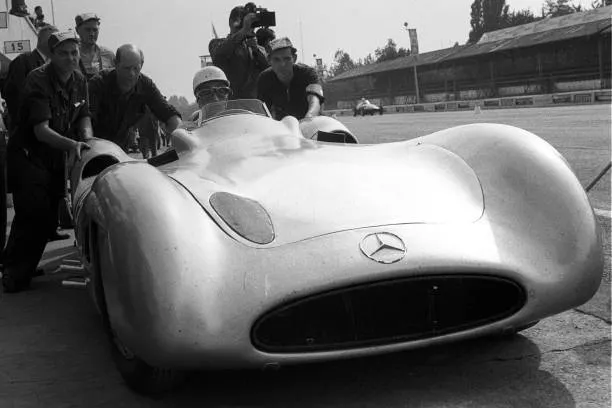
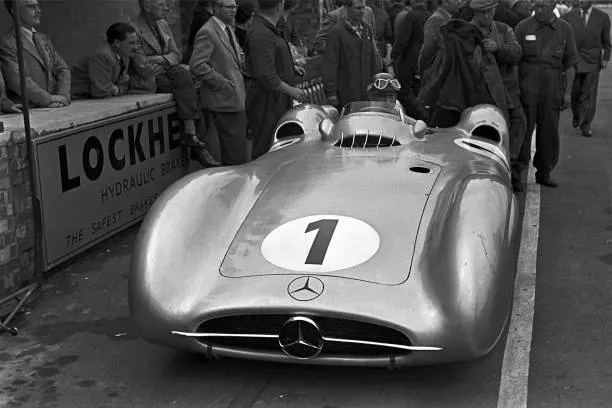
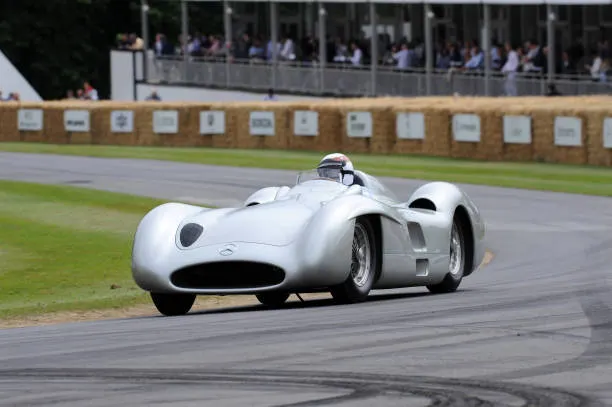
The first, the one that dropped everyone’s jaw, was the Streamliner. A fully enclosed, fully faired body that covered the wheels and turned the car into a smooth, gleaming bullet. They unveiled it at the 1954 French Grand Prix at Reims, a blisteringly fast circuit of long straights. It was Mercedes’ return to Grand Prix racing after twenty years, and it was an exhibition: Fangio and team-mate Karl Kling led from start to finish, side by side, leaving the rivals with no answer. On the last lap the team ordered them to stop racing each other to secure the one-two, and Fangio won by a tenth.
That enclosed body was a marvel in a straight line. But it had a big problem: in corners, the driver couldn’t see the front wheels. And when you can’t see where your wheels are, placing the car precisely in a tight corner is a nightmare. At the British Grand Prix at Silverstone, full of corners and oil drums marking the limits, the Streamliner got a hiding. Fangio kept clouting drums all race because he couldn’t judge where the corners of the car were.
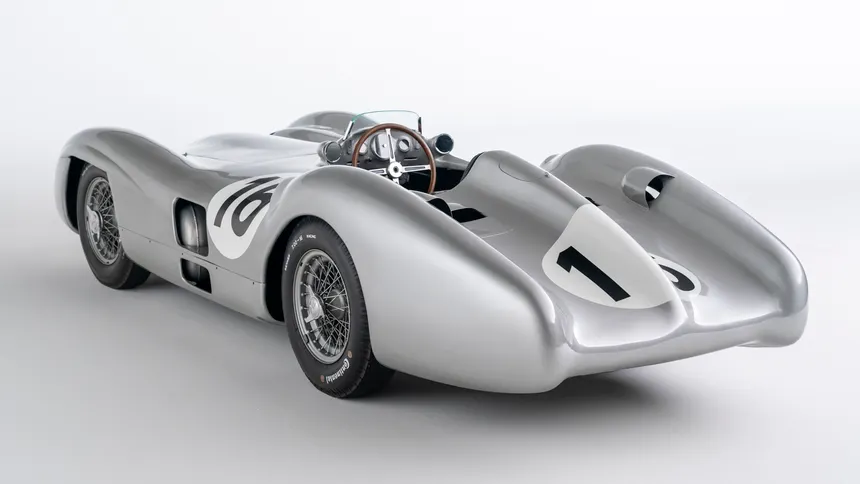
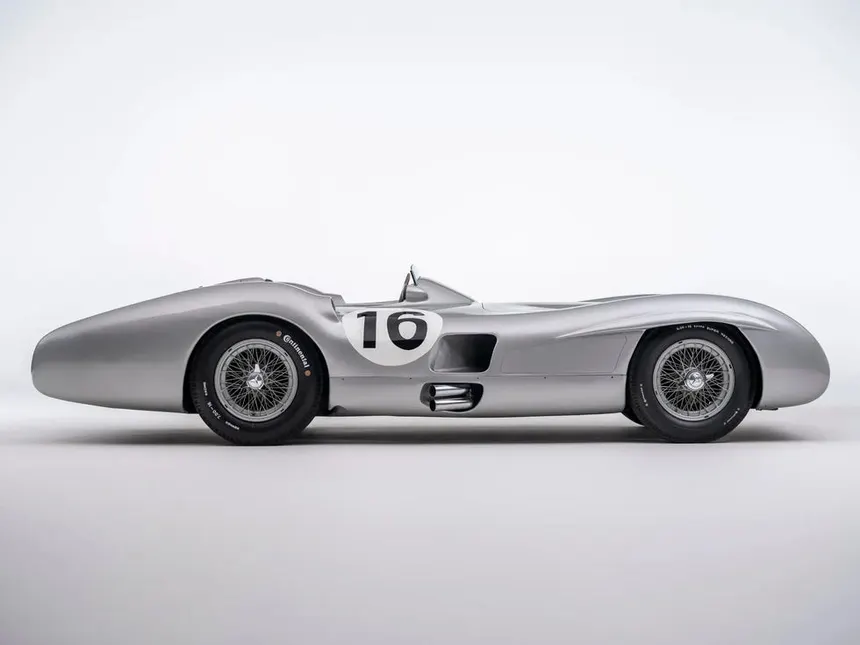
So Mercedes did the logical thing: it built a second body, the open-wheel one, the classic single-seater shape. That was the one used most, on almost every twisty circuit. The Streamliner was reserved for the ultra-fast tracks like Reims and Monza, where top speed was everything and corners mattered less. One car, two suits, depending on the terrain. Once again, the head leading the way: the right tool for each problem.
What it won, and what it wasn’t allowed to win
The W196’s numbers make your head spin when you line them up.
It raced twelve Grands Prix between 1954 and 1955. It won nine. It took eight poles and nine fastest laps. It carried Fangio to two straight world titles. And the 1955 season was almost a joke for how dominant it was: the Mercedes won every race but one, Monaco, where all three team cars broke. At that year’s British Grand Prix at Aintree, Mercedes scored a one-two-three-four, with Stirling Moss taking his first ever win ahead of Fangio himself, at home, by two tenths. The Fangio-Moss pairing was simply unbeatable.
And here’s a detail that stings: the W196 could have won even more. But in that era there was no Constructors’ Championship, which wasn’t created until 1958. So all that technical superiority, all that crushing dominance of the machine, didn’t translate into a single title for Mercedes as a marque. Only into Fangio’s driver titles. The car was better than its official results. One of those injustices you only understand once you know the rules of the time.
The 300 SLR’s brother
If you’ve read the story of the Mercedes 300 SLR already on this site, this will ring a bell. With good reason.
The 300 SLR, the car Moss devoured the 1955 Mille Miglia in, didn’t come out of nowhere. It came from here. From the W196. The SLR was, in essence, the sports-racing version of the Formula 1 car: it shared the DNA, the mechanical philosophy, the same eight-cylinder concept with the same technical genius behind it. The W196 raced in Grands Prix; the 300 SLR carried that same spirit into endurance racing and onto open roads. Two brothers from the same house, dividing the 1950s motoring world between them.
That’s why this car is the piece that ties everything together. Fangio, Moss, the 300 SLR, the Mille Miglia, the two titles. All of it runs through the W196. It’s the mechanical heart of Mercedes’ golden era.
The end, and the legend
The W196’s story was cut off as abruptly as it began.
In June 1955, at the 24 Hours of Le Mans, a Mercedes 300 SLR crashed into the grandstand and caused the worst tragedy in the history of motorsport. A shaken Mercedes decided to withdraw from all competition at the end of the season. The W196, a virtually invincible car, hung up its boots after racing for just one year and two months. Mercedes wouldn’t field a works Formula 1 team again until 2010. Fifty-five years of silence.
But the legend didn’t fade. It grew. In February 2025, a W196 Streamliner, one of those driven by Fangio and Moss, sold at auction for a little over 51 million euros. Fifty-one. It became the most expensive racing car ever sold and the second most valuable car of all time. Seventy years after its last race, that laid-over straight-eight with springless valves was still capable of breaking records. This time in an auction room rather than on a track.
And to me that feels like poetic justice. Because the W196 was never a muscle car, never one of those that win by brute force. It was a car of intelligence, of elegant solutions, of engineers who thought three moves ahead. Just like its driver.
Fangio won by thinking. The W196 won by thinking. That’s why they understood each other so well. That’s why, when you put them together in memory, you can’t tell where the man’s head ends and the machine’s genius begins.
And maybe that’s the exact definition of a perfect car: the one that disappears beneath the right driver and lets him win as if it were an extension of his own way of thinking. The W196 was that for Fangio. And that’s why, of all the cars of that irreplaceable era, this is the one that truly deserves to be called a legend. Not because it was the fastest in a straight line, but because it was the smartest car on the grid, driven by the smartest man on it.