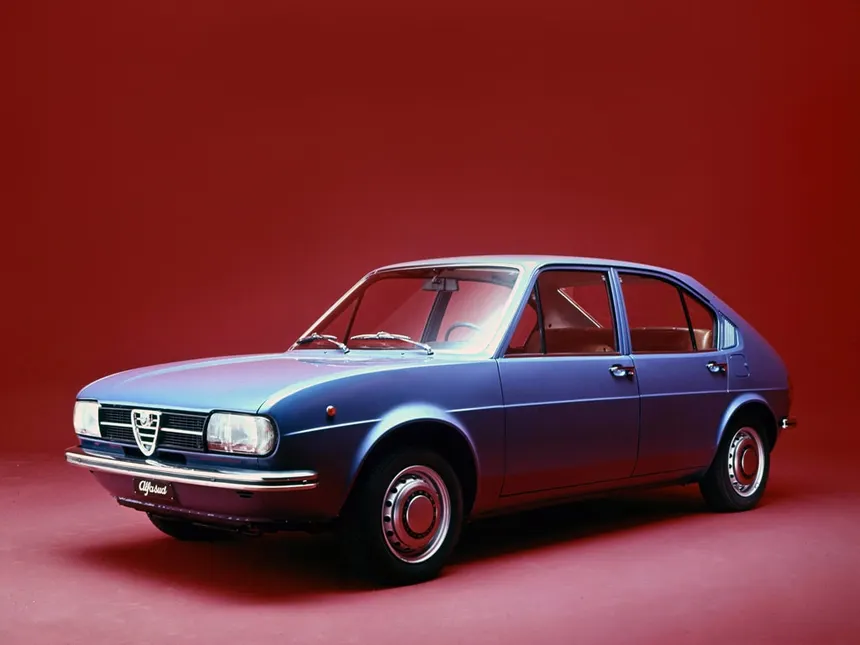
Alfa Romeo Alfasud: The Most Advanced Compact in Europe That Rusted Away Because of Politics
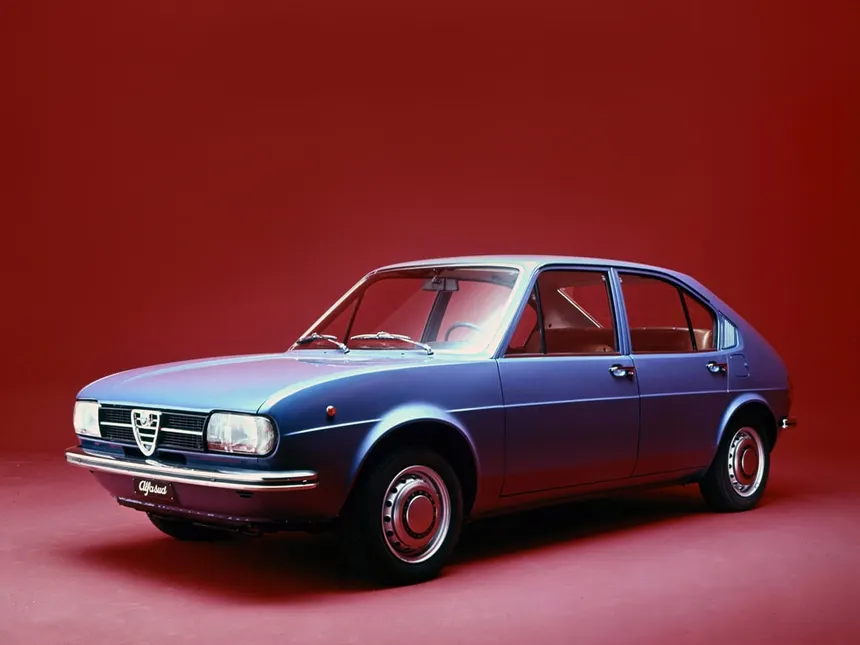
More than a million units built between 1972 and 1989. 893,719 saloons produced between 1972 and 1983, plus 121,434 Sprint coupés between 1976 and 1989. A massive industrial figure by Alfa Romeo standards — a marque that had historically built cars in short series for a well-off clientele. The Alfasud is, to this day, the best-selling model in Alfa Romeo’s history. Above the Giulia. Above the 156. Above the Spider. Above anything the brand has produced in its 120 years of life.
And yet, this car destroyed Alfa Romeo’s reputation for two decades. To such an extent that it opened the door for Fiat to buy the marque in 1986 at a fire-sale price and turn it into the diminished brand that would later pass through successive owners: PSA, Stellantis. If you hear the European motoring joke “rust was invented in Turin” today, that joke comes specifically from the Alfasud.
How can a car that sold so well simultaneously destroy the reputation of the brand that built it? The answer goes like this, and it pays to understand it carefully: the Alfasud was one of the most technically advanced compacts of its era. Mechanically brilliant. Water-cooled boxer engine. Front-wheel drive properly engineered. Inboard front disc brakes mounted next to the differential rather than at the wheels (a Grand Prix trick applied to a 1972 road car). MacPherson front suspension and a rear beam axle with Watt’s linkage to maintain axle geometry under all loads. Body styling by Giorgetto Giugiaro at ItalDesign. Engineering team led by Rudolf Hruska, an Austrian who had worked with Ferdinand Porsche on the Volkswagen Beetle, on German tanks during the Second World War, and had subsequently signed off the chassis of the Fiat 128. The best of European engineering put to work on an Italian car.
And even so, that car came apart on the road. The early production examples showed rust in months, not years. Rotted body shells, panels swelling outwards, welds breaking. An industrial catastrophe that had nothing to do with the car’s engineering. And everything to do with Italian politics of the 1960s and 1970s.
This is the story. And it’s worth telling slowly, because it’s one of the few cases in motoring history where you can cleanly separate the technical office’s decisions from the political office’s decisions, and watch how the latter destroyed the former. Without the political decisions, the Alfasud would have been the VW Golf twenty years before. With them, it was what it was.
The Mezzogiorno question, IRI, and the 360-billion-lira loan
To understand the Alfasud you need to understand Italy’s political and industrial situation in the mid-1960s. Since the Second World War, Italy had been living with a structural economic problem known as the southern question (questione meridionale): the industrialised, wealthy north versus the agrarian, poor, chronically unemployed south. Every Italian government of the postwar period made closing that gap a national priority. Industrialising the Mezzogiorno (southern Italy) was a state aim repeated in every government speech.
The principal financial instrument was the IRI (Istituto per la Ricostruzione Industriale), the Italian state holding company created in 1933 by Mussolini during the Great Depression. As far back as 1933, Alfa Romeo had become an IRI-owned company (covered in the Nicola Romeo article). Forty years later, in 1967, Alfa Romeo was still owned by the IRI. Alfa Romeo’s chairman, Giuseppe Luraghi, reported directly to the Italian government for major industrial decisions.
In 1967, Luraghi launched the internal project for a small, affordable, mass-market car. Something Alfa Romeo, historically premium-sporting, had never seriously attempted. The industrial logic was simple: the European small-car segment was growing at double-digit rates each year, marques like Renault, Fiat, Peugeot and VW dominated a market from which Alfa Romeo was entirely absent. Staying out of that segment meant staying out of European growth.
The IRI agreed to finance the project. But, importantly, with one politically inviolable condition: the new factory had to be in southern Italy. Any industrial expansion of Alfa Romeo financed with public money had to help solve the Mezzogiorno problem. No alternative.
The definitive agreement was sealed in 1968. The new subsidiary company was registered on 18 January 1968 in Naples with the long name Industria Napoletana Costruzioni Autoveicoli Alfa Romeo-Alfasud S.p.A. 90% owned by Alfa Romeo, 10% by Finmeccanica (the IRI’s financial arm). The state loan: 360 billion lire, an enormous sum for 1968. The chosen site for the factory: Pomigliano d’Arco, a town near Naples, 15 kilometres from the Bay of Naples, on the grounds of a former aircraft-engine factory that Alfa Romeo had used during the Second World War to build Daimler-Benz DB 605 engines under licence for Italian military aircraft.
The declared industrial goal: produce one million cars in the first ten years of operation, at a rate of approximately a thousand units a day. The factory was meant to employ up to 15,000 workers. Neapolitan labour force, largely without prior automotive experience, hired in bulk to address the region’s unemployment.
The foundation stone was laid in April 1968. Present at the ceremony, alongside President Luraghi, was the Italian Prime Minister Aldo Moro (who years later would be murdered by the Brigate Rosse in 1978, one of the deepest political wounds in the history of the Italian Republic). And the commercial launch date for the car was set: 1971. Three years from foundation stone to the car on the showroom floor. An extremely tight industrial schedule for a project of this scale.
Rudolf Hruska: the Austrian engineer who passed through Porsche, Nazi tanks, and Fiat
To lead the project technically, Luraghi needed an elite engineer with proven experience in front-wheel drive, compact engine layout, and mass industrial production. Those three requirements were difficult to find combined in one person in 1967 Italy. Alfa Romeo had never built front-wheel drive or mass-market compacts. Fiat had, but Fiat’s engineers were at Fiat.
Luraghi went for Rudolf Hruska, an Austrian engineer born in Vienna in 1915. Hruska’s biography, looked at with a steady head, is one of the richest and most politically loaded of the twentieth-century motor industry:
- 1930s: he worked on the development of the Volkswagen Beetle under Ferdinand Porsche’s direction. Air-cooled four-cylinder boxer, rear-wheel drive. By 1939, Hruska was one of the senior engineers on the Beetle programme.
- Second World War: Hruska stayed with the Porsche team. There he took part in the development of the Porsche Tiger VK 4501, the heavy tank prototype that competed (and lost) against the Henschel Tiger I for the German army contract. It’s the least comfortable episode of his biography and, for good reasons, is rarely mentioned in modern hagiographies about the Alfasud.
- Postwar: Hruska emigrated to Italy. He worked at Alfa Romeo on the development of the Alfa Romeo Giulietta (1954), a car that also deserves its own NEC article in due course.
- 1960s: he moved to Fiat. There he led the development of the Fiat 124 and, above all, the Fiat 128 (1969), a front-wheel-drive compact with a transverse engine that became the first car with that architecture produced en masse in Western Europe, winning European Car of the Year for 1970. The Fiat 128 is probably the most influential single piece of European mass-market automotive engineering of the second half of the twentieth century, because it established the basic architecture (transverse front-mounted engine plus front-wheel drive) that defines almost every modern European compact.
When Luraghi called Hruska in 1967, Hruska was literally the best European engineer available to lead a project for a front-wheel-drive compact with a compact engine. Alfa Romeo offered him the job. Hruska accepted.
His team included: Domenico Chirico, chief engineer of the Alfasud project from 1966, a northern Italian chassis specialist. Giorgetto Giugiaro, who had just left Bertone and Ghia to found ItalDesign in 1968 with Aldo Mantovani. Giugiaro was the most promising car designer in Europe, fresh off the Bizzarrini Manta and just before the VW Golf Mk1. The team was world-class.
The boxer engine: water-cooled, belt-driven
Here comes one of the project’s most intelligent technical decisions. For a front-wheel-drive architecture with a front-mounted engine, engine height is critical. The lower the engine, the lower the bonnet, the lower the overall silhouette, the lower the centre of gravity, the better the handling. If the engine is tall and vertical, the body has to be too, and the car looks and feels like a cube on wheels.
Hruska, with his Volkswagen + Porsche pedigree, knew what a boxer engine was. The boxer architecture (horizontally opposed cylinders in two flat banks) has the lowest height of any four-cylinder configuration. For front-wheel drive + low bonnet + low centre of gravity, a boxer is the natural answer. The only thing is that no European compact had built a transverse front-mounted boxer for FWD until that point. The Alfasud was going to be the first.
Hruska’s team’s technical decision was a flat-four (4-cylinder boxer) water-cooled, with overhead camshafts driven by toothed belts. This matters because it breaks with the boxer tradition of the era, which was air-cooling (VW Beetle, Porsche 911) and gear- or chain-driven camshafts (Porsche, Subaru). Water cooling = quieter engine and better thermal control. Toothed belt = quieter and cheaper to build.
The first engine prototype ran on the bench in July 1968. Three years before the commercial debut. Initial specifications:
- Displacement: 1,186 cc
- Configuration: flat-4 boxer, banks at 180° (true boxer geometry)
- Bore: 80 mm
- Stroke: 59 mm
- Camshaft drive: overhead camshaft per bank (one per bank, two total), toothed-belt driven
- Cooling: water
- Initial power: 63 horsepower at 6,000 rpm
- Torque: 88 Nm at 3,200 rpm
The engine evolved later: 1,286 cc / 76 hp (Alfasud Ti 1.3 and Sprint), 1.5 litres / 84 hp, 1.5 litres Quadrifoglio Verde / 95 hp, and finally 1.7 litres / 118 hp in the Sprint Quadrifoglio Verde. The Alfasud boxer was produced between 1971 and 1997, 26 years, also powering the Alfa Romeo 33, Sprint, 145 and 146.
The chassis: inboard front discs and MacPherson struts
The chassis package was another demonstration of engineering excellence. MacPherson struts up front with coil springs, a clean and efficient geometry. Rear beam axle with Watt’s linkage, a mechanical solution used in Grand Prix cars (and rarely in compacts) to maintain rear axle geometry under all lateral and vertical loads. The Watt’s linkage is a two-arm articulated system that ensures the axle does not move laterally during cornering, guaranteeing predictable, clean behaviour. For a 1972 compact, this is Grand Prix specification.
And here’s the technical detail almost nobody tells about and which shows the care taken by Hruska’s team: the Alfasud’s front disc brakes were mounted in inboard position. That means the brake discs were not mounted at the wheels, as in any normal car, but at the inner end of the driveshafts, next to the differential. The same mechanical solution used in the Jaguar D-Type, in certain Citroëns, and in 1960s Formula 1 cars. Its sole purpose is to reduce unsprung mass (the mass hanging from the suspension that the suspension has to control). By taking the discs off the wheels and putting them at the chassis, the wheels weigh less, the suspension works faster, the car reacts better to road irregularities.
This is engineering that any modern chassis engineer would recognise as exquisite. For a car with a dry weight of 830 kg sold at compact-class prices in 1972, this is engineering that not even the 1974 VW Golf would match. The Alfasud additionally had disc brakes on the rear wheels too (rare in compacts), rack-and-pinion steering (standard in sports cars, not in compacts of the era), and the handbrake operating on the inboard front discs (another competition-grade solution).
The Giugiaro styling: the Golf before the Golf
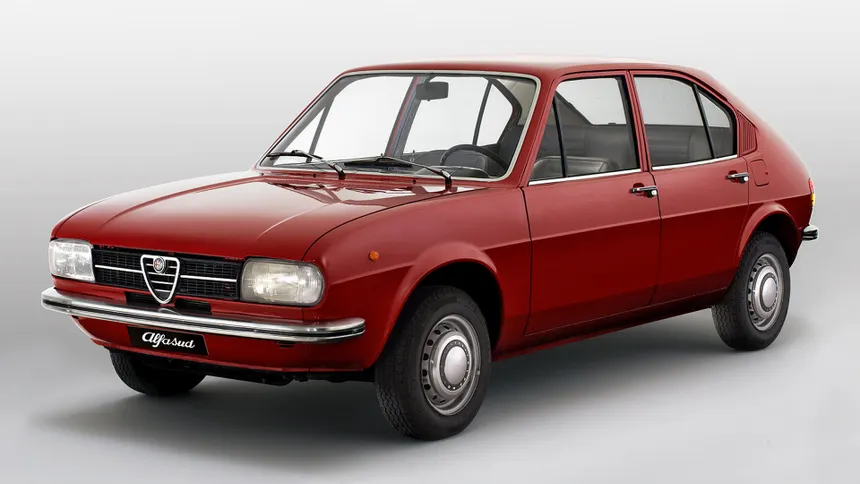
Bodywork design was handed to Giorgetto Giugiaro at ItalDesign. Giugiaro, who had just left Bertone and Ghia to found his own studio with Aldo Mantovani in 1968, received the brief with a tight budget, height restrictions to accommodate the boxer engine, practical family requirements (four doors, 380-litre boot), and the stylistic freedom limited by having to design a car with all those constraints. What he produced is one of the most sober and best-proportioned compacts of its era.
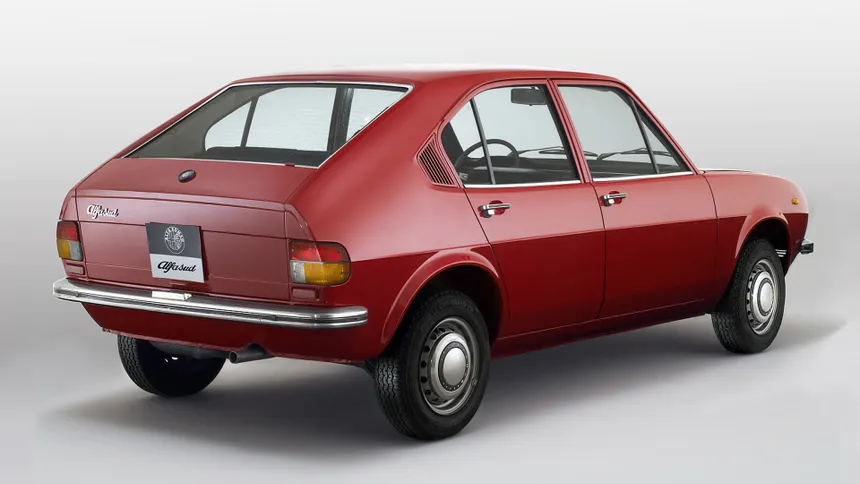
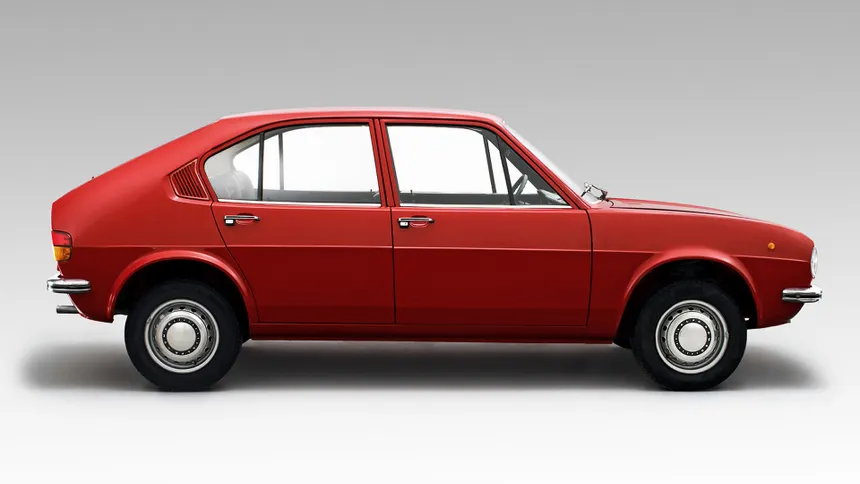
Clean lines, long low bonnet, central cabin, steeply raked rear window. The original Alfasud saloon had four doors and a small rear boot in 2.5-volume format (between saloon and hatchback). That decision was criticised by the European press as old-fashioned — the 1970s fashion was the three-door hatchback. Alfa Romeo added hatchback variants later (1981 three-door, 1982 five-door) when the market demanded them.
Aldo Mantovani, ItalDesign’s co-founder, also signed the Alfa Romeo Caimano, a 1971 concept car with the same Alfasud chassis but 200 mm less wheelbase and a sporting body. A demonstration of what the chassis could do in creative hands. Never reached production.
The importance of the Alfasud’s styling becomes clearer if you look at what Giugiaro signed off three years later: the Volkswagen Golf Mk1 (1974). The Golf silhouette is clearly derived from the Alfasud. Both cars share the same Giugiaro formal language: low bonnet, straight lines, hatchback (in the Golf from the start), central cabin, large glass area. The Alfasud is the Golf before the Golf. It arrived three years earlier and, in theory, should have been the European compact reference of the decade.
And then came the industrial catastrophe
The Alfasud debuted at the Turin Motor Show in November 1971. It shared the stage that day with the Lamborghini Countach. The public was enthralled. The European motoring press described it as “the best small car in the world in terms of handling and engineering”. The Italian launch price was 1,420,000 lire, accessible for a growing Italian middle class.
Production began at Pomigliano d’Arco in April 1972. And within months the complaints started arriving.
The bodies began to rust. Not in years. In months. Some owners reported visible rust on the wheel arches within the first six months of use. At two years, Alfasuds looked like five-year-old cars. At five years, they looked like fifteen-year-old cars. The situation was not similar to that of other Italian cars of the era (the Lancia Beta, also notoriously prone to corrosion). The Alfasud was objectively worse.
The causes, looking back over the years, were several and connected:
Cause one: the steel. The historical sources are not entirely conclusive but they point in one direction. The Pomigliano factory was using low-quality recycled steel for external panels. Some sources mention cheap Russian steel bought by the IRI through bilateral trade agreements with the Soviet Union during the 1970s. That information has not been officially confirmed and should be taken cautiously. But what is documented is that the steel used had insufficient anti-corrosion properties for the coastal environment of Pomigliano.
Cause two: the environment. Pomigliano d’Arco sits 15 kilometres from the Bay of Naples. The air in the area carries elevated levels of marine salt. The unpainted body shells (the so-called “body in white”), once assembled and before going to the paint booth, were frequently stored in outdoor yards, exposed for days to the salty air of the bay. By the time they were finally painted, the sea salt had already begun corroding the steel under the future paint layer.
Cause three: the anti-corrosion foam. To combat the problem once detected, the project’s engineers proposed filling the structural cavities (box-sections) of the bodywork with synthetic foam to inhibit corrosion. Result: the foam absorbed and retained ambient humidity, accelerating corrosion rather than reducing it. The cure was worse than the disease.
Cause four: the workforce. The 15,000 Neapolitan workers hired for Pomigliano had no prior automotive experience. Not their fault. It was inevitable: hire 15,000 people who have never built cars, give them a six-month training course, and engineers don’t come out the other end. Poorly-trained operatives do. Welds were of irregular quality. Panel fits were misaligned. Anti-rust treatments were applied unevenly. And on top of all this came the combativeness of Italian unions in the 1970s: the Neapolitan unions called recurring strikes, practically every Thursday according to contemporary sources, which generated interruptions in the production line affecting the quality of the cars delivered.
Final result: the most technically advanced car in Europe fell apart in six months because of where it was built.
The paradoxical commercial success
Despite the quality catastrophe, the Alfasud sold well. The explanation is threefold. First, the handling was genuinely exceptional for a small car of its class, which generated strong word-of-mouth in the Italian market. Second, the price was competitive, especially compared with the more reliable rivals like the (now ageing) VW Beetle and the Renault 4. Third, the Italian market of the 1970s was deeply patriotic, and buying an Alfa Romeo was an accessible status symbol.
The sales were: 893,719 saloons sold between 1972 and 1983 + 121,434 Sprint coupés between 1976 and 1989 = more than a million units. For a car with so many problems, those are enormous numbers.
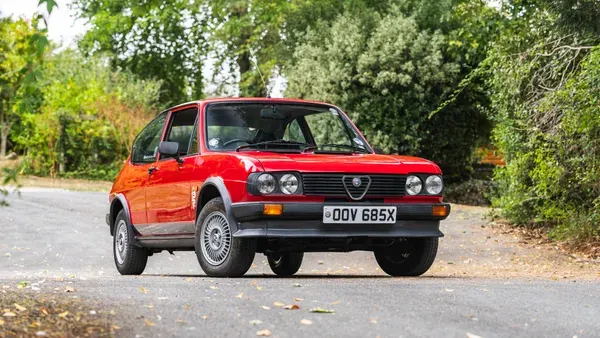
The range expanded quickly. Alfasud ti (1973): sporting version with twin-choke Weber carb, 68 hp. Alfasud Giardinetta (1975-1981): three-door family variant. Alfasud Sprint (1976-1989): coupé with different bodywork (also signed by Giugiaro), 1,286 cc engine and five-speed gearbox. Alfasud Super (1977): replaced the top of the four-door range. Alfasud Quadrifoglio Verde (1980): sporting 1.5-litre with 95 hp. Alfasud Sprint Quadrifoglio Verde: the fastest variant, up to 118 hp with the 1.7-litre.
The catalogue oddity: Autodelta’s Alfasud Sprint 6C
In 1982, Autodelta, Alfa Romeo’s competition department covered in the Tipo 33 Stradale, Montreal and Giulia GTA articles, built two special prototypes of the Alfasud Sprint for Group B of the World Rally Championship. The Group B class (1982-1986) permitted cars with almost free technical configuration as long as it was conceptually based on a production car. The era of the Lancia 037, Audi Quattro, Peugeot 205 Turbo 16, and Lancia Delta S4 was just beginning.
The two Alfasud Sprint 6C prototypes had:
- Busso 2.5-litre V6 from the GTV6 (covered in the already-published GTV6 NEC article)
- Mid-mounted behind the two seats (not in the nose, as in the road-going Alfasud)
- Sprint bodywork with widened wheel arches and aerodynamic kit
- Large-diameter alloy wheels
It is one of the rarest and least-known concepts in Alfa Romeo’s history. It never reached the world rally championship. Alfa Romeo decided to close its Group B programme before homologating the cars. The two prototypes survive today in private collections and are objects of absolute cult status among Alfisti who understand what the Neapolitans had in their hands.
After the Alfasud: the Alfa Romeo 33 and the sale to Fiat
When the Alfasud saloon reached the end of its production cycle in 1983, Alfa Romeo replaced it with the Alfa Romeo 33 (1983-1994). The 33 was a direct evolution of the Alfasud: same platform, same boxer engine, same MacPherson + Watt’s linkage suspension. Main cost-reduction changes: rear drum brakes instead of discs (the inboard front discs were retained), minor chassis refinements, better anti-corrosion treatment (the chronic Pomigliano problem had been mitigated but not eliminated).
The Alfasud Sprint coupé survived under the new name Alfa Romeo Sprint until 1989, keeping the same original 1976 Giugiaro bodywork with minor changes. Total Sprint production: 121,434 units.
But the damage to Alfa Romeo’s reputation was already done. Between 1980 and 1986, the marque accumulated massive operating losses, largely due to the structural overhead of keeping Pomigliano d’Arco operational, the warranty exposure on thousands of corrosion-damaged cars, and the migration of buyers towards the VW Golf, Renault 5, Peugeot 205 and Fiat Uno, which offered comparable performance with much greater reliability.
In 1986, the IRI sold Alfa Romeo to Fiat for a reduced sum. Fiat absorbed the marque, closed model lines, reorganised production, kept Pomigliano d’Arco operational (it still operates today under Stellantis), and, most importantly, decided that the next Alfa Romeo would move radically away from the Alfasud’s compact concept and return to the historical premium-sporting positioning of the brand with the Alfa Romeo 164 (1987) and the 155 (1992). Alfa Romeo’s mass-market adventure ended with the Alfasud.
What I take from the Alfasud on the workshop floor
There’s a workshop-floor lesson the Alfasud illustrates better than almost any other car in European motoring history: engineering quality does not save a car built under impossible conditions. The Alfasud had Rudolf Hruska behind it. It had Domenico Chirico. It had Giorgetto Giugiaro at ItalDesign. It had the water-cooled boxer engine, the properly engineered front-wheel drive, the inboard brakes, the rear Watt’s linkage. It had absolutely everything a European compact of 1972 could dream of having.
And nonetheless, the car fell apart in months because of:
- A political decision (factory in southern Italy required by the IRI).
- A geographical decision (Pomigliano 15 km from the Bay of Naples, salt-laden air).
- An industrial decision (cheap recycled steel, irregular welds, synthetic foam that retained moisture).
- A socio-labour decision (15,000 untrained workers + recurring union strikes).
None of these four causes has anything to do with the car’s engineering. All of them have to do with decisions taken in the political office and the accounting office. The technical office did its job in perfect conditions. The rest of the organisation destroyed it.
This is the lesson any engineer on the workshop floor learns early: a well-designed component in a badly-organised system always fails. The system matters more than the individual component. And systems are designed in the political offices, not in the workshops.
When you see a properly restored Alfasud at a European classic-car meeting today (which is difficult because few survive in decent condition — most rusted to the chassis through the 1980s and 90s), remember that you are looking at one of the few twentieth-century cars in which the technical design and the industrial execution lived on opposite planets. The technical design was world-elite. The industrial execution was a global catastrophe. And that internal contradiction was, for fifteen years, the daily reality of European drivers who bought a 1970s Alfa Romeo expecting a car as elegant as their Giulia and found instead a small saloon rotting through its wheel arches in six months.
The Alfasud isn’t just a car. It is one of the best European industrial case studies for understanding why political projects end up damaging the brands they are meant to save.
Check you’re still alive.