Braid: the Spanish factory that quietly puts half the racing world on its wheels
Chris Harris can tell you everything about a car the second it leaves a corner. The throttle, the slip angle, the way the rear steps out. But ask anyone, Harris included, what the car is rolling on, and the answer goes quiet. The wheel. That dumb, heavy, unglamorous ring of metal that holds everything together and gets exactly zero attention until the moment it explodes.
Here is the thing nobody on Top Gear ever tells you. There is a very good chance that the wheel under that Dakar car, that GT racer, that prototype, was built in an industrial estate in Igualada, an hour outside Barcelona, by a company that does not get a fraction of the recognition it deserves. A company that, with a completely straight face, calls itself the tailors of wheels.
Its name is Braid. And it is one of the best-kept secrets in motorsport engineering.
Two drivers, a closed country, and an impossible idea
Go back to 1976. Spain is still living under the dying years of a dictatorship. Borders are tight, imports are a nightmare, and if you want a proper competition wheel, a real one, you either fight the customs system for months or you simply do without. The market is bone dry.
So two motorsport obsessives made a decision. If nobody was going to bring them the wheel they wanted, they would build it themselves. That was the birth of Stral, the seed that would become Braid. And they did not start with something simple. They started with the hardest thing on the table: a three-piece wheel. The first one ever made in Spain.
Understand what that meant at the time. A three-piece wheel is not something you pour into a mould and call done. It is three separate components, manufactured apart and assembled to a tolerance that allows no mistakes, because a car is about to spin that wheel at full chat with a human life riding on it. In 1976 Spain, with 1976 Spanish tooling, that was not an upgrade. It was a feat.
And the feat went out and won.
The SEAT that proved everything
That first set of wheels did not end up in a display case. It went onto a SEAT 124 Gr.2 and straight into the Spanish Touring Car Championship, with Salvador Cañellas at the wheel. They won. First time out.
Think about that for a second. A brand-new product, from a company that did not even officially carry its final name yet, bolted to a SEAT, winning a national title. That is not luck. Motorsport is the cruellest, most incorruptible judge there is. It cannot be bribed and it cannot be fooled. And motorsport said those wheels were the real thing.
Braid was formally founded in 1979, but the soul of the company was already there from that first lap. Soon after, another legend added his name to the ledger. Antonio Zanini, one of the greatest rally drivers Spain ever produced, took a championship on Braid wheels in his works Lotus Talbot Sunbeam. Two disciplines, two cars, two wins. The pattern was set. Where there was a Braid, there was a car crossing the line first.
The desert connection
Then came the desert. In the 1980s, Braid latched onto what was then the Paris-Dakar, the longest, cruellest, most brutal event in motorsport. The place where a wheel does not fail because of a factory defect. It fails because you dragged it through hell and left it there for a week.
The desert is the final exam. The rock that appears out of nowhere. The jump you did not see. The dangerously low tyre pressures that let a car float over sand and punish the wheel like nothing else on earth. If your wheel survives Dakar, your wheel survives anything life ever throws at it.
Braid did not just survive. Braid stayed. Four decades later the story is still being written in the same ink. At the 2026 Dakar, Nasser Al-Attiyah took the Ultimate category on a Dacia Sandrider running Braid wheels. That bond, born in the eighties, was still alive and still winning in 2026.
But one statistic from that world says more than any trophy cabinet. At one Dakar, Al-Attiyah covered more than forty kilometres with no tyre at all. No rubber. Running on the bare wheel, metal against ground, kilometre after kilometre. And the wheel did not break. Forty kilometres that no wheel on earth is ever asked to endure, endured by a wheel made in Igualada. You cannot buy that with a marketing budget. You earn it by suffering.
Split rims, mad offsets and a whole generation that grew up on them
Now step away from the desert for a minute and walk into a back-street garage in late-eighties, early-nineties Europe. Braid was there too. And for a lot of us, that is where we first met the name, long before anyone was talking about Ultimate categories or hydrogen power.
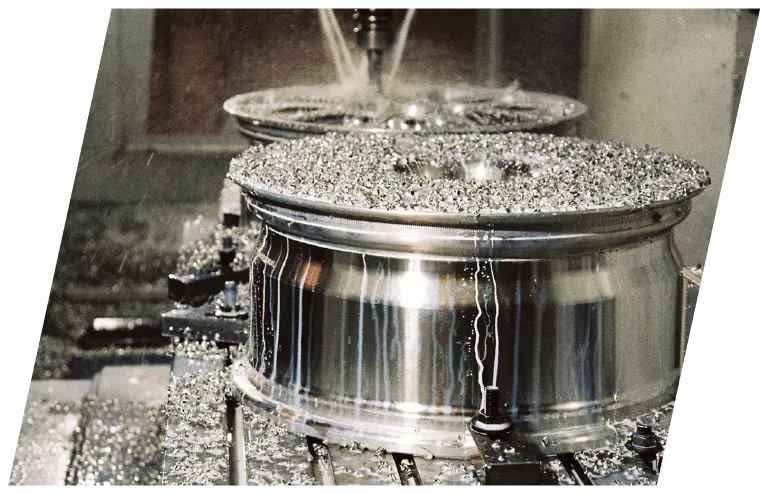
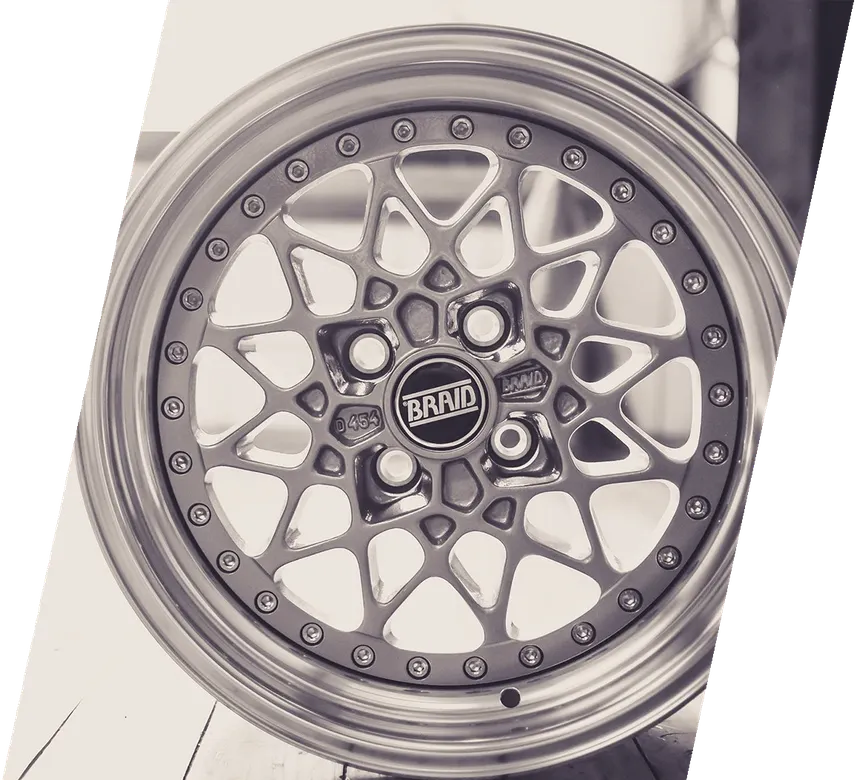
This was the golden, slightly deranged age of the split rim. Braid built multi-spoke, three-piece wheels with interchangeable barrels, and that was where the fun and the danger began. You could bolt on a wider barrel, push the offset out, tuck the wheel under one of those glued-on fibreglass arches everyone was fitting, and stand back to admire a car that now poked its rims proudly past the bodywork. Offsets that ate wheel bearings for breakfast. Cars sitting a finger’s width wider than they had any right to, because it looked glorious, even if the front hub wept quietly every cold morning.
A Renault 5 GT Turbo on a set of Braid split rims, arches flared to the limit, was a statement parked outside the bar. And Braid was not watching from the sidelines. It was the company selling you the very base you built your madness on. The same firm winning championships and heading to Dakar was the one sitting in your mate’s lock-up, helping you gamble your wheel bearings for a couple of extra centimetres of track.
That is why this is not a cold article about a factory. It is memory. And I will put my own cards on the table: when I think about wheels for my Golf Mk1 Cabriolet, I only see two real routes. Machine a set of snowflakes into three-piece wheels, with all the labour and obsession that involves. Or a set of Braid Classics, and be done with it. Nothing else gives me the same itch. Because one of those options carries the whole story inside it, the split rims, the barrels, the era. And that is not something you pull off any old catalogue.
The most brutal brief in engineering: “do it, but we are telling you nothing”
Here is the story that explains why the big names trust these people. The engineers at Renault Sport came to Braid with a job and a single instruction. They needed the wheels for the Renault RS01 and the Clio R3T. And they handed over the brief with no information whatsoever. Nothing. Sort it out.
In competition engineering, that is the highest possible compliment. No drawings, no parameters, no hand-holding. Here is the problem, and we trust that you, with your experience, will solve it better than we could. Braid solved it. And solved it well.
It was not a one-off. When Peugeot Sport decided to return to Dakar, who did they call to develop the wheels for the Peugeot 2008 DKR? Braid. When Mahindra Racing needed wheels for its Formula E single-seater, the most demanding electric category on the planet, who did they trust? Braid. When Lada Sport entered the World Touring Car Championship with the Lada Vesta, what was underneath it? Braid. Opel, Subaru and Alfa Romeo in the TCR ranks, same answer.
Read that list again. Peugeot, Renault, Mahindra, Lada, Opel, Subaru, Alfa Romeo. Manufacturers from half the world, in the toughest categories there are, all choosing a Spanish company that gets nowhere near the recognition it should.
Why they are called the tailors
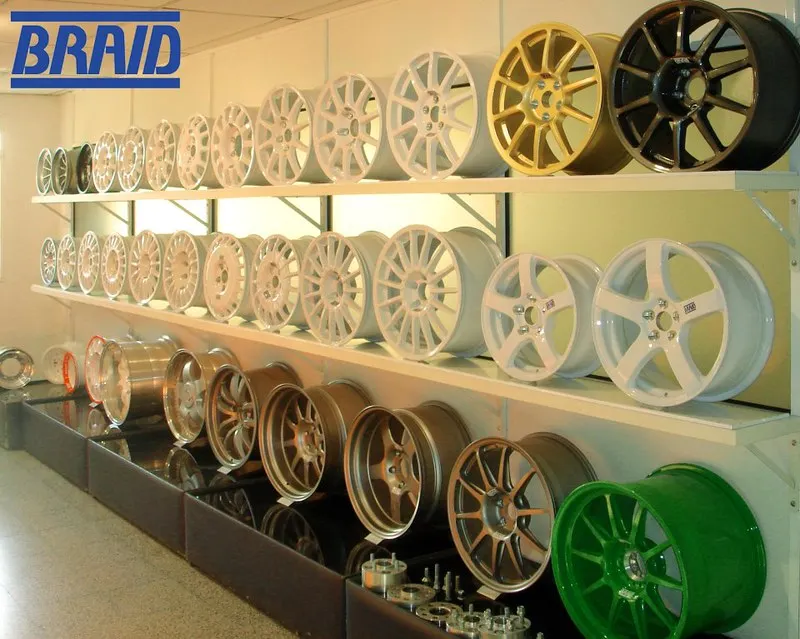
The nickname is not a marketing flourish. Braid are called the tailors of wheels because their real business is making the exact wheel each car needs. Not the one in the catalogue. The one you ask for.
This is the thing a multinational simply cannot do. A multinational makes a hundred thousand identical wheels and sells them to you. Braid makes one. A single prototype unit if that is what it takes, with the precise mounting, the precise width, the precise offset your project demands. Any size, any fit, any finish. Tiny production runs. One irreplaceable piece for whoever dares to ask for something different.
That is the gap between manufacturing and tailoring. And it is why half the paddock, from works teams to the biggest road car makers in the business, calls Igualada when it needs a wheel that does not exist yet.
The technology that does not snap: it deforms
Let us talk about what actually makes a Braid special on the inside. The company developed its own technology, Fullflowcast, and the headline figure is the kind that stays with you. A Fullflowcast wheel weighs up to fifteen per cent less than the same wheel made in one solid block. Less weight means sharper response, better braking, better everything.
But the real point comes next. When an ordinary wheel takes a savage hit, it snaps. It cracks. Game over. When a Braid Fullflowcast takes that same hit, it does not snap. It deforms. It absorbs the impact, it gives, it dents, but it does not leave you stranded in the middle of nowhere with a broken lump of metal.
That difference, snapping versus deforming, is not a technical footnote. It is the difference between finishing the stage and retiring. Between getting home and calling recovery. It is engineering designed by people who know exactly what it feels like to destroy a wheel in the worst possible place.
Add the rest of the armoury: forged aluminium and magnesium, flow forming, every technique that exists to make a wheel both lighter and stronger, two things that fight each other in theory and that good engineering reconciles.
The future rolls out of Igualada too
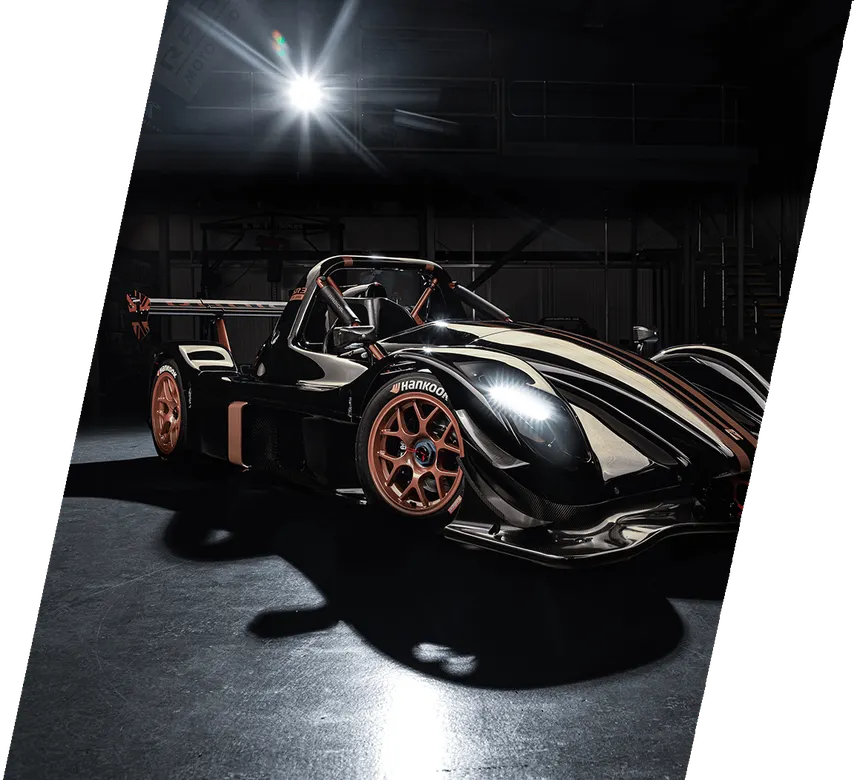
The easy assumption is that a fifty-year-old company coasts on its reputation. Wrong. Braid is still on the front line of what comes next. They developed the wheels for the Pioneer 25, the first one hundred per cent hydrogen-powered race car in FIA Extreme H. The first. When the engine changes, when the energy source changes, the wheel still has to hold. And teams still knock on the same door.
Fifty years since that Stral of 1976. From a three-piece wheel built against all odds in a closed-off Spain, to the wheels of a hydrogen race car and a Dacia winning the 2026 Dakar. Half a century without drifting from one idea: build the best possible wheel for whatever challenge sits in front of you.
And all the while, in its own backyard, it gets nowhere near the recognition it deserves. We talk about the Italian names, the German names, the imported icons, and meanwhile Igualada quietly houses one of the finest competition wheel factories in the world. Putting cars across half the planet on its rims. Winning Dakars. Solving problems Renault could not solve.
Next time you watch a car cross the desert, look at the wheel. It might say Braid. And it might just be the most Spanish thing in the entire race.
Check you’re still alive.