
The Hail Melon: How Ross Chastain Pulled Off a Video Game Move in Real Life and Forced NASCAR to Rewrite the Rulebook
Every kid who played NASCAR games on a GameCube or PlayStation in the early 2000s knew the trick. Damage off. Last lap. Coming through the field. You’d jam your car against the outside wall in Turn 3, hold the throttle down, and let the AI do the rest while your sticker car ground sparks down the entire backstretch wall. The game didn’t care. The car didn’t slow down. You’d come out of Turn 4 in the lead and the chequered flag was yours.
What nobody ever thought was possible: someone doing that in a real Cup car. With a 3,400-pound stock car. At the end of a real race. In front of real cameras. With a real Championship 4 spot on the line.
Then Ross Chastain did it.
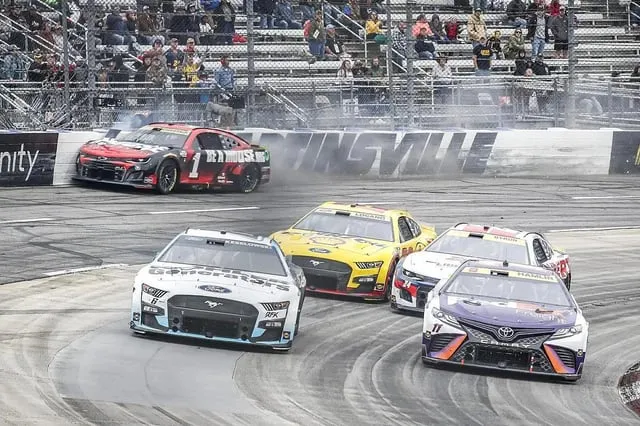
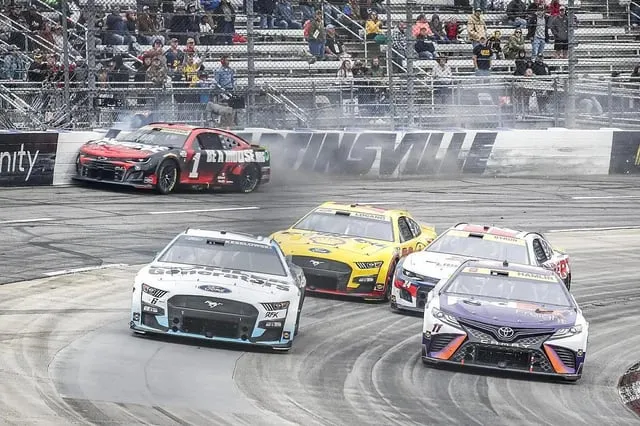
On 30 October 2022, in the closing seconds of the Xfinity 500 at Martinsville Speedway, the kid from a Florida watermelon farm took the wall, planted his right side against concrete, kept his foot in it, and rewrote what was possible in a Cup car. He went from tenth to fourth in a single corner. He set the all-time Martinsville track record. He knocked Denny Hamlin out of championship contention. And he forced NASCAR to write a new rule the following winter so that no driver would ever pull that move again.
The paddock gave it a name almost immediately: the Hail Melon. A pun on the Hail Mary, the desperation final-second pass in American football, crossed with Chastain’s family background — four generations of watermelon farming in Florida. The name stuck. It’s how NASCAR’s own historical records refer to the move today.
This isn’t the story of a great pass. It’s the story of the last exploit American stock car racing will ever see.
What Was Actually on the Line
Set the table. Penultimate race of the 2022 season. Round of 8 of the Cup Series Playoffs. Three races to determine the four drivers heading to Phoenix the following week to fight for the championship. Joey Logano already locked in by virtue of a Vegas win. Christopher Bell was about to win this very Martinsville race and lock himself in. That left two spots and four contenders: Chase Elliott, Denny Hamlin, William Byron, and Chastain himself.
This was Chastain’s first full season with Trackhouse Racing as a genuine title contender. He’d driven for the team in 2021 as well — Trackhouse’s debut year — but 2022 was when Justin Marks’ upstart organisation graduated from new-team-on-the-block to legitimate front-runners. Two wins for Chastain that year (COTA in March, Talladega in April). Led the entire Cup Series in top-five and top-ten finishes. From watermelon farmer to championship contender in eighteen months. But he’d also collected an entire wing of enemies along the way, and the chief among them was Hamlin. The two had run-ins all year. They were already trading paint at Martinsville before the final lap arrived.
Two laps to go: Hamlin sat inside the Championship 4 on points by exactly two points over Chastain. Two. That’s what stood between the No. 1 Trackhouse car and a shot at the title.
The white flag waved. Chastain was tenth.
The Move
A few things you need to understand about Martinsville before this makes sense. It’s a 0.526-mile paperclip — the shortest, oldest, and tightest track on the Cup schedule. Walls are right on top of you. The corners are nearly 180-degree hairpins. The banking is gentle. Passing five cars in two corners doesn’t happen here. It doesn’t happen on most tracks. On Martinsville, it’s a physical impossibility.
Unless the laws of physics are violated. Which is what Chastain did.
He told the media afterwards, plain as day: “I played a lot of NASCAR 2005 on the GameCube with Chad and you could get away with it. I never knew if it actually worked. I just grabbed fifth gear down the backstretch and was fully committed.” Chad is his cousin Chad Finchum. The game in question was NASCAR 2005: Chase for the Cup, released by EA Sports for PS2, Xbox and GameCube. It had a damage model so forgiving that with damage turned off, you could ride the outside wall like it was a banked corner of its own. Generations of teenagers had figured this out and made highlight reels on early YouTube. Nobody, including Chastain, ever thought it would work in real life.
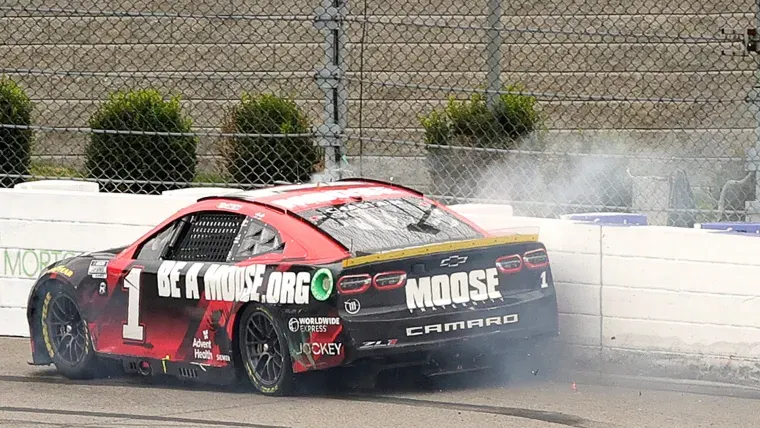
Entering Turn 3, he did the opposite of what every driver does at Martinsville. He didn’t brake. He didn’t downshift to third the way the corner demands. He upshifted to fifth gear. Fifth at Martinsville isn’t supposed to exist. The straights are too short, the corners too tight, there’s never time for that ratio to matter. But with the wall doing the work that the front tyres normally would, fifth was the right gear to maximise terminal velocity and let inertia carry the car through.
He drove his Camaro ZL1 hard into the concrete. He took his hands off the wheel. He kept the throttle pinned, and let the wall do the steering for him while the nine cars in front of him braked into the corner like normal drivers in a normal race.
Through Turns 3 and 4 his car held the wall. The wall held the car. He crossed the finish line in fourth.
The Numbers Don’t Lie
This is the part that turns the move from gimmick into history. The official lap time for Chastain’s last lap was 18.845 seconds. To put that in context: Kyle Larson’s pole speed for that weekend was a 19.709. Chastain beat the pole by nearly a full second. With his right-side sheet metal dragging against concrete. With a car that had taken 499 laps of short-track punishment.
It also set the all-time Cup Series lap record at Martinsville. Worth understanding: race lap records and qualifying lap records are different categories. Qualifying laps are turned in cars set up for one clean lap — no fuel load to speak of, fresh tyres, no traffic, no thermal management. Race laps are slower by definition because cars carry more weight and have been beaten on for hundreds of laps. Chastain set an all-time outright record — faster than the previous qualifying mark — in a race lap, on the last lap, against the wall.
Why does the lap time matter? Because it tells you the move wasn’t a stunt. It was physics being exploited. The banked outside wall of Turns 3 and 4 at Martinsville functioned as a mechanical guide rail. No need for front tyre grip. No load transfer mid-corner. No scrub from the steering input. Just full throttle and a concrete wall doing the work that the front axle would normally have to do. Where the rest of the field rounded the corner at about 70 mph, Chastain went through it at roughly 130 mph — 50 mph faster than anyone else on the racetrack. It was, in pure engineering terms, the fastest theoretical lap that car could turn at Martinsville, if you removed all the constraints that physics normally puts on a stock car in a hairpin.
The Gearbox That Made It Possible
Here’s a technical detail that gets buried in every recap. 2022 was the debut season of the Next Gen Cup car. New chassis. Independent rear suspension with double wishbones (the first in Cup history, replacing the live axle that had been on Cup cars since the dawn of time). 18-inch single-lug aluminum wheels (also a first). Side intrusion structure significantly stiffer than the outgoing Gen 6 car. And, critically, a completely new transmission: the Xtrac P1334.
The P1334 is a five-speed sequential manual transaxle with reverse, mounted longitudinally at the rear of the car. It replaced the four-speed H-pattern gearbox NASCAR had used for decades. It’s still a three-pedal manual — the clutch is still there — but the shift action is now sequential, via a floor-mounted push-pull lever: pull back to upshift, push forward to downshift. It’s not paddle-shifted like an F1 car. It’s a floor lever, but sequential: 1-2-3-4-5 in strict order, no H-pattern hunting.
Why does it matter for the Hail Melon? Two reasons. First, sequential shifting let Chastain grab fifth gear in a fraction of a second, without fighting an H-pattern. With the old four-speed manual, going to top gear mid-disaster, while the car was disintegrating against a concrete wall, would have been almost impossible. Second, the Next Gen’s reinforced side structure absorbed what no Gen 6 chassis could have survived: the right side of the car grinding concrete at 130 mph for the length of Martinsville’s back straight and into the corner.
It’s not a coincidence that the only successful Hail Melon in history happened during the first season of a chassis built to absorb that kind of lateral abuse and a gearbox capable of that shift sequence under that kind of load. The opportunity was created the moment the engineers handed drivers a car that could survive the move. Chastain just happened to be the first one to notice.
The Two Points
He crossed the line fourth. Christopher Bell won. Joey Logano was already in. Chase Elliott held on inside. And Chastain, by virtue of those six positions gained in two corners, picked up the exact points needed to bump Hamlin out of the Championship 4 and put himself in.
By two points. Two.
Hamlin had been defending position all afternoon. He’d been side-by-side with Chastain earlier in the race. He watched the No. 1 car blow past him on the outside, riding the wall like a slot car, in the final corner of the final lap of his championship season. Gone. By two points that materialised in 18.845 seconds against the concrete.
Reaction in the garage split exactly down the middle. Kyle Busch, never one to mince words, said it cleanest months later: “I just never, I guess, had the guts to make the move. Then I saw it done by Ross to get himself into the final round, the championship race at Phoenix. And I thought, damn it, I wish I’d taken that moment. But I didn’t, and so he owns it.” That’s the highest praise a NASCAR driver can give. Acknowledging that someone else had the cojones to do the thing you couldn’t. Even Fernando Alonso chimed in from across the Atlantic: “This is the best thing of 2022 in motor racing. We all did this on video games with damage disabled. Never thought this could become reality.”
What the Car Looked Like When It Stopped
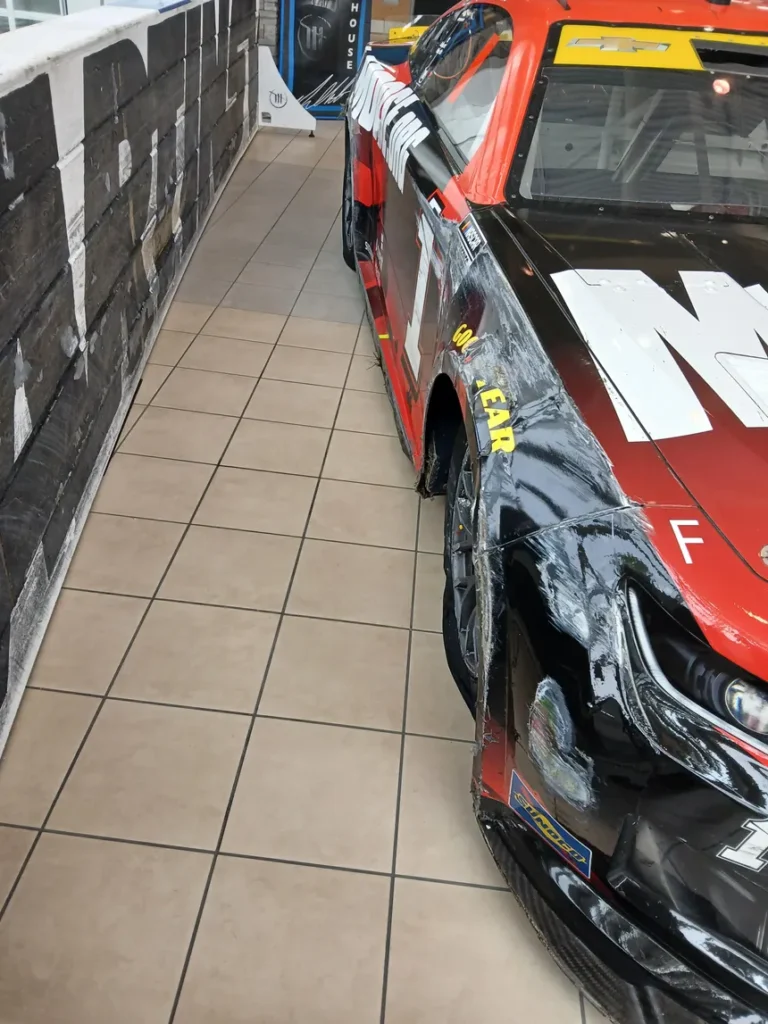
This is the part most outsiders get wrong. The car didn’t disintegrate. It crossed the line damaged but largely intact. Justin Marks, Trackhouse co-owner, later confirmed that roughly 90% of the parts on the No. 1 Camaro remained usable after the move. The right-front upper control arm was broken. The front and rear clips were bent. Part of the suspension was hanging by what it could find. But the engine, the transmission, the main chassis structure, most of the bodywork: recoverable.
The team genuinely considered rebuilding the car for Phoenix the following week. From a pure economics standpoint, that’s what you do — you fix what’s broken and race what works. But when NASCAR announced in late January 2023 that the move would draw penalties going forward, Marks made the call: the car gets retired and preserved as a historical piece. He put it in writing: “Ross’ move at Martinsville was a historic moment and should be preserved for the fans for years to come in physical form. This sport isn’t just about the balance sheet, it’s about passion and moments and people.”
The estimated cost of keeping the car exactly as it had crossed the line: hundreds of thousands of dollars in parts that would never be raced again. Trackhouse swallowed it.
Where the Pieces Live Today
The No. 1 Camaro, with its scarred sheet metal and bent clips, sits on display at Trackhouse Racing’s shop in North Carolina. It spent some time tucked away in the back of the facility while the team worked out what to do with it — they reattached enough suspension and wheels to make it stand on its own — and it’s now positioned near the lobby, where fans and visitors can see it up close.
The section of wall the car ground against — that piece of Turn 4 concrete with the word “Martinsville” still painted on it in white — was physically cut out of the racetrack during the 2023 anniversary weekend. Clay Campbell, Martinsville Speedway’s president, helped Chastain pull it free using a Kubota piece of heavy equipment. The slab is enormous, far bigger than anyone expected. It’s currently held in Campbell’s possession at Martinsville, awaiting transfer to Trackhouse once the team finds enough space at the shop to display the car and the wall together. That’s the intent: reunite the artifacts in one room.
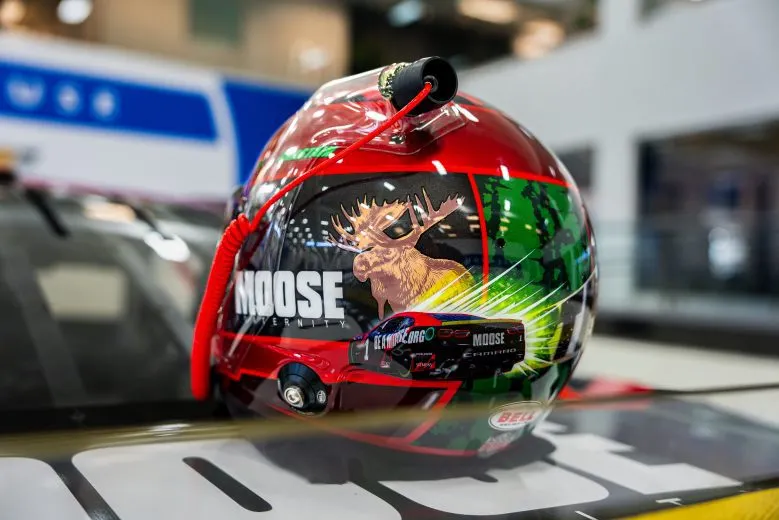
The 1:24 scale diecast of the No. 1 Moose Fraternity Chevrolet — manufactured by Lionel Racing with the exact scrapes and paint transfer the real car finished the race with — became Lionel’s best-selling diecast of 2022. It outsold every championship-winning car, every Daytona 500 winner, every Hall of Fame name. A car that won nothing and finished third in the championship race in Phoenix sold more 1:24 models than any other on the year because the move it pulled mattered more to the fanbase than entire championships did.
What Happened in Phoenix
A week later in Phoenix on 6 November, Chastain raced for the title against Logano, Elliott, and Bell. Logano started on pole. Chastain started 25th. Logano was untouchable, leading 188 of the 312 laps. He passed Chase Briscoe for the lead with 30 laps to go and never gave it back, winning ahead of Team Penske teammate Ryan Blaney (who wasn’t in the title fight). Chastain finished third in the race, 1.2 seconds behind Logano at the chequered flag. With no late caution, no second miracle was available. Logano took his second Cup Series championship. Chastain finished second in the overall standings.
But the result didn’t matter. Not really.
Legal, Then Banned
Here’s the part most people misunderstood at the time. NASCAR didn’t penalise Chastain. They couldn’t. There was no rule in the book that said you couldn’t intentionally use the wall as a guide rail. The rulebook covered aggressive driving, dangerous driving, intentional contact with other competitors, blocking. Nothing about scraping concrete on purpose to gain positions. It was a gap in the rules the size of an entire corner.
Steve O’Donnell, then NASCAR’s Senior Vice President of Competition, said it plainly in the days after the race: “At this point, it was a move that’s within the bounds of the rulebook. I really don’t think it’s right to adjust the rules when we’ve been racing for 35 points races, then throw a wrinkle in it for the 36th.” That’s NASCAR being institutionally fair. You don’t change the rules at the eleventh hour because one driver did something nobody anticipated.
But come the off-season, the new rule arrived. In late January 2023, Elton Sawyer (O’Donnell’s successor as VP of Competition) addressed media and clarified the new interpretation: “This is not new language. Basically if there’s an act that we feel that’s compromising the safety of our competitors, officials, spectators, we’re going to take that seriously. We will penalise for that act going forward. Basically it would be a lap or time penalty at the end of the race. That move at Martinsville would be a penalty in 2023.”
Translation: do it again, and the result gets erased. Which means Ross Chastain is, on the record, the first and last driver who will ever wall-ride his way into the Championship 4. The glitch has been patched. The exploit closed.
Chastain himself agreed: “I think it was the right call. I don’t want to get beat by it, for sure. I don’t want to do it again to beat somebody. So I just want to beat them straight up.” That’s the most sensible thing he could have said, but it’s also a quiet admission that he knew what he’d done wasn’t a technique. It was a hole in the system. And it’s been filled.
What Survives
The result didn’t survive. Chastain lost the title to Logano. What survives is the number: 18.845 seconds. A lap record set with a car against a wall. Faster than the pole. Faster than the previous all-time track record. Faster than anyone ever expected was possible at Martinsville.
And what survives is the idea. That in 2022, an era of seven-post rigs, CFD simulation, telemetry overlays, and engineers building optimal lines corner by corner, a driver who grew up playing a 2005 EA Sports console game with his cousin on a GameCube executed the move the game had taught him. Real life copying the video game. The exploit, run in production.
Sometimes the most outrageous overtake in racing history isn’t engineered. It’s remembered. From a controller, in a living room, twenty years before anyone thought it could ever leave the screen.
Check you’re still alive.