Spain Built a Hyper-Luxury Car That Stole the Paris Motor Show — Then Its Own Widow Had the Blueprints Burned
Ask almost anyone in Britain or America to name a great Spanish car of the 1920s and you’ll get a blank look. Maybe, if they’re sharp, Hispano-Suiza. And that’s it. The received wisdom is that Spain didn’t really build proper cars until SEAT started bolting together licensed Fiats decades later.
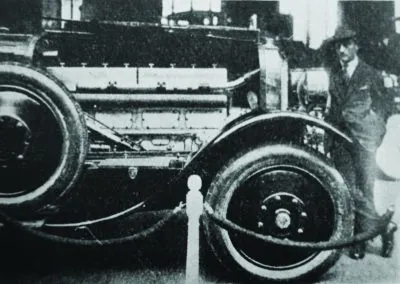
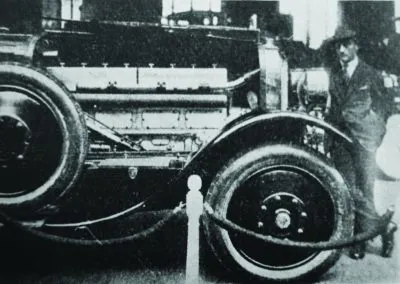
The received wisdom is wrong. And the proof is a single photograph from 1921.
In it stands a man, nearly six foot two, tall for his day. Beside him is a car. And his face doesn’t reach the top of the radiator. Not the roof. Not the window line. The radiator. That man is Arturo Elizalde. That car is the Tipo 48. It was built in Barcelona, and when it rolled into the Paris Motor Show it was the largest car there — billed, with some justification, as the biggest car in the world. Made in Spain.
This is the story of a marque that ran shoulder to shoulder with Hispano-Suiza, sold cars to a king, and left the French gawping at their own motor show. Today, almost nobody remembers it. And the cruellest part is that the fatal blow didn’t come from a rival, or a war, or a market crash. It came from inside the family.
A very rich Cuban with something to prove
Arturo Elizalde Rouvier was born in 1873 in Matanzas, Cuba, into serious money. The kind of man for whom wealth was never a worry, because there had always been plenty of it. And for this story, that matters enormously. Elizalde didn’t build a car company to get rich. He already was. He built it out of passion, out of pride, to prove a point.
In the early 1900s, founding a car marque was easier than you’d think. With money and a bit of technical know-how, you could have a go. So in 1908, alongside his brother-in-law Rafael Biada and an investor named Josep Maria Vallet, Elizalde set up a Barcelona firm that started life as J.M. Vallet y Cía. They began as most did — a workshop making parts, repairing cars, and representing a French marque, Delahaye, in which Arturo himself held a stake.
But Elizalde had no interest in being the man who sold other people’s cars. He wanted to build his own. Within a few years he’d taken control of the company and put his own name over the door. The dream now had a surname.
Cars that dazzled and never made a penny
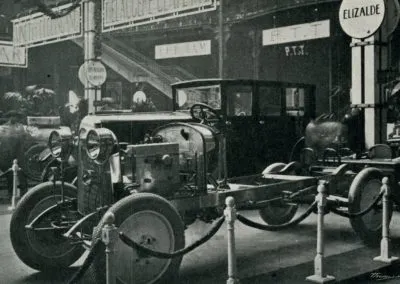
Here’s the first thing you need to understand about Elizalde, because it shapes everything that follows. The cars were magnificent. And they almost never turned a profit.
It’s entirely possible that the car-building side never made real money at all. But Arturo, immensely wealthy, didn’t appear to lose any sleep over it. He built cars because he wanted to, because he wanted the best, and if perfection meant losing money on every single one, then money would be lost. It’s a way of doing things that sounds alien today, but among the very rich playing at car manufacture in that era, it wasn’t so unusual. Think of it as the Bugatti approach a century early — engineering as an act of ego, with the accountants firmly told to wait outside.
And out of that freedom, that “I don’t care what it costs,” came beautiful things. A car company born without the noose of profit around its neck can afford to be brave. Elizalde was.
The bronze cylinder head: the house signature
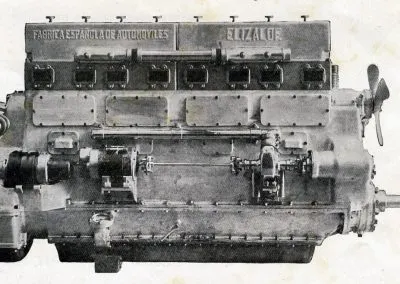
If one technical detail defines Elizalde, it’s this. While the rest of the world cast its cylinder heads in iron or steel, Elizalde cast them in bronze. Not as a gimmick, not to show off. It was a considered decision by Arturo himself, who had an engineer’s head to go with the millionaire’s wallet.
Bronze has a lower coefficient of thermal expansion than steel. In plain English: it copes better with heat without warping, it sheds temperature more effectively, and that translates into an engine that runs more efficiently and more smoothly. It was an expensive, unusual solution, near-exclusive to the marque. The kind of detail only afforded by someone who builds not to make money, but to do things properly.
That bronze head is Elizalde in a single component. Brilliant, costly, unlike anything else. And, as you’ll see, also one of the reasons for its downfall.
The king who drove their cars
In the Spain of that era, there was no better advertisement than a monarch behind the wheel. And Elizalde landed exactly that.
In 1915, King Alfonso XIII — a self-declared motoring enthusiast — personally test-drove an Elizalde, running from Madrid to Navacerrada and back to the Polo Club, where he congratulated the makers warmly and urged them on. Shortly after, he visited the Barcelona factory and bought himself an Elizalde cabriolet. The King of Spain, a customer.
It wasn’t a one-off. Alfonso XIII returned to the factory in 1924, by then a landmark of Spanish industry. Having the monarch testing your cars, buying them, and walking your factory floor was the ultimate stamp of prestige. Elizalde had it.
And there was substance behind the glamour. In 1919 the marque unveiled a car that was a statement of modernity: the Reina Victoria Eugenia, named in the queen’s honour, was the first car in Spain with brakes on all four wheels. It sounds utterly ordinary now. Back then it was cutting edge. While almost everyone else still braked on the rear wheels alone, Elizalde was already stopping on all four.
The Tipo 48: the monster that stopped the Paris show
And now the jewel. The car in the photograph. The one that left Europe slack-jawed.
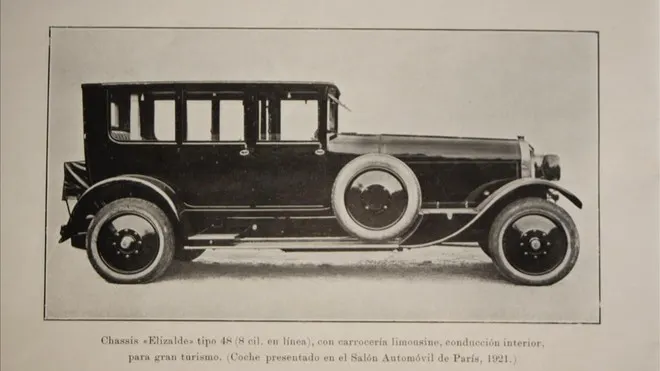
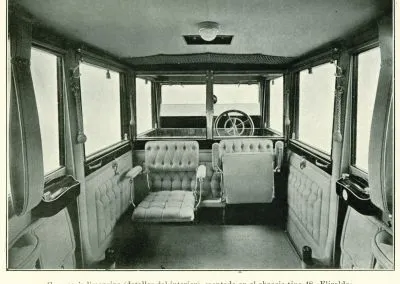
Designed over the winter of 1920 into 1921, the Tipo 48 was a beast of proportions that are hard to picture today. A chassis nearly six metres long. A straight-eight engine with an aluminium block — genuinely rare in those years, when most of the world was still casting in iron. Not one but two bronze cylinder heads, the house signature taken to its extreme. Thirty-two valves, four per cylinder, when most engines made do with two. Twin ignition, two spark plugs per cylinder. And 8,143cc of displacement. Eight-plus litres of Spanish engine.
It didn’t stop at the engine. The Tipo 48 came with toys that read like science fiction for 1921. Automatic central lubrication. Brakes on all four wheels with mechanical assistance, servo-aids everywhere. And my favourite: a built-in pump to inflate the tyres that doubled as a compressor to clean the car. A car that pumped up its own tyres and dusted itself off. In 1921.
When it appeared at the Paris Motor Show, it caused a sensation as the largest and most luxurious car of the entire event. For a Spanish car to be the king of the Paris show, in the golden age of the European automobile, with Rolls-Royce and the great French houses and everyone watching — that is not a minor footnote. To put it in terms a British reader will feel: imagine if, at the height of Rolls-Royce and Bentley’s pre-war pomp, the car everyone crowded around at the biggest show on the continent came from Barcelona. That’s what happened.
But let’s be straight, because NEC doesn’t invent happy endings. The Tipo 48 was a total commercial failure. It cost 60,000 pesetas when an ordinary car of the day ran to about 10,000. Six times the price. It was so colossal, so expensive and so exclusive that it barely sold. Five were built. Five. Arturo kept one himself for family trips. The car that gave the marque worldwide fame didn’t earn it a single peseta. Pure Elizalde: technical glory, commercial ruin.
The death that changed everything
In December 1925, Arturo Elizalde died unexpectedly in Paris. And note the irony of the timing: he had just signed a hugely important contract with the French firm Lorraine to build, under licence, the engines that would power the Breguet aircraft of the Spanish air force. He died at the very moment he was opening the door to his company’s future — a future that lay not in cars, but in the sky.
Because you have to understand that Elizalde had been building aircraft engines for years. The quality of its engines had caught the attention of the military. The cars brought prestige and racing wins, but no money. The aero-engines were the future. And with Arturo gone, the balance tipped completely.
The fatal blow came from within
And here is the part that stings most in this whole story. The part that makes it more than just another marque that shut its doors.
Elizalde wasn’t killed by its competition. Not by a war, not by a crash, not by a bad market call. The car-making Elizalde was erased, deliberately, by its own widow.
After Arturo’s death, his widow chose to steer the company exclusively towards aviation, leaving cars behind for good. And she didn’t simply stop building them. She gave an order that is still painful to read: she had every blueprint and document relating to the automobiles in the factory destroyed. All of it. The entire technical memory of the marque, thrown out. And as if that weren’t enough, she ordered the surviving racing single-seaters scrapped — among them the fabled 5181, a 3.2-litre straight-eight that between 1922 and 1924 had left every rival behind on the Rabassada hillclimb. To the breaker’s yard.
Think about what that means. Most marques that vanish do so from the outside: they stop selling, they close, they get swallowed by another company — but their traces survive. The blueprints, the cars, the history. Not Elizalde. Elizalde had its tracks deliberately wiped from within. It didn’t just cease to exist physically; someone made sure it would be far harder to remember. That’s the difference between a marque that dies and a marque that is erased. Elizalde was erased.
And the bronze cylinder head, its great technical pride, ended up part of the problem. An engine full of expensive, exclusive solutions is wonderful to admire and ruinously costly to build and maintain. The very thing that made Elizalde special was also what made it unviable.
What remains
The company lived on, but it was no longer the same. It built aircraft engines for decades. In 1951 it was absorbed by Spain’s National Institute of Industry and renamed ENMASA, the National Aircraft Engine Company. It ended up, of all things, building diesel engines for the SEAT 1400 and 1500. From the hyper-luxury that stopped the Paris show to the engines of Spain’s economy-boom runabouts. A journey that tells you everything about what Spanish industry was, and stopped being.
But the next time someone tells you Spain never built real cars — that all we ever did was assemble little runabouts under someone else’s licence — remember the photograph. The tall man whose face doesn’t reach the radiator. Remember that in Barcelona, a century ago, somebody built an eight-litre, thirty-two-valve car with bronze cylinder heads that was the largest in the world and left Paris stunned. And remember that we erased it so thoroughly it now has to be rescued. Not because it failed. Because somebody burned the blueprints. Let’s not forget it twice.