The Pinzgauer Is the Best Camper Base on Earth (and the One You Shouldn’t Buy)
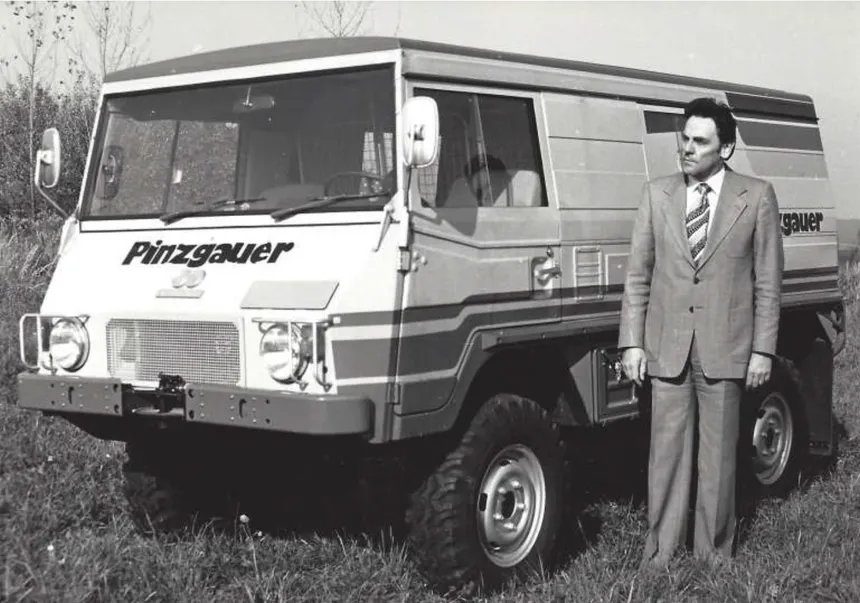
Top Gear once parked a Pinzgauer next to a Land Rover and the joke wrote itself: one of them looked like it had wandered off a NATO base, the other looked like it wanted to go to Waitrose. Twenty years later the joke has flipped. The Land Rovers are restoration projects with a forum full of electrical gremlins, and the Pinzgauer is the thing serious overlanders quietly spend a fortune converting into a home.
There’s a contradiction baked into this Austrian box on wheels, and it never resolves. It is, by a clear margin, the most intelligently engineered off-road platform ever built to haul people and cargo across terrain that defeats everything else. It is also a narrow, deafening tin can designed by people who never once imagined someone would want to sleep, cook and live inside it for six months crossing a continent.
Let me explain why both things are true, and why they come from exactly the same place.
A horse, then a truck
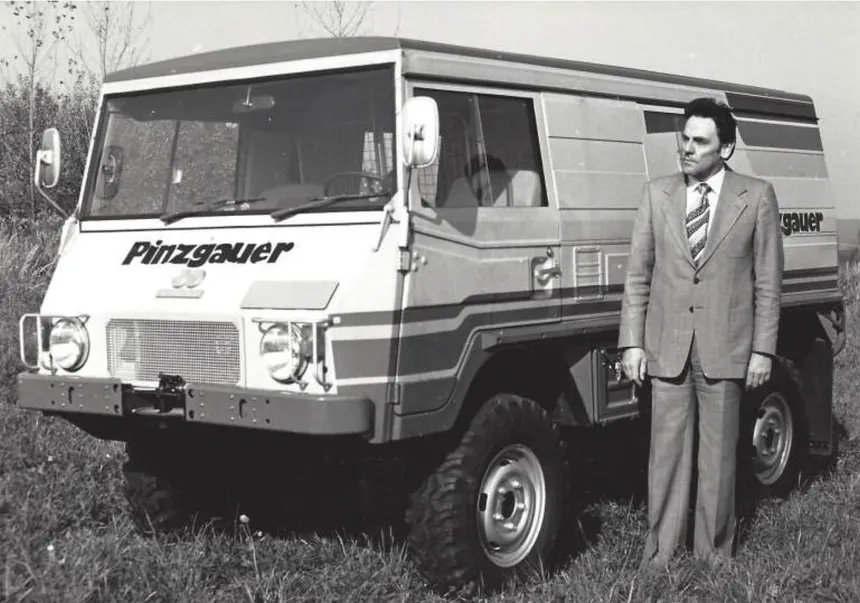
The name is the first clue. The Pinzgauer is an Austrian horse breed, the kind bred to handle impossible alpine ground without complaint. Steyr-Daimler-Puch in Graz had that idea firmly in mind when they designed the vehicle in the late sixties as a successor to the smaller Haflinger.
First-generation production kicked off in 1971. The 710 was the 4×4, the 712 the 6×6, and the two shared the same chassis, the same engine and the same philosophy. Between 1971 and 1985 the factory built 18,349 of that first run, split between military and civilian buyers across the world.
Here’s where it gets good. Most off-roaders of the era were adaptations. Take a van chassis, bolt on four-wheel drive, say a prayer. The Pinzgauer did none of that. The engine was designed for this vehicle specifically. The chassis was designed for this vehicle specifically. Nothing on this thing is a borrowed part from somewhere else, and that single fact explains everything about how it behaves.
To understand where that obsession comes from, you have to look at the smaller sibling that came first. The Haflinger, also from Steyr-Daimler-Puch, was a tiny all-wheel-drive runabout that already played with the central-tube chassis and independent suspension idea. It worked, but it ran short on payload and power. The Pinzgauer took that same mechanical philosophy and scaled it up. It kept the boxy stamped-steel nose inherited from the Haflinger, but moved the engine behind the driver to shrink the front overhang to almost nothing, added more power, and reorganised everything around a usable rear box. It wasn’t a clean-sheet new vehicle. It was a good idea finally built at the size where the idea actually made sense.
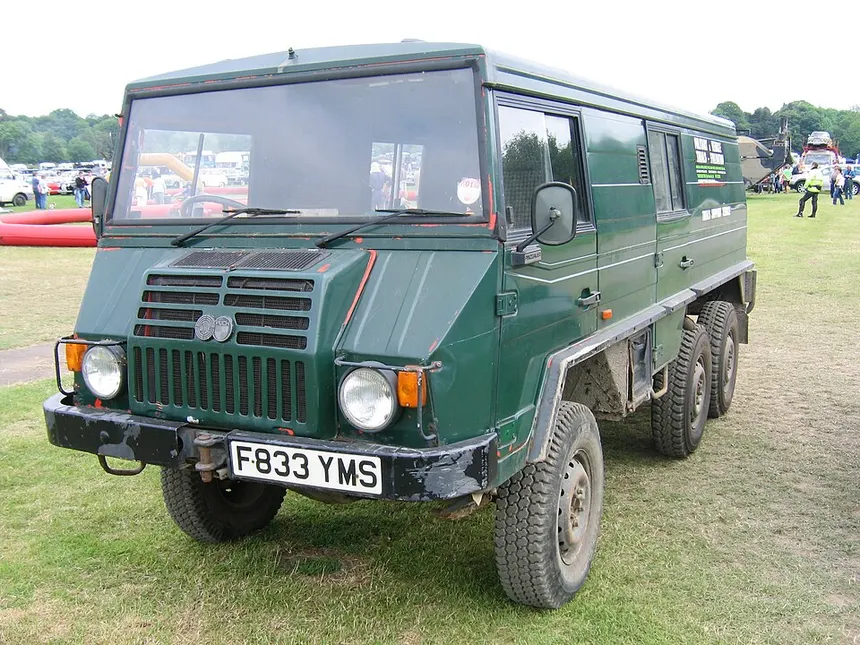
And from day one it came in two formats. The 710 four-wheeler was the big seller, the general-purpose utility off-roader. But the 712 6×6 wasn’t a later bodge or a curiosity: it was on the drawing board from the start. That third pair of wheels isn’t there for show. It spreads the weight across more contact points, multiplies traction in mud and sand, and pushes payload and towing capacity through the roof. When we talk about the best camper base, a lot of people who are serious end up looking precisely at the 6×6, because that longer rear box is where a full house actually fits without giving up off-road ability.
It’s all in the tube
Forget the tyres and the headlights for a second. What makes a Pinzgauer special is underneath, where you can’t see it.
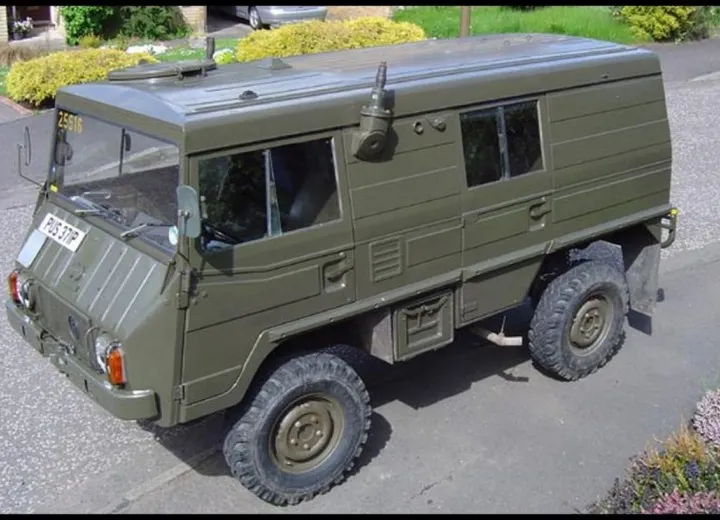
Instead of the classic ladder frame with two parallel rails that almost every truck uses, the Pinzgauer runs a central tube chassis. One fat backbone running the length of the vehicle, with the driveshaft living inside it. Everything else hangs off that tube.
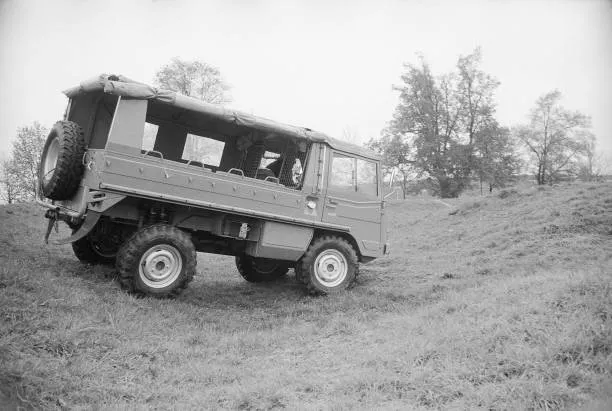
Why does this matter? Two reasons. First, weight distribution: a central spine spreads the mass far more evenly and keeps the centre of gravity low. That’s what stops the thing rolling when it crosses a steep side-slope with half a tonne of kit on board. Second, flex. A central-tube chassis lets the wheels work far more independently over broken ground, because the structure isn’t fighting the articulation. Each wheel finds its own line.
Add fully independent coil-sprung suspension on all four corners. On a 1970s military truck. That was science fiction at the time, and Chris Harris would still tell you most modern off-roaders don’t articulate this cleanly.
Portal axles, or why it climbs over everything
This is the part it shares with the Unimog, and the part that defines the whole silhouette.
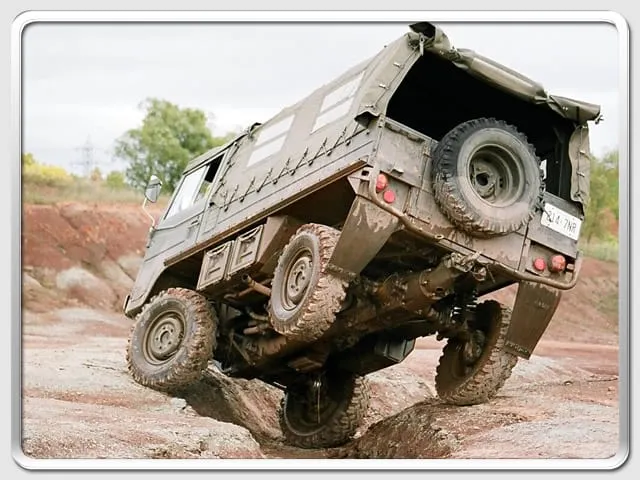
A normal axle carries the differential in the middle, level with the wheel centres. Which means the lowest point of your vehicle is that diff hanging in the middle, and it’s the first thing a rock grabs. Portal axles flip the problem. Instead of sending power straight to the wheel centre, they send it higher, and then a set of gears inside the hub steps the drive back down to the wheel.
The result? The differential sits well above the wheel centre. You gain ground clearance underneath without fitting tractor tyres. The vehicle literally walks over obstacles that would beach any other off-roader of comparable size. And because those hub gears are reduction gears, they multiply torque too, which is exactly what you want for crawling slowly and forcefully.
The differentials, by the way, are sealed. Not a minor detail. Sealed means you can drive the thing into a river and ford it without water ruining the mechanicals. Minimal maintenance, minimal lubrication, designed so a soldier in a field could keep it running with little more than a spanner.
The engine that never runs dry
The first generation ran a 2.5-litre inline-four, air-cooled, fed by twin Zenith carburettors. Somewhere between 87 and 93 horsepower depending on the version. Nothing remarkable on paper.
But there’s one detail that tells you everything about the mindset. The engine carries more than one oil pump. Why? Because they pictured the vehicle nose-down on a brutal slope, at angles where a normal engine would starve a corner of itself and seize. With multiple pumps, it doesn’t matter how the Pinzgauer is oriented: oil always reaches where it needs to go.
That’s engineering from the problem backwards, not from the spec sheet forwards. And it’s precisely why these things still run fifty years on.
The price you pay is known to anyone who’s stood next to one at idle: the air-cooled engine, with almost no sound deadening in a military body, sounds like a cement mixer having an argument. Inside an army truck with no acoustic insulation, the noise is part of the deal.
Why it’s the perfect camper base
Now let’s put the pieces together, because this is where the Pinzgauer separates itself from everything else.
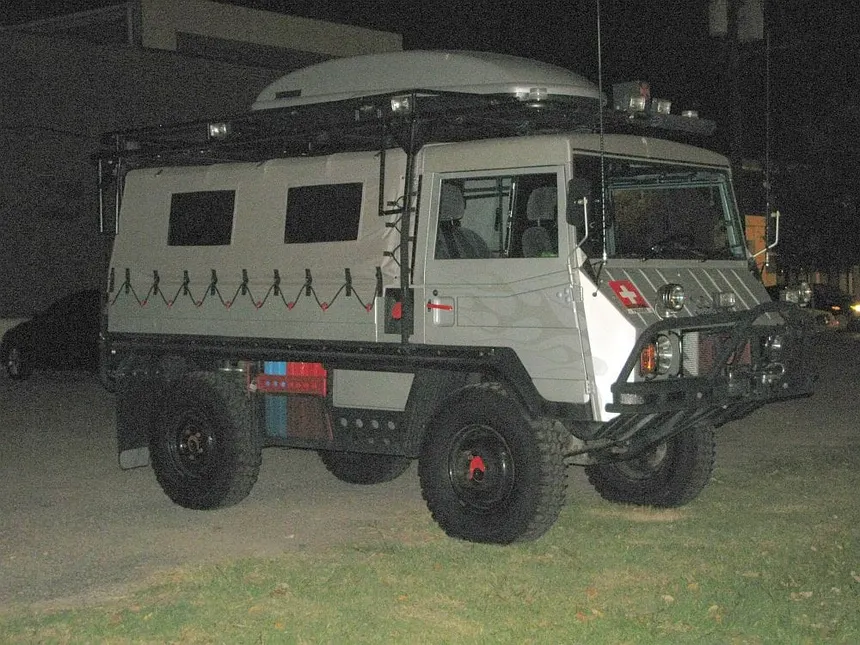
When you want to turn a vehicle into a genuine self-contained expedition home, something that can cross a desert and sleep wherever it stops, you need three things that almost never come together. You need real off-road capability. You need mechanical reliability in the middle of nowhere. And you need a large, uncluttered cargo area to build your living space into.
The Pinzgauer has all three. The portal axles and central tube give you the capability. The engine and sealed diffs give you the reliability. And here’s the bit a lot of people miss: the forward-control cab.
With the engine sitting behind the driver rather than in front, the nose is tiny and the rear load area is huge, square and clear. It’s one of very few vehicles of its size that can genuinely be made self-contained, precisely because that rear box allows it. You’re not fighting wheel arches eating into the space or a transmission tunnel down the middle. You get a clean box to build your world on.
The second generation, the 716 in 4×4 and the 718 in 6×6, arrived from 1986 and sharpened the recipe for camper use. Out went the air-cooled flat-four, in came a six-cylinder Volkswagen turbodiesel, water-cooled this time. More torque down low, more refinement, and the ability to haul the thing fully loaded with a house on its back. It’s the base nearly everyone hunts for today when they want a serious conversion.
Then there’s range, which for an expedition home isn’t a footnote, it’s the line between arriving and being stranded. The standard Pinzgauer already managed over 400 kilometres on a tank. With the optional larger tank, that figure climbed close to 700. For a vehicle this size with this much off-road ability, that’s exactly the autonomy you need when there’s a desert between you and the next fuel stop. It’s not a brochure number. It’s the thing that lets you actually plan a route far from anything.
The flip side nobody puts on Instagram
I’ve sold you the dream for six paragraphs, so here’s the other half, because the Pinzgauer is not for everyone and pretending otherwise helps no one.
It’s narrow. That slim silhouette that makes it so nimble on impossible trails is exactly what squeezes you inside when you try to fit a transverse bed and a basic kitchen. What’s a virtue on the mountain is a punishment in the cabin.
It’s loud, especially the first generation. You’ll hear the engine on every kilometre of motorway, and the motorway is where you’ll spend most of your time linking one adventure to the next.
It’s slow. The first generation topped out around 110 km/h, and that’s empty. Load it with your entire home and the number drops. This is not a vehicle for covering distance. It’s a vehicle for reaching where others can’t.
And it’s a project, not a product. The second-generation VW-diesel models took years before they could legally be imported into certain countries. Finding a good one, maintaining it, sourcing parts for a vehicle that stopped being built in its original form decades ago: that’s a part-time hobby, not a purchase.
The contradiction that never resolves
And so we’re back to the start. The Pinzgauer is the best expedition camper base on earth and, at the same time, one of the most uncomfortable places to live on wheels. Both are true, and both come from the same source: it was designed by Austrian engineers to move soldiers through the Alps, not for you to sleep inside.
Every gram of its off-road brilliance comes from decisions that had nothing to do with comfort. The central tube, the portal axles, the engine out back, the clean rear box. All the things that make it perfect for building your home were born in a military requirements document where the word “comfort” never appeared.
That’s the whole point. You don’t buy a Pinzgauer because it’s comfortable. You buy it because nothing else will take you as far with your home on its back. And if you understand it that way, if you accept you’re going to live inside a repurposed instrument of war rather than a motorhome, then yes: there’s no better base on the planet.
The Austrian horse was never comfortable. It just got to places no other animal could reach.