Czinger 21C: The Hypercar That’s Really a Rolling Advert
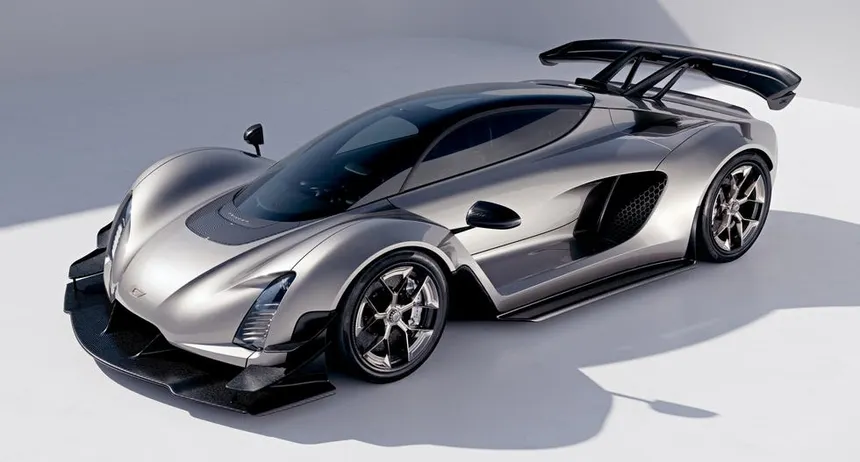
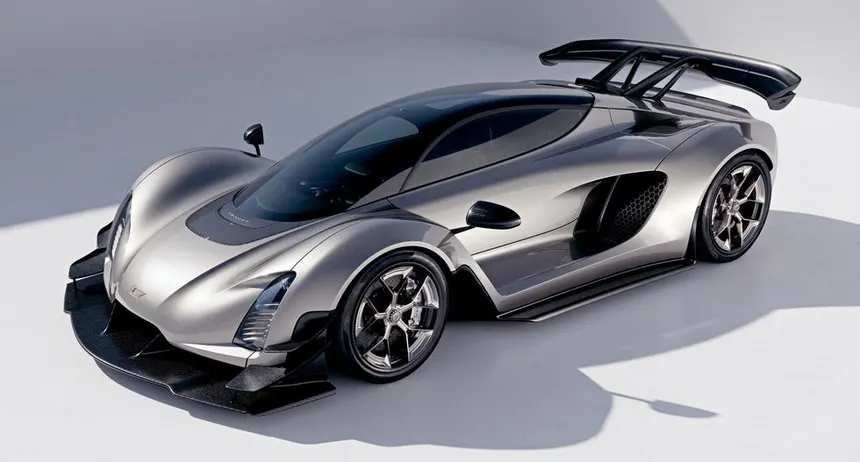
Let me ruin the surprise in the first line: the Czinger 21C isn’t a car. Or rather it is, and one of the most savage ever built, but that’s the part that matters least. The 21C is a brochure. An advert on wheels. The most expensive, most spectacular demonstration of an idea that isn’t about cars at all, but about how you manufacture absolutely everything else.
And once you grasp that, the whole car changes meaning in front of your eyes.
A former prosecutor with a fixed idea
Behind all this stands a character who sounds made up. Kevin Czinger, pronounced “zinger” like the spicy chicken, doesn’t come from cars. He was a federal prosecutor and a Goldman Sachs executive before becoming obsessed with a question almost nobody in the industry was asking seriously: why is building a car still as expensive, as heavy and as dirty as it was a hundred years ago?
His answer wasn’t to design a better car. It was to design a new way of manufacturing. In 2014 he founded Divergent 3D, a Los Angeles company devoted to producing lightweight, advanced structures without the eye-watering tooling the car industry had treated as inevitable for a century. Five years later he launched Czinger Vehicles, the car brand carrying his surname. And in 2021 he unveiled the 21C at a private event in London.
The order matters enormously. First the factory, then the car. The car exists to sell the factory, not the other way round. That inversion of priorities is the key to the entire story.
DAPS: the real product
The real product is called DAPS, the Divergent Adaptive Production System. And here’s where you park the engine noise and pay attention, because this is what actually makes these people remarkable.
DAPS is a complete software-and-hardware solution built to replace the traditional process of manufacturing a vehicle. It works roughly like this: you tell the system what a part has to do, what loads it must carry, where it mounts, how much it’s allowed to weigh, and the software, through generative design and topology optimisation, calculates the mathematically optimal shape to meet those requirements using the least material possible. That shape is then 3D-printed, layer by layer, from a powdered aluminium-titanium alloy. Robots assemble and bond the resulting parts.
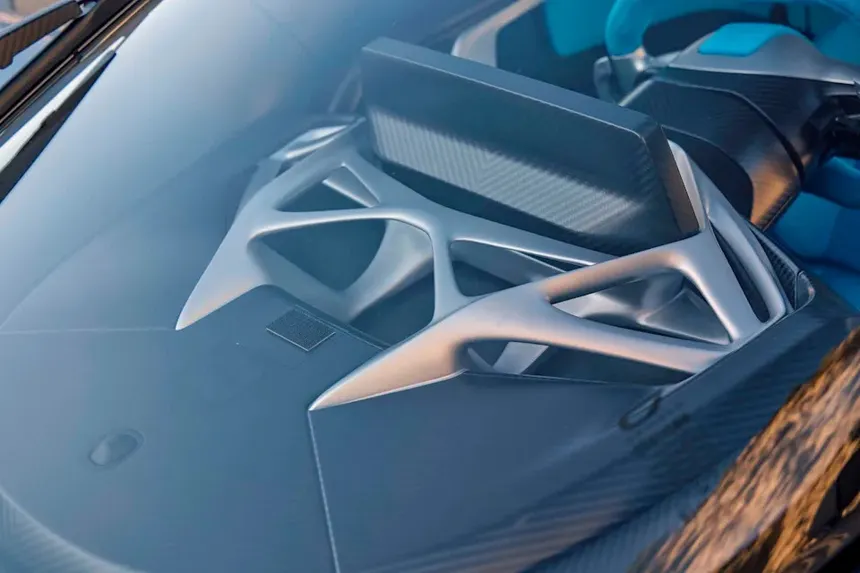
The result has an unmistakable look. Divergent’s parts don’t look like car parts. They look like bones. Organic structures, full of voids and ribs, as if nature had designed them rather than an engineer with a ruler. And in a sense that’s true: topology optimisation mimics what evolution has done for millions of years, putting material only where it’s needed and stripping it from where it isn’t. A 21C suspension arm has hollow, complex geometries achievable only by printing layer upon layer. Casting or machining that would be impossible.
The beauty of the system isn’t just that the parts come out lighter and stronger. It’s that you need no tooling. No ruinous moulds, no dedicated lines, no months of waiting to change a design. You change the file and the next part comes out different. You iterate at the speed of software, not the speed of steel. For an industry that takes years to modify a single component, that’s heresy and revolution in equal measure.
It’s worth understanding where the saving comes from to see why this keeps half the industry awake. Building a normal car begins with a brutal outlay before the first good part exists: casting moulds, stamping dies, assembly lines purpose-built for one specific model. That’s tens or hundreds of millions, recouped only by building hundreds of thousands of identical units. Which is why the traditional industry hates change: every tweak to a part forces costly retooling, so cars are designed to leave everything untouched for years. The system rewards the big, the uniform and the immovable.
DAPS flips that entire logic. Without tooling, making ten different parts costs almost the same as making ten identical ones. The economics stop punishing variety and iteration. And in a world where everyone is chasing short runs, personalisation and development speed, that’s precisely what classic manufacturing has never managed to deliver cheaply. There’s the real fist on the table, not in the car’s horsepower.
The car as shop window
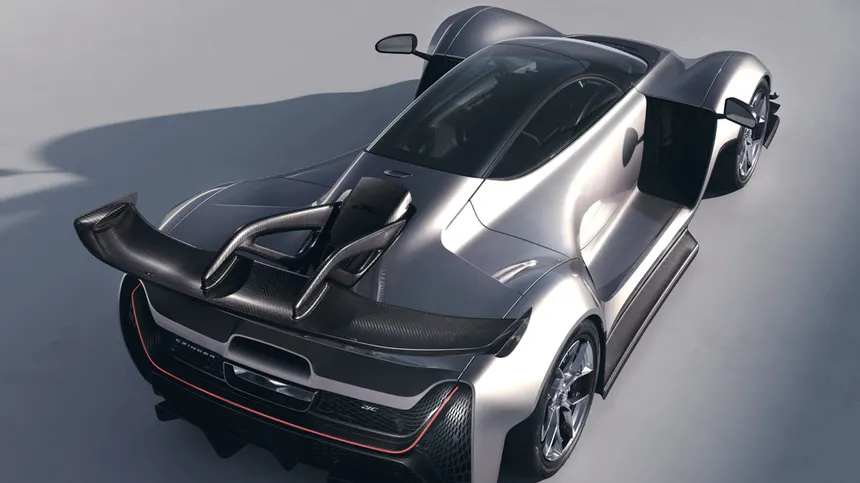
And here comes the 21C which, as Czinger’s own people explained, was born as exactly that: a technology demonstrator. A shop window. The loudest possible way to show the world what DAPS can do.
It wasn’t their first attempt. In 2015, Divergent had already shown the Blade, a prototype that went down in history as the first car with a chassis and body formed by 3D printing. On paper it was revolutionary. In practice it passed almost unnoticed: a crude prototype with the face of a lab experiment, and the world glanced at it for a second and carried on. The technology was there, but it lacked the wrapping. It lacked desire. The Blade proved you could print a car, but it never made anyone care.
The 21C learned that lesson thoroughly. If you want the entire planet to notice how you manufacture, don’t show an ugly prototype. Show the most desirable object you’re capable of building. Because of course, they could have printed a part and shown it at a trade fair. But nobody would have looked. Print half a 1,250-horsepower hypercar instead, break lap records and drop it into the magazines, and the whole world pays attention. The car is the loudspeaker. The organic printed part that looks like a bone is the message. The spectacle serves the engineering, not the reverse.
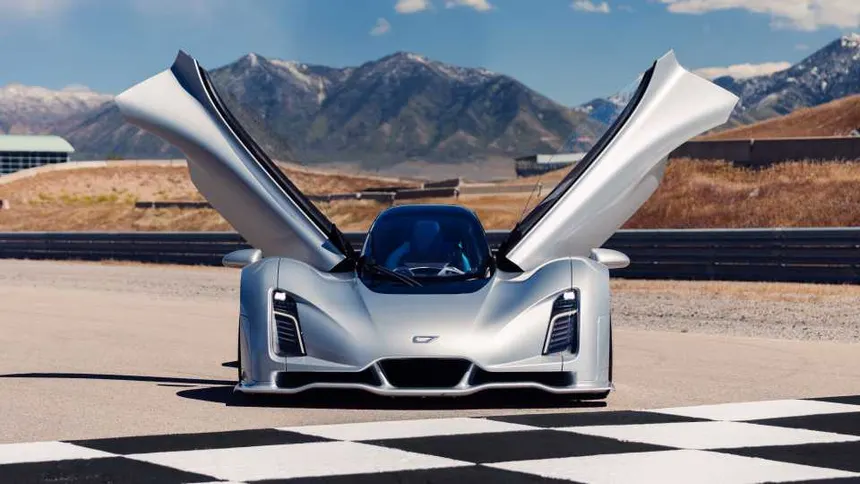
And what a spectacle. The 21C has a deeply odd layout: tandem seats, one behind the other, driver up front and centred like in a fighter jet or a single-seater, passenger directly behind. That decision isn’t styling vanity. It forces the car to be extremely narrow, which sharpens the aerodynamics, but it also forces the engine and gearbox to be as short as possible to fit behind two seats in a row. The whole architecture of the car flows from that geometry, and solving it was a brutal packaging exercise.
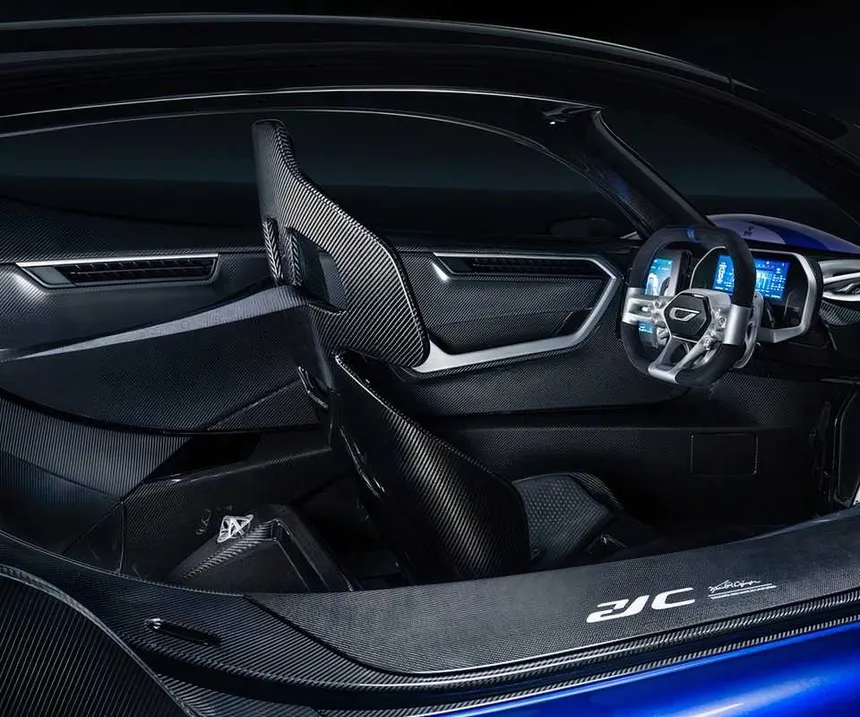
A beast of impossible numbers
On to the mechanicals, which don’t hold back either. In the middle, behind the seats, sits a 2.88-litre twin-turbo flat-plane-crank V8 that spins to 11,000 rpm. That figure belongs to a superbike, not a car. On its own it delivers close to 950 horsepower, making it the most power-dense production engine in the world at roughly 329 horsepower per litre. To grasp how absurd that is, a well-tuned road engine is happy with half of that.
The brand insists the engine is developed in-house. It’s worth noting that several sources suggest its block derives from the Mitsubishi Lancer Evo four-cylinder reworked into a V8, and since that isn’t fully confirmed, I’ll leave it there, as a caveat and not a verdict. Whatever its origin, what that engine does is from another planet.
To the V8 are added two axial-flux electric motors, one per front wheel, fed by an 800-volt system. Together they total around 1,250 horsepower and 692 lb-ft of torque, with all-wheel drive. The transmission is a seven-speed sequential developed with Xtrac, so compact it’s one of the most spectacular printed parts on the car, with that organic shape that melts into the rear structure. You can order it smooth for street use or as a full race dog box for instant shifts.
And the weight is the cherry on top. Dry, the 21C dips below 1,250 kilos. With 1,250 horsepower, that leaves you a power-to-weight ratio of 1:1. One horsepower per kilo. It’s the number engineers dream of and almost never reach. The acceleration figures induce vertigo: Czinger claims zero to sixty in 1.9 seconds and zero to 124 mph in 4.8. As Top Gear found when it drove the thing, that’s around a second quicker than the Ferrari F80 to 124 mph, and a second at those speeds is an eternity.
The small print on the records
A warning is due too, because at NEC we contextualise figures rather than swallow them whole. Czinger has been very loud about its lap records, and they reward a close look. The brand trumpeted a record at Laguna Seca with a 1:25 time, but the circuit itself clarifies that it doesn’t ratify records outside sanctioned races, and that the fastest lap in that track’s history was set by a Penske IndyCar in 2000 with a 1:07. In other words: the 21C is among the fastest things you can buy, but the word “record” in a press release should always be read with a finger on the asterisk. Being a missile doesn’t make every headline literal.
Why this matters more than the car
Back to the start, because that’s what’s truly worth taking home. The fascinating thing about the Czinger 21C isn’t that it’s fast. There are plenty of fast cars. The fascinating thing is what the factory that spits it out represents.
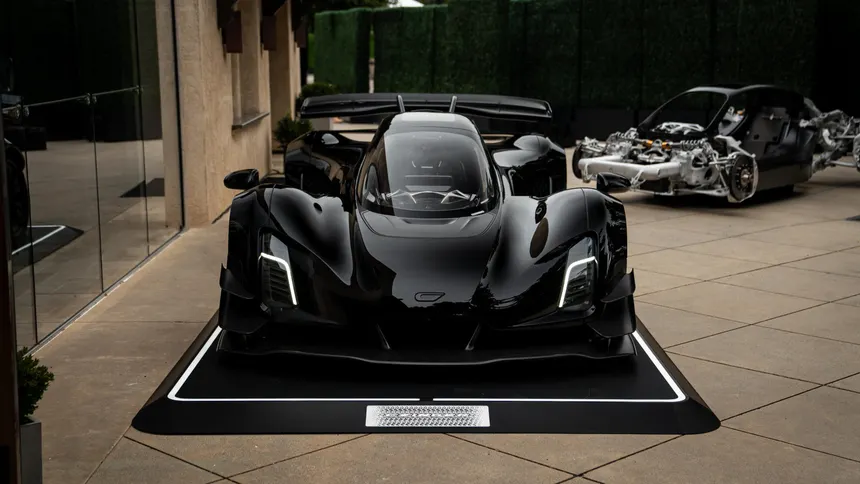
By 2024, sister company Divergent was already printing parts simultaneously for Bugatti, Aston Martin, McLaren, SpaceX and the military. Read that again. The same technology that makes this hypercar’s chassis manufactures components for rockets and for military hardware. Divergent has sunk close to a billion dollars into DAPS, and the 21C is merely the pretty advert, the neon sign they hung over the door so everyone would come in asking what on earth they were doing inside.
That’s the play, and it’s one of the smartest I’ve seen in years. Build the most desirable, most exhibitionist object possible, a minimal-run hypercar, ruinously expensive, savage, not to sell it, but to sell the machine that made it. The car is the bait. The factory is the business. And it worked precisely where the old Blade had failed: this time, to look at the factory, the world had no choice but to look at the car first.
What’s left
For me, coming from the assembly bench, this hits a strange nerve. I’ve spent half my life fitting parts made the way they’ve always been made: cast, stamped, machined, bolted. And suddenly along comes a former prosecutor from California, asks a computer what shape a suspension arm should be, prints it in titanium powder in the shape of a bone and lets a robot bond it. I don’t know if it’s the future or just the ruinously expensive shop window of a possible future. But I know that when I see one of those organic parts, I understand something has shifted.
The Czinger 21C is a spectacular car, yes. But its real power isn’t in the 1,250 horsepower. It’s that, a few years from now, the car you drive, the plane you fly in or the rocket you watch lift off might carry inside it a bone-shaped part born from this very idea. The 21C isn’t the product. It’s the advert. And rarely has an advert been so damn good.
1 thought on “CZINGER 21C”