
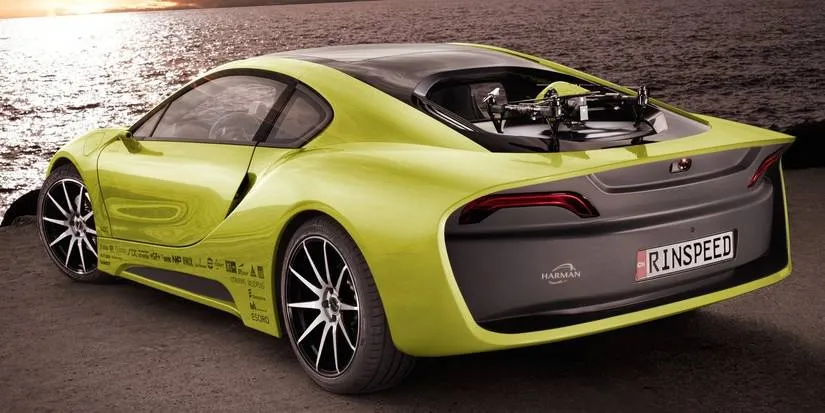
Rinspeed: the man who’s spent fifty years building cars nobody buys
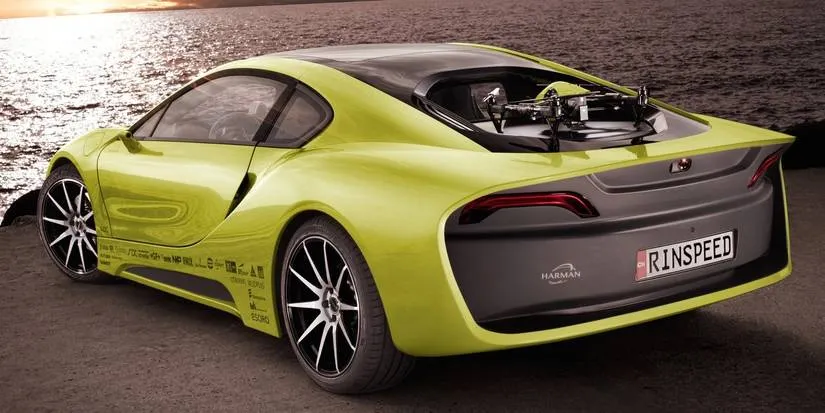
Every January, while the tech world descends on Las Vegas for CES to gawk at foldable phones and robot vacuums, a Swiss man rolls in with a car that shouldn’t exist. One year it drives underwater. Another it has a garden growing inside it. Another the steering wheel folds away because the car drives itself. The cameras swarm. The headlines write themselves. And then the car goes… nowhere. No dealership. No order book. No production line. Ever.
So here’s the question buried at the heart of this story, and it’s a good one: why on earth would someone spend an entire life building cars he knows, going in, will never be sold?
Because that’s exactly what Frank M. Rinderknecht has done. Nearly fifty years of unveiling impossible machines — first at the Geneva Motor Show, later at CES — a parade of cars that submerge like submarines, amphibians that fly over water on hydrofoils, transparent cars, cars with a living garden inside. Machines that turn millions of heads, that land in every newspaper on earth each spring, and then quietly refuse to go on sale. None of them. Not once.
The easy move would be to make a list of the weird ones and have a laugh. But that list explains nothing. The real question isn’t what strange cars this Swiss guy has built. It’s why. And what his obsession tells us about one of the most misunderstood genres in the whole automobile: the concept car.
The business that pays for the dreams
To understand Rinderknecht you first have to understand how he actually makes a living, because that’s the key to the whole thing.
Rinspeed didn’t start as a fantasy factory. It started as a garage. In 1977 Rinderknecht kicked off the Rinspeed Garage doing something as unglamorous as importing sunroofs from the United States and converting cars for disabled drivers. Wrench-and-elbow-grease work. Two years later, in 1979, he showed up at the Geneva Motor Show for the first time with a turbocharged Volkswagen Golf GTI wearing square grille and headlamps. That was the brand’s debut to the world.
And here’s the part almost nobody tells: for decades, Rinspeed’s real business was tuning and importing. Rinderknecht became a Porsche tuner. In the eighties, Rinspeed became the exclusive Swiss importer of AMG and AC Schnitzer — two names that were pure gold back then to anyone who wanted a Mercedes or a BMW on steroids. He built convertible 911s when Porsche didn’t offer them, Turbo coupes inspired by the Ferrari Testarossa (the R69, of which maybe twelve were made). He sold speed, exclusivity and status to Swiss people with money.
That was always the economic engine. Tuning paid the bills. And the bills, in turn, paid for the impossible dreams Rinderknecht unveiled every year in Geneva with zero intention of selling them. In 2008, in fact, he sold off all the tuning operations to Mansory Switzerland. The garage spent thirty years paying for the right to dream in public.
The submarine that came out of a Bond film
The concept that best explains Rinderknecht is the sQuba, and it’s worth a close look because it isn’t a random brainstorm — it’s the literal fulfillment of a childhood fantasy.
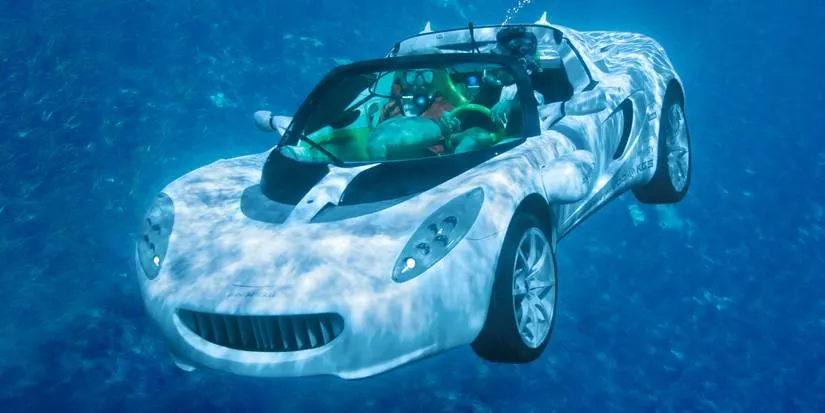
In 1977 — the same year Rinderknecht was setting up his garage — “The Spy Who Loved Me” hit theaters, the James Bond film where a white Lotus Esprit launches off a pier, sinks into the sea and transforms into a submarine. That scene branded an entire generation of kids, and one of them, a Swiss boy, never let it go. Three decades later, Rinderknecht decided to make it real. Not similar. Real.
The sQuba, completed in 2008, was the world’s first car that could genuinely be driven both on land and underwater. It started from a Lotus Elise chassis — an obvious nod to the film — and was fully electric, with three motors: one for land, two for water. On entering the sea, it floated on the surface until the driver flooded the cabin to submerge it. Yes, you read that right: it floods. The sQuba is an open convertible and the occupants go down with the water, breathing from an onboard air system, to a depth of ten meters, pushed along by two electric propellers and two Seabob-style jets. The interior was water- and salt-resistant so it could be taken into the ocean.
Sit with that a moment. A man saw a movie at twelve, kept the image lodged in his head for thirty years, then assembled a team of engineers to build that image with his own hands. Not to sell it. To prove it could be done.
The amphibian that flew over the water
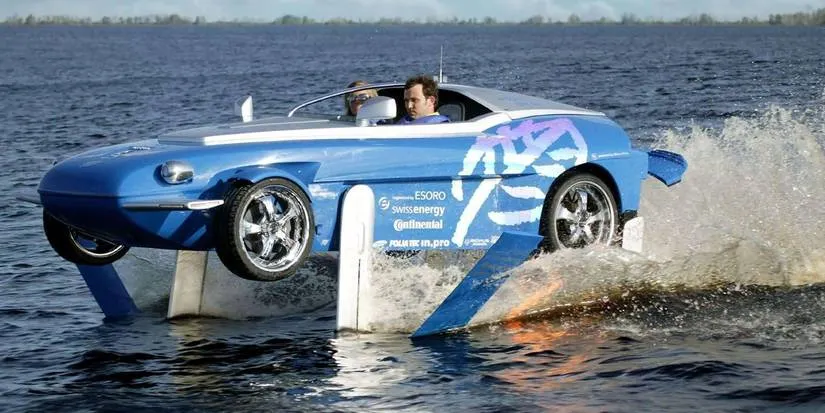
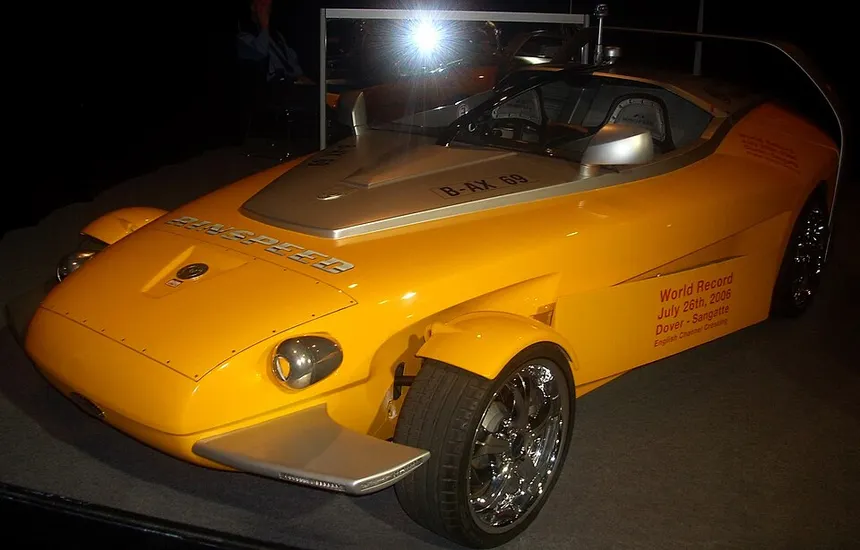
The other great aquatic milestone was the Splash, shown in Geneva in 2004. If the sQuba went down, the Splash went up. It was a hydrofoil amphibian: a system that, above a certain speed, lifted the vehicle’s body clear of the water’s surface to cut drag and literally fly over the waves.
The figures Rinspeed published are the kind you treat with due caution, because they’re the numbers of a one-off prototype and not a homologated car: it claimed around 45 knots on water and close to 200 km/h on land, driven by a 750 cc two-cylinder turbo burning natural gas for 140 horsepower, weighing a scant 825 kg. In 2006, so it wouldn’t stay mere auto-show swagger, a Splash crossed the English Channel and set a time record for a hydrofoil. There Rinderknecht proved something important about himself: showing the pretty mockup isn’t enough for him. Every so often he needs to prove the madness actually works.
Not an eccentric — a thermometer
And here comes the part that really matters, the part that separates Rinspeed from a mere carousel of oddities.
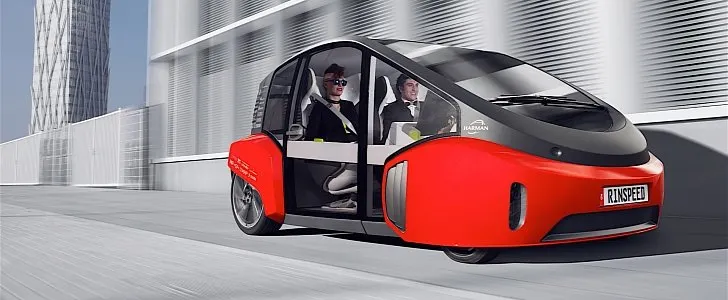
Look at Rinderknecht’s career with some distance and you realize his concepts aren’t isolated whims. They’re a thermometer for where the automobile is heading, presented years before the big industry dares to say it out loud. Rinspeed was a pioneer in electric vehicles when the rest of the world still saw them as a crank’s hobby. His Bamboo concept was an electric, eco-friendly beach buggy. His Oasis concept anticipated autonomous driving with a retractable steering wheel and — very much his style — a small garden inside the car, seriously asking how our lives would change once the car drove itself and the cabin stopped being a command post and became a living room.
That’s the trick almost nobody gets. The concept car doesn’t exist to be sold. It exists to think out loud. It’s the lab where the industry — or in this case, an obsessive Swiss man with a tuning shop behind him — lets itself ask “what if?” without the tyranny of cost, homologation and the marketing department. The sQuba was never going to sell, but it forced a team of engineers to solve real problems of watertight sealing, underwater electric propulsion and safety. The Oasis will never be built, but it put questions about the interiors of autonomous cars on the table that are now asked in earnest in Munich and Detroit.
And if you think that’s reading too much into a handful of oddities, check the calendar. Rinspeed showed the eXasis in 2007, a car with a transparent plastic body and floor that left its whole structure on display, before the fashion for transparency and radical lightness had reached the big show floors. It showed the iChange in 2009, billed as the first car whose body adapted to the number of passengers aboard, years ahead of the entire conversation about adaptable vehicles that followed. Every year, punctual as a clock, a new theme. He doesn’t always get it right — plenty of his bets stay curiosities — but the pattern is unmistakable: Rinspeed has spent decades asking the questions the big industry only dares to raise once it’s safe to. He gets there first, without a net, and on less money than a manufacturer spends catering a single auto show.
Rinderknecht doesn’t sell cars. He sells questions. And he’s been doing it for half a century better than almost anyone.
What you see and what’s really underneath
Careful with the easy read that Rinspeed is just “the crazy-car guy.” That label is convenient and it’s the one that slips into every spring feature, but it stays on the surface.
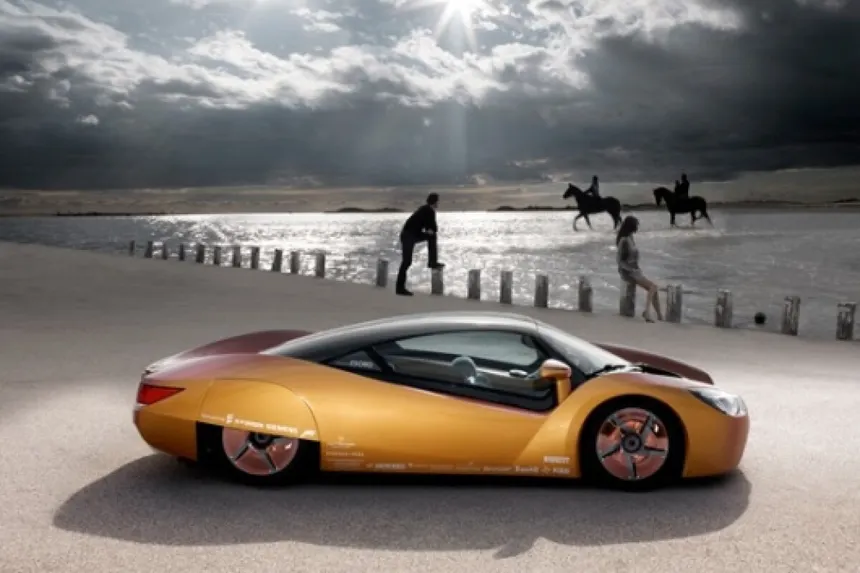
What’s underneath is a very rare figure in the industry: someone who’s turned the concept car into an end in itself, not a means. For a normal manufacturer, the concept is bait — you show a fantasy at the show to draw eyes toward the boring cars you actually intend to sell at the dealership next door. For Rinderknecht, the fantasy IS the product. There’s no boring car behind it waiting for your signature. There’s only the idea, polished to the last detail, and the question it raises.
He is, in a way, the automobile’s art critic — one who, instead of writing his opinions, builds them at full scale, with wheels, and drives them into the water to prove he wasn’t kidding. A man who understood that in a world drowning in cars sold for what they are, there was an enormous, lonely gap for someone who made cars for what they mean.
And there’s a definitive proof this was never a marketing strategy in disguise. In 2008 Rinderknecht sold the tuning business — the part that made money. He could have closed the concept-car chapter, which never directly earned a cent. He didn’t. He kept going. Year after year, without the money machine behind him, unveiling a new idea every spring: the iChange in 2009, the UC? in 2010, the Dock+Go in 2012, and on to today. An unbroken chain running from the early nineties that hasn’t skipped once. When a man keeps doing something after selling the profitable half, he isn’t doing it for business anymore. He’s doing it because he doesn’t know how not to. And that’s probably the cleanest definition there is of a real visionary: someone for whom the idea isn’t a means to reach something else, but the whole destination.
What Rinspeed teaches
This story gets under my skin for a reason that goes beyond cars. We’re surrounded by people who abandon their strange ideas the moment someone asks “what’s this for?” or “who’s going to buy this?” Rinderknecht built an entire life on the opposite answer: sometimes an idea doesn’t have to sell, and nobody has to buy it, for it to deserve to exist. It’s enough that it nudges the edge of what we thought possible, and that someone has the stubbornness to actually build it instead of leaving it as a drawing.
The sQuba never sold. The Splash never sold. Not one of his cars ever reached a showroom. And yet, every spring for nearly fifty years, the whole world has turned its head to look at what this Swiss man had built this time. Ask yourself which is worth more: building a million cars nobody remembers, or building a single one everybody looks at even though nobody can have it.
Rinderknecht chose the second. And he’s spent half a century proving that a car nobody buys can be worth more than one everybody drives.
Check you’re still alive.
Great research and fascinating reading! Thank you for this outstanding article!
Thank you so much Frank. Coming from the founder of the brand, it’s truly an honor to receive these words. Best regards!!!