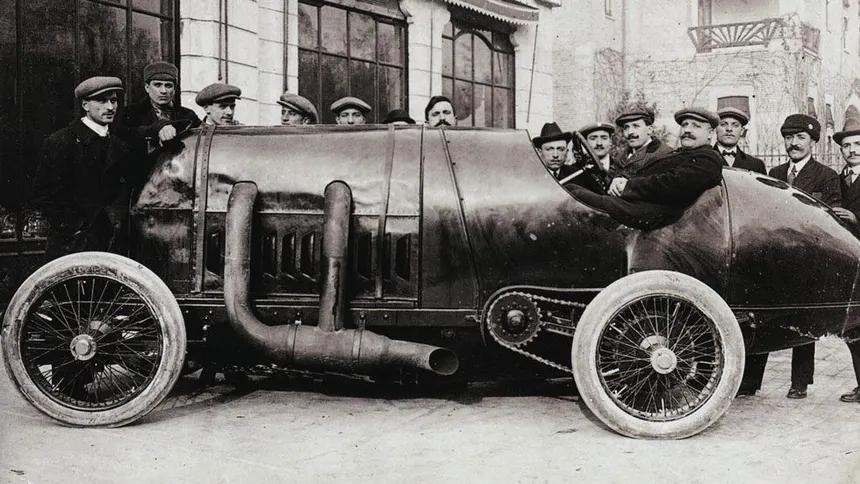
Fiat S76: the Beast of Turin, the car that terrified its own drivers
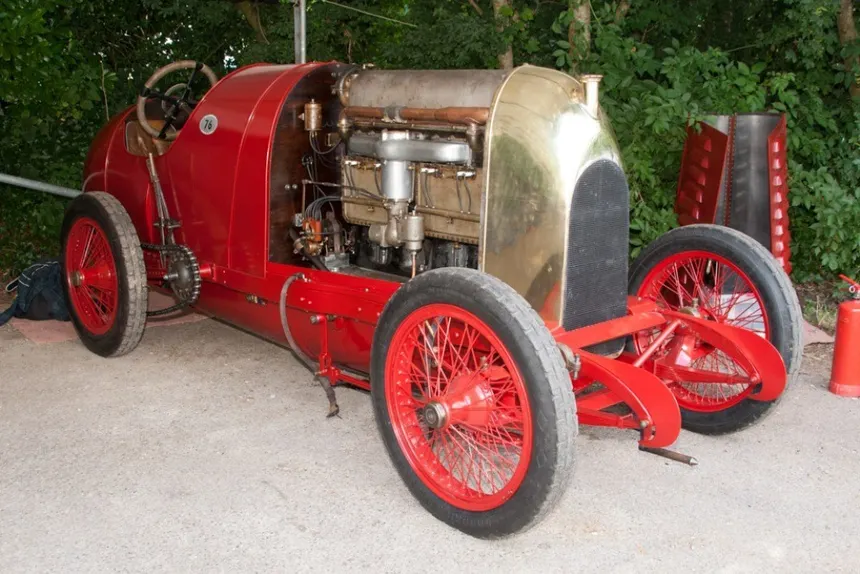
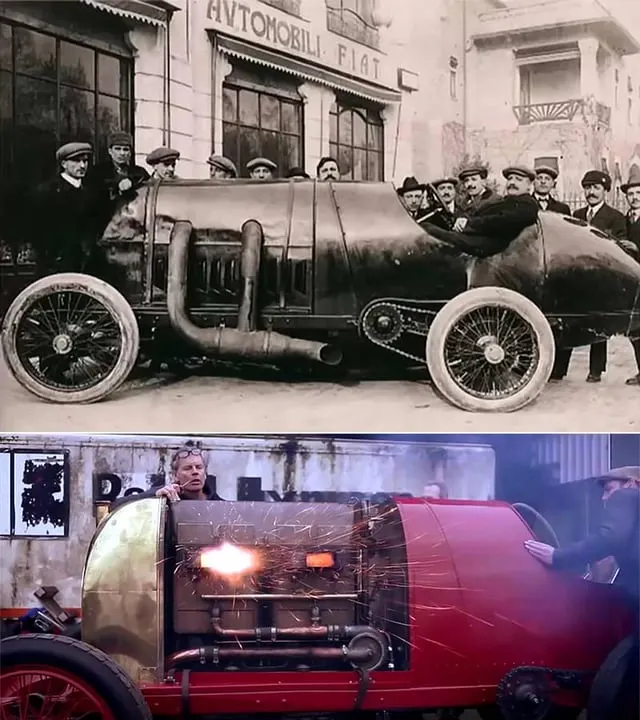
You’ve probably seen the video. A monstrous, ancient car sits on the grass at Goodwood, someone hand-cranks it, and it erupts — sheets of flame shooting sideways from open exhaust ports, a noise like artillery fire mixed with a warplane engine, spectators flinching backward. Millions have watched it. Almost none of them know what they’re looking at.
What they’re looking at is a hundred-year-old argument, made in iron, for the most American idea in all of motoring: there’s no replacement for displacement. Except this thing was built in Italy in 1910, and it took that idea to a place no American hot-rodder ever dared. It’s the Fiat S76, and its own factory test driver — one of the best drivers alive at the time — climbed out after a single fast run and swore he’d never get back in. He’s the one who reportedly named it: the Beast of Turin.
He wasn’t exaggerating.
The grudge that birthed a monster
To understand why anyone would build such a thing, you have to stand in the Europe of 1909, when raw speed was a matter of national honor. That year the French Grand Prix — the most important race in the world — wasn’t held. Some say economic hardship; others say the French were sick of Germans and Italians winning on their own soil. Either way, big-car competition cooled, and manufacturers looked for another stage to prove who was boss: the land speed record.
Mercedes-Benz struck first. Its Blitzen Benz, with an enormous 21.5-liter engine making around 200 horsepower, set a record near 125 mph in 1909. Germany ruled. And that stuck in the pride of Fiat’s engineers in Turin. They’d already built the S74 Grand Prix car, a 14.2-liter four making 180 horsepower that had raced with honor. But 180 horsepower wasn’t going to beat the Blitzen Benz. They needed more. Much more.
The Fiat engineers’ solution was terrifying in its simplicity: they took the basic architecture of the S74 engine and simply doubled the size of every component. Every part, twice as big. The result defies sanity even now.
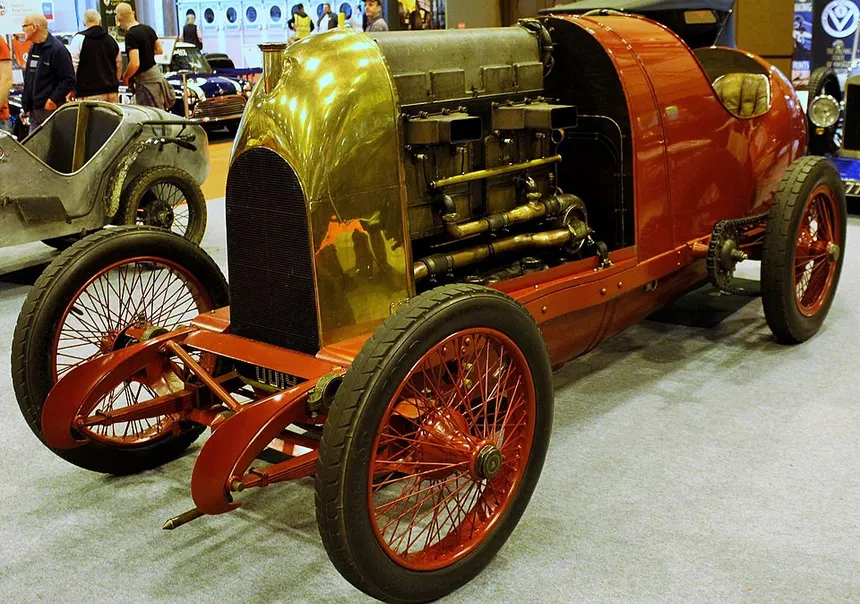
An engine meant to fly
The heart of the Beast was an inline-four displacing 28,353 cubic centimeters. Twenty-eight and a half liters. Four cylinders. To grasp the scale, each one of those four cylinders had more displacement than the entire engine of a modern family car. In raw numbers, the block was the size of four big American V8s stuffed into one machine.
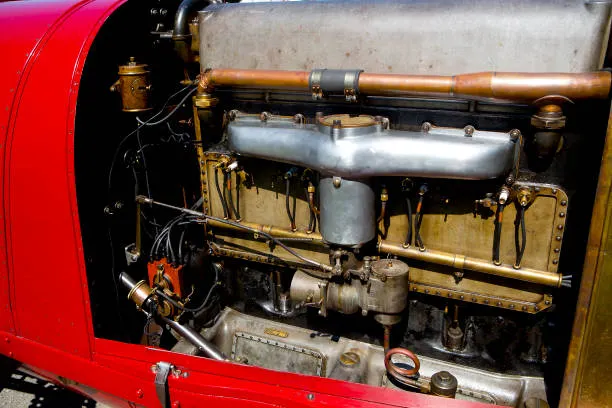
And it wasn’t a crude engine — this is the detail that gets lost under all the flamethrower theatrics. For 1910, the Beast ran genuinely advanced technology: four valves per cylinder, overhead camshaft, twin ignition per cylinder. Cutting-edge refinement wrapped in an obscene size. It made around 290 horsepower, brushing 300, a figure that in that era was simply from another planet. It drank a gasoline-benzene brew at a demented rate, on the order of four or five miles per gallon.
There’s a claim about this engine’s origin that gets repeated constantly and needs telling carefully, because legend has warped it. People say the engine “came out of an airship” or an aircraft. The more rigorous version is different: this class of colossal engine was conceived to power airships — Forlanini-type dirigibles — not pulled from one already flying. Even the man who resurrected the car a century later admits he researched that airship-engine story and found the reality more nuanced. An engine of aeronautical intent bolted into a wheeled chassis: that’s the honest way to put it.
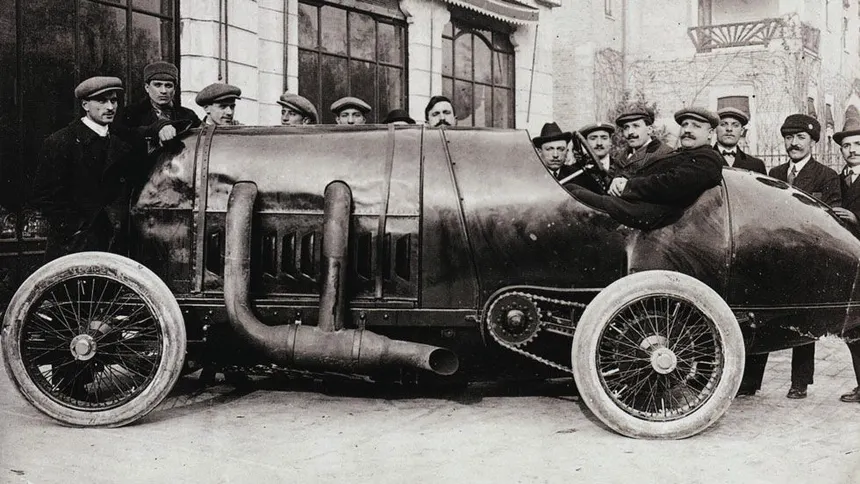
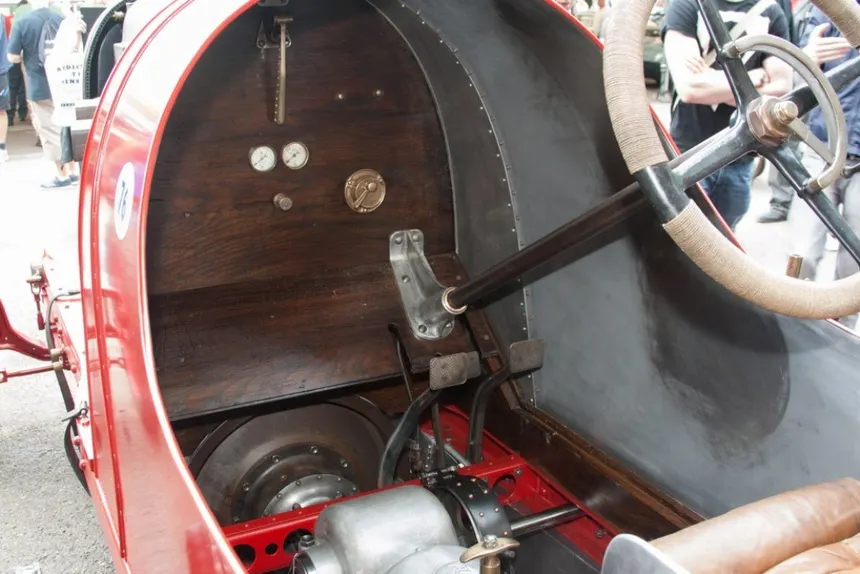
The rest of the car was as primitive as the engine was brutal. A basic chassis, solid axles front and rear, chain drive, a tall but wind-cheating body by 1910 standards. And one blood-chilling detail: the brakes acted on the rear axle only. A car capable of topping 120 mph that stopped, essentially, with half a system. It weighed around 3,700 pounds of pure menace.
The drivers who said no
Fiat built two cars. And what happened when they tried to use them tells the story better than any spec sheet.
You’ve met Felice Nazzaro, Fiat’s star driver, who worked on the car’s development from the start and, after driving it once at speed, refused to repeat. With their ace sidelined, Fiat lost momentum in its record crusade. So the second car was sold to a wealthy, adventurous Russian prince, Boris Soukhanov, who wanted the record glory for himself.
Soukhanov hired Pietro Bordino, one of the most promising Italian drivers of his generation, a twenty-four-year-old with no apparent fear of anything. Bordino took the Beast to Brooklands in England, the record mecca of the day. And there, the fearless young gun folded: he declared the car uncontrollable above 90 mph, partly due to the track’s deteriorated surface, and refused to go faster. When two of the best drivers in the world separately tell you your car is too frightening, maybe the drivers aren’t the problem.
Be careful with the speed figures, because they vary by source and the Beast has earned that caution. On the packed sand of Saltburn in England, Bordino managed practice speeds that accounts place somewhere between 116 and 125 mph, right around the Blitzen Benz record. Later, in December 1913, Soukhanov hired driver Arthur Duray for the definitive attempt, in Belgium. Duray, fully aware of the car’s reputation, screwed up his courage and hurled the Beast to 132.27 mph on one pass — faster than many airplanes flew that year. But a land speed record requires averaging two runs in opposite directions within a time limit, and Duray couldn’t complete the return run in time. The mark was never officially ratified. The Beast was, unofficially, the fastest car in the world, and never had the paperwork to prove it.
The century of silence
Here the story turns almost archaeological. After the First World War, Fiat scrapped the first S76 at the end of 1919. The second, the prince’s car, lost its original engine and ended up, by murky paths, in Australia, where someone rebuilt it and fitted a Stutz engine just to move it. The Beast, decapitated, languished on the far side of the world for decades. A ghost chassis without its heart.
The resurrection came from a British enthusiast, Duncan Pittaway, who’d had the Beast lodged in his memory since childhood, when he saw a photo of that impossible-looking car in one of his father’s books. In 2003, following a lead, he traveled to Australia and found the remains of one of the only two S76s ever built. He bought the chassis. But the essential piece was missing: the engine. Without that engine, he said himself, the car had no soul.
This is where the two cars cross paths like something out of a novel. Pittaway obtained the surviving engine from the sister car — the one Fiat had scrapped. Chassis from one car, engine from the other, reunited at last a century on. What followed was a monumental rebuild lasting close to thirteen years. Three major pieces had vanished entirely and had to be recreated from scratch, guided by original Fiat drawings and the handful of period photographs that survived: the double-chain-drive gearbox, the body, and the radiator. The engine was seized after a century idle and had to be coaxed back to life piece by piece, with an Italian magneto expert rebuilding the entire ignition system and realigning a crankcase deformed by a hundred years of neglect.
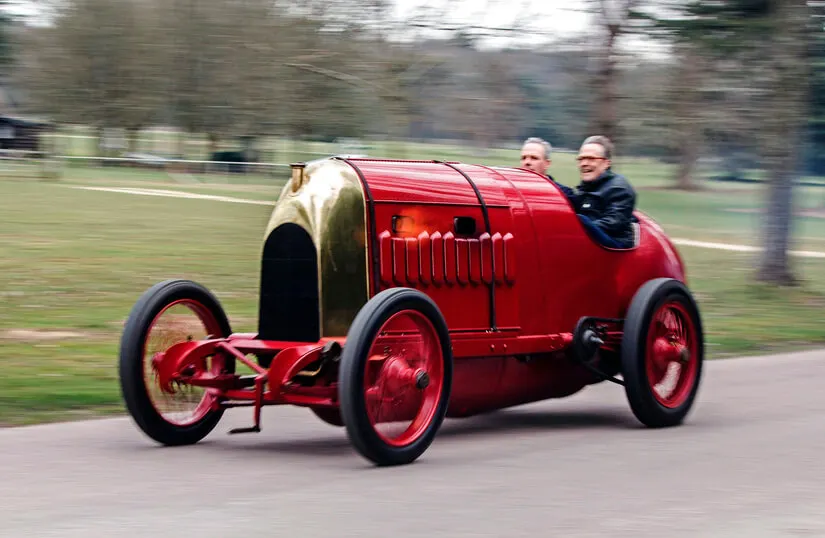
In November 2014, for the first time in nearly a century, the Beast roared again. It spat fire from bare headers, no exhaust, with a din described as a mix of artillery and a warplane engine. In 2015 it climbed the famous hill at the Goodwood Festival of Speed before hypnotized crowds, and in 2016 Pittaway did something that sums up his refusal to keep the car dead in a museum: he drove it 150 miles on open roads from Bristol to Goodwood, the Beast’s longest journey in a century.
It’s worth measuring the Beast against the rival it was built to humble, because the contrast explains Fiat’s madness. The Blitzen Benz that held the record ran a 21.5-liter engine making around 200 horsepower. Fiat’s answer wasn’t to engineer something cleverer or lighter — it was to go bigger and angrier: 28.5 liters, nearly 300 horsepower, brute force piled on brute force. Where a modern engineer would chase efficiency, Fiat in 1910 chased sheer size, and did it with a single-mindedness that reads today as either heroic or unhinged, depending on your taste. Pittaway himself has said he wanted to set the record straight, because over the years the car was almost ridiculed for being overweight and not fast enough, and it wasn’t around to defend itself. Bringing it back to life, and even taking it back to Ostend where Duray made his 1913 run, was partly an act of restoring a reputation the paperwork had denied it.
The shadow of doubt
No resurrected legend comes back entirely clean, and here’s the part almost nobody finishes. A dispute hangs over the engine’s authenticity that remains unresolved. The Antonio Capetti Collection, at the Polytechnic of Turin, maintains that the surviving engine wasn’t sold but loaned for study, and that the block eventually returned to them was a non-functional replica missing original parts. It’s a serious charge, and the other side defends its account of events.
It’s not my place to rule on who’s right, not least because the public evidence isn’t enough to do it. But the episode adds a perfect layer to the Beast’s story: even in resurrection, this car generates suspicion, dispute and mystery. It’s so excessive that not even its return from the dead could be simple. Classic-car detectives still argue on forums over which parts are original and which recreated, and probably will for a long time yet.
What the Beast teaches
This story fascinates me for what it says about limits and obsession. The S76 is what happens when national pride and blind faith that “there’s no replacement for displacement” are carried to the last possible extreme — no brakes, no common sense, no thought spared for the poor human who’ll have to hold the wheel. Fiat didn’t build a car for anyone to drive comfortably. It built a declaration of war on four wheels, aimed at Germany, and cared very little that it was nearly untameable.
And yet, more than a century later, what do we remember? Not the official records, because it had none. We remember exactly that: the excess. The Beast that spat fire, that sent spectators running, that defeated the best drivers of its time just by starting up. Sometimes what makes a machine a legend isn’t that it won, but that it dared to exist when no one in their right mind would have built it.
Ask yourself something next time you watch that clip of the Beast breathing flame on startup: you’re looking at a car from more than a hundred years ago that still delivers more fear, more awe and more spectacle than almost anything built today. They made it with no computers, no wind tunnels, nothing but wounded pride and a few engineers willing to double the size of everything. And it still roars.
Check you’re still alive.