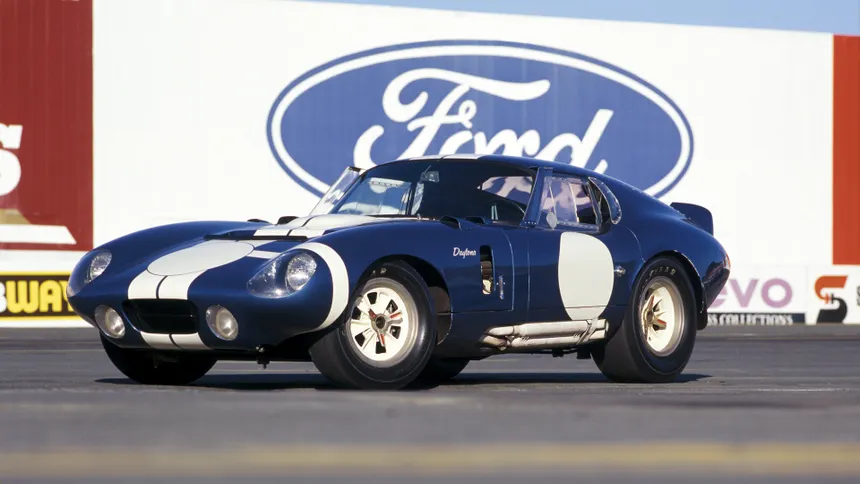
Shelby Daytona Coupe: six cars to take the world away from Ferrari
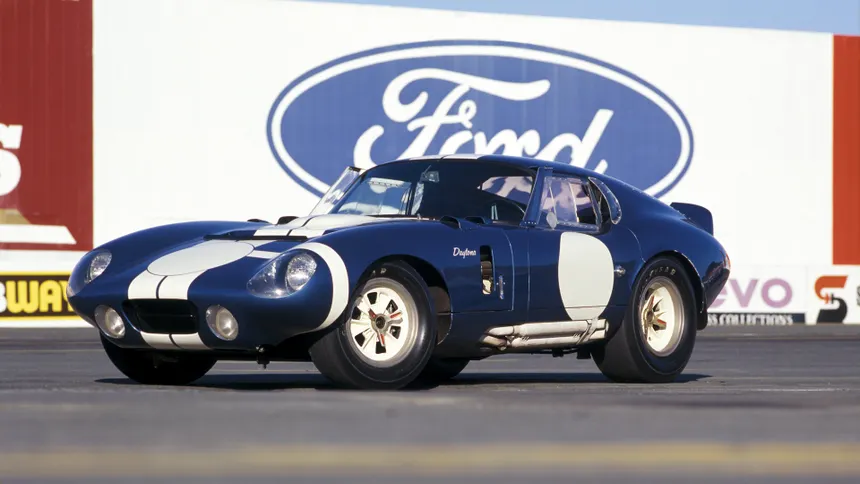
Before Ford stormed Le Mans, before the movie, before the GT40 became a legend, a skinny Texan with a bad heart did something that seemed impossible: he took a world championship away from Enzo Ferrari. Not General Motors with its bottomless resources. Not Ford, not yet. Carroll Shelby — a man who a few years earlier had been raising chickens — with a shop in Venice, California, and a payroll that fit in a couple of vans.
The tool Shelby used for this heist wasn’t a fleet. It was six cars. Just six. Six coupes designed by a kid in his early twenties who wasn’t even a trained engineer. And it worked. This is the story of how half a dozen hand-built cars pried loose from Ferrari something the Italian considered his by divine right.
The problem: a roadster punching a hole in the air
To understand the Daytona you have to understand what was wrong with what Shelby already had. His Cobra was a beast: a light British AC roadster with a big Ford V8 shoehorned in. On American circuits, in the tight and twisty layouts of SCCA competition, the Cobra crushed. It debuted in 1962 and left the new Corvette Sting Ray lapping four seconds slower. At home, the Cobra was queen.
But the FIA World Championship was contested in Europe, and Europe had something that mattered far less on America’s tight corners: enormously long, fast straights, like the Mulsanne at Le Mans. And there the Cobra had an insurmountable problem of physics. It was a convertible, with the aerodynamics of a brick. Past a certain speed, all the engine in the world did nothing, because the car simply slammed into a wall of air. The Cobra roadster topped out around 160 mph and stayed there, while the Ferrari GTOs, with their sleek closed bodies, kept pulling.
Shelby knew it. In his autobiography he put it plainly: their most pressing need, and Pete Brock had been pointing it out for a while, was a far more streamlined body than the roadster’s. They had the engine. What they lacked was a way to cut the air.
The kid who drew the answer
Enter the unlikely hero of this story: Peter Brock. In 1963 he was Shelby American’s director of special projects, and he was very young — young enough that the responsibility he’d been handed seemed almost unbelievable for his age. He’d previously worked at General Motors, where he’d contributed to early ideas for the Corvette Sting Ray. Brock had an intuition that in that shop full of Texan hot-rodders sounded like European witchcraft: 1930s German aerodynamic theory, specifically Wunibald Kamm’s work on how a tail chopped off abruptly — truncated — could cut drag better than a long, tapered one.
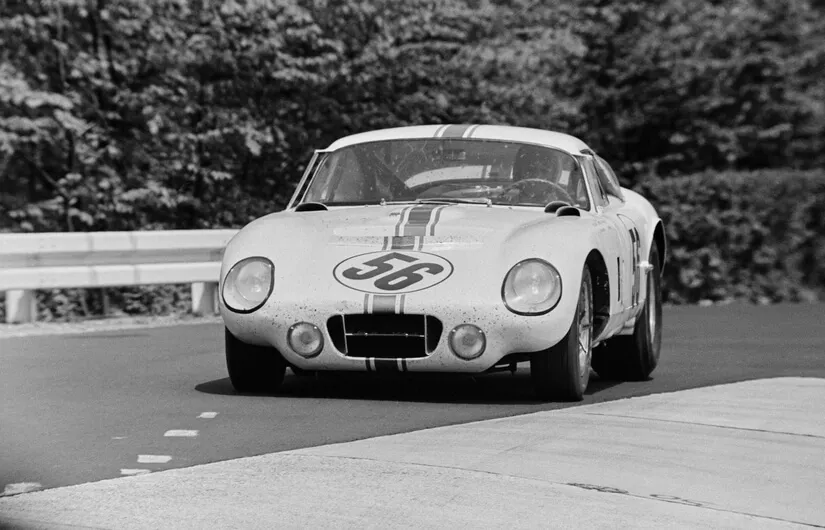
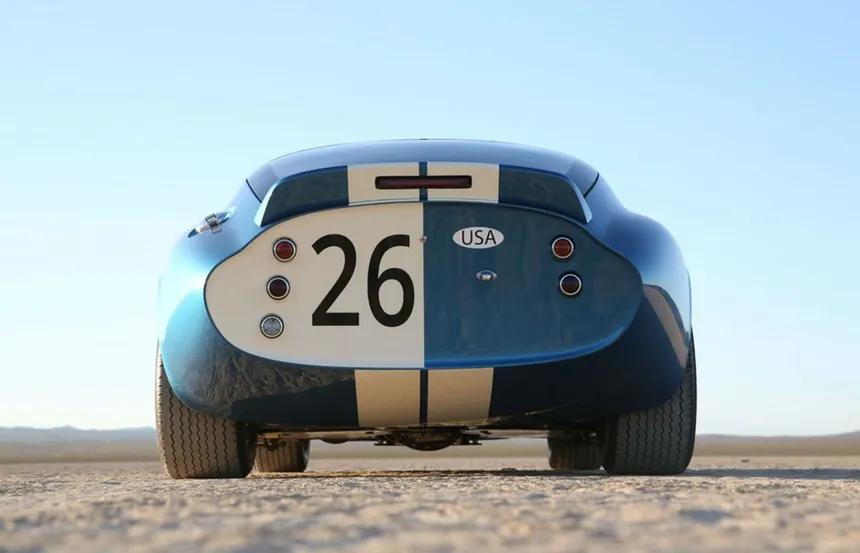
Brock proposed clothing the Cobra chassis in a closed body, with a low, sharp nose and, above all, that truncated tail, the famous “Kammback.” The team looked at it with skepticism. It was ugly, strange, unlike anything. The design was, in the language of the day, controversial. But Brock defended his lines, and Shelby — who was many things but not a fool — let him try.
The result was the Shelby Daytona Coupe. And on the same chassis, the same suspension, the same engine and the same mechanicals as the roadster that topped out at 160, Brock’s coupe passed 180 mph. Twenty miles per hour faster, without touching the engine, purely through shape. That’s the magic of aerodynamics properly understood: the same force pushing, but against far less air. Suddenly the Cobra could look the Ferraris in the eye on Europe’s straights.
It’s worth understanding who they were fighting, because the rival was no ordinary foe. The Ferrari 250 GTO was, and remains, one of the most revered competition cars in history, an Italian masterpiece with a glorious V12 and a reputation as untouchable in the World GT Championship. That fight between Shelby’s Cobras and Ferrari’s GTOs is known among enthusiasts as the “Cobra-Ferrari wars,” and it was one of the most thrilling duels motorsport has ever seen: American garage muscle against Italian blue-blooded engineering. That a handful of Americans with a Ford V8 and an English chassis would even dare to face Maranello was audacity. Winning was unthinkable.
Six cars, two continents
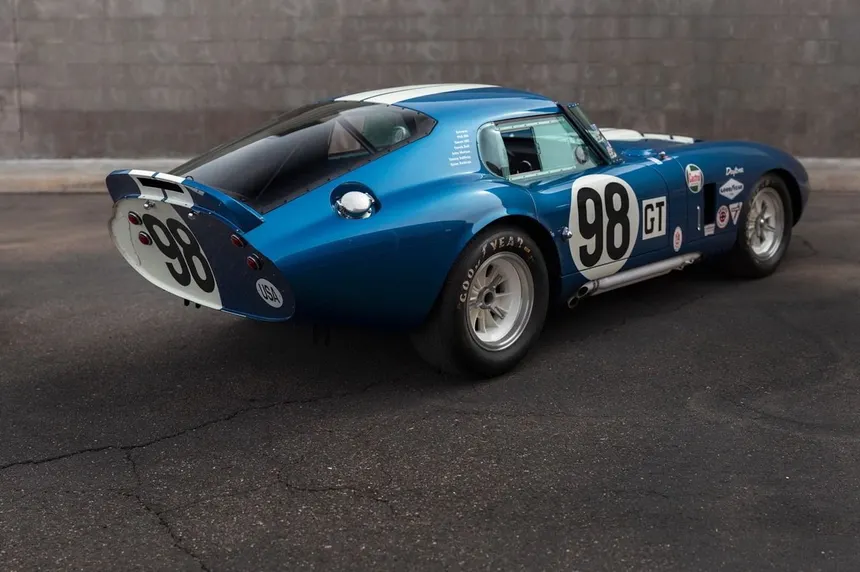
How they were built says a lot about how things were done in that hand-crafted world. The first Daytona, chassis CSX2287, was built entirely at Shelby’s California shop between October 1963 and January 1964, by hand, by a team that included fabricator John Ohlsen and chief engineer Phil Remington under the racing direction of Ken Miles. The other five were started as chassis in California and then flown to Italy, to Carrozzeria Gransport in Modena, to have their bodies built there. An American car, with a Ford heart, California styling of German inspiration, and Italian skin. Pure garage crossbreeding.
Only six were built. Not one more. Each was, in practice, a hand-formed prototype, with no production line, no evolution plan, nothing but the specific mission of winning races. And here’s an artful legal maneuver that made it all possible: the Daytona raced in the GT class under the homologation of the Cobra roadster. Shelby argued the coupe wasn’t a new car, merely an aerodynamic variant of an already-homologated GT. A loophole in the rulebook, cleverly exploited. As long as the engine was the Cobra’s small-block V8, the argument held.
That detail has more to it than it seems. Homologation in that championship required building a minimum number of units to prove a car was a production “grand tourer” and not a pure prototype. Shelby hadn’t built hundreds of Daytonas: he’d built six. The alibi was that the body didn’t change the nature of the homologated car, only its aerodynamics. It was a bold reading, right at the edge of what was allowed, the kind of maneuver that separates those who win from those who merely compete. When Shelby later wanted to drop the enormous 427-cubic-inch V8 into a Daytona, that argument collapsed: with that engine the car was no longer a variant of the roadster, it was a different beast entirely, and would have changed class. That project, the Super Coupe, was never completed.
The year Enzo cheated
The Daytona debuted in 1964 and immediately began winning its class, even at Le Mans. By season’s end, the Cobra was within striking distance of taking the World GT Championship from Ferrari. It all came down to the final race, at Monza.
And then something happened that captures Enzo Ferrari whole. Ferrari came into Monza with a small points lead, but he knew his GTOs were no longer fast enough to beat the Daytonas. So he pulled the strings he knew how to pull: he pressured the Automobile Club d’Italia to have the race stripped of its FIA sanction. The race ran anyway, but with no points at stake. With nothing to gain, Jaguar, Aston Martin, Ford and Cobra all chose not to take part. Ferrari “won” the championship in an office, not on the track. Shelby was denied at the threshold by a backroom maneuver.
It must have stung. But history has justice, and sometimes it’s patient.
1965: the first American to conquer the world
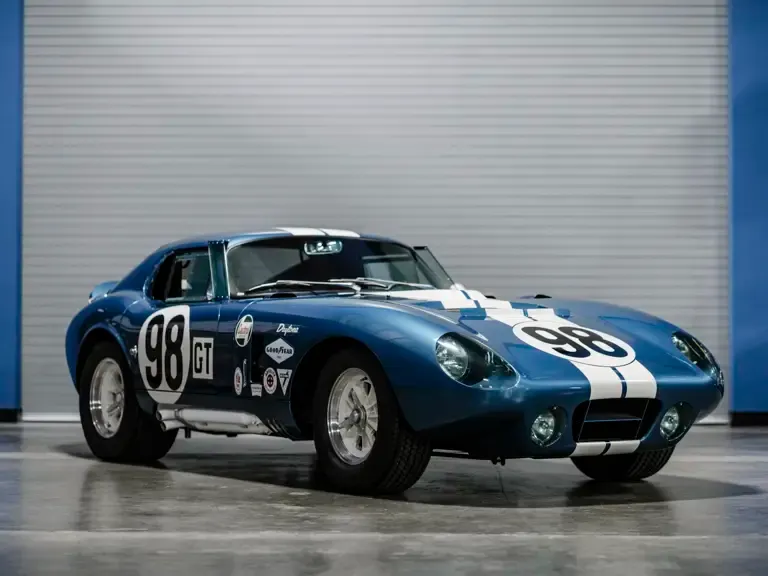
The following year, in 1965, no tricks could help. The six Daytona Coupes — this time formally “loaned” to Britain’s Alan Mann Racing, which actually campaigned them to victory while Shelby American stood as the FIA’s official manufacturer of record — dominated. Shelby American won the FIA World GT Championship.
Read it slowly, because it’s a true and historic headline: it was the first time an American automobile manufacturer had won an FIA international championship. The first. A former Texan chicken farmer, with six hand-built cars in a shed, took from motoring Europe a trophy that had never crossed the Atlantic. And he did it the same year history began to turn elsewhere, because Shelby had just been handed the Ford GT40 program to assault Le Mans overall, and the Cobra program was shut down. The Daytona had accomplished its exact mission and retired at the summit.
What vanished and what just changed value
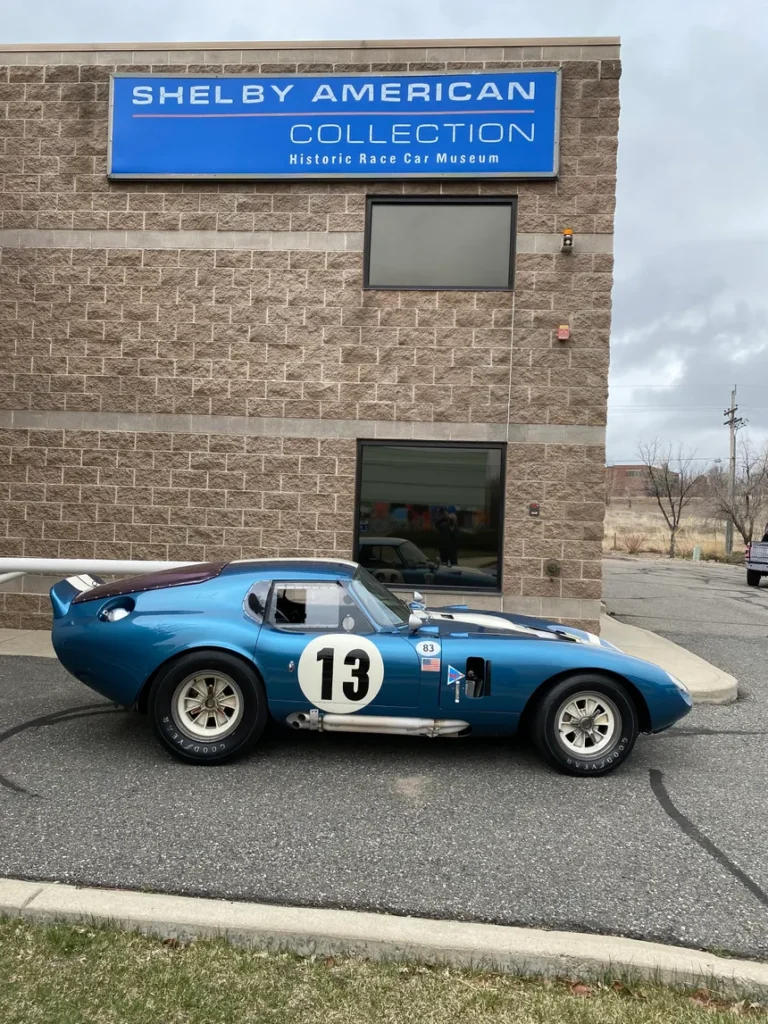
Careful with the nostalgia, because the Daytona didn’t vanish, though it came close. Those six cars, worth little as used racing scrap when they stopped competing, are today among the most valuable and coveted automobiles on the planet. The first, CSX2287, the one built entirely in California, not only raced eight events in 1964 and 1965 but set twenty-three speed records at Bonneville in November 1965, and over the years became the first car entered in the United States’ National Historic Vehicle Register. From racing junk to national treasure.
The trajectory of CSX2287 alone reads like a novel. After Bonneville it passed through a string of owners, at one point vanishing for decades into a private collection wrapped in its own murky mystery, before resurfacing and eventually being recognized as the historic artifact it is. A car that once existed only to beat Ferrari on a Sunday became, half a century later, a piece of American heritage formally protected by the Library of Congress. Few racing cars travel that arc: from disposable tool to documented treasure of a nation.
Physical death and paper death aren’t the same. The six original cars still exist, tended like relics, and their shape has been recreated in official continuation series, with Peter Brock himself affixing his designer badges to each one. The silhouette that in 1963 the team eyed warily as ugly and strange is today one of the most recognizable and admired in automotive history. Time, that slow judge, eventually ruled for the kid with the chopped tail.
What the Daytona teaches
This story fascinates me for what it says about intelligence versus muscle. Shelby didn’t beat Ferrari with more money, or more cars, or more power. He beat him by seeing a problem clearly — the air — and trusting a twenty-something who brought an idea from a dead German aerodynamicist to solve it. It didn’t take a factory. It took six cars and a good idea carried all the way through by people who wouldn’t accept that “this is how it’s always done.”
And there’s a more bitter lesson in the Monza affair. Ferrari — the giant, the myth — when he saw his cars weren’t the fastest, didn’t accept losing on the track: he pulled strings so there’d be no track. It’s what people accustomed to winning sometimes do when someone better shows up. But notice what history remembers today: not that 1964 championship won in an office, but the six Daytona Coupes and the 1965 season, when there was no escape left.
Ask yourself something next time you see the chopped-tail silhouette of a Daytona Coupe: what looks today like the very definition of beauty in a racing car was born the ugly duckling of the shop, defended against everyone by a kid almost nobody took seriously. The next great idea in your field probably looks ugly today too. Someone will have to dare to build it.
Check you’re still alive.