Covini C6W: thirty years chasing a six-wheeled supercar
In 1976, a Formula 1 car with four tiny front wheels won a Grand Prix and turned the motoring world upside down. It was the Tyrrell P34, and among the millions it fascinated was a young Italian engineer from a small town in the Oltrepò Pavese. For that kid, Ferruccio Covini, the image branded itself into his mind. And it planted an idea that wouldn’t leave him for the next thirty years: bring Formula 1’s six wheels to a road-going supercar.
It would take him nearly three decades to build it. Not for lack of desire, or talent, but for something as silly and as insurmountable as this: the tires he needed didn’t exist. This is the story of a stubbornness that beat time itself, and of what happens when you finally build the car of your life and discover the world doesn’t want it.
The Formula 1 car that started it all
To understand Covini’s obsession you have to understand what he saw in 1976. The Formula 1 of those years was a playground for mad engineers, with few limits in the rulebook. And out of that playground came one of the strangest machines ever to hit a grid: the Tyrrell P34, designed by Derek Gardner.
Gardner’s idea was brilliant and counterintuitive. F1 single-seaters are, by their very shape, an aerodynamic disaster, and much of the blame lies with the front wheels — big and exposed to the wind. What if, instead of two big wheels up front, you fitted four small ones, just ten inches, nearly go-kart size? They’d be lower, they’d tuck behind the nose reducing drag, and with four contact patches instead of two you’d gain grip and braking. The car was unveiled in secrecy in 1975, a sheet carefully arranged to hide the extra wheels, and when it was pulled away, jaws dropped. It looked like science fiction.
And the best part is that it worked. In 1976, Jody Scheckter won the Swedish Grand Prix in the P34, followed home by teammate Patrick Depailler in second: a one-two that silenced everyone who’d called it a publicity stunt. Tyrrell finished third in the Constructors’ Championship. The six-wheeler wasn’t a pointless oddity: it was a race winner.
But its glory was brief, and the reason is crucial to this story. The P34’s weak spot was precisely its tiny tires. Goodyear, which made them to order, was locked in a tire war with its rivals and decided to concentrate its development on the standard-size rubber every other team used. While the P34’s rear tires kept evolving, the front ones froze in time. The car’s balance, once its greatest strength, fell apart. After two seasons, Tyrrell abandoned the project. Years later, in 1983, the FIA settled the matter forever: it ruled that all cars must have four wheels, with only two driven. The six-wheeler was banned from Formula 1.
The idea, at the summit of motorsport, was dead. But in the head of one Italian, it was very much alive.
And Covini wasn’t drawing on the Tyrrell alone. The dream of four steering front wheels was older than the P34. As far back as 1963, Ford had shown a landmark concept at the Seattle World’s Fair, the Seattle-ite XXI, whose specification list read like science fiction for its day: interchangeable power units, interchangeable bodies, computer navigation, and four driving and steering front wheels. Williams and Ferrari had also toyed with six-wheeled Formula 1 prototypes before the concept was shelved. The notion kept surfacing across decades, always brilliant on paper, always defeated by the same practical problem. Covini simply refused to let it stay defeated.
The wall no enthusiasm could break
Ferruccio Covini, born in 1948 in Arena Po, had loved cars and speed since childhood. In 1978 he founded his own company, Covini Engineering, and had already been turning over his six-wheeled supercar for some time. His reasoning had the logic of a craftsman who knows he can’t go toe-to-toe with the giants: the supercar world is brutal, and to stand out against Ferrari or Lamborghini it isn’t enough to build another similar car. You have to offer something nobody else has. Where another boutique maker, Cizeta, bet on a V16 engine, Covini bet on three axles.
But he slammed straight into the same wall that had killed the Tyrrell: tires. Covini needed smaller-than-normal front tires, low-profile, capable of handling the demands of a powerful, fast car. And in the late seventies, through the eighties, and much of the nineties, those tires simply didn’t exist on the market in the size he needed. Without them, his car couldn’t be built. It was that simple and that maddening.
So Covini did what a stubborn craftsman does: he parked the dream without giving it up, and turned to other things to keep the company alive. He built peculiar diesel prototypes, like the T44, a boxy 4×4 with interchangeable outer panels, or the B24, a small sports car of which he made around nine units. Strange, niche cars, while the six-wheel idea slept in a drawer waiting for tire technology to catch up. Years passed. Decades passed. And Covini didn’t forget.
2004: the dream finally hits the tarmac
By the early 2000s, at last, the market had the low-profile tires Covini had spent thirty years waiting for. Materials science, sensors and electronics had advanced enough to control all the complexity of what happens with four wheels steering up front. The wall had fallen. Covini got to work, and in 2004 he presented the first working prototype of the C6W at the Geneva Motor Show.
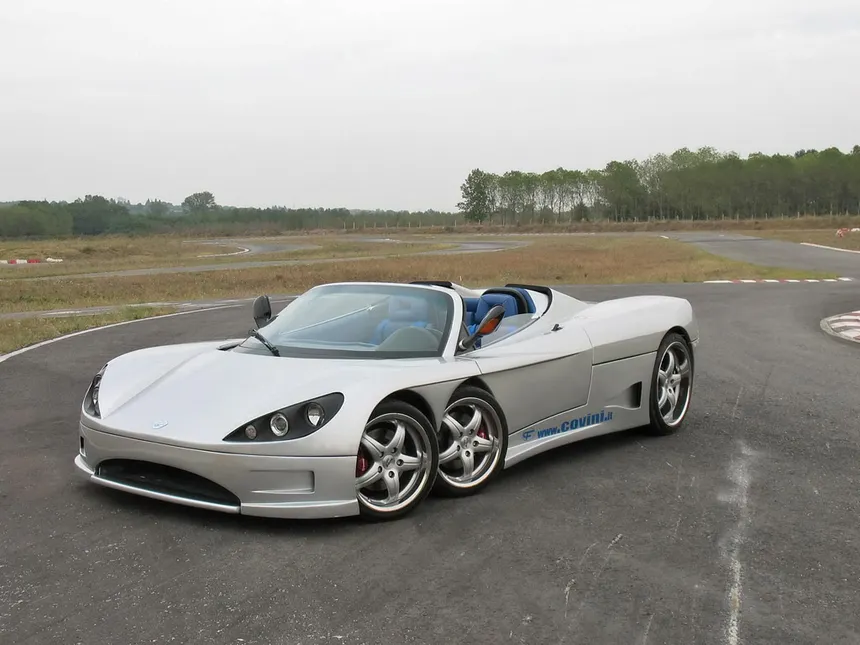
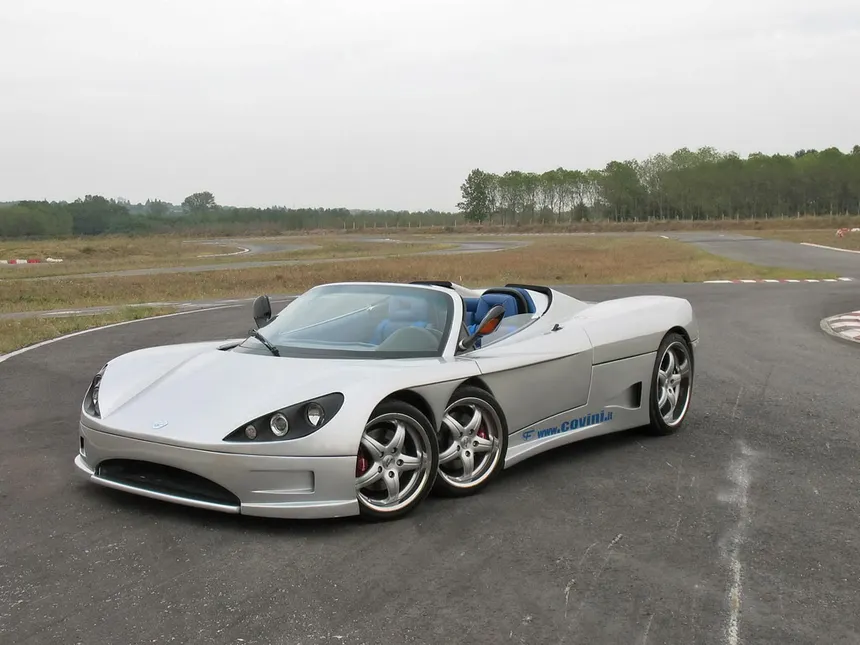
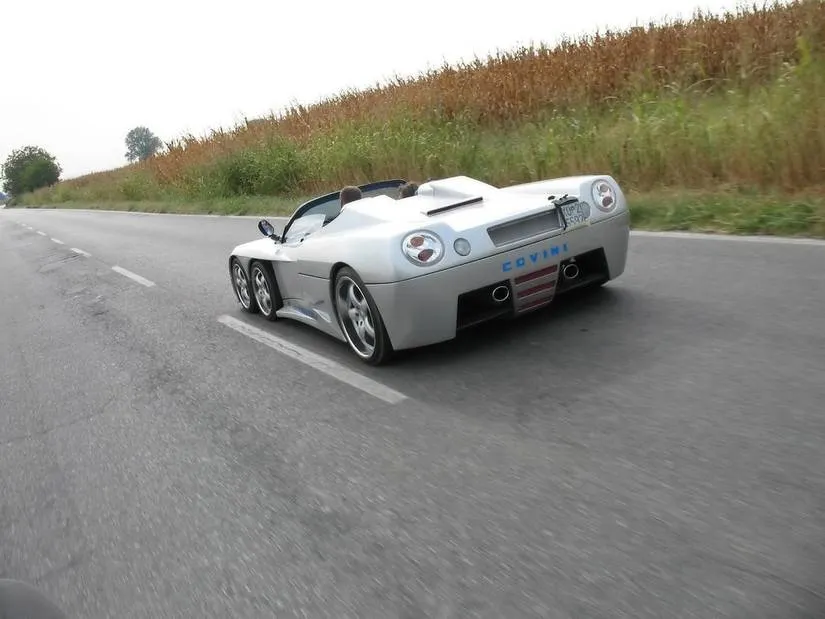
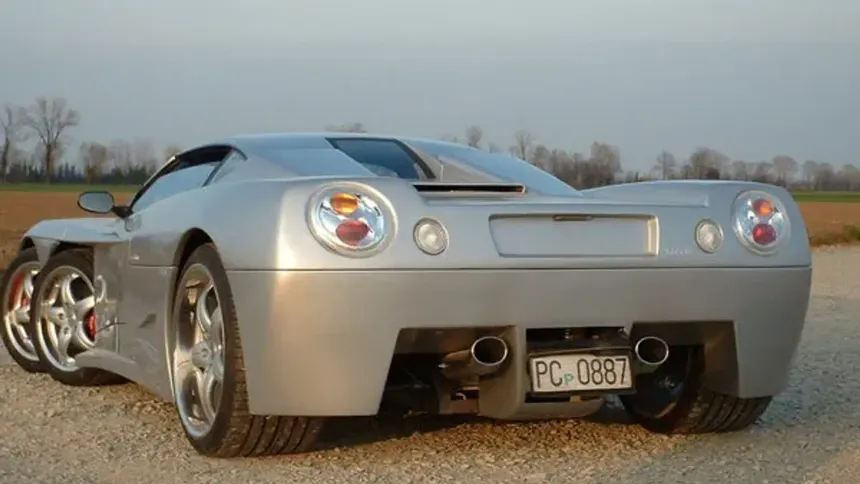
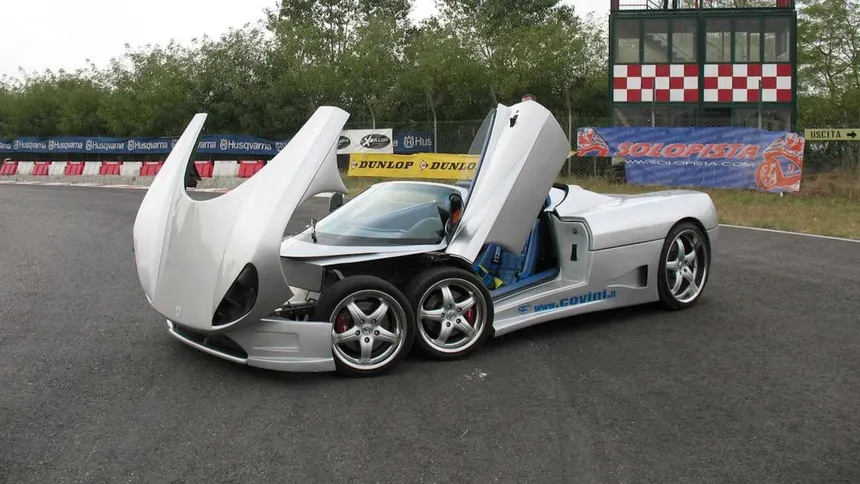
And what a car. A two-seat, two-door coupé with a removable targa roof, a light body on a tubular steel chassis reinforced with carbon-fiber elements, with a dry weight of just 1,150 kilograms. In the center, behind the occupants, a 4.2-liter Audi V8, the same block shared by models like the S4, the A8 and the Q7, and curiously the same one used by the Dutch Spyker C8. Covini tuned it in-house to around 434 horsepower. With that engine and so little weight, the C6W approached 300 km/h. And up front, of course, the four wheels: two steering axles with the smaller tires tucked under a sharp nose.
Here’s the detail almost nobody gets right, and it’s the philosophical heart of the whole thing. The Tyrrell put four wheels up front for one reason: aerodynamics, cutting drag. Covini, by contrast, wasn’t chasing the same thing. His argument for six wheels was safety. Consider it: if a front tire blows at 155 mph in a normal car, you have a very serious problem, because you lose half your steering and much of your control. In the C6W, if a front wheel blows, three others up front keep the car stable and governable. On top of that, four front brake discs dissipate heat far better and stop harder. And the front wheels, passing first, clear the water for those behind, reducing the risk of aquaplaning. Covini hadn’t copied the Tyrrell. He’d taken its idea and changed its purpose: from pure speed to driver safety.
Right on the engineering, and he still lost
And here comes the bittersweet part, the one that makes this more than the anecdote of an odd car. Covini built his dream. He proved the idea worked, that a six-wheeled supercar could be driven, could brake better, could be safer. The engineering proved him right. But the market didn’t.
The plans spoke of building six to eight units a year. The reality is the C6W ended up an extremely expensive car, priced around €580,000, extravagant, impossible to justify for most of the few customers who can afford a supercar and who, when the moment comes, almost always prefer the prestige of a Ferrari or Lamborghini over the oddity of a six-wheeled Italian built by one man in a workshop. In total, barely two production units were built, plus the prototype. Two cars. The thirty-year dream materialized in a handful of examples that are cult collector’s pieces today.
It wasn’t an engineering failure. It was a market failure, which is different and in a way crueler. Covini solved the technical problem that had stalled him for decades, and when he finally had it solved, he discovered the real problem had never been technical. It was that almost nobody, however many advantages you laid before them, wanted a supercar with six wheels.
What vanishes and what just moves
Careful with the easy nostalgia. The Covini C6W didn’t disappear: the cars exist, and the company kept offering it made-to-order for select clients even after production was parked around 2016. The car ran at events like the Goodwood Festival of Speed in 2011, cultivating that status of beloved oddity among enthusiasts. Physically, the C6W is still here.
And its idea didn’t quite die either. The fascination with multi-axle vehicles that the C6W rekindled has since shown up elsewhere, from brutal six-wheeled off-roaders like the Mercedes G63 AMG 6×6 to the eternal question that resurfaces every few years in the hypercar world: what if we tried six wheels again? Covini didn’t found a dynasty, but he kept alive an ember many had given up for dead since the FIA banned the concept in 1983.
Physical death and paper death aren’t the same. The car exists, the idea still stirs, and the story of Ferruccio Covini is told today with more warmth and more respect than it enjoyed in its commercial moment. Sometimes recognition arrives, only it arrives late and without money.
What the C6W teaches
This story moves me for what it says about stubbornness and its limits. Ferruccio Covini gave thirty years of his life to an idea. Thirty. He endured the wall of technology that didn’t exist, scraped by with strange cars to keep the company afloat, and didn’t let go of the dream even when Formula 1, the summit of motorsport, had declared it dead and buried by regulation. That kind of perseverance is admirable and extremely rare. Most people abandon their strange ideas the first time someone asks “what’s this for?”
But the story has a harder lesson too, and leaving it out would tell only half the truth. Being right on the engineering isn’t enough. Covini proved his car worked, that it was safer, that it braked better. And he still sold two units. Because the supercar market doesn’t move on logic or engineering: it moves on desire, on brand, on status, on the irrational thrill of a prancing horse on the hood. A lone Italian with a brilliant idea and a small workshop couldn’t compete against that, however good his idea was. Reason, sometimes, doesn’t sell.
Ask yourself something next time you see that impossible car with four wheels up front: you’re looking at thirty years of a man’s life who refused to give up, who beat time and technology, and who still discovered that winning that battle wasn’t enough. There’s something deeply human in that. Chasing a dream until you make it real, and having reality prove you right and turn its back on you at the same time.
Check you’re still alive.