Alfa Romeo SZ / RZ “Il Mostro”: Alfa Romeo’s Provocation
Fiat had just bought Alfa Romeo, and nobody yet knew what would be left of the brand.
In 1986, the IRI sold Alfa Romeo to the Fiat Group after Ford had also tried to acquire the Milanese manufacturer. The new owner inherited financial problems, an unsettled product range and a question that could not be avoided: would Alfa Romeo keep building cars with a personality of its own, or would it become another badge in Turin’s portfolio?
The answer arrived at Geneva in March 1989.
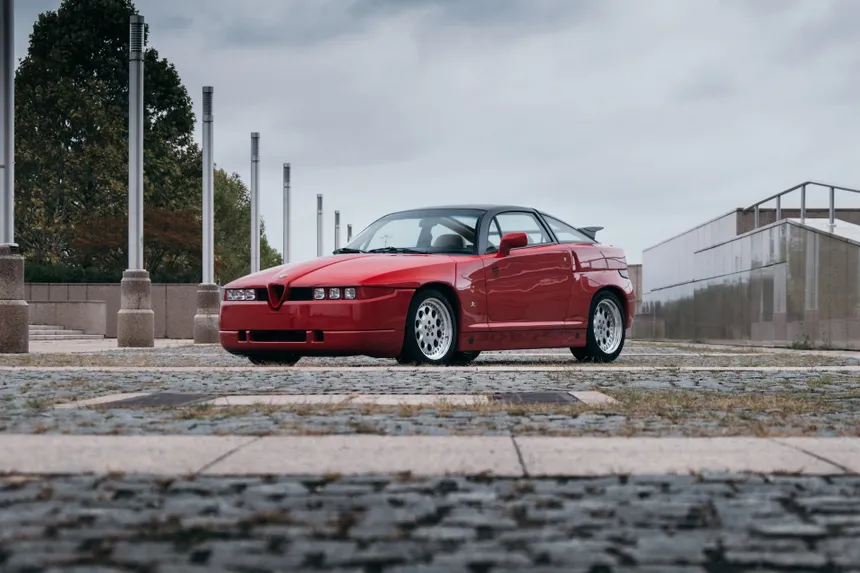
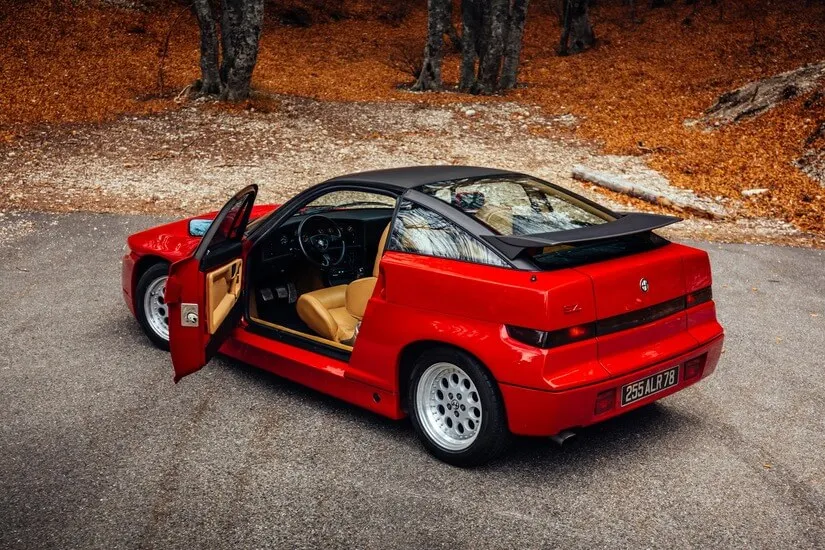
It was red, low and sharp-edged. Six square headlights sat across the nose, three on each side. The bodywork was made from composite material over a steel structure. Underneath sat a 2.959-litre Busso V6, a rear transaxle and suspension developed with experience from Alfa Romeo’s competition programmes. Alfa Romeo called it SZ, for Sprint Zagato. Enthusiasts gave it the name that stuck: Il Mostro.
It was not designed to make everybody comfortable.
It was a road-legal provocation.
Alfa Romeo built 1,036 SZ coupes between 1989 and 1991. The RZ roadster followed, with 278 cars generally listed as produced between 1992 and 1994.
Just over thirteen hundred cars for a manufacturer that needed volume.
Industrial logic called it an extravagance.
Alfa Romeo’s logic was simpler: if Fiat wanted to know what it had bought, it could start by looking at the car.
The ES-30 project
The SZ did not begin as the SZ.
Its internal code was ES-30: Experimental Sportscar 3.0 litre. The project was shown as a design study before the production car arrived, and the reaction was strong enough for Alfa Romeo to turn the shape into a limited series.
The job was not straightforward. Alfa Romeo had to turn an aggressive design into a homologated road car, preserve the 75’s mechanical architecture and produce it in numbers large enough to justify the programme but small enough to allow a special body.
The ES-30 was an attempt to reaffirm Alfa Romeo’s rear-wheel-drive sporting tradition with newer technology and limited production entrusted to Zagato. Stellantis Heritage describes the project in those terms.
It was not meant to replace a volume model.
It was meant to send a message.
Alfa Romeo still had its own engines, its own rear-drive hardware and engineers willing to make life difficult in order to build something more memorable than a badge on a shared platform.
The Z does not tell the whole story
The name has created a confusion that refuses to die.
The car was called Sprint Zagato. It wore the Zagato badge. Zagato built the bodies. It is therefore often described as a Zagato design.
The story is more complicated.
The project brought together Alfa Romeo, Fiat and Zagato. Robert Opron produced the initial sketches at Fiat’s design centre. Antonio Castellana developed many of the final exterior and interior details. Zagato contributed its composite-body expertise and built the cars.
It was not a one-man, one-studio Zagato design.
Nor was it simply a Fiat drawing handed to an outside contractor. Design, development and production overlapped.
The Z explains the relationship with Zagato and the tradition of special Alfa Romeos. It does not automatically make Zagato the sole author of every line.
The car makes more sense when the roles are separated: Alfa Romeo supplied the technical identity, Fiat supplied group resources, and Zagato turned the shape into a short production run.
The result looked like an industrial-design project that had escaped from an exhibition hall.
A 75 taken somewhere else
The SZ used the Alfa Romeo 75 architecture: longitudinal front engine, rear-wheel drive, rear transaxle and De Dion rear suspension.
That was where the easy part ended.
The road-going 75 used front torsion bars. The SZ received independent double-wishbone front suspension with coil springs and dampers. Its set-up, brakes and dynamic development drew on the competition experience accumulated with the 75 Turbo Evoluzione and Fiat Group racing programmes. Stellantis Heritage specifically links the transmission, suspension, damping and brakes to the competition 75 1.8 Turbo Evoluzione.
The transaxle layout was not new to Alfa Romeo. What mattered was what happened when the car no longer had to carry a family, four bags and a discreet reputation.
The SZ was a two-seater. There were no rear seats. The cabin ended in a carpeted shelf, and the boot was not pretending to carry half a life.
It was built to be driven.
And to make clear that the outrageous part was not only the bodywork.
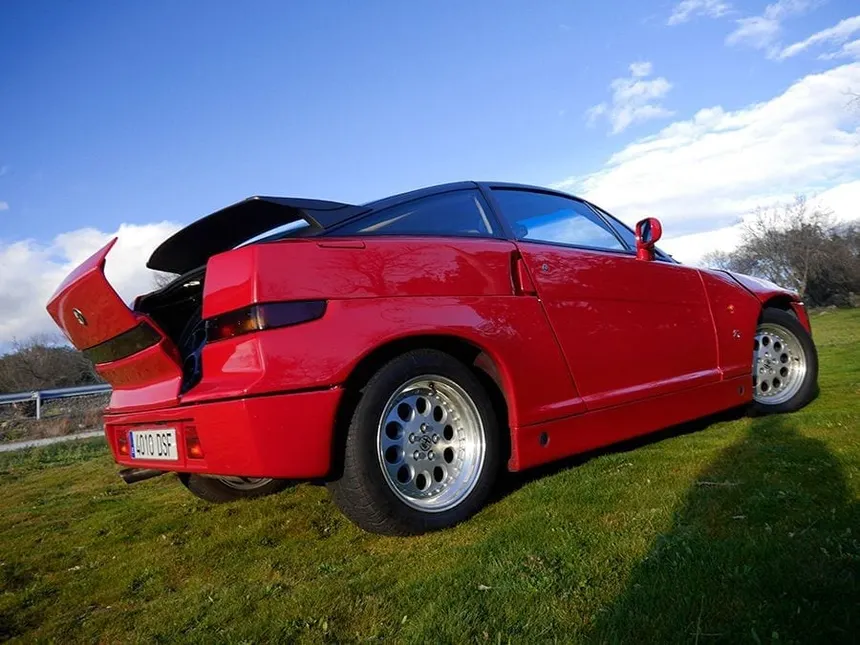
The twelve-valve Busso
The engine was Alfa Romeo’s 2.959-litre Busso V6. It used a 60-degree bank angle, one overhead camshaft per bank, two valves per cylinder and Bosch Motronic multipoint injection. Alfa Romeo’s heritage material lists 207 hp at 6,200 rpm and a 245 km/h top speed. [web:172][web:185][web:258]
Other specifications list 210 PS, equivalent to 207 bhp. Maximum torque was 245 Nm at 4,500 rpm.
This was not the later 24-valve Busso. It was not a race engine dropped into a road car without modification. It was a highly developed road version of Alfa Romeo’s three-litre V6, with enough character to make the SZ more than a sculpture with a number plate.
The engine used a wet sump. Its appeal was elsewhere: naturally aspirated response, six cylinders, high revs and a linear delivery that did not need a turbocharger to make its point.
The Busso did not fill the car with noise because the car needed theatre.
It filled the car with noise because a V6 like this was never going to be discreet.
The corner was the point
The SZ did not need to win every straight-line comparison to justify itself.
Its argument was in the bends.
Period references commonly attribute up to 1.1 g of lateral acceleration to the car under favourable conditions. The result depends on tyres, surface, temperature and measurement method, but it remains remarkable for a late-eighties road car.
There is no need to compare it with a Formula One car.
The SZ was a road-going sports car with a balanced layout, dedicated suspension, De Dion rear axle, serious brakes and a two-seat body.
The V6 pushed. The transaxle helped place the mass where it mattered. The front end bit. The rear axle stayed involved.
That was the point.
The SZ was not especially discreet in a straight line. A Porsche 911 Carrera or Lotus Esprit Turbo could make life difficult in acceleration and top speed. The Alfa did not answer with a bigger number in the brochure.
It answered by arriving better prepared for the next corner.
That is why the car still has such a strong reputation among drivers who care more about behaviour than ease of use. The SZ was precise when asked and demanding when the driver got things wrong.
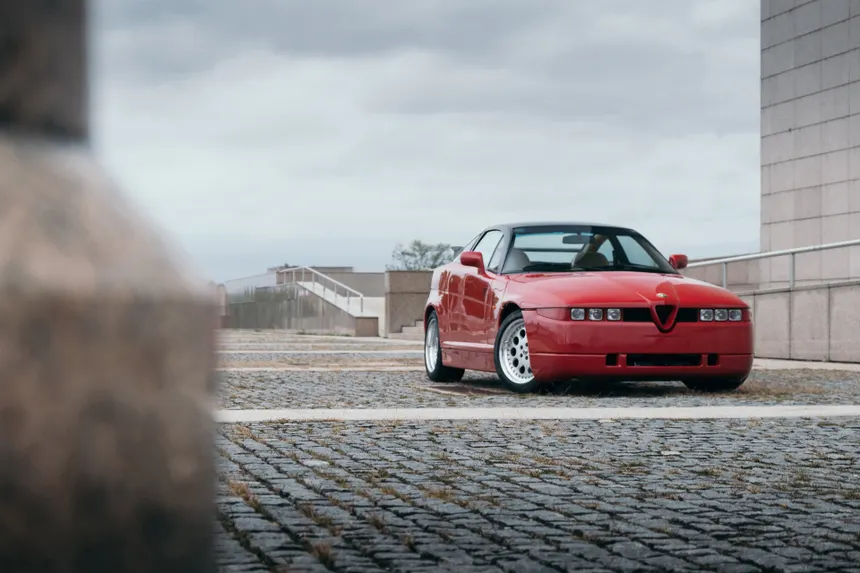
Composite instead of steel
The outer body panels were made from composite material over a steel structure. Alfa Romeo and Zagato used the solution to produce a complicated shape in a series of roughly one thousand cars.
Composite solved several problems at once.
It allowed sharp changes of plane and difficult surfaces without a high-volume steel-stamping operation. It also meant that the outer panels would not rust in the same way as conventional steel bodywork.
That does not make the entire car corrosion-proof.
The structure, subframes, mounts, fasteners and other metal parts still need inspection. A SZ can have perfect outer panels and corrosion in places nobody sees at a concours.
The body material was not merely a styling trick.
It was a sensible manufacturing decision for a low-volume car with a shape Alfa Romeo could not have produced economically through a normal mass-production process.
The SZ had to be rare in order to exist.
And it needed composite panels to make that rarity financially possible.
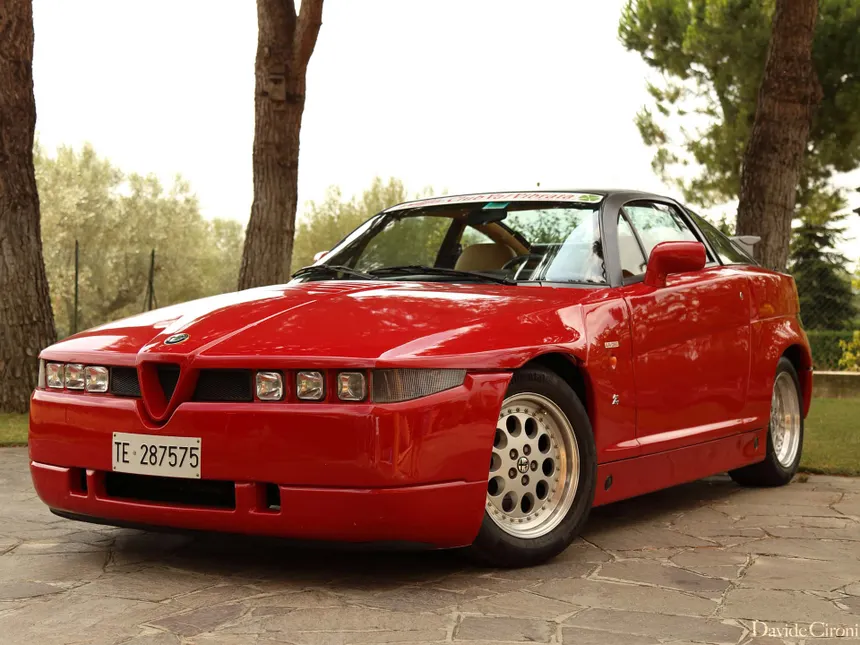
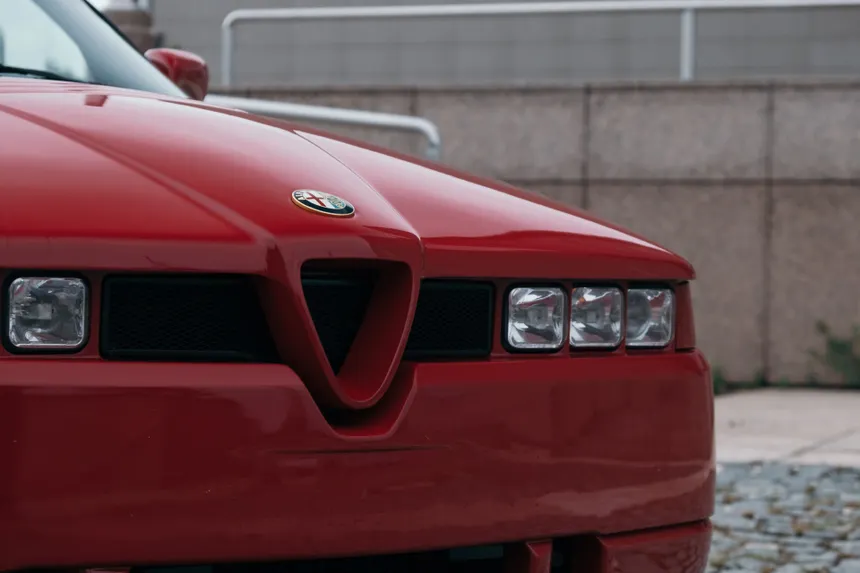
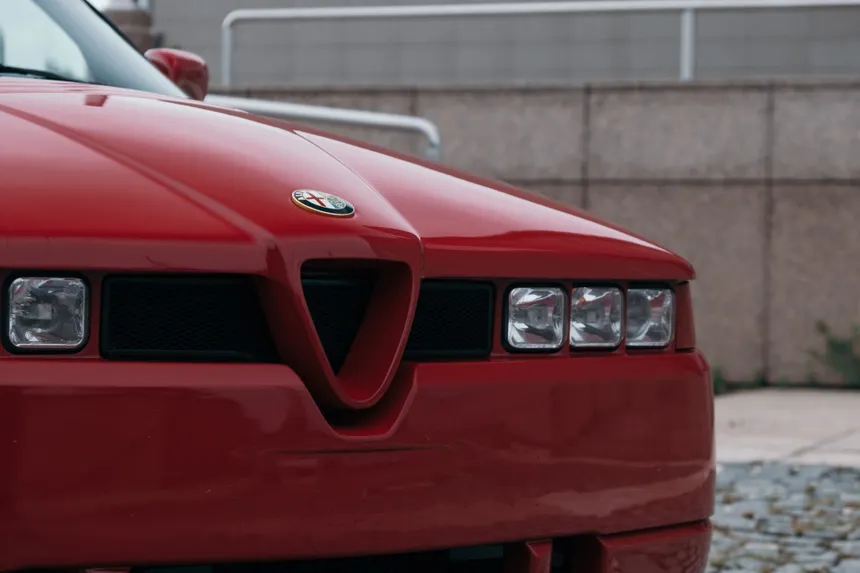
Six square headlights
The front end contains the entire argument.
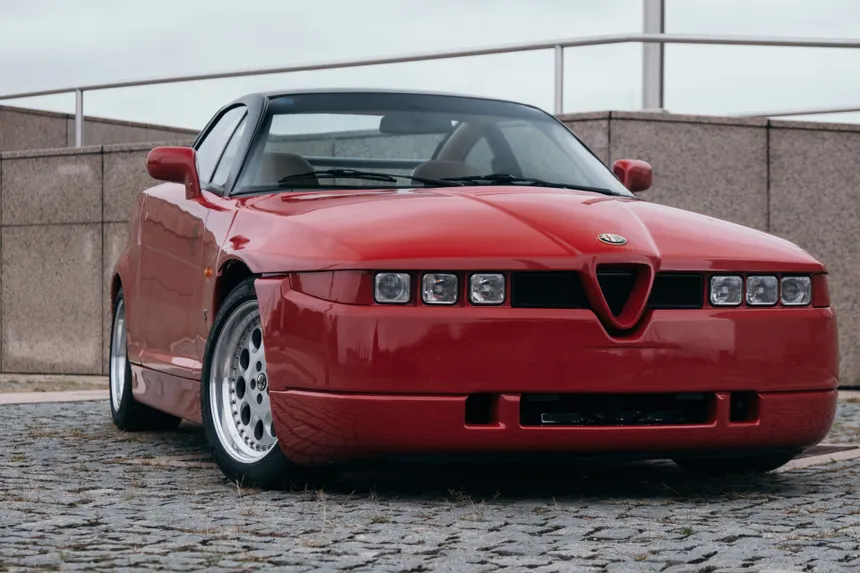
Six square headlights. Three on each side. They sit inside a mask that does not soften the car’s expression or ask permission from conventional taste.
The SZ does not have round headlights.
It has six square units packed around the central shield, as if the car needed six eyes to keep watch over everybody preparing to criticise it.
In 1989, the arrangement divided opinion. The high beltline, steep windscreen, cut-off tail and accumulation of hard edges did not fit the usual idea of Italian beauty.
The SZ was not chasing classical beauty.
It was chasing identity.
This is also where the GTV 916 enters the conversation. Not as a documented technical copy, but as a similar idea of what an Alfa Romeo coupe could be: low, sharp, tense and immediately recognisable.
The SZ pushed that idea to the limit. The GTV 916 later translated some of the same energy into a cleaner and more commercial shape. It was designed by Enrico Fumia for Pininfarina and reached the market in 1994 on a Fiat Group platform.
In my view, the SZ was one source of inspiration for the GTV 916 at a conceptual level, not necessarily in every line. Both cars make the bodywork carry the identity rather than treating it as decoration around the mechanical package.
The SZ shouts.
The GTV 916 makes the same point with better manners.
The clearest later return of the six-projector face came with the Alfa Romeo 159 and Brera in the 2000s. Decades later, Alfa Romeo reinterpreted the 3+3 language in models such as the Tonale.
The SZ did not dictate every Alfa Romeo design that followed.
It left a recognisable signal.
An interior to match
Alfa Romeo did not simply fit the SZ body over a 75 dashboard.
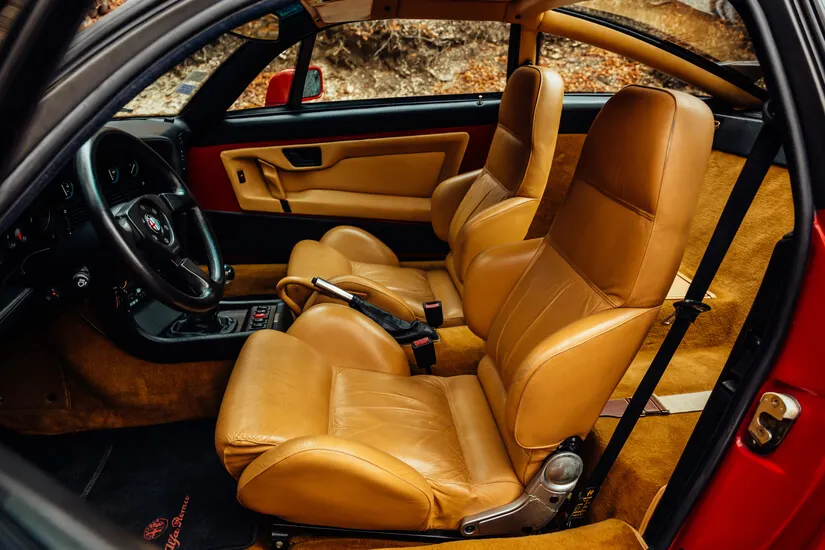
The interior had its own design, with dedicated instrumentation, a low driving position, enveloping seats and a centre console angled towards the driver. It felt like a special machine, not a saloon with the back doors removed.
There were no rear seats.
There was a carpeted shelf.
The boot did not turn the SZ into a practical grand tourer, and the spare wheel occupied space that was never generous. This was not a car for buyers who needed rationality.
It was for people willing to sacrifice convenience in exchange for something that looked like nothing else.
That explains part of its appeal among Alfa enthusiasts. The SZ did not promise to be the best car at everything. It promised to be the car you remembered after driving it.
The SZ Trofeo
Alfa Romeo produced 13 SZ Trofeo cars for a one-make series. They received circuit preparation, racing seats, interior changes, dedicated wheels and a more aggressive set-up. [web:183][web:215]
The importance of the Trofeo is not only its rarity.
It showed that the SZ’s basic architecture could leave the road and work on a circuit with relatively limited preparation. The car already had the right foundation. It only needed less comfort, sharper responses and no pretence that the journey would be pleasant.
The Trofeo cars are considerably rarer than the road cars, but their value depends on identity, history, preparation and documentation.
Rarity helps.
It does not perform miracles.
The RZ without a roof
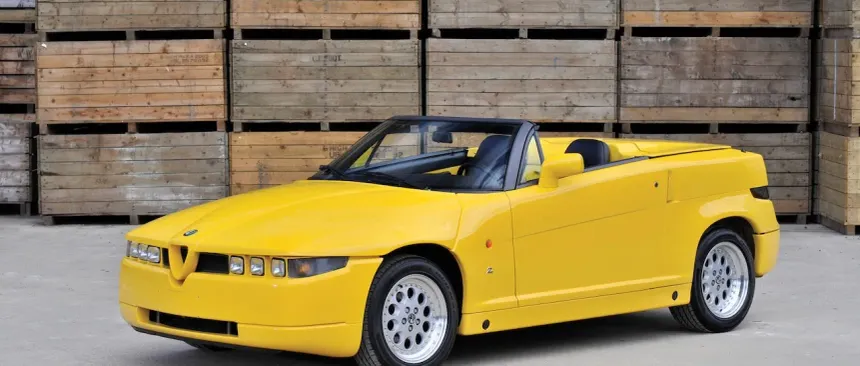
The RZ arrived as the open version of the concept: Roadster Zagato.
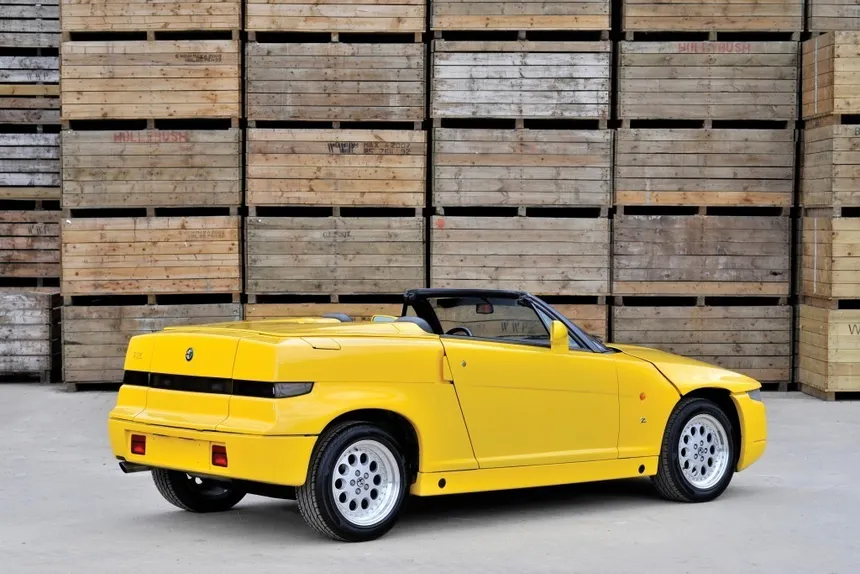
It was not simply an SZ with its roof removed. It shared the basic architecture but received its own bodywork, a lower windscreen, revised waistline, new side windows and different rear panels.
The RZ was offered in black, yellow and red, with special cars in other colours. A run of 350 had been planned, but 278 roadsters were completed according to the most commonly cited figure.
The RZ is rarer than the SZ, but rarity does not automatically make it the better car. The open body changes the experience, the rigidity and the way the V6 reaches the cabin.
The SZ has the closed, brutal shape.
The RZ adds air, noise and public exposure.
An expensive statement
The SZ was expensive when new.
In Britain, prices around £35,000 are often cited, depending on the year of the price list. That placed it alongside cars such as the BMW E30 M3, Lotus Esprit and Porsche 911, although exact comparisons depend on market, date and specification.
The price was not only paying for the engine.
It also paid for a low-volume body, hand assembly, transaxle architecture and an identity that no high-volume model could offer.
The problem was that Alfa Romeo was asking specialist money without always offering the service network, support and perceived quality of the brands competing for that budget.
The customer was not only buying a car.
The customer was buying the responsibility of explaining the choice.
Today, values still depend on condition, originality and documentation. Hagerty lists a reference value of $58,900 for the SZ in its valuation tool, but that is not a universal price and cannot automatically be labelled as the value of every excellent car.
A documented car with sound mechanics and original bodywork belongs in a different category from a neglected example or a reconstruction without traceability. The RZ normally commands a rarity premium, but the actual value still belongs to the individual car.
The provocation
The SZ was Alfa Romeo’s answer to Fiat’s arrival without the need for a press release.
The company could have presented a sensible product that was easy to manufacture and easy to explain. Instead it presented a two-seat sports car with six square headlights, composite bodywork, a Busso V6, transaxle transmission and suspension linked to the competition experience of the 75.
It was not perfect.
The ride could be demanding. The ergonomics were not brilliant. The price was high. Rear visibility was poor. Composite panels did not eliminate corrosion in the steel structure. Servicing required knowledge, and the limited production made the car impractical as ordinary transport.
But the SZ was not trying to be ordinary transport.
It was trying to prove that Alfa Romeo could still build something that did not look like it had come from a cost meeting.
The GTV 916 later carried some of that energy into a cleaner and more sellable shape. The 159 and Brera brought the six-projector face back to Alfa Romeo. The Tonale revisited the 3+3 language decades later.
The SZ was not an industrial solution.
It was a statement.
A brand newly absorbed by Fiat could still build cars that were expensive, awkward and difficult to justify. It could still put personality ahead of volume logic.
And it could do it with six square headlights staring into traffic.
Il Mostro did not need everybody to like it.
It needed nobody to forget it.
Check you’re still alive.