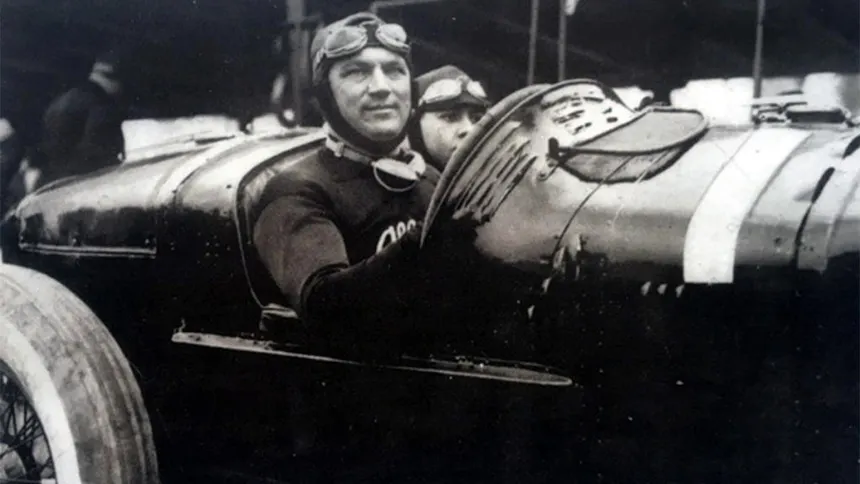
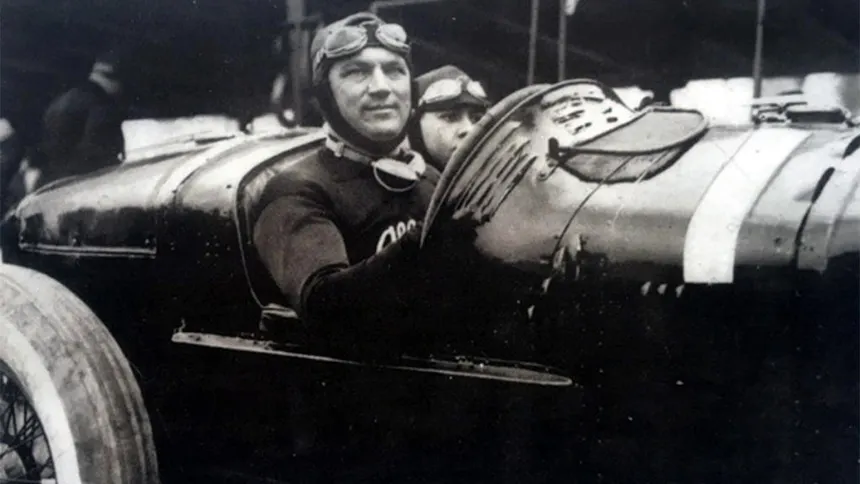
Antonio Ascari: The European Champion the Sport Killed Before He Could Lift the Crown
Let me start with the coincidence, because there isn’t another way to start. Two men dead at age 36. Both on the 26th day of the month. Both four days after surviving a serious accident. Both at the exit of a fast left-hand corner. Both with exactly thirteen championship Grand Prix victories. Both racing with car number 26. Both married, with two children left behind. Both wearing somebody else’s borrowed helmet on the day they died. Both buried in the same Milanese cemetery, side by side.
Father and son. Antonio Ascari, killed on 26 July 1925 while leading the French Grand Prix at Montlhéry. Alberto Ascari, killed on 26 May 1955 while doing four warm-up laps at Monza in a friend’s Ferrari. Thirty years between the two deaths, almost to the day. And practically every variable from the first one, replicated in the second.
This is the story of the father. The original. The driver who was on the verge of being crowned the best in the world when a poorly-secured wooden fence at a brand-new French circuit ended his career and his life on lap 23 of an 80-lap race. And because the Ascari story refuses to behave like a normal racing biography, this is also, by extension, the story of what came afterwards. Of the boy who saw his father killed in newspaper headlines at the age of six, who grew up to become the first proper Italian Formula 1 champion, and who died thirty years later with all the same variables ticking down to the same closing zero. Call it what you want. Genetic risk-tolerance. Sicilian mysticism. Statistical bad luck of cosmic proportions. But two men dying with the same numbers, on the same dates, in the same kind of corner, thirty years apart, isn’t clean coincidence. It’s something worth pausing to tell properly.
Bonferraro, September 1888
Antonio Ascari was born on 15 September 1888 in Bonferraro di Sorgà, a tiny farming village in the Veneto region, near Mantua. The Veneto detail matters because Italian motorsport mythology later painted him as a thoroughbred Milanese. He wasn’t. He was the son of a wheat merchant, raised among harvests, livestock and the dust of country roads. Working-class family, no shortcuts, no money. He left school early and went to work at a blacksmith’s forge. That pre-history is worth dwelling on. Every serious pre-war Italian driver had some kind of workshop in their past, but few had started as physically low as Antonio. The blacksmith’s forge in the Veneto of 1900 was the hardest manual trade you could pick. Anvil, hammer, fire. Where Sivocci came from music and bicycles, Ascari came from beaten hot metal.
The family eventually moved to Milan, somewhere between 1900 and 1910. Antonio joined De Vecchi, the Milanese sportscar maker, as a mechanic. There, by chance or by destiny, he met Ugo Sivocci. The two became close friends — closer than just paddock acquaintances. In 1911, someone at De Vecchi let him take the wheel of a touring car in a race at Modena. He was 22. He caught the bug immediately. The First World War cut any sporting career short: Antonio served as an aircraft mechanic for the Italian air corps. The war gave him serious technical experience with aero engines, knowledge that few drivers of his post-war generation would possess.
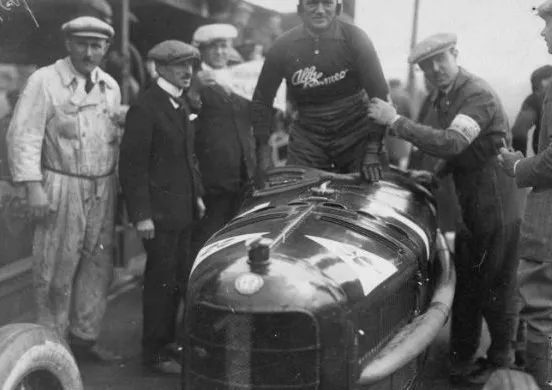
When the war ended in 1918, Ascari made a move that English-language histories rarely highlight. He opened his own Alfa Romeo dealership in Milan. He didn’t sit around waiting to be hired by the works team. He set up the commercial operation himself. He sold cars, he repaired them, he prepared them. That gave him two things that mattered: a paddock network (every Milanese motoring figure passed through his showroom at some point) and enough cash to buy his own racing cars when he needed them.
Parma-Poggio Berceto, 1919: how to buy a win without a sponsor
Antonio’s first serious victory deserves its own moment, because it tells you exactly what sort of operator he was. 1919, the first racing season after the war. The race was the Parma-Poggio di Berceto hillclimb, a classic Apennine climb. Fiat, the Turin titan, had at the last minute decided to pull out of the event and had put its Grand Prix 4.5-litre cars up for sale. Ascari, who had commercial relationships and ready cash, went, bought one, and entered the climb.
The move matters for two reasons. The first is the car: a Fiat GP 4500, 4.5-litre engine, a serious bit of competition kit. Buying one in 1919 was the rough equivalent of buying a current LMP1 prototype today. The second is the race itself: Ascari won. And the same event was the absolute racing debut of a young man named Enzo Ferrari (I told you that part in the earlier Nicola Romeo article). The day Ferrari first drove a competition car was the same day Antonio Ascari took his first major victory. The two of them already knew each other from Milan, frequented the same paddock, were friends. From that 1919 hillclimb onwards, Antonio’s career was inseparable from the future of the Italian racing scuderia that would later carry Enzo’s name.
The cyclic-bad-luck years, 1920-1922
Ascari joined Alfa Corse when the works team was formed in 1920, alongside Sivocci, Campari and Ferrari (the quartet known as the Musketeers — I covered the composition in the Sivocci article). But the first few years with the marque were a parade of strong runs without a major win. 1919 Targa Florio: crashed into a ravine. 1920-1921: nothing. 1922: fourth at the Targa Florio. Time and time again, the car would let him down at the critical moment, or a rival would slip past in the closing kilometres, or some mechanical detail would send him to the pit and out of contention.
The Targa Florio of 15 April 1923 I already told you in the Sivocci article. Ascari set the fastest lap of the race (1h 41min 10s, average 63.986 km/h), led on the final lap, his engine failed on the very last corner, took ten minutes to restart it, and crossed the line three minutes after Sivocci. Second. The “eternal second” Sivocci had finally beaten him. One month later, in May, Ascari got his revenge at the Cremona Circuit: his first major Grand Prix victory, in the Alfa Romeo RL TF. He was 34.
The P1 he never raced
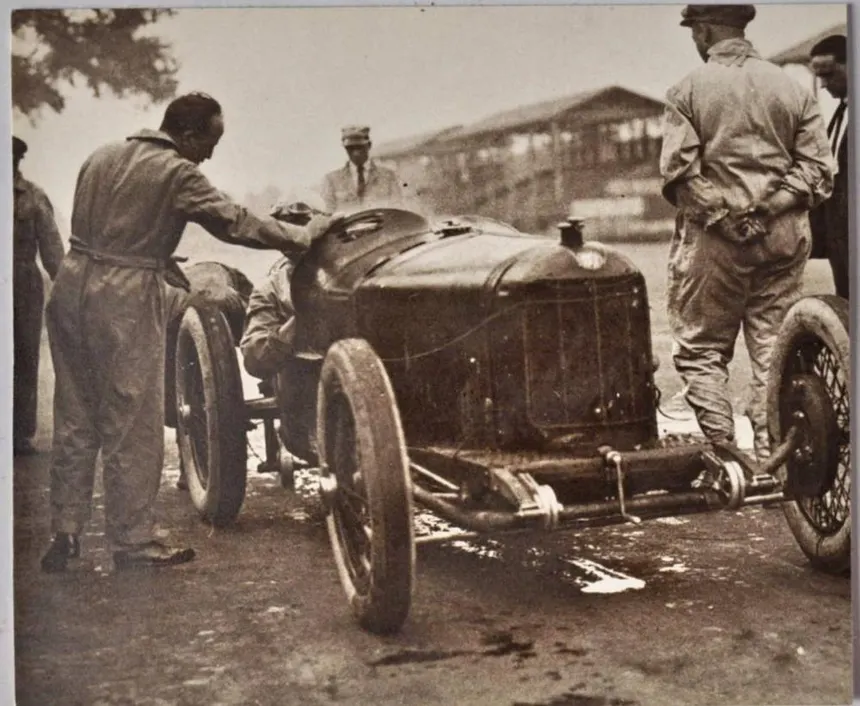
By September 1923, Ascari was entered as one of three drivers for the Alfa Romeo P1 at the Italian Grand Prix in Monza. The P1 was the marque’s first single-seater Grand Prix car, designed by Merosi (I told you about it in the Merosi article). On Saturday 8 September, during practice, Sivocci was killed at the Curva del Vialone. Alfa Romeo withdrew the other two P1s from the race in mourning. Ascari, an intimate friend of the dead man, never drove the P1 in an official competition session. The car he had helped develop died, in effect, before he could prove it on a Sunday. It was the first time Antonio touched up close what motorsport collects as its real price.
What came next is usually told as straightforward sporting progress. It’s more than that. It’s the exit of Merosi from Portello (also covered earlier), the arrival of Vittorio Jano from Fiat, and the start of the P2 project that would change everything.
The P2 of Jano and the 1924 season
Jano, having arrived at Portello in September 1923, designed the P2 from a blank sheet in less than a year. The engine: inline eight, two litres, double overhead camshafts, Roots-type supercharger. The new architecture was brutal for 1924. Ascari debuted the car at the Cremona Circuit and won. He won again at the Italian Grand Prix at Monza, leading from start to finish for the full five hours and two minutes of racing. A monumental victory.
But 1924 also delivered the most frustrating wound of his career: the Targa Florio. Ascari was leading. On the final straight before the finish line, with about a hundred metres still to go, his engine cut out. His riding mechanic, Giulio Ramponi, jumped out together with some spectators and physically pushed the car across the line. They were duly disqualified for receiving outside assistance. Picture the scene. Leading 432 kilometres of Sicilian mountain road, arriving at the last straight, losing the victory to a regulation that forbids your own mechanic from giving the car a final shove. Some frustrations fade with time. That one didn’t.
1925: the inaugural World Championship and the year of the champion
In 1925, the AIACR (the body that would later become the FIA) introduced the first World Manufacturers’ Championship in motorsport history. Four rounds: the Indianapolis 500, the Belgian/European Grand Prix at Spa, the French Grand Prix at Montlhéry, and the Italian Grand Prix at Monza. Alfa Romeo decided not to travel to Indianapolis (too far, the logistical infrastructure for a banked oval didn’t suit the European-engine philosophy of the marque). The European season opened at Spa.
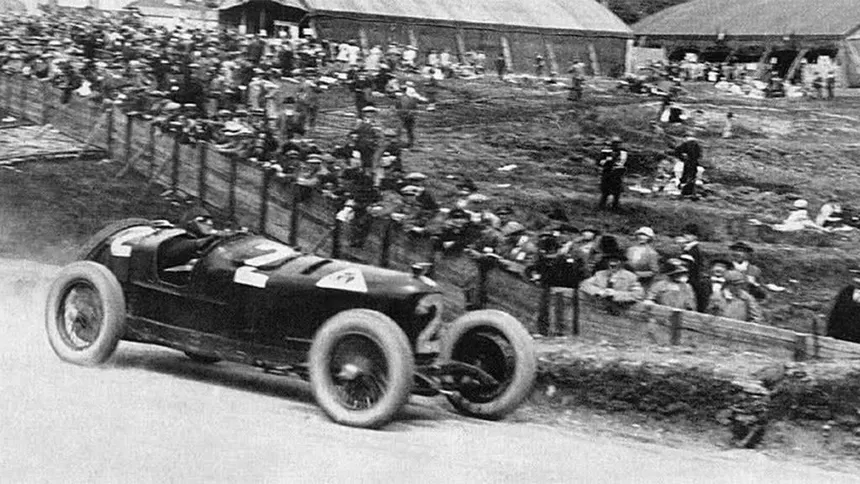
The Belgian/European Grand Prix at Spa was an almost comic spectacle. Of the twelve drivers entered, only seven actually appeared. Of those seven, four retired in the first half of the race. By two-thirds distance, only the two Alfas — Ascari and Campari — were still circulating. Ascari won by 21 minutes and 58 seconds over his own teammate. A demonstration of total dominance. Campari, second, had to drive two extra laps alone after the chequered flag because the regulations demanded the full race distance. The P2 was, simply, a different category of machine.
After Spa, Ascari was the favourite for the championship. The next round was the French Grand Prix at the brand-new Autodrome de Linas-Montlhéry, opened only months earlier south of Paris. The circuit had a spectacular banking and a flat infield section with fast left-hand corners running close to wooden fencing. That combination, in 1925, was a powder keg.
26 July 1925, Montlhéry
A detail before the race worth pausing on. On Friday 17 July, nine days before the race, Antonio said goodbye to his family in Milan and left for France. In Italian folklore, 17 is the unlucky number — the equivalent of 13 in the Anglo tradition. A Friday 17th in Italy is what a Friday 13th is in Britain. Kevin Desmond, biographer of Alberto Ascari, records that Antonio left Milan with a sense of weighed-down foreboding. At Montlhéry, again according to Desmond, he became increasingly preoccupied with the wooden fencing around the circuit. He mentioned it to several people. On the night of the 25th to the 26th, in his hotel near the track, he couldn’t sleep because of celebrating revellers in the street outside.
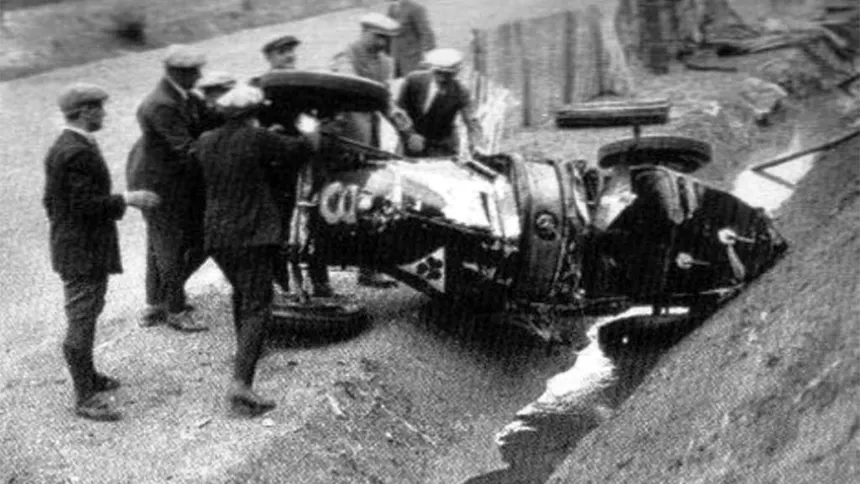
On Sunday 26 July, he climbed into his Alfa Romeo P2 and from the green flag he dominated. As at Spa. As at Cremona. As at Monza. On lap 23 of the 80-lap race (the race distance was 1000 kilometres), Ascari entered a fast left-hander on the straight leading back to the banking. Something happened. The accounts contradict each other. One: a slight misjudgement of line. Another: the car jumped on a bump. Another: oil on the racing line. What is certain is that the P2 slid wide to the left and caught on the wooden fencing along the outside of the track. The car hooked on a fence post, sharp wooden splinters drove into the open cockpit, and the car flipped over.
The medical findings recorded at the time make hard reading: one leg almost severed, multiple deep lacerations, a head wound, massive bleeding. Track medical response was slow. By the time the ambulance reached him, Antonio was still conscious. He died in the ambulance on the way to a Paris hospital. He was 36 years, 10 months and 11 days old.
The gesture almost nobody tells you about
Alfa Romeo withdrew its remaining cars from the race, just as they had done in Monza in 1923 when Sivocci was killed. A team mourning decision. But the most powerful gesture of that Sunday at Montlhéry wasn’t Alfa’s. It came from the French. Robert Benoist and Albert Divo, the two Delage drivers who finished first and second and thus actually won the 1925 French Grand Prix, drove to the site of the accident and laid their winners’ garlands beside the wreckage of Ascari’s car. It is one of the cleanest sporting gestures in the recorded history of motor racing. Two French drivers, winners of their own home Grand Prix, choosing to skip the protocol of victory to take their winners’ flowers to a dead Italian. You don’t see that any more. Not remotely.
The funeral, Mussolini and D’Annunzio
Here comes the part that the romantic version always skips, and which deserves to be told straight. Antonio’s body was repatriated to Milan for the funeral. The cortège passed through the city streets. And among the wreaths that arrived at the Cimitero Monumentale of Milan, where Antonio was buried, two were particularly significant: one from Benito Mussolini and one from the poet Gabriele D’Annunzio. The Fascist regime, in power since 1922 and in its consolidation phase by mid-1925, appropriated the dead driver symbolically. Antonio Ascari, Milanese by adoption, successful, young, killed at the wheel, was turned by the regime’s propaganda apparatus into a martyr of the new Fascist Italy. Retroactively associated with the “war generation” (despite never having fought at the front), compared with the dead of Caporetto and the Isonzo, his death became a piece of the political narrative the regime was constructing for the years to come. D’Annunzio, the key nationalist poet of early-20th-century Italy and Mussolini’s intellectual ally, embodied in his work the binary of “speed and death” that Fascist Italy cultivated as part of its aesthetic. His wreath next to Mussolini’s was a deliberate political statement.
This point matters because romantic motorsport history tends to forget the political context that surrounds racing. Antonio Ascari’s death coincided with the consolidation of Mussolini’s regime, and the regime used it. None of that diminishes Ascari’s sporting achievement. It places it in the world that actually existed.
The season ended without him. The championship was won. Alfa walked away.
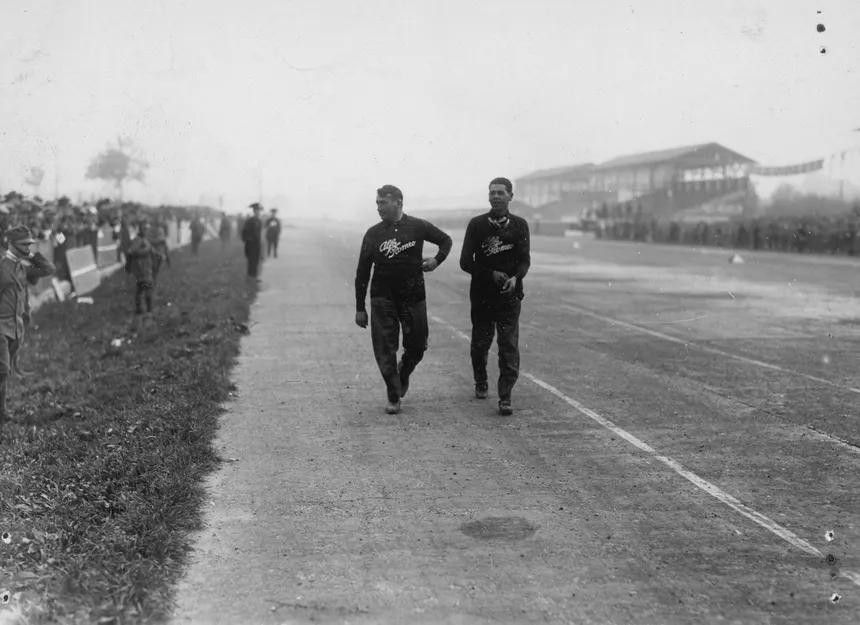
The Italian Grand Prix, the final round of the inaugural Championship, was run on 6 September 1925 at Monza. Alfa Romeo decided to compete and brought in Pete DePaolo (winner of that year’s Indianapolis 500) as a replacement for Ascari. Gastone Brilli-Peri won in a P2. That victory, added to Ascari’s win at Spa, gave Alfa Romeo the first Manufacturers’ World Championship in motor racing history. Inaugural. Legendary. A trophy Alfa would never again chase with the same depth of involvement.
And then Alfa did something almost no modern premium brand would understand. It withdrew from Grand Prix racing at the end of the season. Just like that. Championship won, brand at the absolute peak, P2 dominating, and Romeo (still at the helm at this point, though only just) decided that was enough. Several documented reasons. One: the industrial cost of the racing programme was eating commercial margins. Two: the company needed to sell road cars, not just chase chequered flags. Three: the new AIACR regulations for 1926 cut engine capacity to 1.5 litres and would have required a complete redesign. Four, the one that few sources mention but that was undeniably in the room: two drivers killed in two seasons (Sivocci 1923, Ascari 1925), both close friends, both champions, both in cars of the marque. The sport was consuming too much. Romeo, the cold industrialist I described in his article, read the spreadsheet of losses and the spreadsheet of deaths and called time.
Alfa would return to Grand Prix in the 1930s, with the Scuderia Ferrari as the contracted operator of the racing programme (also covered in the Romeo piece). But the 1924-1925 phase, the P2 era, Ascari’s era, ended the day he died.
Alberto, age six, an orphan in a paddock
Antonio left behind a widow, Mietta Tavola, and two children. The elder, a daughter; the younger, a boy of six years and eleven months called Alberto Ascari, born on 13 July 1918 in Milan. Two weeks before Alberto’s seventh birthday, his father died in France. The widow kept running the Alfa Romeo (later Fiat) dealership Antonio had founded, and Alberto grew up surrounded by cars, by the paddock, by his father’s friends. Chief among them was Enzo Ferrari, who frequented the dealership and developed a quasi-paternal bond with the boy.
What happened thirty years later defies clean rational explanation. Alberto Ascari, a meticulous racing engineer, a notorious superstition-watcher, double Formula 1 World Champion with Ferrari (1952 and 1953), died on 26 May 1955 at Monza doing four warm-up laps in a Ferrari 750 Monza Sportscar belonging to his friend Eugenio Castellotti. He was 36, the same age as his father. He died on the 26th day of the month, just like his father. Four days after surviving the Monaco Grand Prix crash of 22 May (when his Lancia D50 ended up in the harbour), just as his father had died four days after a near-miss in the Spa practice session before Montlhéry. The corner where he was killed, today the Curva Ascari at Monza, was a fast left-hander, the same as the one at Montlhéry. He was wearing Castellotti’s borrowed white helmet because his own was at a repair shop having a chin strap replaced after the Monaco accident. His father had also been wearing a borrowed helmet on the day he died, according to the period accounts. Both had won exactly 13 championship Grands Prix. Both raced with the number 26. Both left behind a widow and two children. Alberto was buried next to his father in the Cimitero Monumentale in Milan.
Alberto’s widow, also called Mietta (not to be confused with Antonio’s widow Mietta Tavola), later told Enzo Ferrari that if it weren’t for her children she would have voluntarily joined her Alberto in heaven. It is one of the hardest sentences recorded in the Ferrari archive.
What I take away from this when I think it through on the workshop floor
I’ve got a rule on the assembly bench: when a component fails the same way twice in succession with two different materials, it isn’t a material defect. It’s a design defect. And when a driver dies the same way as his father thirty years later, with the same circumstances, it isn’t clean coincidence. It’s something darker that we don’t have a vocabulary for but that’s clearly there.
What hits me hardest about the Antonio Ascari story, though, isn’t the later curse. It’s how close he was to not dying at all. He was 36, in less than two full seasons as Alfa Corse’s lead, he had already won Cremona, Monza, Spa, and he was dominating Montlhéry when a poorly-secured wooden fence at the edge of a brand-new circuit drove splinters into his cockpit. He didn’t die through a mistake. He didn’t die through a car failure. He died through inadequate infrastructure that nobody at the time considered part of race safety. That issue, the fencing and the run-off areas, would not begin to be properly addressed in motor racing until the 1970s. Forty-five years after his death.
And the other thing. If Antonio Ascari doesn’t die in 1925, he probably wins several more championships. The P2 remained competitive through 1930. Alfa probably doesn’t withdraw at the end of 1925 with the human bleeding it had endured, keeps racing, keeps winning. And the entire industrial history of Alfa Romeo in the pre-war period is different. A piece of wooden fencing on lap 23 changed the strategic planning of an entire car company for a decade. That’s what losing a driver cost in 1925. That’s what the absence of active safety cost in that era. Not just lives. Industrial history.
When you see a P2 on display today at the Museo Storico Arese, what you’re looking at is one of the most beautiful Grand Prix cars ever built. But you’re also looking at the model in which a man on the verge of being world champion died, and whose son would die the same way thirty years later. It’s hard not to take your mental helmet off in front of that.
Check you’re still alive.
1 thought on “ANTONIO ASCARI”