
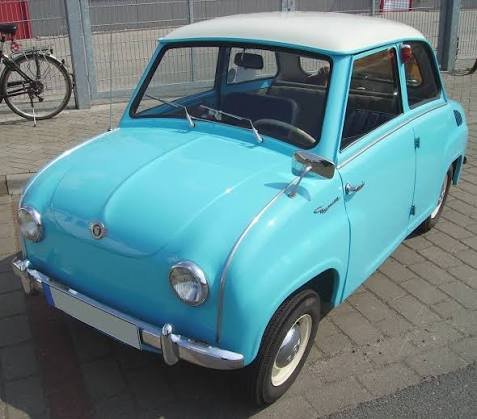
Goggomobil: The Toy That Built BMW
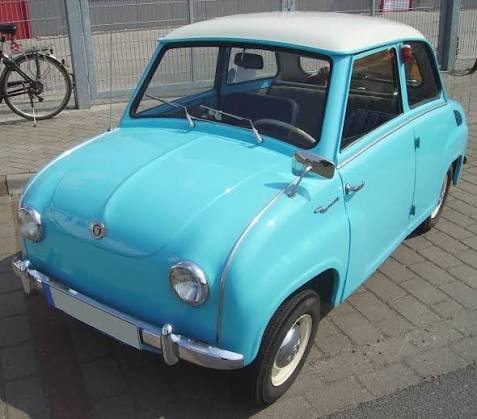
Here’s a sentence that sounds like a wind-up, but stay with me to the end because every word of it checks out. The biggest factory BMW owns anywhere on the planet today — the one churning out 5 Series, 7 Series and the bodyshells for every single Rolls-Royce made in the world — started life building a thirteen-horsepower toy car named after a farm-machinery maker’s grandson.
I haven’t skipped a step. Seed drills, a toddler, thirteen horsepower, and from there to the industrial crown jewel of BMW. That’s the story of the Goggomobil, and it’s one of those you drop at the bar and watch the bloke next to you put his pint down and stare. Let’s get into it.
From sowing fields to sowing roads
Let’s start at the real beginning, which isn’t a car. It’s a plough.
In a Lower Bavarian town called Dingolfing, the Glas family had been in agricultural machinery since the late 1800s. They started out fixing steam engines for farms, and by 1905 they were building their own seed drills — the machines that dribble seed into the furrow at a steady rate. Business was good. For decades, the Glas name meant farm implements in that corner of Germany. No cars. Soil, seed and iron.
Then came the postwar years. Germany was in pieces, no money, barely any fuel, an entire country needing to move and nothing to move in. Across Europe, microcars started sprouting like mushrooms — those minimal, cheap little contraptions that solved the mobility problem for anyone who couldn’t stretch to a proper car. British readers will remember the bubble-car boom well: the Reliant, the Peel, the Isetta with its front door. In Germany, one of the men who smelled the opportunity was Hans Glas.
In 1953 he gave the order: I want us to develop a small car. But with one condition that tells you everything about the firm’s character. He didn’t want to build some weird contraption, an egg on wheels like a Messerschmitt or one of those motorised bubbles that looked more like a household appliance than an automobile. Glas wanted a real car, with four proper wheels at the corners and the silhouette of a normal motor, just shrunk down. A small car, not an oddity. That distinction, which sounds trivial, was one of the keys to its success.
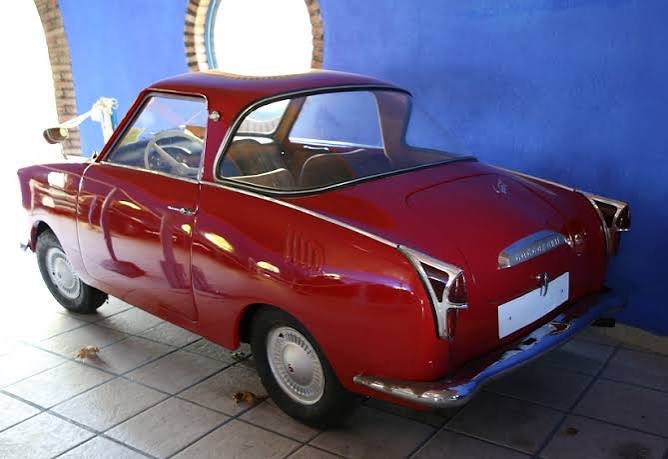
A car named after a kid
Here comes the first detail people love, because it humanises the whole thing.
The car needed a name. And where did they get it? From Hans Glas’s grandson. At home they called the little lad “Goggo” — one of those affectionate nicknames pinned on children that mean nothing in particular. They stuck “mobil” on the end, and that was that. Goggomobil. The best-selling microcar in German history, a car built for fourteen years that rolled out in well over a quarter of a million units, is named after a Bavarian kid’s baby nickname.
Bear that in mind next time you hear pompous car names lifted from Italian winds or Greek gods. This one is named after what they called the grandson at the dinner table. And it worked a treat, because the name was friendly, round, easy to say and easy to remember. It sounded like something small and lovable. Which is exactly what it was.
The first Goggomobils came off the Dingolfing line in January 1955. And the success was so violent that, building 150 cars a day, they still couldn’t keep up with the orders. A seed-drill manufacturer, suddenly, with a waiting list for its little car.
Thirteen horsepower and a family inside
Let’s talk mechanicals, because that’s where you see what this thing really was.
The Goggomobil carried a twin-cylinder two-stroke engine at the back, air-cooled, hung out behind the rear axle. It started at 250cc and about thirteen and a half horsepower. Thirteen. In time came 300cc and 400cc versions that pushed towards twenty horses and felt like rockets next to the first one. The gearbox was an electromagnetic pre-selector built by Getrag — a curious setup where you selected the gear and the box engaged it for you, quite sophisticated for such a humble little car.
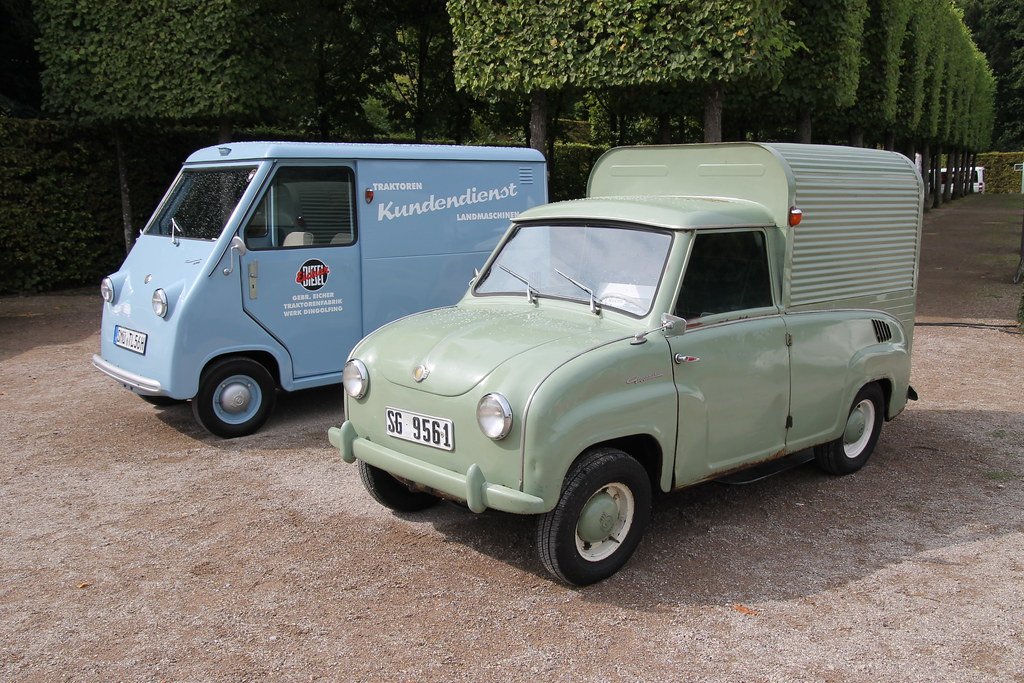
It measured two metres ninety long. Under three metres. And here’s the incredible bit: it was a four-seater. In theory, a family of four fit inside that handkerchief. In practice, let’s say the family had to get on well and not have eaten much, but they fit. That was precisely one of its selling points: it wasn’t a bike with bodywork for one and a half people, it was a genuine family car, minimal but a family car.
And the press of the day, far from laughing, fell in love. When Britain’s The Autocar tested one of the little ones, they wrote that the little engine revelled in high revs and that, with a keen driver, the sensation inside was almost that of a grand prix car. A thirteen-horsepower microcar compared to a single-seater. That’s charisma. That’s a car that, objectively ridiculous on paper, won over anyone who climbed aboard.
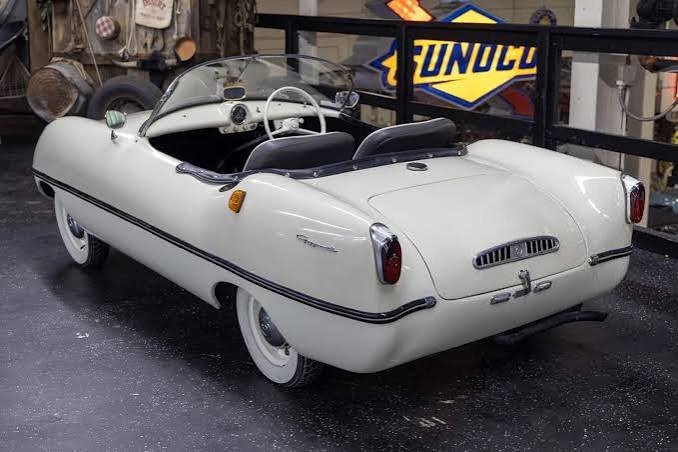
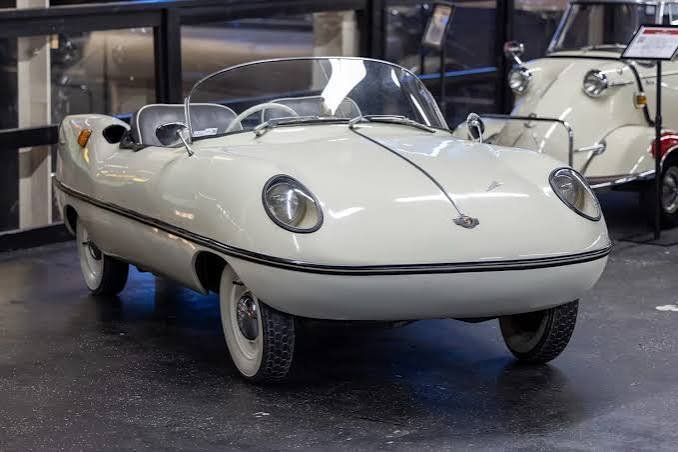
It came as a saloon, as a coupé with a racier body, as a delivery van. The van, in fact, was ordered by the German post office, which bought more than two thousand to deliver the mail. And it was built under licence across half the world: Spain, Argentina, and Australia — where a man called Bill Buckle wrapped it in a doorless fibreglass body and turned it into a tiny, gorgeous little sports convertible called the Dart.
They even shipped it to America. The US export versions got the bigger 400cc engine, an automatic oil-petrol mixer so owners didn’t have to mix the two-stroke brew by hand, and seven-inch sealed-beam headlights to satisfy American regulations. A German toy car, tweaked to clear Washington’s rulebook, sold in the land of the tail-fin and the big-block V8. It was never going to conquer Detroit, but the sheer nerve of trying is pure Glas.
That Dart deserves its own mention, because it gave Australia one of the most beloved television adverts it ever produced. Decades later, a commercial for the Yellow Pages showed a man ringing workshop after workshop trying to track down parts for his obscure little car, forced to spell it out letter by letter: “G — O — G — G — O.” It lodged in the national memory the way few ad breaks ever do. And the Dart itself? Its two-cylinder engine has been fairly described as roughly the equivalent of a pair of lawnmower motors. A doorless sports car, 345 kilos, powered by what amounts to two Victa mowers. The Bavarian toy had gone global, and picked up a cult following on the way.
What nobody tells you: the part you’re driving
Now grab hold of the bar, because here comes the part almost nobody knows, and it flips the whole thing on its head. The part this article exists for.
With the money pouring in thanks to the Goggomobil, Glas did what anyone does when things suddenly go well: it wanted to move up. It started building bigger, more ambitious cars — proper saloons and coupés with four-stroke engines. And in one of them, the Glas 1004 of 1962, it fitted a technical solution that would change the entire car industry forever.
Glas was the first manufacturer in the world to put, in a mass-produced car, an overhead camshaft driven by a rubber toothed belt.
That’s workshop jargon, so let me translate. The camshaft is the part that opens and closes the engine’s valves, and it has to stay perfectly in sync with the crankshaft. For decades, that timing was done with metal chains or gears: heavy, noisy, expensive. Glas had the idea of doing it with a toothed rubber belt, like a bicycle’s but in reinforced rubber. Cheaper, lighter, quieter. A stroke of engineering genius out of an old seed-drill factory.
And you know what? That toothed belt, that idea from the Glas 1004, is today’s timing belt — the cam belt sitting under the bonnet of a vast slice of the cars that have rolled the world’s roads over the last sixty years. The one you’ve had changed at the garage at some point, handing over a chunk of money and praying it didn’t snap early. That everyday, unglamorous part was fathered by the same people who made the little car named after a grandson. And hardly anyone knows it.
BMW swallows the lot
Now tie the threads together, because the ending deserves a round of applause.
By the mid-1960s, BMW had a nice problem: its saloons were doing so well that its Munich plant couldn’t keep up. It needed more space, more engineers, more capacity. And on the other hand, those Glas timing-belt patents were exactly the kind of technology any serious manufacturer wanted to own outright.
So in 1966, BMW did the logical thing: it swallowed Glas whole. Bought the company. And while the experts still argue over whether it was more for the patents, the factory or the engineers, the reality is it kept the lot. The Goggomobil carried on for a couple more years under BMW’s wing, until it finally died out in 1969. Fourteen years and over two hundred and eighty thousand cars had passed.
But the story doesn’t end in the microcar graveyard. It ends in the opposite place.
That Dingolfing factory — the one in the Bavarian town where they used to make seed drills and then a thirteen-horsepower toy — BMW didn’t close it. It grew it. And grew it. And grew it. Today, BMW’s Dingolfing plant is the largest car factory the brand owns anywhere in the world. Some twenty-two thousand workers. More than thirteen hundred cars a day coming off the line. That’s where they build the 5 Series, the 6 Series, the 7 Series, the luxury saloons half the planet dreams about. And that’s where — hold on — the bodyshells for every Rolls-Royce in the world are made.
On the very ground where a farm-implement maker built a little car named after his grandson, they now construct the summit of German luxury. The toy didn’t just survive. The toy laid the foundations.
What remains
It’s dead easy to look at a Goggomobil and see only what it appears to be: a joke on wheels, an endearing postwar contraption, something that raises smiles at a classic-car meet and not much more. And stopping there would be the usual mistake — judging things by their size and their face.
Because that toy did three enormous things without breaking a sweat. It got a country moving when it had nothing to move in, and did it better than anyone, as Germany’s best-selling microcar. It gave the car industry a component that millions of cars carry today, straight out of the heads of some seed-drill makers. And it built, brick by brick, the factory that is now the industrial heart of one of the most prestigious marques in the world.
Not bad for a car named after a kid, with fewer horses than plenty of today’s motorbikes. Next time you see one, don’t laugh. Take your hat off. That little thing is, quite literally, the humble grandfather everything else came from.
Check you’re still alive.