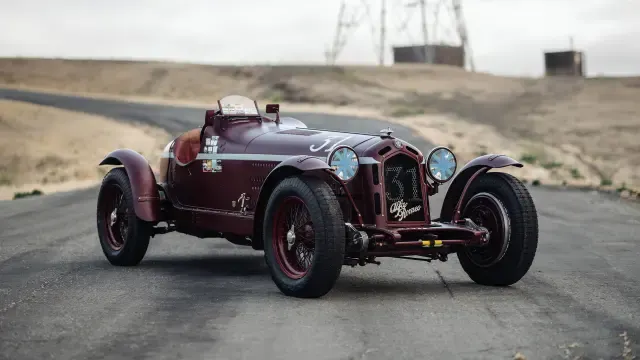
Alfa Romeo 8C 2300: The Car That Buried Bentley at Le Mans Four Years Running
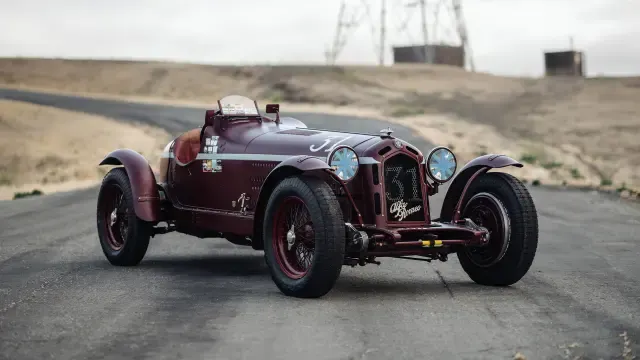
Between 1923 and 1930, Le Mans belonged to Bentley. The British marque won five of the first eight editions of the 24 Hours (1924, 1927, 1928, 1929, 1930), with those enormous British Racing Green machines, 4.5- and 6.5-litre engines the size of boat propulsion units, bodies that weighed close to a metric ton and a half, and a “Bentley Boys” cultural mythology that the British motoring press still tries to sell today as the pinnacle of pre-war endurance racing. Bentley was Le Mans. Le Mans was Bentley. Ask any British enthusiast over the age of 70. They’ll tell you so without blinking.
Then, in 1931, an Italian car arrived. 2,336 cubic centimetres. 142 horsepower. Lighter than any Bentley. And an inline-eight engine with a Roots supercharger and twin overhead camshafts that was, in effect, the Grand Prix P2 engine repackaged for road use. It had been designed by a man from Turin called Vittorio Jano (covered in his already-published NEC article), and it was being built by Alfa Romeo at Portello. It was the Alfa Romeo 8C 2300. It won Le Mans in 1931. It won Le Mans in 1932. It won Le Mans in 1933. It won Le Mans in 1934. Four years in a row.
Bentley would not win Le Mans again until the year 2003. Seventy-two years later.
That is what the 8C 2300 does. It isn’t just a car. It is the engineering instrument that broke a British industrial-sporting empire, buried it for seven decades, and proved that a small supercharged inline-eight could beat an atmospheric 6.5 litre over 24 hours of Le Mans. By pure technical design. That is workshop-floor engineering. Mechanics applied to victory. And in motoring terms, that deserves a slow, careful read.
The P2 turned into a road car
To understand what the 8C 2300 is, you have to understand where it comes from. And where it comes from is the Alfa Romeo P2 of 1924, the Grand Prix single-seater that Jano designed when he was poached from Fiat to replace Merosi at Portello (I told you about that in the Merosi piece, and the P2 reappears in the Antonio Ascari article). The P2 had an inline-eight, 2-litre, DOHC, Roots-supercharged engine that produced 155 horsepower at 5,500 rpm. That car won Alfa Romeo the first World Championship for Manufacturers in the history of motorsport in 1925.
By the late 1920s, Jano was thinking about something obvious to the workshop floor but less obvious to the commercial office: the P2 engine was too good to be used only in single-seaters. If the architecture could win Grand Prix titles, it could also win endurance races, sell road cars to wealthy customers, and sustain an entire commercial platform for a decade. Jano took the proposal to Portello’s board. They approved the project. And so the 8C 2300 was born.
Here’s the detail worth highlighting. The 8C 2300 is not a road car into which they crammed a racing engine. It is a racing car to which the coachbuilders offered road bodies. The distinction is fundamental. When Alfa Romeo built the 8C, they built it first to win Le Mans, Mille Miglia and the Targa Florio, then let the coachbuilders (Zagato, Touring, Castagna) put luxury bodywork on top if some wealthy customer wanted a road car. The philosophy was the inverse of Bentley’s. Bentley built heavy road cars that went to Le Mans. Alfa built light racing cars that could also be registered for road use.
The mechanical architecture that defines Jano
The 8C 2300 engine is the component that rewards close inspection, because it contains several design decisions you don’t see in any other European engine of the period — decisions only Jano’s mind could have brought together into a single architecture.
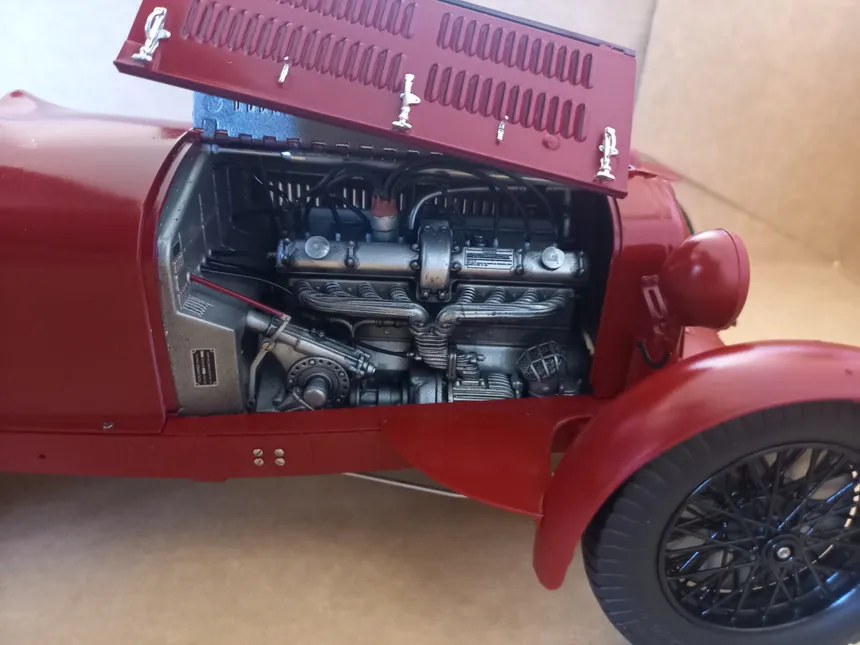
Start with the block construction. Jano did not cast a single eight-cylinder block. In 1931 Italian metallurgy, that was costly, complex, and produced foundry rejection rates that destroyed margins. What Jano did instead was build two identical four-cylinder blocks joined in the middle by a gear train. That central gearbox arrangement did two things at once: it distributed the drive to the two overhead camshafts (DOHC), and it also drove the Roots-type supercharger mounted on the side. An inline-eight engine built as if it were two inline-fours. Brilliant. It allowed Alfa to manufacture using tooling almost identical to that of the four-cylinder engine they already produced, cut foundry rejection rates in half, and gave the engine a vibration behaviour that was actually superior to that of a one-piece eight-cylinder block of the period.
Continue with the crankshaft. Two-piece crankshaft, running on ten bearings. Industrial luxury. Most period inline-eights used a single-piece crankshaft with fewer bearings to keep costs down. Jano went all in. Ten bearings on a two-piece crank means each crank throw works in near-isolation from the others, which translates into lower torsional stress, longer durability, and the headroom to push revs higher without risking failure.
Continue with the dry sump. Lubrication via a separate oil reservoir, pressure pump and scavenge pump. That was standard in Grand Prix engines but still rare in road cars of the period. Dry-sump lubrication delivered two advantages: lower engine height in the chassis (lower centre of gravity) and no loss of oil pressure in high-G cornering. For Le Mans, where the engine works at its limit for 24 hours, dry-sump lubrication was the difference between finishing and blowing up.
End with the Roots supercharger. Mechanical forced induction. Boost pressure was moderate (around 0.5 bar in road versions, more in racing variants), but enough to extract 142 horsepower from 2,336 cc. In 1931, that was more than double the specific output of average atmospheric engines of the day. A contemporary Bentley 4.5 Litre supercharged produced only about 240 horsepower from 4,500 cc. That is 53 hp/litre for Bentley against 61 hp/litre for the 8C 2300. The Italian breathed better.
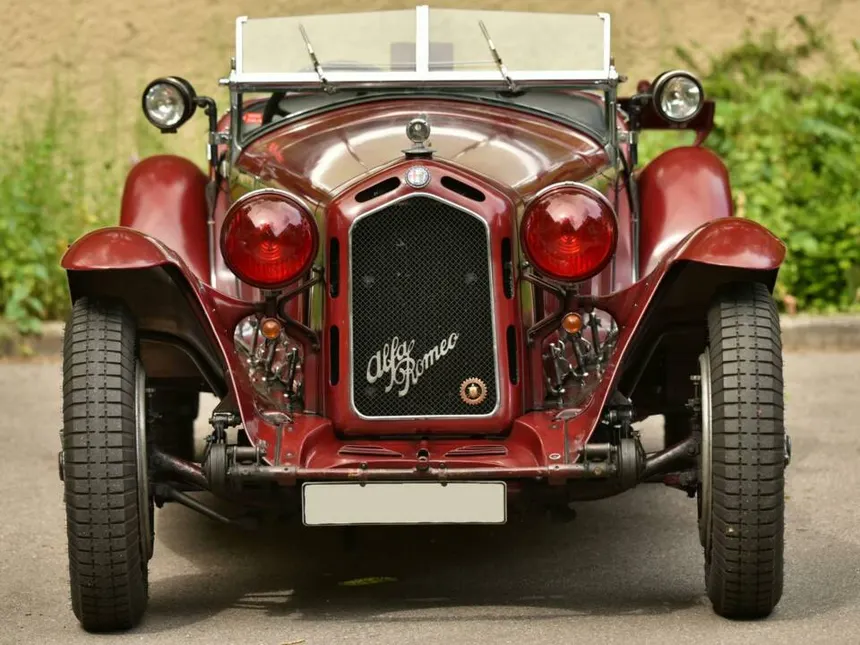
Chassis modularity: short and long
Here Jano demonstrates something that in 1931 very few manufacturers had internalised. The same engine can be used in different chassis depending on which race it is going to enter. Modularity. What modern industrial jargon calls a “platform”. In 1931 the term didn’t exist yet. Jano did the thing anyway.
The 8C 2300 was offered in two wheelbase lengths:
Short chassis (also known as Spider Corto or, after Nuvolari’s victory at the 1931 Italian Grand Prix at Monza, simply Monza). Two seats, light, aggressive, hugging the road. Designed for two-seat Grand Prix events, road sprints, and short races like the Targa Florio. Top speed up to 225 km/h in its most highly-tuned forms. This is the chassis the Scuderia Ferrari ran as the contracted operator of the Alfa Corse programme from 1929 onwards. Enzo Ferrari, as team manager, chose the Corto/Monza as the team’s workhorse.
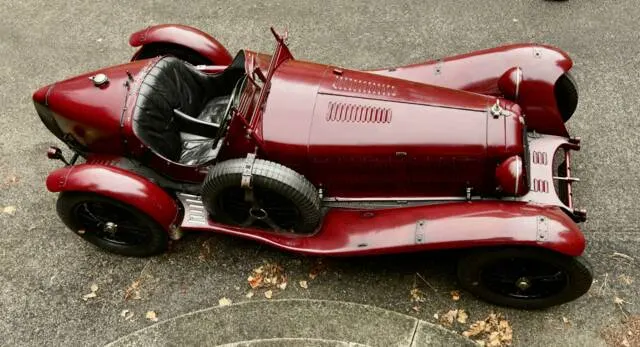
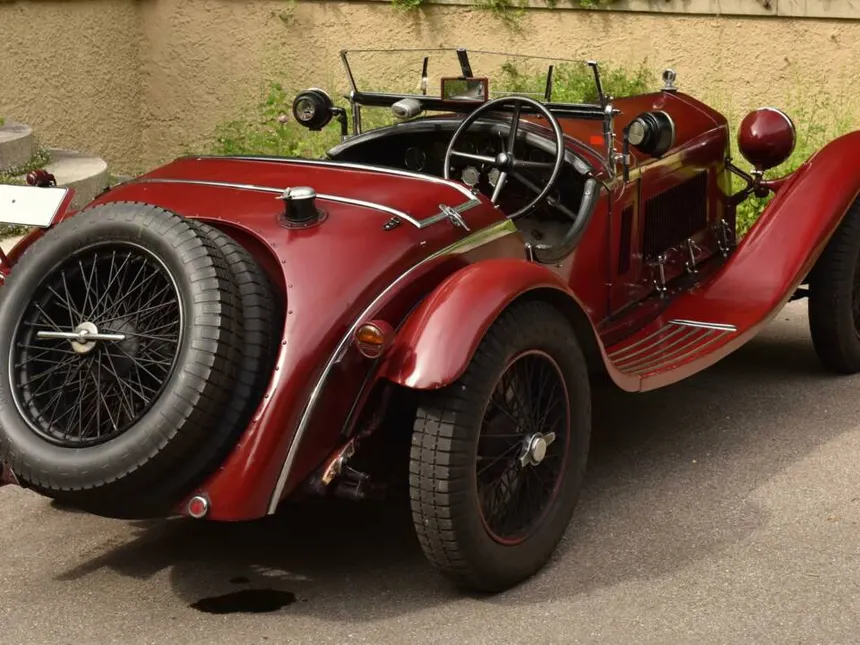
Long chassis (Lungo or Le Mans). Longer wheelbase, more stability at sustained high speeds, more room for large fuel tanks, more complete bodywork. Designed for endurance racing. The 24 Hours of Le Mans was the natural destination for this chassis. The most common body configuration was open coachwork from Zagato or Touring, with the aerodynamic shield over the spare wheel at the rear to reduce drag.
Modularity applied intelligently. Customer who wants to do the Italian Grand Prix: Corto. Customer who wants to do Le Mans: Lungo. Customer who wants to do the Mille Miglia: either, depending on taste. Customer who wants to drive along the French Riviera with his fiancée: Lungo with Touring bodywork. Same engine, same crank, same sump, same supercharger. Only the wheelbase dimensions and the body bolted on top change.
Le Mans 1931: the first hammer-blow to Bentley
The first victory came on 14 June 1931. The team was not the Alfa Romeo works outfit. It was a privateer British team. Here comes the first detail that rewards a careful telling because of its cultural texture.
Francis Curzon, 5th Earl Howe, British aristocrat born in 1884, former Royal Navy officer in the First World War, devoted motoring enthusiast, decided in 1931 to purchase two Alfa Romeo 8C 2300s to enter Le Mans. Accompanying Howe was the British driver Henry “Tim” Birkin, one of the original “Bentley Boys”, who had switched manufacturer because he had understood before anyone else in Britain that the Bentley era was finished. Howe painted his 8C in a particular shade of light metallic blue, which has been known ever since by enthusiasts as “Howe blue”. Any serious vintage car collector recognises the colour at a glance.
Howe and Birkin won Le Mans 1931 by several kilometres over the next competitor. The sporting significance was one thing. The cultural significance was another. Italy defeated Bentley at Le Mans with two British aristocrats at the wheel of an Italian car. The French motoring press got it. The Italian press got it. The British press took longer to admit it. And the original Bentley Boys — the ones who weren’t there because Bentley had just been absorbed by Rolls-Royce that very same year — watched their monopoly being broken by a car that wasn’t even made in their country.
Le Mans 1932: Chinetti enters the record
On 19 June 1932, the second victory came. Luigi Chinetti, born in Italian Lombardy and future founder of the Ferrari North American Racing Team (NART), won Le Mans alongside French driver Raymond Sommer, again with an 8C 2300. Chinetti is a figure who deserves his own NEC article in the future (the man who took Ferrari to the United States in the 1950s). Here it’s enough to say that his 1932 Le Mans win was one of the first major international appearances of a driver who would be central to the history of the Italian racing marque for the next four decades.
Sommer, French, was a driver who combined real talent with uneven luck. He won Le Mans twice with Alfa (1932 and 1933, both times as co-driver). He died in a minor race in 1950, an end almost forgotten in official histories.
Le Mans 1933: Nuvolari closes the hat-trick
On 18 June 1933, the third victory. You already know this one. Tazio Nuvolari and Raymond Sommer won with an 8C 2300 entered by the Sommer team. The story is in the Nuvolari article. Worth adding one detail here. Nuvolari’s Le Mans win in 1933 was the first and only time the Flying Mantuan ever won the 24 Hours. By then, Sivocci had been dead for ten years, Antonio Ascari for eight, and two of the four original Musketeers of the 1920 Alfa Corse line-up were in the cemetery (covered in the Sivocci article). Nuvolari, by contrast, had been racing for thirteen years. And at the wheel of the Sommer team’s Corto 8C 2300, in pouring French rain, he simply did the job.
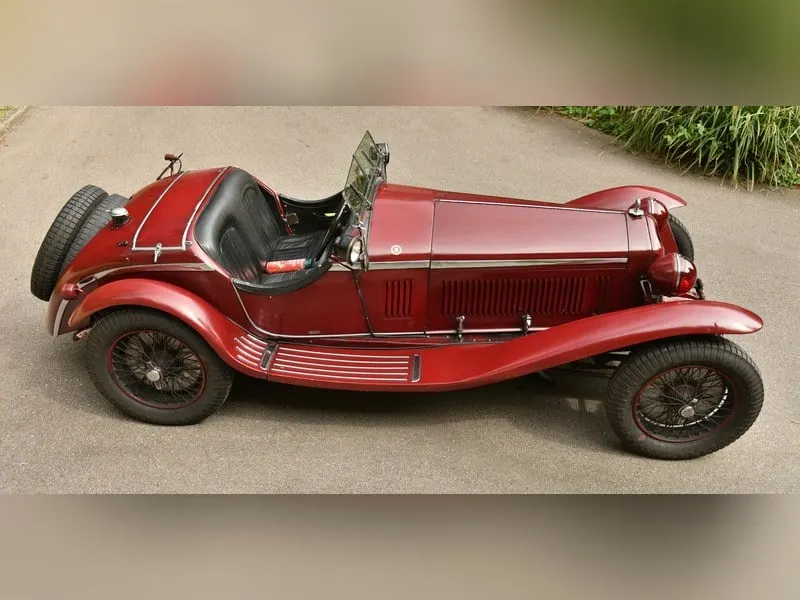
Le Mans 1934: the fourth consecutive win
On 17 June 1934, the fourth consecutive victory. Luigi Chinetti once again, this time alongside French driver Philippe Étancelin, won with an 8C 2300. Chinetti became the first driver to win Le Mans twice with Alfa Romeo, and consolidated his relationship with the marque before emigrating to the United States in the 1940s.
Four consecutive victories. 1931, 1932, 1933, 1934. The same model with incremental development. Same engine. Same long chassis. Different drivers. Different privateer teams (Howe, Chinetti, Sommer). And always at the front. By 1934 Le Mans was no longer a race for Bentley. It was a race to see which version of the 8C would win, and with which Touring or Zagato bodywork.
The Scuderia Ferrari 8C 2600 and the P3
While that was happening in Le Mans, the Scuderia Ferrari, as the contracted operator of the Alfa Corse programme from 1929, wasn’t idle. Under Enzo Ferrari’s technical management (still as team principal, not as a manufacturer) and with Jano’s backing from Portello, Alfa Romeo developed two derivatives of the 8C 2300 worth mentioning.
The 8C 2600: engine stretched to 2,557 cc (bore 68 mm, stroke 88 mm), 215 horsepower. Installed in the Monza short chassis, it delivered a top speed of around 217 km/h (135 mph). The Scuderia Ferrari secured several important victories with this variant, mostly in Italy.
The Monoposto Tipo B (P3): in 1932, Jano took the 8C 2300 engine (later 2600) and mounted it in a single-seater Grand Prix chassis with revised suspension. The P3 won 46 Grands Prix between 1932 and 1935. It is the car Nuvolari drove to his Nürburgring 1935 victory (covered in his article). The P3 is a direct descendant of the 8C 2300. Same engine, different chassis, different competition envelope. Modularity taken to its limit.
The coachbuilders: Zagato, Touring, Castagna
The 8C 2300 was a rolling chassis. What you saw on the road or on the track depended on which coachbuilder had dressed it. Alfa Romeo never built a body of its own for the 8C. They sold the complete chassis with the engine and the running gear, and the customer chose who to send it to for bodywork.
Zagato, the Milanese house of Ugo Zagato, made lightweight aluminium bodies for customers who wanted to go racing. Their design philosophy was weight before everything. Open bodies, minimal mudguards, basic aerodynamic shield, barely-padded seats. Zagato 8Cs were the fastest. The ugliest, to those who valued conservative aesthetics. The most beautiful, to those who understood that beauty resides in the elimination of unnecessary mass.
Touring, also Milanese, built more sophisticated bodywork. Their patented “Superleggera” (literally “super lightweight”) construction used a fine tubular skeleton with aluminium panels riveted over it. The result was light bodies with aesthetically more refined surfaces. The Touring-bodied 8C 2300 Le Mans is the most beautiful version of the model in long-distance configuration.
Castagna, also Milanese, built the most luxurious bodies. Cabriolets, sporting saloons. Grand touring aesthetics, not competition aesthetics. The Castagna customer was the Italian aristocrat who wanted a car capable of winning Le Mans during the week and reaching Lake Como with his wife on the weekend.
That diversity of bodywork over a single chassis is one of the reasons the 8C 2300 fascinates modern collectors. Of the ~188 examples built, virtually no two are identical. Each was dressed by a different coachbuilder, in a different combination, for a different customer. 8C 2300s that pass through auctions today reach prices of between 8 and 20 million euros depending on the example and its racing history.
What the 8C left behind before the 2900
When Alfa Romeo retired the 8C 2300 at the end of 1934, the record stood as follows. Four consecutive Le Mans victories (1931-1934). Three consecutive Mille Miglia victories. Three consecutive Targa Florios. Two consecutive 24 Hours of Spa. The 1931 Italian Grand Prix with Nuvolari (which is where the “Monza” name came from). And, via the P3, 46 Grand Prix victories between 1932 and 1935. The single most successful car of the first half of the 1930s in European motorsport. No argument.
Next came the 8C 2900, with the engine stretched to 2,905 cc (bore 68 mm, stroke 100 mm), now with two Roots superchargers and two Weber updraught carburettors, producing 220 horsepower at 5,300 rpm. The 2900 evolved into the 8C 2900B, the road-going version with the engine slightly detuned for better comfort. The 1938 8C 2900B Mille Miglia Roadster, with Touring bodywork, is one of the most beautiful cars ever built by human hand. That story belongs to another pack in this series.
What I take from the 8C 2300 on the assembly floor
There’s something you learn over years on the workshop bench, and it is that modularity done well beats differentiation done well. Differentiation means making many different components for many different applications. Modularity means making one intelligent component that serves many applications. Differentiation collapses the moment the rules change. Modularity survives.
The 8C 2300 is the mechanical proof of that. One engine. Two chassis lengths. Three principal coachbuilders. Four consecutive Le Mans wins. Three Mille Miglias. Three Targa Florios. Forty-six Grands Prix via the P3. The entire competitive and commercial record of Alfa Romeo during the first half of the 1930s came out of the same mechanical architecture. One intelligent component serving many uses. Jano understood this in 1931. The modern automotive industry calls it a “platform” today and presents it as innovation. It isn’t. It is what Jano did almost a century ago.
And the other thing I take from this. When a car wins four Le Mans in a row, it isn’t luck. When a marque breaks a seven-year industrial-sporting empire (Bentley 1923-1930), it isn’t chance. It is superior technical product applied with industrial discipline. That is what Alfa Romeo did between 1931 and 1934. That is what the 8C 2300 represents. And that is what no British, French or German manufacturer was able to match during those four years.
Bentley needed 72 years to win Le Mans again. When they did, in 2003, it was with a car developed in large part by Audi/Volkswagen Group engineers and platforms, not by original Bentley engineering culture. The Bentley of the Bentley Boys, of the 4.5 Litre supercharged, died at Le Mans 1931 when Howe and Birkin crossed the line in their Howe-blue 8C 2300.
When you see a modern Bentley with the W logo (Continental, Bentayga, Flying Spur) on the road today, remember that the marque is sustained by German engineering because the original British engineering that built it was beaten at Le Mans four years running by an Italian inline-eight of 2.3 litres. That is what Jano did. That is what the 8C 2300 did.
Check you’re still alive.