
Oshkosh JLTV: The Vehicle That Buried the Humvee — Then Got Buried Beside It
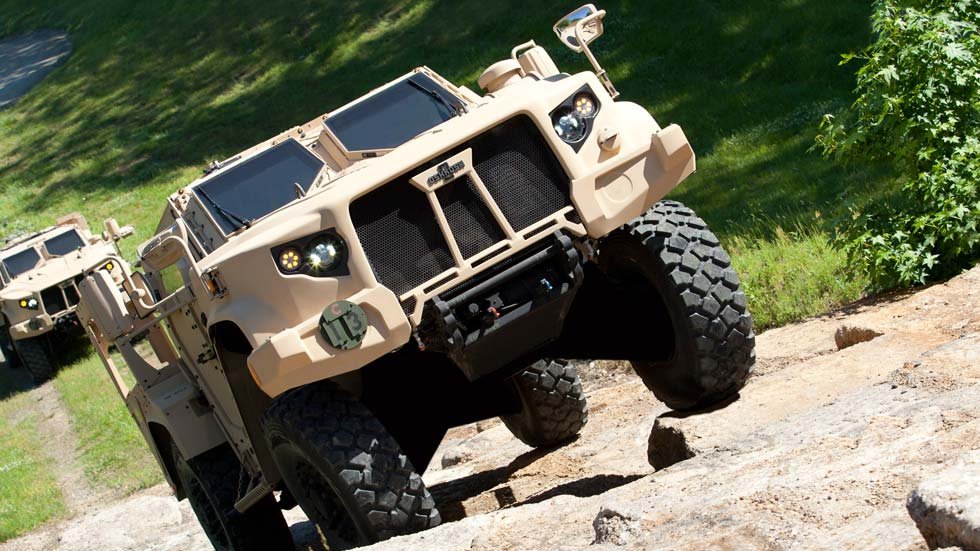
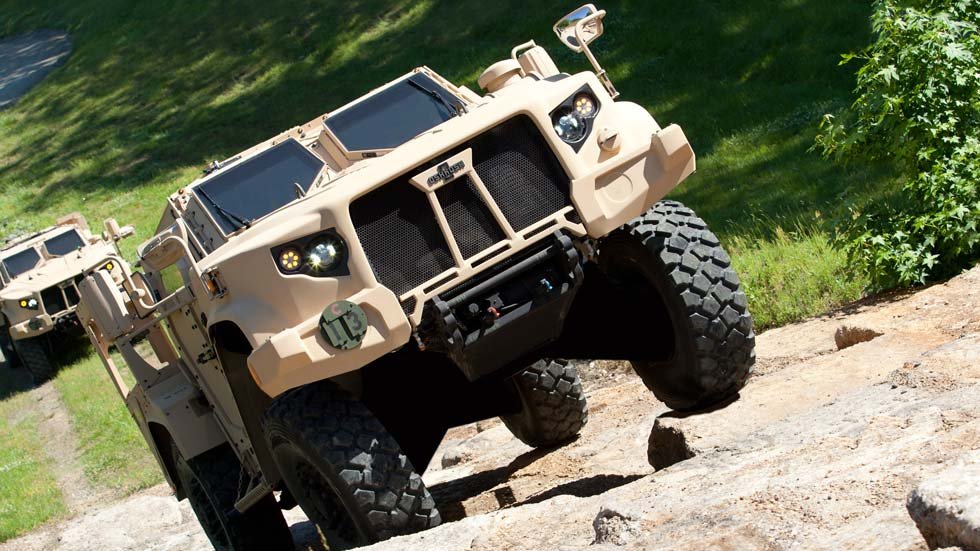
When Oshkosh won the largest light tactical vehicle contract in history, one of its executives made a claim that sounds like ad copy but turned out to be roughly true. He said the vehicle delivered the ballistic protection of a light tank, the underbody protection of an MRAP, and the off-road mobility of a Baja racer. Three things nobody had ever crammed into the same chassis. If you have ever watched a Baja 1000 highlight reel and then looked at the boxy menace of an armoured truck, you understand why that sentence raised eyebrows.
That vehicle is the JLTV — the Joint Light Tactical Vehicle — the machine the U.S. Army chose to retire the Humvee. But the story of how it got there, and what happened to it afterwards, is far stranger than a simple changing of the guard. It involves a desert race, a contractor knife-fight, a final twist in which the old rival steals the throne back, and a Pentagon memo that nearly killed the whole thing. Buckle in.
The problem the Humvee could not solve
The Humvee was designed in the 1970s to move fast behind the lines, hauling troops and light cargo. It was never meant to absorb explosions. Like the jeep it replaced, the original M998 had no armour and no protection against nuclear, biological or chemical threats. For the job it was built to do, it was excellent.
The trouble began when warfare changed shape. In Iraq and Afghanistan there was no neat front line — the enemy buried improvised explosive devices in the verges and ambushed convoys. The Humvee, with its flat floor and bare skin, became a death trap. The U.S. answered with two stopgaps. First, bolt-on armour kits for existing Humvees, which weighed 860 to 1,000 kilograms, punished the steering and suspension, and still could not stop explosively formed penetrators. Second, an emergency buy of some 29,000 Mine Resistant Ambush Protected (MRAP) vehicles, including Oshkosh’s own M-ATV.
MRAPs protected vastly better, especially against underbody blasts, thanks to the distinctive V-shaped hull that deflects the shockwave outward. But they were huge, heavy and clumsy off-road. They were never meant to be permanent — when operations wound down, thousands were scrapped, repurposed or handed to allies. The U.S. kept just over 11,100, around 6,350 of them Oshkosh M-ATVs.
That left an obvious gap. The armoured Humvee was vulnerable; the MRAP was safe but ponderous and useless cross-country. Each fix had solved one problem and created another. The military needed something new that balanced the three impossible variables: payload, mobility and protection — without sacrificing any one of them to buy the others. The JLTV programme was born from that gap in 2006.
The race for the contract
The Department of Defense opened a competition to create a whole new generation of light tactical vehicles marrying Humvee mobility to MRAP protection. The industry’s heavyweights piled in: AM General — maker of the Humvee itself — Lockheed Martin, a General Dynamics joint venture, and Oshkosh.
Oshkosh came armed with a party trick. In 2010 its LCTV prototype became the first military-class vehicle to complete the Baja 1000, the brutal Mexican desert race. This was not empty showmanship: it proved an armoured machine could move at rally-car speeds over the roughest terrain imaginable. In 2011 the company evolved that design into the L-ATV (Light Combat Tactical All-Terrain Vehicle), the platform for its JLTV bid.
In August 2012 the government awarded three development contracts — to Oshkosh, AM General and Lockheed Martin — to build prototypes. Oshkosh delivered its in August 2013, built on a warm production line to cut risk. The prototypes cleared the severe off-road track at Quantico without failure. After a final phase pitting twenty-two prototypes from each bidder, Oshkosh won on 25 August 2015. The initial contract was worth $6.7 billion.
The decision came down to reliability above all. In a limited user test the L-ATV demonstrated 7,051 mean miles between operational mission failures — better than the Humvee and better than either rival. In a world where a vehicle that breaks down mid-ambush becomes a coffin, that number outweighs any horsepower figure.
What’s inside
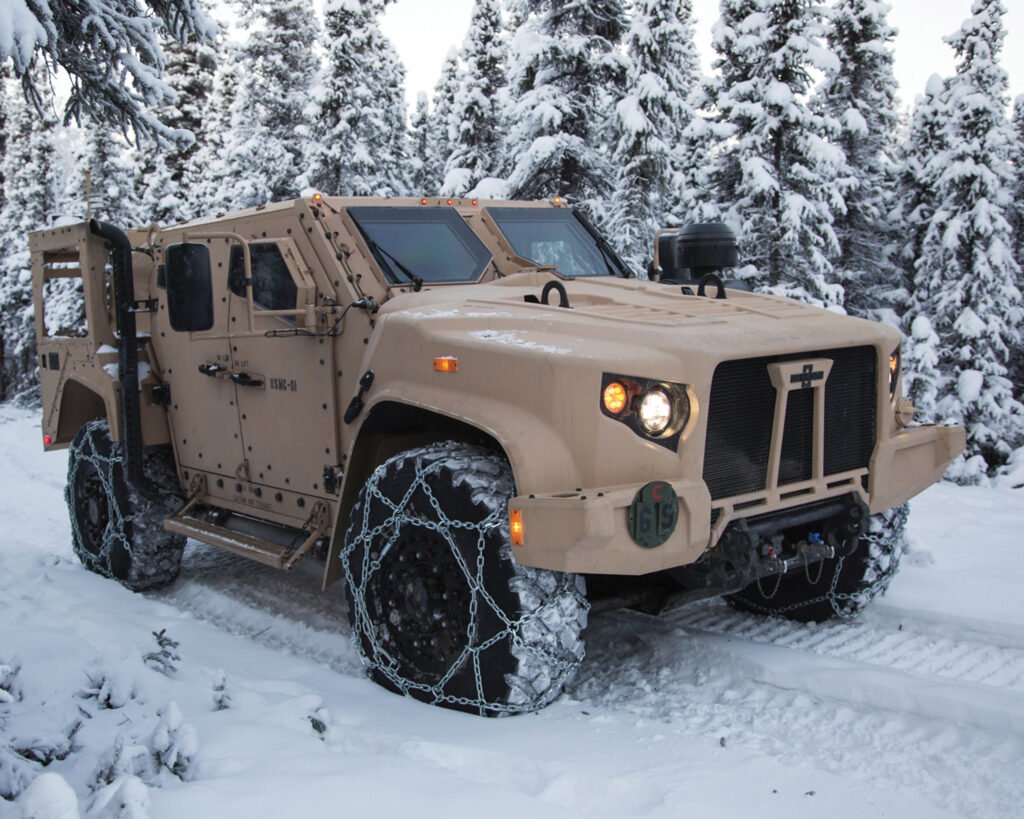
The JLTV’s technical headline act is its suspension, the TAK-4i — the “i” stands for intelligent. It’s an evolution of the TAK-4 system Oshkosh already fitted to more than 20,000 military vehicles — from the MTVR medium truck to the armoured M-ATV itself, plus heavy logistics trucks and even airport fire engines — but the L-ATV version ditches coil springs for a variable, adjustable ride-height setup with up to 20 inches of wheel travel — 25 percent more than the previous standard. The driver tunes the height from inside to suit the terrain. Oshkosh itself boasts that the L-ATV matches the ride quality of its M-ATV at speeds 70 percent higher over difficult ground. That’s the Baja-racer leg of the promise made real, and it’s no accident: the system descends in a straight line from a decade of accumulated combat experience.
Power comes from a V8 turbo-diesel built on the General Motors Duramax L5P architecture and developed by Gale Banks Engineering, making around 400 horsepower and 850 lb-ft of torque, paired to a six-speed Allison automatic. There’s an optional ProPulse diesel-electric powertrain capable of exporting up to 70 kW of military-grade power — the vehicle as a rolling generator to run a command post.
Protection is the MRAP leg. The armour system was co-developed with the Israeli firm Plasan and includes a blast-deflection zone between the floor and the crew compartment. It follows the Army’s modular Long Term Armor Strategy, the A-kit/B-kit principle: the A-kit is fitted at build and provides the fixings, while the B-kit is the add-on armour, bolted on or stripped off depending on the mission so the vehicle isn’t lugging dead weight when it isn’t needed. The CORE1080 crew protection system rounds it off, alongside gunner protection, thermal and electromagnetic systems, jammers and automatic fire extinguishers.
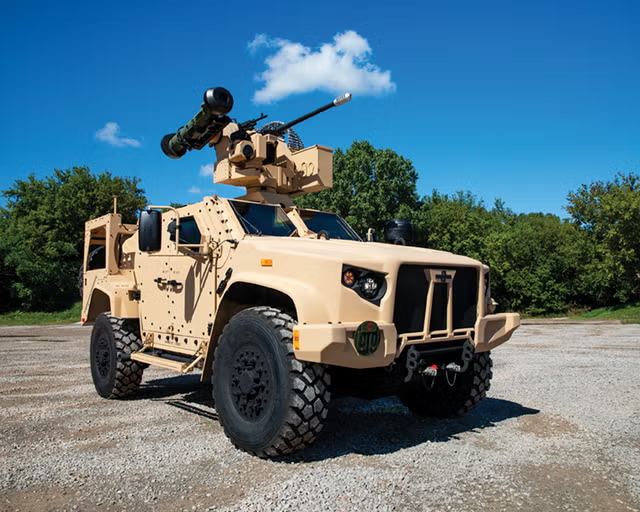
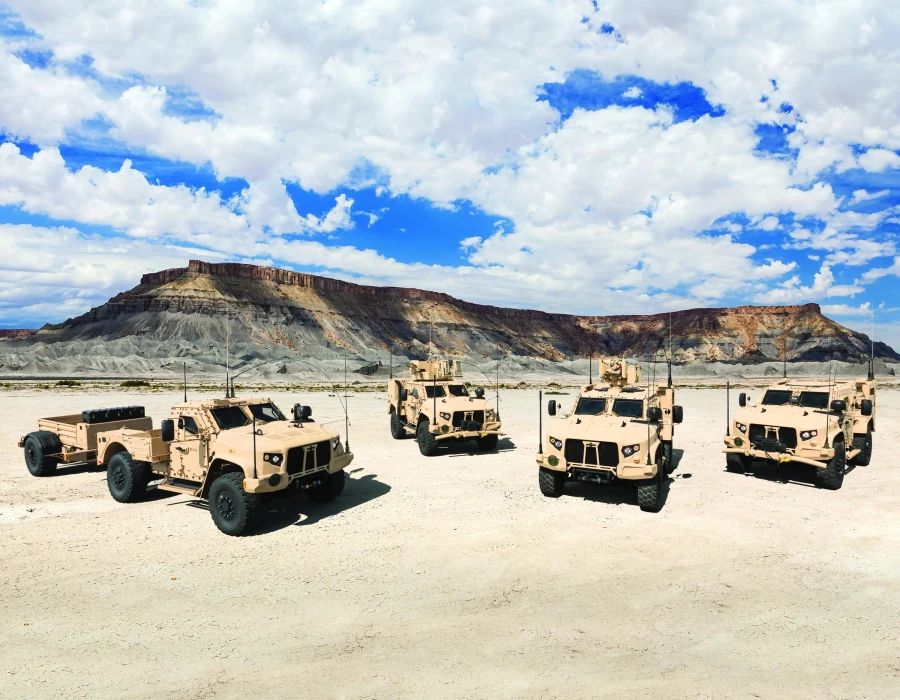
The JLTV family comes in two base bodies — two-seat and four-seat — and several configurations: utility, general purpose, close combat weapons carrier. Payload exceeds 5,100 pounds. And, crucial for modern war, a digital backbone that plugs it into the networked battlefield, linking communications, sensors and remote weapon stations.
The numbers piled up fast once production began. Oshkosh delivered seven JLTVs to the Army and Marines for testing in October 2016, and from there the orders cascaded: 409 vehicles here, 748 there, 611, 258, 416, then a single June 2018 order for 1,574 worth $484 million. Full-rate production began in June 2019, and that August the Marine Corps declared initial operating capability. By the time the dust settled, well over 7,500 vehicles had reached the U.S. Army, the Marines, the Air Force and the Navy. This was no boutique programme — it was a wholesale re-equipping of American light tactical mobility.
The twist: the old king takes the crown back
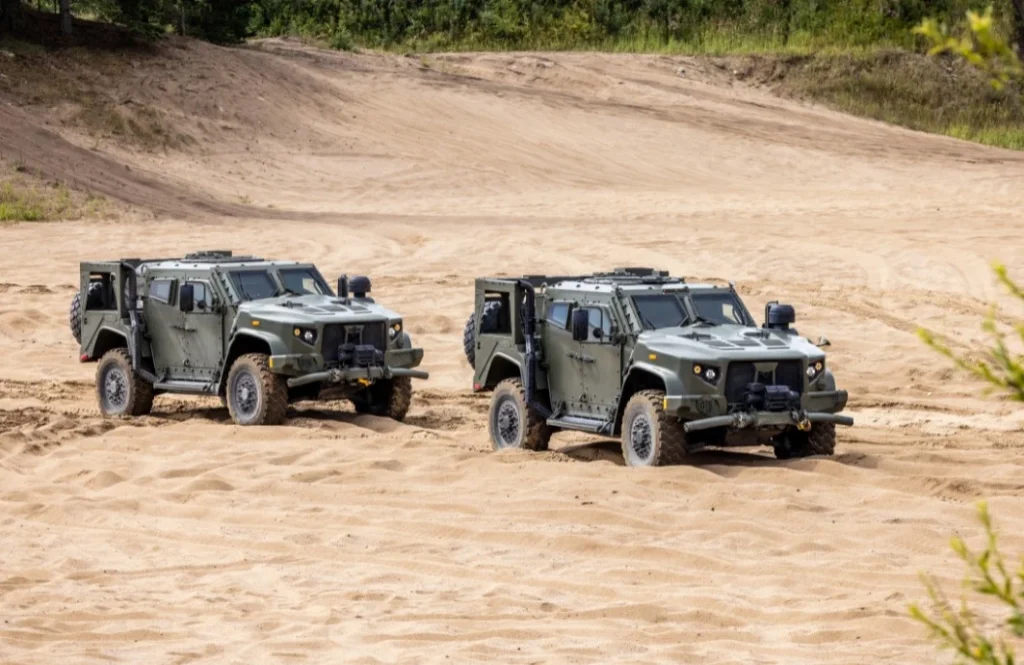
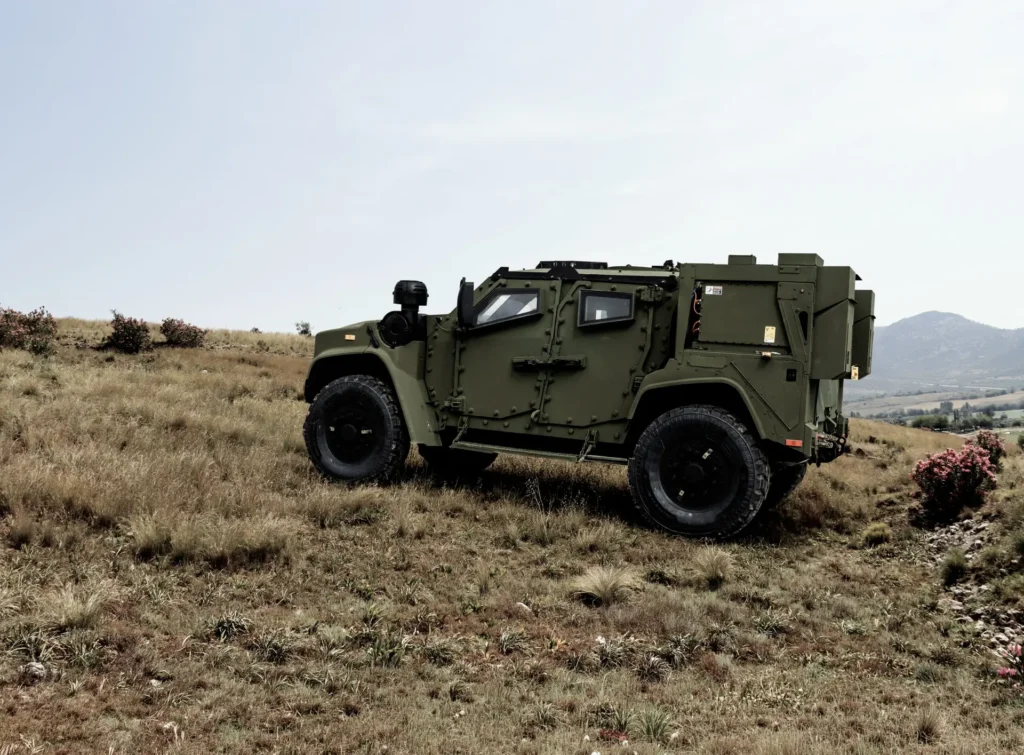
Here the story turns almost novelistic. Oshkosh won production in 2015 and delivered thousands to the Army, Marines, Air Force and Navy. But the original contract allowed for a follow-on competition. And in February 2023 the Army picked AM General’s bid to build the new A2 variant — 250 engineering changes over the A1.
Read that again. AM General, maker of the Humvee, the vehicle the JLTV was built to replace, ended up wrenching production of the Humvee’s own successor away from Oshkosh. Oshkosh filed a formal protest, which the Government Accountability Office denied. AM General put up a fresh 96-acre plant for the A2 and committed to building 20,000 JLTV A2s and 10,000 trailers by 2057, targeting a rate near fifteen vehicles a day. The circle closed on a perfect irony: the company that birthed the Humvee ended up building its executioner too.
The final blow: when the Pentagon said enough
Then, on 30 April 2025, the hammer fell. Secretary of Defense Pete Hegseth signed a memo titled “Army Transformation and Acquisition Reform,” ordering an end to procurement of “obsolete systems” and the cancellation of “ineffective or redundant” programmes. On the list, alongside outdated crewed attack aircraft and obsolete drones, sat two names you already know: the Humvee and the JLTV.
The Humvee’s replacement and the Humvee itself, condemned in the same sentence, on the same day. The Army announced it would stop buying both. But — and this is the nuance the headlines kept dropping — that does not mean they vanish tomorrow. AM General replied that it held a delivery backlog through 2027 and would keep running its Humvee and JLTV A2 assembly lines as normal to honour its contracts. Ceasing new purchases is not the same as retiring what’s already rolling. And while the Pentagon hit the brakes, allies kept buying: Slovakia, Lithuania, Slovenia, the Netherlands — which in April 2025 ordered 150 for its Marine Corps, christened the Kaaiman — and more besides.
No handover is ever clean
It’s worth resisting the easy line here. It’s tempting to write that the JLTV “killed” the Humvee, just as it’s tempting to say Spain’s VAMTAC bettered the Humvee it sprang from. But military handovers are almost never clean or instant. The Humvee has been in service since 1985 and will keep rolling for years yet. The JLTV was always framed as a partial replacement, not a one-for-one swap. And in April 2025 both ended up in the same budgetary limbo — alive by contract, dead by procurement.
If the Humvee was the vehicle that proved a single modular chassis could do everything, the JLTV is the one that proved that same chassis could also survive a mine without surrendering its speed. It’s the answer to lessons learned in blood in Iraq and Afghanistan, engineering distilled from a decade in theatre. That its commercial life turned so messy — snatched by the rival, frozen by the Pentagon — takes nothing from its technical merit. If anything it adds to it: a vehicle so capable and so costly that its own success made it a budget target. And there’s the deeper paradox. The JLTV costs considerably more than the Humvee it replaces, and at a moment when the U.S. Army is pivoting its spending toward drones, unmanned systems and networked warfare, a top-shelf crewed off-roader — however capable — starts to look like a luxury from another era. The civilian Hummer died for drinking too much fuel; the JLTV stalled for costing too much money. Two different ways for excess to come due.
The Humvee was born from a blueprint stolen off a Lamborghini and went on to conquer the planet. The JLTV was born from the verges of Baghdad and conquered the physics of the impossible: tank armour, MRAP floor, rally-car pace. Two very different answers to the same eternal problem — how to get a soldier where they’re needed, and bring them home whole.
Check you’re still alive.