Fiat Turbina: The Jet-Age Prototype America Never Heard Of
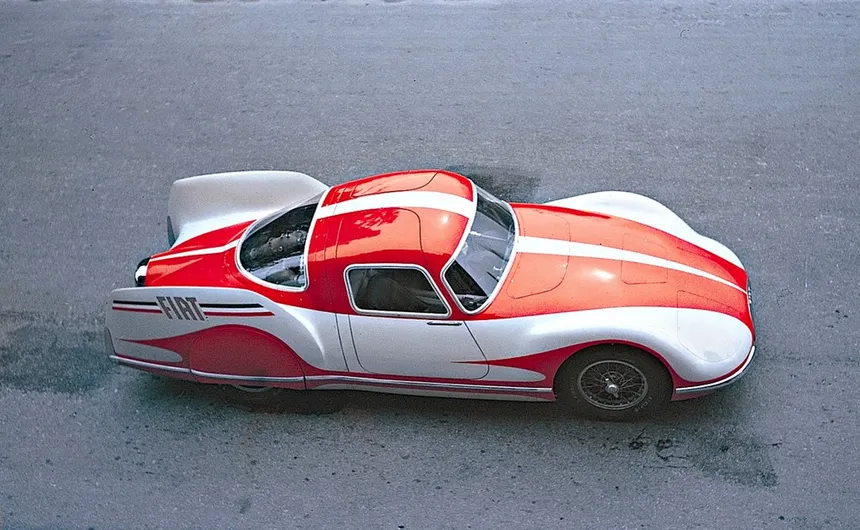
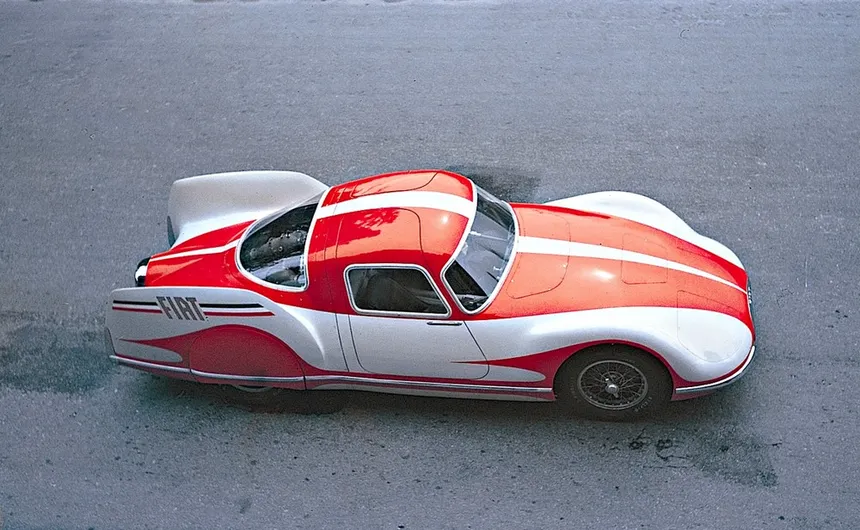
Ask an American gearhead about turbine-powered cars and you’ll get one answer: the Chrysler Turbine Car, the bronze coupe Chrysler loaned out to ordinary families in 1963 as a rolling experiment. What most of them don’t know is that nine years earlier, an Italian engineering team had already built, tested, and shelved a turbine car of its own — one with a drag coefficient so low it wouldn’t be matched by a production car for thirty years. That car was the Fiat Turbina, and it never got the recognition on this side of the Atlantic that its numbers deserved.
Built by the man who designed the people’s Fiats
The project started in 1948 inside Fiat’s technical office, run by Dante Giacosa — the engineer better known for shaping the small, affordable Fiats that motorized postwar Italy. Turbine and driveline work went to Oscar Montabone, with Vittorio Bellicardi overseeing development. The logic driving the whole effort was straightforward for the era: piston aero-engines had just been swept aside by jets in a matter of years, and Fiat wanted to know whether the same shift was coming for the road. The company already had turbine know-how through its aviation division, which built the de Havilland Ghost jet engine under license, so the automotive leap wasn’t a cold start.
Development ran six years. The engine went into the finished chassis on March 15, 1954, and the first runs happened shortly after on Lingotto’s famous rooftop test track — the same elevated circuit that made the factory itself an architectural landmark. Sources disagree on the exact date of that first test, citing either April 4 or April 14; what’s confirmed is that by late April 1954 the Turbina was on the stand at the Turin Motor Show, with a public demonstration at Caselle airport where Fiat test driver Carlo Salamano put the car through its paces in front of the company’s top brass, covered at the time by the Turin daily La Stampa.
A turbine engineered for wheels, not wings
The Turbina’s heart was the Tipo 8001 engine: a two-stage centrifugal compressor, three can-type combustors, a two-stage turbine driving that compressor, and a separate power turbine sending drive to the rear wheels through a reduction gearset. There was no torque converter and no conventional gearbox — the turbine itself handled that job, acting somewhat like a hydraulic coupling would later. It ran on kerosene, and once combustion was underway, the engine would tolerate nearly any liquid fuel fed into it.
Fiat’s published figures were 300 hp at 22,000 rpm, with an estimated top speed of 250 km/h (about 155 mph). That rpm figure sounds extreme, but it’s the power turbine’s speed, not the gas generator’s — that spun faster still, up to 27,000 rpm — and it ran through a reduction gearset that brought it down to roughly 4,000 rpm at the differential; without that reduction, no tire would have survived contact with the road. That word “estimated” matters too: there’s no record of a timed top-speed run, so treat that number as Fiat’s engineering projection rather than a verified result. Curb weight sat around 1,000–1,050 kg according to the most reliable technical sources, though one period account puts the fully-equipped weight closer to 1,270 kg — where sources conflict, the lower, better-documented figure is the one worth trusting.
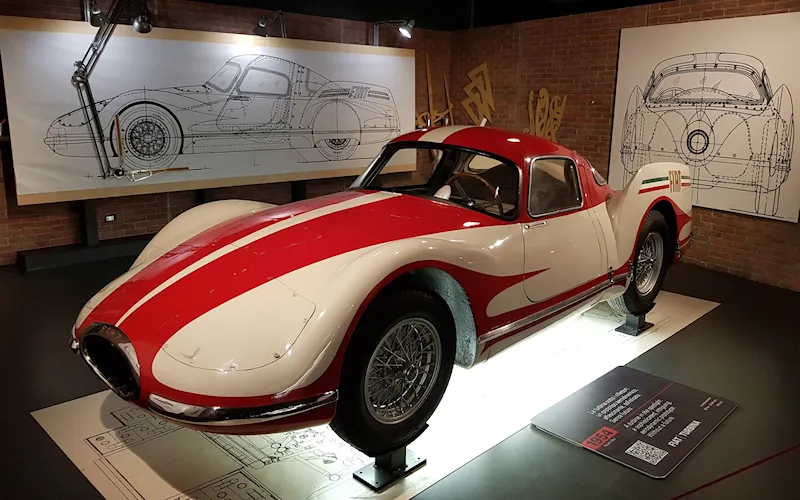
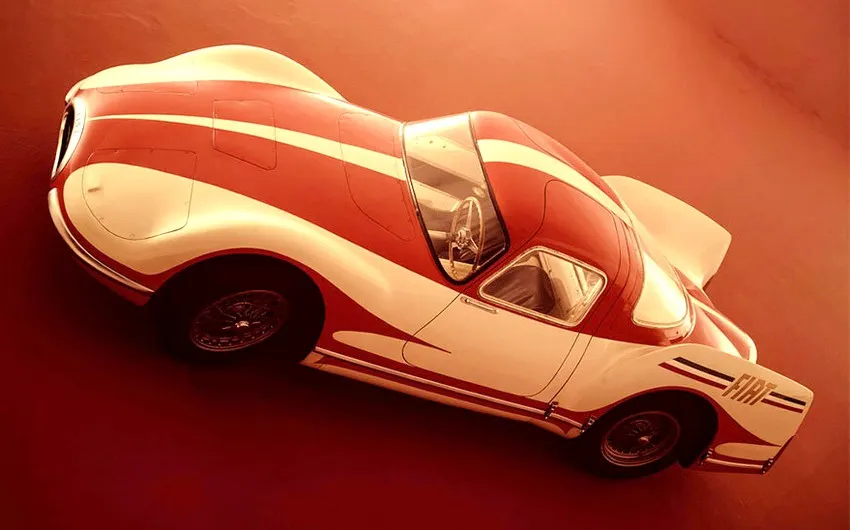
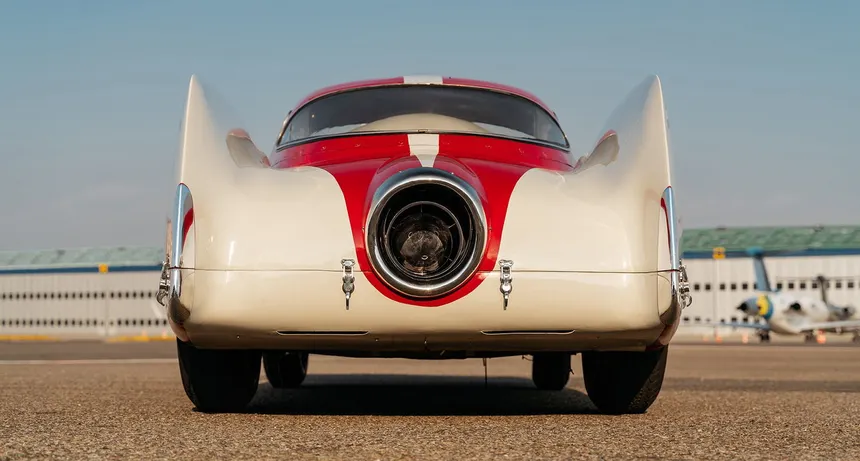
The body, styled by Luigi Rapi, wasn’t just theater. Wind-tunnel testing at Turin Polytechnic measured a drag coefficient of 0.14 — a figure no production road car would beat for the next three decades. The tubular chassis carried four independent wheels, with front suspension borrowed from the 1952 Fiat 8V, which also donated part of the mechanical base. That donor car is worth a beat of its own: the 8V wasn’t some volume runabout, it was Fiat’s own low-volume V8 grand tourer, built to go head to head with Lancia and Alfa Romeo in the artisanal GT class. Fiat didn’t cobble the Turbina together from spare parts bin leftovers — it built the thing around the best hardware the company had. Twin rear fins stabilized the car at speed and hid the turbine exhaust, and the entire rear section, including the fully soundproofed engine bay, came off in one piece.
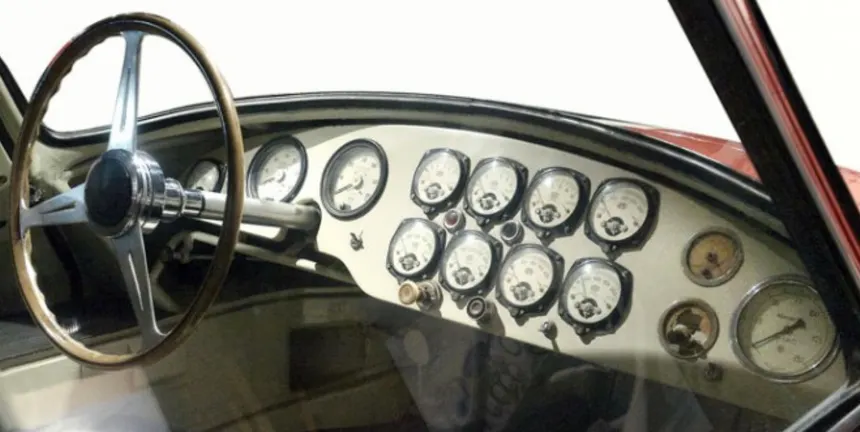
Starting the thing was nothing like turning a key. The ignition sequence took about 15 seconds: the engine caught at 5,000 rpm, and the gas generator didn’t become self-sustaining until 10,000 rpm — only then could the driver actually ask the power turbine for real output. There was no electronic management of any kind; a variable fuel-metering valve controlled the whole process, and it was down to the driver, watching that dozen-gauge dashboard, to judge when the engine was ready to be pushed.
Inside, the Turbina made no attempt to look production-ready: no headlights, no taillights, no trim suggesting a path to showrooms. The dashboard was the one place Fiat did go all-in — a dozen gauges, with separate tachometers for the two turbines and pressure and temperature readouts spread across the whole combustion and lubrication circuit. One bucket seat for the driver, one for a passenger, nothing else.
It wasn’t the only one chasing this idea
Context matters here, and the numbers tell the story better than any adjective would. Rover had already beaten everyone to the concept in March 1950 with the JET1 — a topless conversion of its own P4 sedan with the turbine mounted behind the seats, putting out just 100 hp and topping out at 85 mph at its debut. Rover kept developing it, and by June 1952, now making 230 hp, the JET1 set a gas-turbine speed record of 152.691 mph on the Jabbeke highway in Belgium. Road & Track’s contemporary numbers make the case for how strange this whole era really was: a Ferrari 250 Mille Miglia of the period ran 0-60 mph in 5.1 seconds, quicker than the JET1’s 6.5. But the quarter mile flipped the result: the Rover covered it in 11.9 seconds against the Ferrari’s 14.4, likely thanks to the turbine’s flat, stepless torque delivery against the Ferrari’s need to shift gears. Rover would go on to develop the T3 and T4 prototypes through the rest of the decade, eventually adding all-wheel drive and fiberglass bodywork. Worth noting: Rover’s compressor turbine spun as high as 45,000 rpm, roughly double the Fiat unit’s 22,000 rpm — a reminder that “gas turbine” covered a wide range of engineering solutions in the 1950s, not one standardized approach.
Fiat knew it wasn’t first, which is why its own marketing carefully claimed the Turbina as “the first turbine car built in Continental Europe” — leaving Rover its island-nation head start intact. On the American side, that same 1954 was the year General Motors rolled out the Firebird XP-21 at the Motorama show at New York’s Waldorf Astoria — a single-seat, fiberglass-bodied machine styled by Harley Earl and lifted almost directly from the silhouette of the Douglas Skyray fighter jet. Its Whirlfire Turbo-Power engine made 370 hp at a comparatively low 13,000 rpm, with exhaust gases leaving at a scorching 677°C, and — unlike Fiat and Rover — it kept a conventional two-speed transmission.
That gearbox didn’t do its first test driver, Ray Conklin, many favors: shifting into second unleashed enough turbine torque to break the rear tires loose, and Conklin reportedly never pushed it that hard again. Racing driver Mauri Rose later ran it properly at the Indianapolis Speedway. At 1,134 kg, the Firebird weighed almost exactly what the Turbina did, but it never pretended to be anything but a styling exercise — a single-seat missile with no path to a passenger cabin at all.
That same year, at that same Waldorf Astoria, Chrysler showed a turbine-powered Plymouth running a regenerative heat-exchanger design that brought fuel consumption down to roughly 13.5 mpg — itself a rough number by the standards of the day. Chrysler kept refining the concept for another nine years, eventually building 55 examples of the 1963 Turbine Car for a real-world consumer trial that Fiat’s single prototype never came close to.
Lined up against those three programs, Fiat’s real achievement comes into focus. It wasn’t first, and it didn’t have the biggest number on the spec sheet — GM’s Firebird beat it easily on raw horsepower. What Fiat built was, by a wide margin, the most aerodynamically sophisticated car of the bunch, with a drag figure none of its turbine-era rivals came anywhere near, and it did that without following GM’s route of keeping a conventional gearbox: like Rover, Fiat let the turbine itself handle all the work of putting power down, a mechanically cleaner answer than Detroit’s, even though neither school ever solved the problem that actually mattered, which was economic.
Why there was only ever one
The Turbina never moved past its single prototype. The reasons show up consistently across technical sources: the sheer difficulty of building a reliable automotive turbine, fuel consumption that made no economic sense outside a test bench, and the thermal management of a component spinning at 22,000 rpm inside a tight rear compartment. Add to that a problem inherent to any small turbine in a road car — sluggish low-rpm response and real throttle lag — something neither Rover nor Chrysler ever fully solved either.
Fiat never presented the Turbina as a step toward series production. It was a demonstration of engineering muscle at a moment when Italian industry wanted to prove it built more than budget economy cars, and a genuine research platform for a propulsion path nobody could yet rule out in 1954 — two years before the Suez Crisis made fuel costs a mainstream European anxiety, and at a point when nobody in the industry was yet forced to reckon with what a thirsty engine would cost to run at scale. Once the fuel and heat numbers became impossible to ignore, the project closed with no further development — no second unit, no revised version, no attempt to license it elsewhere. Nothing in the sources reviewed points to any additional unit ever being built.
The Turbina now sits in the Museo Nazionale dell’Automobile in Turin (MAUTO), alongside the rest of Italy’s own automotive history, on display as exactly what it always was: an engineering exercise that went precisely as far as it needed to prove its point, and not one mile further.
The take
The interesting part isn’t that the Turbina failed. It’s that it failed for the exact same reasons that would later sink every turbine car that came after it — including Chrysler’s far better-funded program: fuel burn, heat, and an engine that only behaves at sustained high revs, the opposite of what city driving actually demands. Fiat knew this in 1954. What’s strange is that it took the rest of the industry, Chrysler included, another two decades and a lot more money to arrive at the same conclusion. Sometimes the prototype that stops at one isn’t the one that failed fastest — it’s the one that understood fastest.
So here’s the actual question worth asking: what other propulsion technology do you think the auto industry gave up on too soon, or held onto for far too long?
Check you’re still alive.