
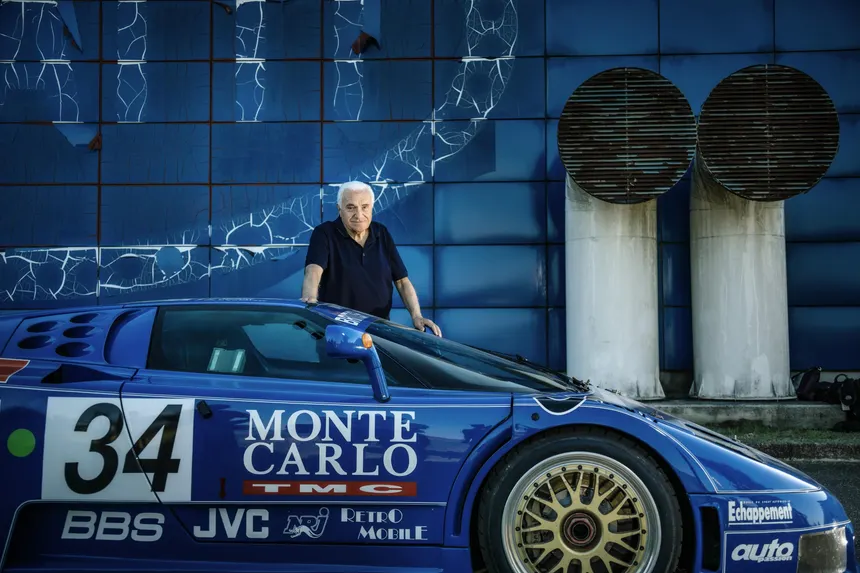
Romano Artioli, the industrialist who decided what Campogalliano would look like when he was sixteen
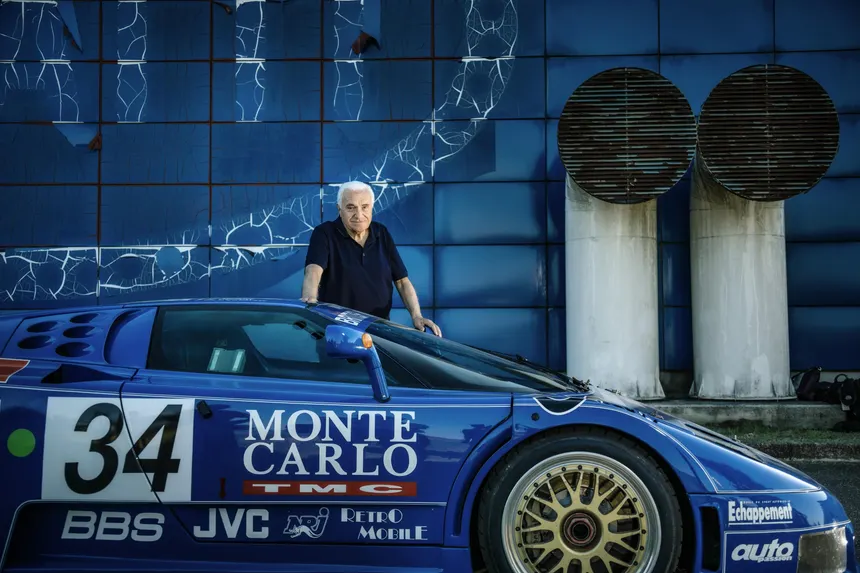
The easy version of Romano Artioli has been in circulation for thirty years. The Italian dreamer who came a cropper with Bugatti in the nineties. It comes neatly packaged, with its romantic adjectives, its scattered figures on the EB110, and a melancholy closing note that serves as a footnote to how Volkswagen came to spawn the Veyron on the wreckage. It’s an easy read. It’s short to write. And it requires calling no one.
It falls short.
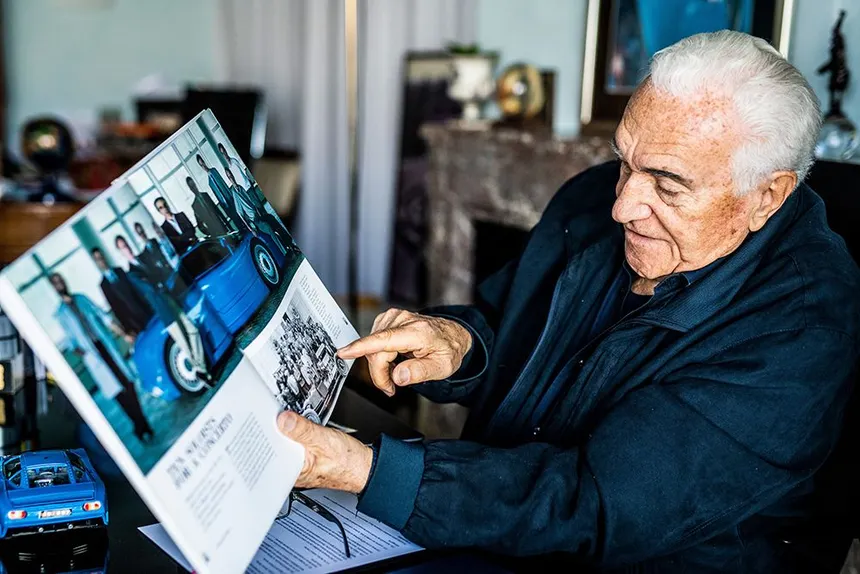
The other version of Romano Artioli is available if you bother to ask him. At ninety-three, with one office in Trieste and another in Lyon and a full working day every day at CRMT, his sustainable propulsion company, Romano agreed to sit down with an earlier version of an article, work through it page by page, cross out what was wrongly told and add scenes that appear nowhere else at this level of detail. Forty-five handwritten pages. In parallel, his granddaughter Elisa Artioli, the Elisa who gives her name to the best-selling Lotus in history, has answered her own questionnaire with the composure of someone who has had the time to think it over. With that material, and with what one learns to read in this trade, I write what follows.
This article doesn’t aim to close Romano Artioli’s story. It aims to open it the way he wanted it opened. I bring the order, the reading and the voice. They bring the facts, the scenes and the names. The sum of that is what you’re reading.
The decision that was made at sixteen
Of everything Romano has sent me, what makes me think the most isn’t in the Bugatti years. It’s in his school days.
Romano fell in love with the mechanics of the automobile at eleven. In his own words: “I was fortunate to become passionate about automotive engineering right after finishing the Salgari books, which for us kids were wonderful adventures of pirates and characters to imitate.” A boy from Bolzano, son of a family that had moved from Moglia, province of Mantua, in the middle of the Second World War, swaps Salgari’s pirates for the gears of the internal combustion engine. At twelve he already knew what his life would be devoted to.
He studied at the Istituto Tecnico Galileo Galilei in Bolzano. Eight hours a day, four on Saturdays. And there, a Mathematics and Physics teacher would repeat a sentence to the students that Romano wanted to pass along personally, and that is probably the cornerstone of everything he did afterwards.
“Whatever idea you intend to launch, you must first work to earn the money to make it happen.”
Romano took it to the letter. Before founding any company, he set up an informal workshop in the family garage to fix his friends’ cars. With the money he made, he raced motorbikes and modified them. At sixteen, president of the Circolo degli Studenti di Bolzano that he had founded himself with his classmates, he ran the afternoon tea dances. Five to eight, so that the girls of the city, then under the strict watch of their mothers, could leave home accompanied by them. The success was such that two tickets had to be sold, one for the mother and one for the daughter. They added Sunday afternoon teas, New Year and Carnival parties, ski trips. He ran the lot.
The Circolo’s coffers were healthy enough that at the end of every school year Romano chartered a coach to take his entire class to visit car factories all over Europe.
Here comes the detail. And it’s probably the most important thing in everything Romano has sent me.
In his words: “These visits were shocking realities for Romano: noisy factories, with an unbreathable atmosphere and most of them without windows because of the installations and machinery invading the premises. This fact convinced him that, if he ever managed to build cars, the factory would have to be built for the staff, therefore completely open.”
Forty-two years later he built Campogalliano.
Carrara marble floors. Naturally lit atriums. Circular showroom. Management building separate from the production one. Test track inside the compound. And within those walls, a working atmosphere Romano describes in his own words: “We had to beg everyone to go home in the evenings. They were always in the factory, Saturdays and Sundays, and they went back to studying to make their car dreams come true. We ate all together in our internal restaurant, with the young ones trying to sit close to the chiefs to bombard them with technical questions.” The mainstream version has always sold Campogalliano as Italian megalomania. I see it differently. It’s what a man does when at fifty-eight he delivers what he decided at sixteen. And that biographical coherence, in this trade, is so rare that it’s probably the single most important thing you can write about Romano Artioli. When someone takes four decades to see through an adolescent decision, the word megalomania comes up short.
The right word is character.
In those same Circolo years, at sixteen, Romano was also organising the protest marches of Bolzano’s youth against Marshal Tito, who at that time was trying to annex Trieste. The garage boy was already the public man he would later become. All of him was in place before he turned eighteen.
The school they don’t teach in business schools
Between the fifties and the eighties, Romano devoted himself to selling other people’s cars while building up the capital and the network that would later let him build his own. He started as an Opel dealer for General Motors in Italy. He was the youngest in the country. And instead of shutting himself inside his own showroom, he founded and chaired the Italian Association of General Motors Dealers, with the aim of collaborating with the Americans, who had a different culture, and getting from that what was needed for the Italian market.
It occurred to him to take the two-seat Opel GT and modify it to take on the Porsche 911.
And he won. OPEL beats PORSCHE on every car magazine cover.
GM thanked him by promoting him to first place in the dealer ranking, both in sales and in customer satisfaction, and from then on put into production the sport version of every model. In parallel, elected president of the Automobile Club di Bolzano, he changed the city’s zoning plan, put underground parking beneath every square, and, with the collaboration of the Fourth Army Corps, transformed the bed of the broad Talvera river into a green park with walkways and sports grounds that crosses the entire city from north to south. He also built a network of gas pipelines carved into the rock to reduce the diesel smoke in the villages of the Dolomites.
A man in his early thirties was already sorting out at the same time his own company, the association of his peers and the entire city he lived in.
Then he founded Autexpò, his import-export company, and from 1982 he became the first importer of Japanese cars in Italy, with Suzuki. But the big turn came with Ferrari. And here Romano has told me personally how he obtained the direct dealership, in a scene that is probably the best possible description of the man who would later carry himself to Bugatti.
At first Ferrari only granted him technical assistance to train personnel. Enzo Ferrari was selling his V12s in Italy through two historic centres, Milano Crepaldi and Roma Malagò, who did not like selling their few cars to other dealers. Everything changed when Ferrari decided to also make the eight-cylinder models. Romano went to Maranello to see what was happening and found about twenty cars sitting in stock.
He asked to speak with the Commendatore. He explained to Dr. Manicardi, Commercial Director, that he wanted to become a direct dealer. And that he was ready to purchase every car in stock to properly launch the new Autexpò office.
Ferrari accepted. Manicardi did the numbers.
Romano filled out the cheque for the full amount and handed it to Enzo Ferrari in person.
And Enzo Ferrari, one of the most famous industrialists on the planet, one of the most documented egos in the history of the European motor industry, exclaimed with emotion: “This is the largest amount I have ever received in a single payment for my cars.”
Read it twice.
And the scene went up another rung. Romano asked Enzo Ferrari for something specific. That Niki Lauda, when passing through on his way home to Innsbruck, stop in Bolzano to take part in the presentation of the Ferraris to Autexpò’s clients. Ferrari agreed. And so, about twenty selected clients of Romano had the thrill of trying out the speed sitting next to Niki Lauda. Every one of them ordered a Ferrari on the spot.
Ten days later Romano was back in Maranello asking for more cars. Enzo Ferrari invited him into his office and offered him the representation of the brand across the whole of the Three Venices. He accepted gratefully.
A man who in a single scene gets that sentence out of Enzo Ferrari, who sets up a Bolzano weekend for Niki Lauda, and who in ten days expands his territory to three entire regions of northern Italy, is not an enthusiast with money. He is a salesman from another galaxy. And this is the school he will be bringing to the table when he negotiates the purchase of Bugatti with the French government.
How a gentleman takes his leave
The Ferrari relationship ended as it always ends in this trade when the ownership changes. In 1988, on the very day Enzo Ferrari turned ninety, FIAT officials showed up at the door of his office to remind him that his active role at Ferrari was over by contract. FIAT was taking the wheel.
A letter reached Autexpò announcing the new strategy. Direct management by Ferrari of the world markets, starting with the German one, which Romano had grown tenfold in his territory. The Bolzano dealership was over.
Romano made no drama of it. He replied simply asking for the return of the deposits on the cars he had ordered. And announced that he would close the relationship by August 15th.
FIAT wanted to take the legal route, which was standard practice for them. Autexpò then sent the certified letter from Stuttgart, its German office, to Ferrari’s registered address in Modena.
The letter came back with a single phrase written on the label: “Company unknown in the area.”
Behind that dry phrase lie seven years of delay before Romano recovered the deposits he had put down. Seven years queuing in the courts.
But before the litigation began, Romano organised one last public event with his clients. On August 14th, 1988, at the Nürburgring circuit, he arranged all the Ferraris in formation to spell out with their bodywork the words “Viva Enzo Ferrari”.
He announced to the clients that from that moment on, the FIAT group would be handling their passion for Ferrari.
In Romano’s words: “They started to cry. But how, why, when it’s so nice with you. At that precise instant came the fateful news of Enzo Ferrari’s death, and again everyone cried.”
There is no film script that writes it better. And there is no official Ferrari biography that has captured it this way.
Bugatti, 1987
With the fortune built up over decades of Opel, Suzuki and Ferrari, Romano closed in 1987 the purchase of the rights to the Bugatti brand from the second French government, after more than two years of absolutely secret negotiation. When the world found out, he was already the owner. Neither the Italian press nor the French nor the international had smelled anything.
A man who negotiates like that, with that discipline, with that network and with that ability to move money without leaks, sits down well prepared to negotiate first with the socialist government and then with the liberal one in France. That was already known from the Ferrari scene.
What came next is the most disputed part of the story. And it’s the part Romano wanted to personally rewrite in this material.
The truth about the EB110 according to the man who paid for it
The official story has always given the technical protagonism of the EB110 to Paolo Stanzani, an engineer known for his time at Lamborghini. He is credited with having pushed the project, having designed it, having been the key piece in the Bugatti resurrection. On that basis a technical reputation was built for him.
Romano has rewritten the entire chapter for me. And because it touches on the memory of deceased people, and because it is delicate, I publish it in his own words. Without translating into my voice what he has decided to say with his.
“Given the excellent results obtained with Ferrari, Romano managed to develop half of the German territory as well, and realised that he would have to satisfy that clientele of great enthusiasts by carrying out for them the upgrades needed to allow the Grand Turismo clients to compete in the Club races that Ferrari didn’t have time to address. For that reason he acquired the Tecnostile company of Modena, which was specialised in the design of sports cars on behalf of third parties, owned by three partners, whose leading designer was the head technician Oliviero Pedrazzi, a genius of mechanics who had worked with the top specialists in the sector and was ready to produce exciting Grand Turismo versions.”
“Artioli changed the programme and explained to Oliviero that he had to imagine that Ettore Bugatti was still alive and would indicate to them what to do to position the Bugatti brand exactly at the top of the sports luxury cars category, without copying anything from the competitors. Everything had to be executed with maximum quality, with the best materials and with the most rigorous precision, guaranteeing maximum driving safety and maximum performance with the lowest possible weight. The most refined interior finishes. Given the performance, it had to be equipped with all-wheel drive without cluttering the driving cabin with the transmission. Finally the genius Oliviero could make a masterpiece without compromises, all the best there is to do under the bodywork of the best sports car. If he hadn’t been there, Bugatti would never have been reborn.”
“He accepted, unfortunately, the advice of the engineer Baraldini, whom he had hired to direct Autexpò, who described the engineer Paolo Stanzani as a qualified engineer who had spent several years at Lamborghini. He told Stanzani that the acquisition of the Bugatti brand was underway, that it was a matter of bringing it back to life, and Stanzani replied that he would accept if he could work without interference, and that he would make him the most beautiful GT car. It was a totally wrong piece of advice, because he realised that Stanzani knew nothing about designing cars. In fact all the Lamborghinis had been designed by the good engineer Dallara, and not by him at all. He had entered Lamborghini as a trainee and was only a management engineer who had convinced himself he could design. To complete the fraudulent operation he had chosen someone who knew less than himself, the engineer Trucco of Turin.”
I leave it as it is.
The man who paid for the entire project out of his own pocket has decided to put on record who the true mechanical genius of the EB110 was and what Stanzani was really doing in the story. The name Oliviero Pedrazzi, head technician of Tecnostile of Modena, appears in practically none of the bibliography on modern Bugatti.
After this article, for whoever needs it, it does.
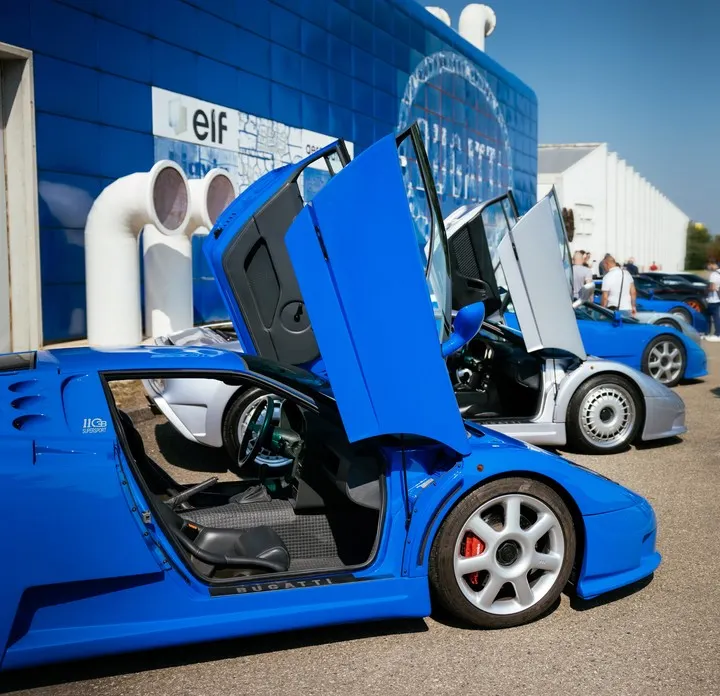
Mulhouse, the scene that closed the Stanzani chapter
And there is an episode Romano wanted to tell here, which gives the cinematic closing to this whole section, and which no European automotive chronicle has ever captured.
Paris Motor Show. Romano is with Ferruccio Lamborghini, with Stanzani and with Borel. He tells them he’s about to fly back to Italy in his own plane, and if they fancy a ride, he’ll take them to visit the Musée National de l’Automobile in Mulhouse, near Basel, because he has to meet with the Director there.
All three accept enthusiastically.
When the small group leans out from the top of the museum entrance and sees for the first time the enormous collection of blue Bugattis lined up down below, dozens of them, every variant of the Molsheim genius laid out in formation, Ferruccio Lamborghini is literally struck dumb.
He turns to Stanzani, in tight Bolognese dialect, and says:
“Socmel, mi avevi detto che aveva fatto un paio di auto e poi era morto, ma guarda qui che straordinaria meraviglia è la Bugatti.”
Loose translation: bloody hell, you told me he’d made a couple of cars and then died, but look here what an extraordinary wonder Bugatti is.
Stanzani turned red.
Romano saw it.
And from that moment on, in his own words, Ferruccio Lamborghini, once back home, took counsel with his advisor and his wife and decided to cancel Stanzani’s plans. And organised, on his own initiative, several trips to the Musée National de Mulhouse inviting his friends to see that wonder of Bugatti he had just discovered.
Picture the scene. The rival king par excellence of Enzo Ferrari, the man who founded Lamborghini against Ferrari in person, turned at sixty-something into a tour guide for his friends to take them to see the Bugattis of Molsheim.
These things happened. Nobody told them.
Here they are.
Renata, the silent engine of the entire project
About his wife, Renata Kettmeir, Romano wanted to leave a clear record.
In his words: “She has always worked more than him and is better than him.”
It’s a public statement that few husbands would make with such clarity. And it’s not protocol courtesy. It’s industrial fact.
In 1989, Romano inaugurated the Cultural Centre and Historical Archive of Ettore Bugatti in Ora, near Autexpò. Renata took over the entire management, with a team of specialists and lawyers. The objective was protective. When the word of the Bugatti resurrection began to circulate around Europe, brand pirates rushed to register the EB logo in every possible luxury goods category, so as to later block the legitimate exploitation of the brand. Perfumery, watchmaking, fashion, stationery, hotels.
Renata Kettmeir set up and directed the whole counter-offensive. She had produced, in each category, the official Bugatti special items to consolidate legitimate use of the logo. She coordinated the lawyers who went case by case recovering every pirate registration. And she made sure that in the nineties the EB logo did not end up hijacked by fraudulent licences.
Without that silent work, without that team led by Renata from Ora, when Volkswagen bought the Bugatti rights in 1998 it would not have had a clean brand on which to build the Veyron.
That Romano insists on putting on record, thirty-six years later, that his wife worked more than him and was better than him, says something no biography had captured properly. In this project there were two heads working full time. His, public. Hers, invisible to the press but highly valued and followed by every luxury brand, which drew inspiration from the work of the Ettore Bugatti Centre for the development of their own brands in every direction. And it was she who organised the world presentation in Paris. And here, with his permission, we leave her where she belongs.
La Défense, September 15th, 1991
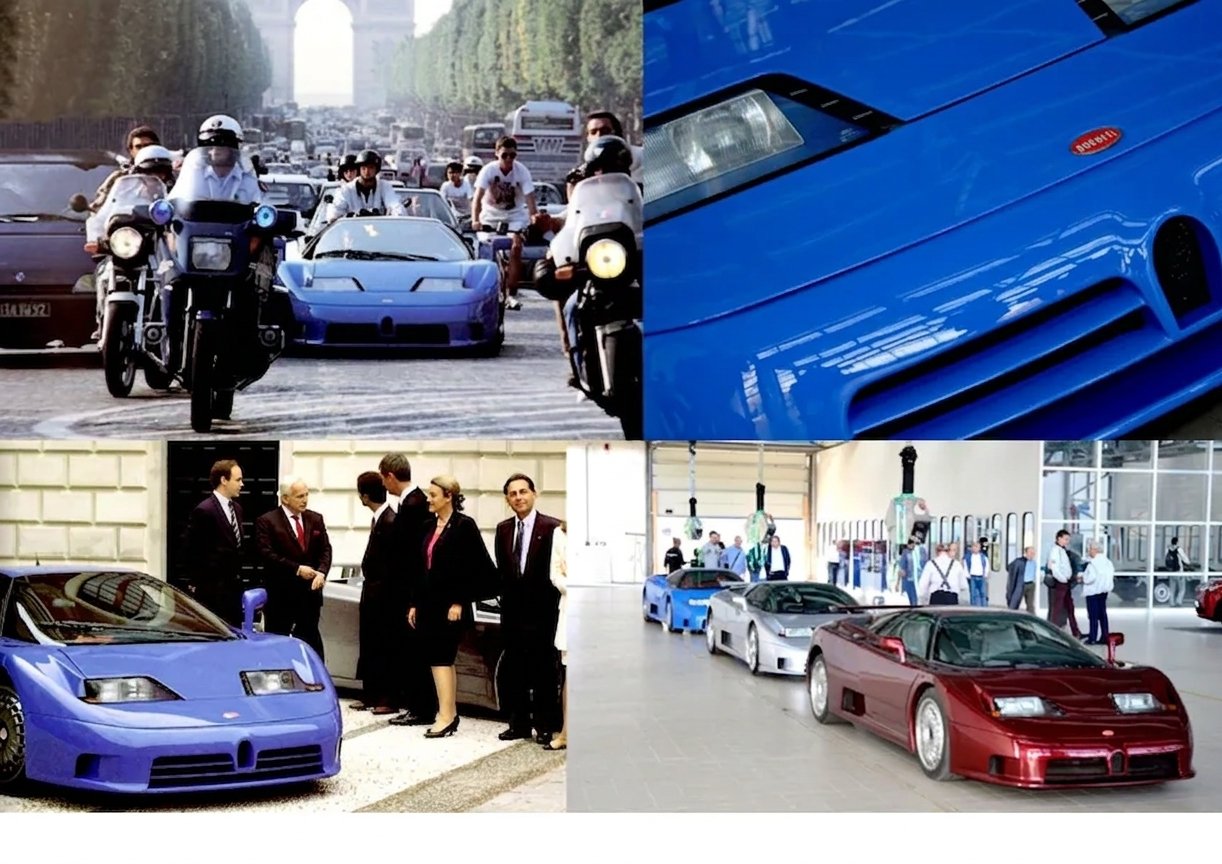
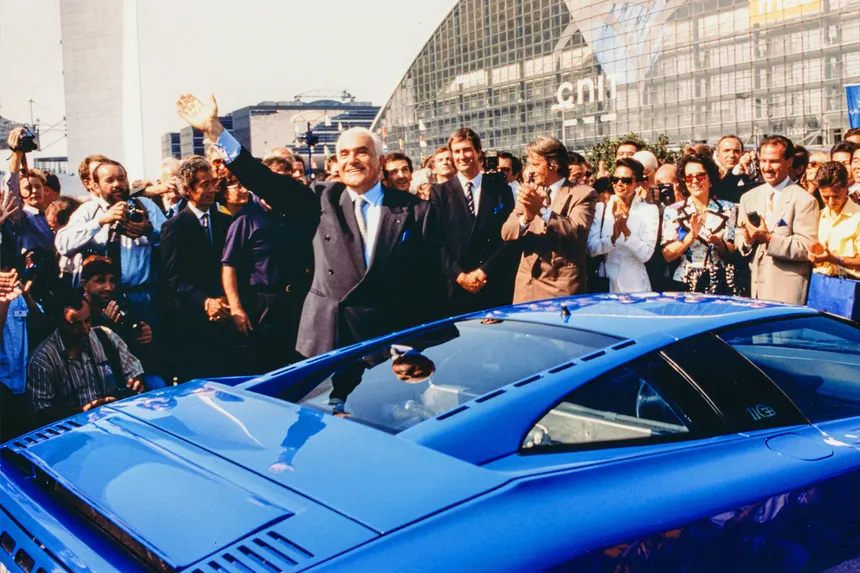
On the 110th anniversary of Ettore Bugatti’s birth, Romano presented the EB110 at La Défense in Paris. Alain Delon unveiled the car alongside Renata, and with the test driver Vittecoq at the wheel it paraded down the Champs-Élysées. Five thousand journalists covering the event. Gala dinner at the Château de Versailles. All the directors of the European motor brands, with their wives, personally invited by Romano.
It was to be the day the whole world welcomed Bugatti back.
And something happened that Romano hasn’t told in this detail anywhere else, and that probably explains much of what came next.
On the eve of the event, letters of withdrawal reached the organisation from all the invited executives, awkward in tone, warning they would not be able to attend due to “unforeseen commitments”. All of them. At once. After having confirmed with enthusiasm.
Someone had circulated something among the owners of the major European automotive groups.
And at noon, shortly before the presentation, the president of ELF, the French oil company sponsoring the event, came running from the ELF building. He was angry. Very angry.
A journalist had gone to him to say that ELF had to distance itself from Bugatti because the Artiolis were financed by the Mafia.
The president of ELF, whose company had done thorough verifications before signing the sponsorship and had cross-checked them with those of the French government, which had investigated the Artioli family back to the year 1600 without finding a single stain, knew perfectly well it was false. He threatened to call the police if the journalist didn’t tell him who had put the slander in motion.
He was given a name.
Romano calls him “the Hidalgo”.
He never identifies him beyond that. Throughout the material he has sent me, that figure always appears with the same nickname, no real name. I have no evidence about who he was, and I will not invent it. But the events that followed confirm the effects Romano describes. With the shadow of a Mafia accusation hanging over the brand, Romano could not choose the strong industrial partner he needed to bulletproof Bugatti.
The Sultan of Brunei, a client in love with the project, was ready to enter with 49% of the capital of Bugatti International. He was content with that share. He did not want control.
He couldn’t enter, because 35% of the capital remained locked by a dispute with Stanzani. And the people who inside the company itself were working in the shadows for the Hidalgo, according to Romano, made a point of advising the Sultan against it on the grounds that it was unknown how the Italian justice system would rule on the case.
The Sultan withdrew.
Bugatti was left with no financial cushion.
And when 1993 arrived, with the Japanese yen surging and the lira heavily devalued to protect the big group, with Lotus just bought from General Motors which was to complete the industrial group of sports luxury cars to be launched as soon as possible, with the British bank wanting to pull off the heist of the century, and the EB112 in braked development with an expanded team, the operation entered terminal tension.
In September 1995 the bankruptcy was declared. That Saturday morning was supposed to be a mere formality, but it had been prepared with the ferocity of those who bear a deep envy of success. The so-successful rebirth of Bugatti could not be defeated with the modest technical arguments of the big group. It had to be destroyed from within and from without. In Romano’s words, they had threatened all the suppliers who with Bugatti could finally offer only top quality, while the big group only asked for the lowest possible price. They had built up nonexistent debts that caught Bugatti’s lawyer by surprise at the hearing. He had a heart attack and died three days later in hospital. The hearing was not suspended because the big group’s lawyers had to obtain the bankruptcy, and by 11 in the morning there was already a Curator appointed sealing the factory. He tore it apart at once, despite BMW first and Porsche afterwards being ready to buy it by paying off all the debts and taking on the entire workforce. The Curator answered that he wanted to do things properly, and immediately liquidated at fire-sale prices the Mandelli machining centres with the special tooling that worked engines to the thousandth of a millimetre, and the 400 km/h Schenk test benches, built to measure for Bugatti.
According to Romano, it was celebrated precisely by those people inside the company itself who had been working for years to bring it down. In his words: “They were discovered when they celebrated with the Hidalgo the organised bankruptcy of Bugatti Automobili. They were aware of every smallest detail because they lived at the guest house together with Artioli and every problem was discussed among them.”
Listening to a man who at ninety-three sits down to order in forty-five pages what he lived through, I don’t feel like putting his word in quarantine. Something happened. That the Italian and international press has not gone deeper into that trail in thirty years says more about the press than about Romano.
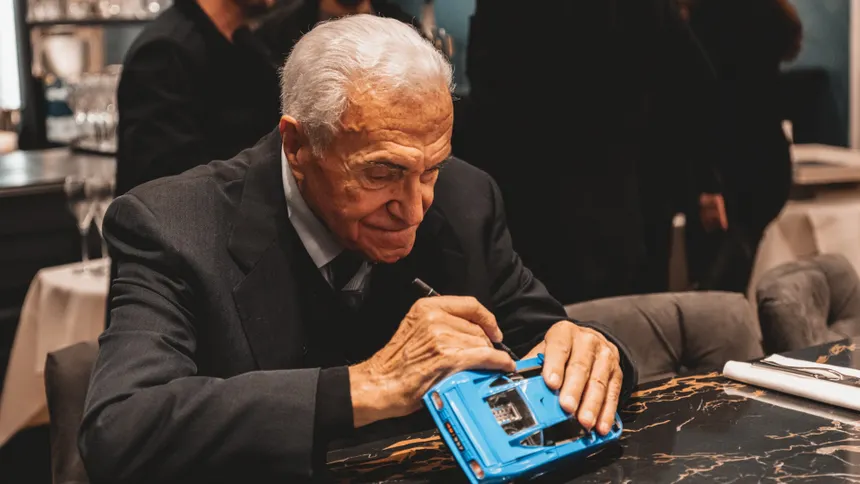
Lotus, zero layoffs and profit in the first year
The purchase of Lotus from General Motors in 1993 has been told for decades as the desperate operation of an obscure Italian. The data, when put on the table, tells a different story.
General Motors had been trying to sell Lotus for a while and could not. Everyone wanted the engineering, nobody the production. Production was losing money. Romano called a contact at GM who had risen to become responsible for the European market, and told him he wanted to buy the complete package, production included. He was invited to sign in Zurich because they knew him and trusted him after years of excellent Opel work and now also as the importer of Lotus in Italy.
The Financial Times ran a cartoon of him as a Sicilian mafioso, in flat cap with a shotgun over his shoulder, announcing that Lotus had a new owner.
The same slander as at La Défense. The same actors in the shadows.
Lotus had 1,450 employees. Many of them elderly. All of them feared mass layoffs, because that’s how you buy industrial companies in trouble in late capitalism.
Romano fired none of them. Except the two executives who were trying to take the company through a Management Buy Out.
In his words: “Everyone started working for free for the first 15 days to clean everything up nicely to welcome the Lotus clientele and the historical Bugatti Group. Already the first year Lotus closed the balance sheet in profit, while with GM it had lost 30 million pounds a year over the last three years. We were also lucky with the Esprit, which was 27 years old and we decided to revitalise it with a fine eight-cylinder engine: it was chosen for the film Pretty Woman with Julia Roberts and Richard Gere and immediately sold like hotcakes in the USA. There were, however, some executives at Midland Bank who thought they could pull off the heist of the century, and they didn’t, because I had prepared myself to receive them.”
Let me say it again, in case it hasn’t sunk in.
Lotus, with Romano at the helm, in a year when Bugatti itself was starting to shake, with the British press painting him as a mafioso, closed the first financial year in profit. Without firing a single one of the 1,450 employees. With the workers themselves putting in fifteen days for free cleaning the factory to prepare for the clients’ visit.
When a man says to Enzo Ferrari, in person, the sentence Romano said with cheque in hand, and then resuscitates Lotus like that, and on top of it is painted as a Sicilian mafioso in the Financial Times, it isn’t that life is unfair. It’s that there are people actively working to make it look that way. That is the nuance thirty years of media coverage have preferred not to look at.
And under Romano’s direction at Lotus, the Elise was born.
The car that saved the British brand from extinction. The best-selling in its history. And named the way it is for a reason Romano wanted to tell in the first person, and which is probably the most moving passage in all the material he has sent me.
Why the Elise is called Elise
I hand it over to him.
“I did not have the money to hire Naomi Campbell, who would have attracted all the journalists getting in and out of the car. That is why I chose Elise, who was the dearest thing I had, and she played along without any fuss, staying hidden for a long time under the cloth covering the car that was rotating on its display, and then she understood it was important to step up immediately to help make the most of it. We got all the covers of the world car magazines for free.”
“It is also the result of the tradition of naming models starting with E, wanted by Colin Chapman in honour of his wife. The engineers would have preferred the code M111, in English M one eleven, which however reads differently in every part of the world. After letting them vent, I imposed the name Elisa, which was available for free and which brought a lot of luck to Lotus and to the dealers who were selling them at 30 to 40 per cent above list price.”
Stop here for a moment.
The best-selling car in the history of a British brand is called what it is called because its Italian owner, unable to afford the world’s top-tier model for the launch, resorted to a family expedient. He used his two-and-a-half-year-old granddaughter, hidden for hours under the cloth covering the rotating prototype at the stand, to draw the journalists’ attention.
When someone solves an international marketing problem by resorting to their granddaughter under a sheet, it isn’t about being thrifty.
It’s about being of another industrial species.
And it worked. Every cover of every car magazine in the world. For free.
And it worked so well that thirty years later, when Colin Chapman is long gone, when Lotus has changed hands several times, when the Elise has been discontinued and reborn and will surely be reborn again with electric propulsion, that little girl has grown up and has answered a questionnaire that closes a loop not even the best scriptwriter could have imagined.
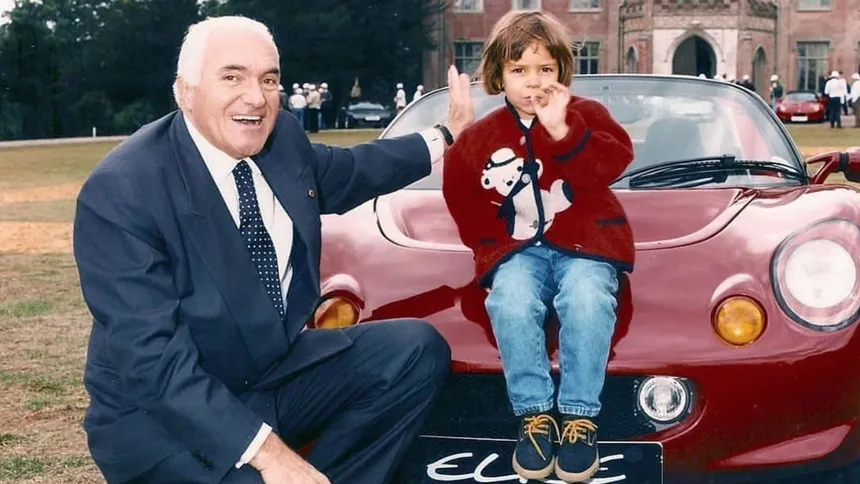
Elisa, thirty years later
That little girl is Elisa Artioli. She learned to drive with the very car that carried her name. And she has built her professional life around driving.
I asked her what all this means to her today, and she came back with lines I leave whole. Any summary would betray them.
“I practically grew up inside that car. When the Lotus Elise was presented, in 1995, I was just two and a half, so obviously I couldn’t realise what it meant to have my name on a car destined to become that important. I understood the meaning much later. And the peculiar thing is that the Elise did not just carry my name: it ended up concretely changing my life.”
“With that car I practically learned how to drive, and I fell in love with a way of driving that today I feel is increasingly rare: analogue driving, pure, without filters. The Elise made me fall in love with driving for what it is, not simply with the car as an object. At some point I understood that this passion could become part of my life. I created Delightful Driving to share with other people what I feel behind the wheel: driving on the most beautiful roads in Europe, with cars that can truly express all their character there, and creating moments that go beyond simple driving.”
“For this reason today I do not experience the fact that the Elise carries my name only as a source of pride. It is almost a coincidence turned into destiny.”
A coincidence turned into destiny.
I know of no more precise phrase to describe what has happened with that little girl under the sheet and with the adult woman who has now founded her own company built around pure analogue driving on European roads.
About her grandfather, Elisa adds a description I also leave whole. Because there are things only granddaughters say.
“As a grandfather he is an extremely bright, strong and curious person. At 93 I am still amazed by his energy, both mental and physical. And above all I am struck by how much he is still projected toward the future. One of the phrases he tells me most often is: ‘I have so much to do, because I have started so many projects. Now you’ll see that, as soon as they take off, you have to be ready because there will be a lot of work.’ At 93 he could easily look back and say ‘I have done enough’. Instead he keeps thinking about what he still has to do. And there you really understand that he is made of a different substance from most other people.”
Made of a different substance.
That is the definition given by the granddaughter. And after reading the forty-five pages Romano sat down to annotate and the scenes he wanted to hand me one by one, contradicting her by a single syllable is not something I would do.
On family memory
Elisa also added her own reflection on how her grandfather’s story is told, and it deserves to be collected. Because it is probably the best possible summary of why this article exists.
“I believe there is an important difference between the version of the story that has become mainstream and the one known by the people who actually lived that story. The mainstream version is often the easiest to tell. It’s the one that creates the most suspense, that works best in an article, and that, precisely because it is repeated many times, ends up becoming the one you find most easily also by searching for information on the internet. But the fact that a story has been told many times does not necessarily mean that it is the most complete or most correct version. What hurts me the most is precisely when a complex story is reduced to a very simple explanation, because often, in doing so, what people call the ‘uncomfortable truths’ get eliminated.”
Uncomfortable truths.
That is the word she chose to use, between her own quotation marks, and so I leave it. Because when a granddaughter in her twenties, daughter of a politician and granddaughter of an industrialist, with professional experience at Bugatti design in Wolfsburg, writes “uncomfortable truths” about her grandfather’s story, she is not using a cliché. She is saying she knows things she has not been asked about.
And here, as far as she wanted, she has been asked.
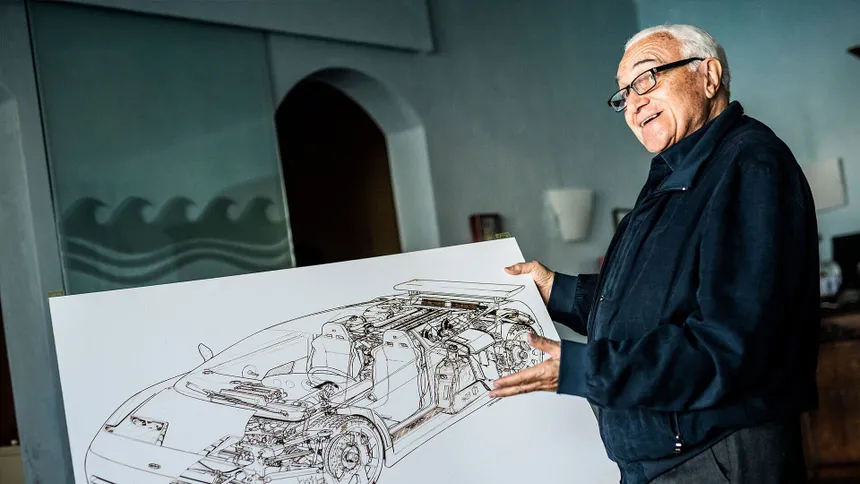
Bugatti today, two truths that coexist
Elisa, who studied Architecture in Vienna and graduated with 110 cum laude in German, did a six-month internship at Bugatti design in Wolfsburg and has told me those were some of the most beautiful months of her life. She personally knows the people working at the brand today and has asked me to make clear that she considers them extraordinary people, who put in enormous effort to keep the logo at its level of prestige.
I have no reason to argue with that. She knows them, I don’t. The engineers, designers and technicians of the W16 and of the new V16 of the Tourbillon give everything to their work. Acknowledging it is a matter of justice before saying what I will say next.
Because today’s Bugatti, as an industrial philosophy, is not Romano’s Bugatti.
It is technology taken to absurd lengths for posturing. Cars designed to justify prices of four million euros and to be photographed in the garage of the ultra-millionaire who buys them. With no real practical use beyond pure display. Without the raison d’être the Romano project had, which was to prove that an Italian with a trade could build the best sports car in the world with his own money on the table and his own name behind it.
That was industrial passion executed with judgement.
Today’s is an image operation by the automotive group that owns the brand. Accounting-wise in the red for years, according to the numbers Bernstein Research published in 2013 about the Veyron era. Strategically profitable in brand terms for the conglomerate that exploits it.
They are two different things using the same logo. And saying so is not betraying Elisa, nor the work of today’s people. It is separating product from people, which is what anyone who takes this seriously with their own judgement has to do.
Elisa put it better than I can in her response. I quote her to close the matter:
“I would simply like that, in telling the future of the brand, one would never forget where it comes from.”
Signed.
Lyon, every day
At ninety-three, Romano chairs CRMT in Lyon, a French research and development company specialised in sustainable propulsion. Natural gas engines, hybrid systems, and now also on-board generated hydrogen to lower consumption and reduce emissions.
He works every day and lives between France and Trieste with Renata.
I asked him how he sees the future of the automobile from that observatory of his, with the perspective of someone who has lived through this trade in all its faces. His answer deserves to be read whole. Because it is probably the most lucid diagnosis of European urban mobility I have read in years, and it comes from a man who was already close to fifty when I was born.
“We find ourselves facing the problem of billions of ever bigger automobiles in our narrow historic streets choking every city, and we study how to squeeze in many more by incentivising even the Chinese ones of every size, which are electric but we do nothing to clear the streets of parked cars.”
“There is some mayor who thinks of solving the circulation problems of the cities with trams, which were useful only compared to horse carts, but today they are certain disaster for those who move on two wheels. Today circulation in the cities has to be solved with aerial routes.”
“We will be able to circulate with clean engines running on cryogenic liquid methane: nice to leave the cities and take trips to the old villages. I work to make the emissions of piston engines clean. It is an undertaking that involves nature as well, which is the best filter one can imagine and is the most generous.”
A ninety-three-year-old man who in his answer about the future of the motor talks about urban aerial routes, about the green park he himself built on the Talvera riverbed in Bolzano decades ago, about cryogenic natural gas, and about hydrogen generated on board the vehicle. And he writes all this from Lyon or Trieste, where he works every day.
He is not a retiree killing time.
He is an industrialist at work.
And he is probably one of the few left in Europe who can afford to talk about how humanity will move in the coming decades without sounding like a corporate slide.
The sentence
I asked him what sentence he would like to see appear in a history book of the automobile fifty years from now about him.
Answer:
“I am in no hurry to know what they will think of me when I am dead.”
What this material leaves
When someone sits down to explain to you how things were, with first and last names, with scenes that appear nowhere else, and on top of that does it at ninety-three years old and with the energy Elisa describes better than anyone, the minimum obligation is to order it with respect and put it in writing without ornament.
Romano Artioli and Elisa Artioli have given me material that will probably not be repeated. I have cooked it my way, with the voice that belongs to NEC and with the editorial decisions a managing editor takes when facing material of this weight. They put in the facts and the scenes. I put in the order and the reading.
Any error or imprecision left in the text is the sole responsibility of the author. Everything else belongs to the voice of those who were there and still are, and who at ninety-three continue to work to build what is to come.
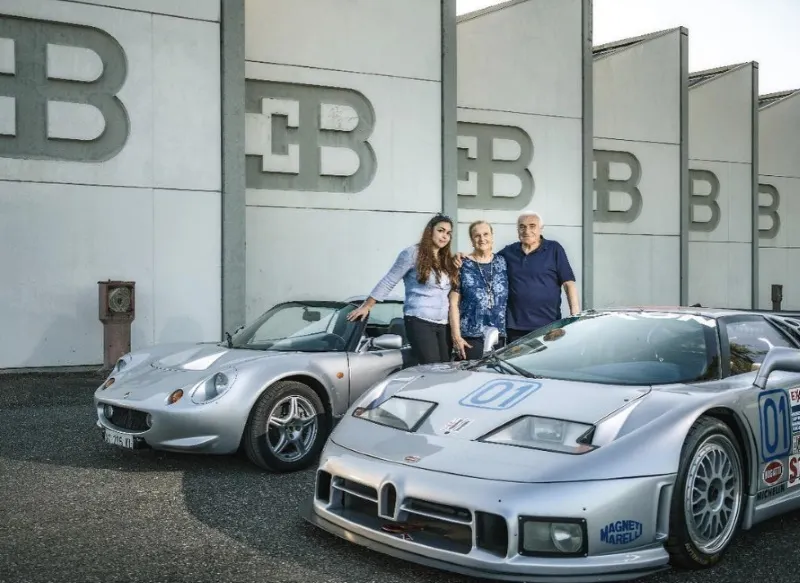
Thank you, Romano. Thank you, Renata. Thank you, Elisa.
Check that you’re still alive.