Talladega Superspeedway: The Cursed Track Where Cars Hit 210 MPH and Drivers Pray Before Going Out

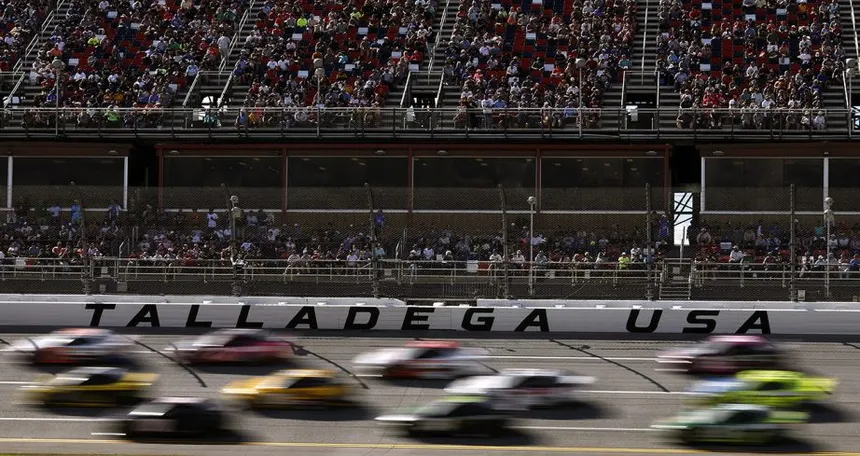
If Daytona is NASCAR‘s cathedral, Talladega is its colosseum. The place where gladiators enter knowing that the odds of walking out in one piece depend as much on luck as skill. Where four cars race side by side at over 190 mph separated by inches. Where a single wrong move triggers what the paddock calls “The Big One” — the mass accident that can destroy half the field in an instant.
Talladega Superspeedway isn’t a circuit. It’s a statement of intent. The statement of a man who had already built the fastest track in the world and decided it wasn’t enough.
Bill France Wanted More
When Bill France Sr. opened Daytona International Speedway in 1959, he created the largest and fastest superspeedway in existence. 2.5 miles. 31 degrees of banking. Speeds that exceeded anything ever seen in stock car racing.
But France wasn’t satisfied. He wanted something bigger. Faster. More brutal. And he wanted it in the deep American Southeast, where NASCAR had its geographic heart.
In the mid-1960s, France started scouting land. He first explored the research triangle near Raleigh, North Carolina. It didn’t work out. Then he searched between Atlanta and Birmingham along Interstate 20. An insurance agent from Anniston, Alabama named Bill Ward — an amateur racer and stock car fan — suggested a site in Talladega County: a former military airfield, the old Anniston Army Air Force Base, which the government had sold to the city of Talladega after World War II.
France visited the site. Two thousand acres of flat land with the old runways still visible. Interstate access. Twenty million people living within 300 miles. Perfect.
In a restaurant in Anniston in 1966, France convinced local authorities that a race track would transform the area’s economy. He invited them to the Firecracker 400 at Daytona to see the economic impact firsthand. They were sold.
Construction: Bigger, Faster, More Dangerous
The groundbreaking ceremony took place on May 23, 1968. The project cost $4 million — a million more than Daytona a decade earlier.
The specifications were deliberately superior to Daytona in every way: the oval measured 2.66 miles, compared to Daytona’s 2.5. The banking in the turns was 33 degrees, compared to Daytona’s 31. The backstretch stretched 4,000 feet. The frontstretch, curved in a tri-oval shape, measured 4,300 feet with a slight fifth turn in front of the main grandstands. The track was wider. The straights longer. Everything designed for one thing: maximum absolute speed.
The start-finish line was offset toward Turn 1, not centered like at most circuits. France wanted main grandstand spectators to have the best possible view of race finishes.
The circuit opened as Alabama International Motor Speedway. It didn’t change its name to Talladega Superspeedway until 1989.
September 1969: The Strike, the Curse, and the First Winner
The first Cup Series race at Talladega should have been a celebration. It became a crisis.
During practice and qualifying, drivers discovered cars were reaching speeds approaching 200 mph — nearly 30 mph faster than IndyCars were managing at Indianapolis. The problem: the tires weren’t designed to handle those forces over 500 miles. They were deteriorating dangerously.
The Professional Drivers Association, led by Richard Petty, called for a boycott. The top drivers refused to race. Petty, Pearson, Yarborough, Allison — the biggest names — left the track the night before the race.
Bill France responded the only way France could: he climbed into a car, drove several high-speed laps to demonstrate it was safe, and invited non-union drivers and competitors from the lower Grand Touring division to fill the grid. The race was held on September 14, 1969, before 62,000 spectators. Richard Brickhouse won — his only Cup Series victory. Rick Hendrick, who was on the grid at France’s invitation, would parlay that experience into one of the most successful ownership careers in NASCAR history.
The strike lasted a single race. By 1970, Talladega had two dates on the calendar and every driver was competing.
But the curse stories had begun. According to local legend, the track was built on a former Native American horse racing ground, or possibly a tribal burial site. Whatever the origin, the bizarre accidents, inexplicable failures, and tragedies that have marked Talladega’s history have fed the superstition for over half a century.
The Fastest Track in the World
Speeds at Talladega have consistently been the highest ever recorded in stock car competition.
In March 1970, Buddy Baker became the first driver to exceed 200 mph on a closed course, registering 200.447 mph in a Dodge Charger Daytona. In 1975, Mark Donohue set the world closed-course speed record driving a Porsche 917-30 at 221.160 mph — a record that stood for four years.
But the record that defined the era belonged to Bill Elliott. On April 30, 1987, Elliott qualified his Ford Thunderbird at 212.809 mph. It remains the all-time NASCAR qualifying record and will remain so forever, because what happened next changed the rules permanently.
In May 1987, during the Winston 500, Bobby Allison suffered a crash at over 200 mph. His car went airborne, spun, and slammed into the catch fence, destroying a 35-yard section. Miraculously, no spectators were killed. But the image of a stock car tearing through the fence toward the grandstands was enough.
NASCAR responded by imposing restrictor plates for the fall race that same year. Since 1988, all cars at Talladega and Daytona carry restrictor plates that limit air and fuel flow to the engine, reducing power and top speed. Elliott’s record has never been surpassed in official competition.
The Big One: The Crash That Always Comes
The restrictor plates created an unexpected side effect: draft pack racing. By limiting power, cars travel in tight packs — sometimes four-wide — where the aerodynamics of the group dictate more than individual horsepower. Drivers are separated by inches at over 190 mph.
When something goes wrong in a pack of 30 cars at that speed, the result is “The Big One” — the chain-reaction crash that can destroy 15 or 20 cars in seconds. It’s a phenomenon almost exclusive to Talladega and Daytona, and at Talladega it occurs with a frequency that drivers accept as inevitable.
The first notable “Big One” came in 1973, when a crash on the backstretch eliminated 20 cars on lap 9 of the Winston 500. Since then, images of cars flipping, spinning, and disintegrating in chain reactions have become as synonymous with Talladega as the track itself.
Dale Earnhardt won 10 races at Talladega — the all-time record. His mastery there was supernatural. His final NASCAR victory came at Talladega in the fall of 2000, when he passed 17 cars in four laps using the new aerodynamic package NASCAR had specifically designed for that track.
Talladega by the Numbers
The monster’s stats: 2.66 miles (4.28 kilometers). 33-degree banking in turns. Backstretch: 4,000 feet. Capacity: approximately 175,000 spectators. Qualifying record: 212.809 mph — Bill Elliott, 1987 (permanent). First driver over 200 mph: Buddy Baker, 1970. Closed-course world record: 221.160 mph — Mark Donohue, Porsche 917-30, 1975. Cup wins record: Dale Earnhardt with 10. Most lead changes in 500-mile race: 75. Most leaders in single race: 26. Fastest 500-mile race average: 188.354 mph — Mark Martin, 1997. Built on former military airfield. Opened September 13, 1969 as Alabama International Motor Speedway. Renamed Talladega Superspeedway in 1989. Restrictor plates mandatory since 1988.
My Final Word
Talladega Superspeedway is the result of what happens when human ambition knows no limits. Bill France wanted the fastest track in the world. He built it. And then spent the next five decades trying to slow down what he’d created.
Restrictor plates exist because Talladega is too fast to be safe without them. The Big One happens because restrictor plates force cars to race in packs. Drivers hate restrictor plates but can’t compete without them. It’s a loop of unintended consequences that perfectly defines NASCAR’s history: every solution creates a new problem.
And that, paradoxically, is what makes Talladega the most exciting circuit in the world.
Because when 40 cars run four-wide at 190 mph down a 4,000-foot straightaway, separated by the distance of an outstretched arm, anything can happen. And at Talladega, everything happens. Always.
The cursed circuit. The fastest track in the world. The place where heroes are made and races are destroyed in the blink of an eye.
If you want to understand NASCAR, you need to understand Talladega. And if you think you can predict what’s going to happen there, you don’t understand it at all.