
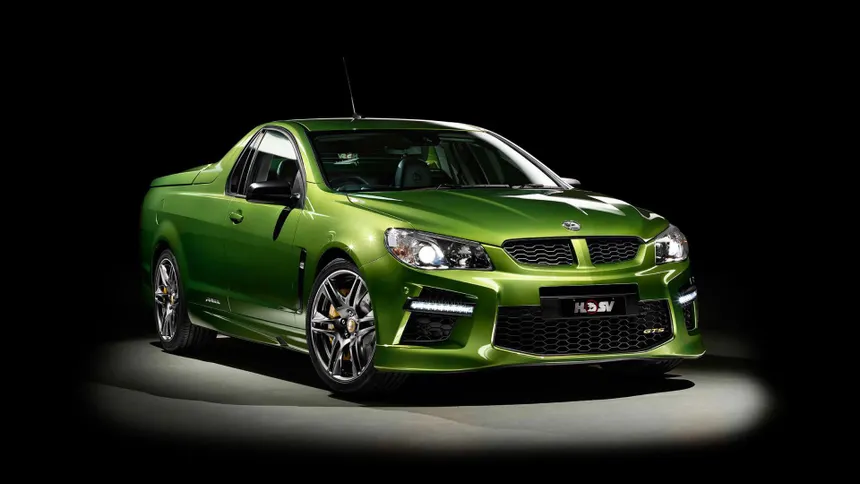
HSV Maloo, the Australian ute that took America’s pickup speed record and never gave it back
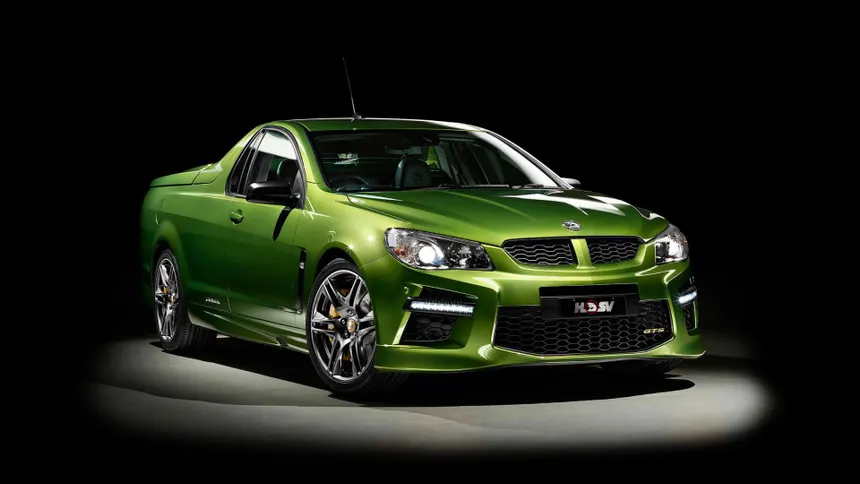
The fastest production pickup in the world was never sold in America. It wasn’t built in Dearborn, Detroit or Saltillo, and it didn’t have a Hemi, a Viper V10 or a blower bolted to a truck motor. It was an Australian car with a bed, built by a small outfit in the Melbourne suburbs, and the one that set the record belonged to a school principal. As of March 2025, nearly two decades on, nobody had gone faster.
Ford and Dodge spent 2003 and 2004 trading the title like a pair of heavyweights. Then a two-seat sedan-based “ute” from the other side of the planet walked in and took it by more than 14 mph. Americans nearly got to buy one, too. GM had a version ready for Pontiac showrooms before the bankruptcy lawyers showed up. This is the HSV Maloo, and the story starts with a letter about pigs.
Before the El Camino, there was a farmer’s wife in Victoria
If you grew up with the Chevy El Camino and the Ford Ranchero, you already understand half of this. A ute, short for utility, is a passenger car with the roof chopped behind the front seats and a cargo bed built into the same body shell. No separate frame. The body itself carries the loads, the way a unibody sedan does. That’s the opposite of an F-150, a Silverado or a Ram, which ride on a ladder frame, two long steel rails running front to back, with the cab and bed bolted on as separate pieces. One drives like a car. The other drives like a truck, because it is one.
Australia got there first, and by accident. In the early 1930s, sources disagree on 1932 or 1933, a letter landed at Ford Australia’s head office in Geelong, Victoria. The most repeated version credits a farmer’s wife from Gippsland. Her problem was simple: the family couldn’t afford both a car and a truck, but they needed a car to go to church on Sunday and a truck to haul the pigs to market on Monday. Managing director Hubert French handed the letter to the company’s only designer, Lewis Bandt, who was 22 or 23 depending on who tells it.
Bandt took the front half of Ford’s five-window coupe, flathead V8 and all, stretched the rear into a steel load bed with a tailgate, and called it a “coupe utility.” Production started in Geelong in 1934 with a payload of about 1,200 pounds. When Bandt showed early examples to Henry Ford, the old man dismissed it as a “kangaroo chaser.” Australians bought it anyway. GM followed with its own, and the ute became as Australian as cold beer and warm Christmases. America came to the idea decades later, and its best-known answer, the Chevy El Camino, was gone by 1987.
One detail almost never makes it into the retellings. Bandt died on March 18, 1987, driving a restored 1934 ute home from the Australian Broadcasting Corporation studios, where he had just recorded a documentary about his invention. He collided with a truck near Bannockburn.
Crystals, magnets and a Scotsman
The Maloo wasn’t a Holden. It was built by Holden Special Vehicles, HSV, and HSV was born out of one of the strangest scandals in performance-car history.
Through the 1980s, the hot street Holdens came from Peter Brock’s Holden Dealer Team. Brock was Australian motorsport royalty, but Holden didn’t own or control HDT, and the relationship was souring. On February 20, 1987, HDT unveiled the Director, a VL Commodore offered with a 480 Australian dollar option called the Energy Polarizer: a small box of crystals and magnets that Brock insisted made the car drive better. There was no science behind it. The Australian Skeptics handed him their Bent Spoon award. Holden cut ties that same month, though insiders later said the company was already looking for a way out.
Into the gap stepped Tom Walkinshaw, the Scottish racer who had won the 1984 European Touring Car Championship and ran TWR. Holden and TWR formed HSV as a joint venture in 1987, based in Clayton, outside Melbourne. The first product was the 1988 VL Commodore SS Group A SV, 750 homologation cars wearing a wind-tunnel-developed body kit styled by Peter Stevens, who would go on to shape the McLaren F1.
The first Maloo, and a lesson in limited-slip
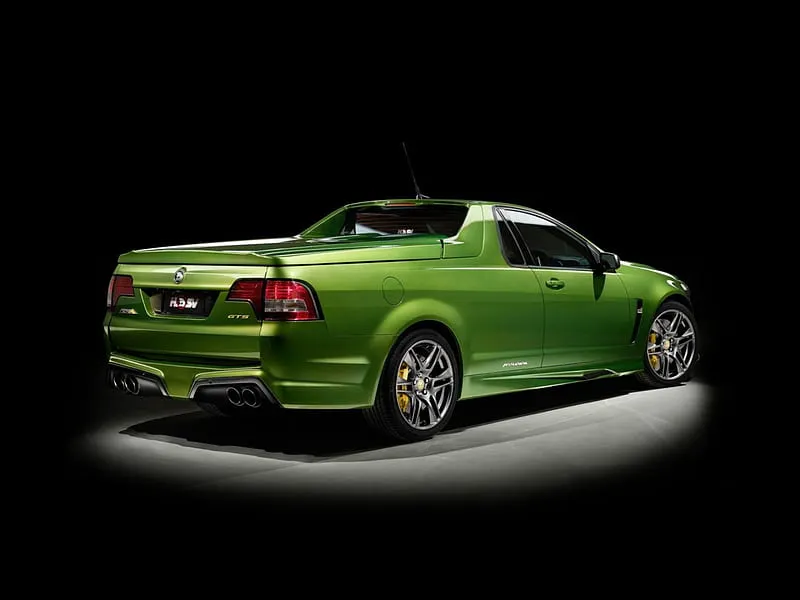
HSV launched the first Maloo in October 1990, based on the VG ute, the first Holden ute built off the Commodore. The name, according to HSV and the Australian press, comes from an Aboriginal word for storm or thunder. The sources we checked don’t say which Aboriginal language, and Australia has hundreds, so treat that part as unconfirmed.
Power came from Holden’s own 5.0-liter V8, largely stock inside but breathing through a freer dual exhaust and a better intake, with a reflashed engine computer. It made 180 kW, 241 hp, which was 15 kW more than the regular V8 ute. Torque figures don’t agree between sources, 385 Nm in one and 400 Nm in another, so call it around 290 lb-ft and leave it flagged.
The VG Maloo came with a Momo steering wheel, Pirelli tires, 16-inch alloys and a limited-slip differential. That last one matters more in a ute than almost anywhere else. An open differential splits power between the two rear wheels, but when one spins, it takes nearly all the drive with it. A limited-slip diff restricts that and keeps the wheel with grip doing work. In a vehicle with almost no weight over the rear axle, which is exactly what an empty ute is, that’s the difference between leaving a corner and just making smoke.
The rear was still a live axle, a solid tube connecting both wheels, located by five links. Payload was 592 kg, about 1,305 pounds. HSV’s own database counts 132 VG Maloos. Another source says 135. Nobody seems sure.
Through the nineties the Maloo tracked each new Commodore generation, reaching 195 kW in the 1999 VS Series III. That truck holds one historical footnote: it was the last HSV powered by the Australian-designed Holden V8. After that, the engine bay went Chevy.
An LS1 in a ute, explained for people who already love the LS1
With the VU generation, tested by the Australian press in March 2001, the Maloo got the Corvette’s 5.7-liter LS1. HSV rated it at 255 kW, 342 hp.
American readers know the LS family better than anyone, but it’s worth spelling out why it suited a ute so well. It’s a pushrod V8: one camshaft in the block, in the valley between the cylinder banks, pushing long rods up to rocker arms that open two valves per cylinder. European luxury sedans of the day bragged about four cams and 32 valves. The LS answered with displacement, an aluminum block, and heads so short that the whole engine fits almost anywhere. Big torque low in the rev range, modest weight, and durability that survives abuse as long as somebody changes the oil.
The VU was also the first Maloo with a six-speed manual, which allowed a shorter final drive: 3.77:1 with the stick versus 3.07:1 with the four-speed automatic. Final drive is the last gear reduction, inside the differential. The higher the number, the more times the engine turns for each turn of the wheel. More acceleration, less top speed. Keep that in mind. It comes back.
The other major change was independent rear suspension from the Commodore sedan. Unladen, a ute carries very little weight over the driven wheels, and a solid axle passes every bump from one side to the other. With IRS, each wheel moves on its own and stays planted. Australia’s Drive put it plainly in 2001: with that much power and so little weight at the back, a ute can turn into a tire-spinning monster that gets downright frightening in the wet.
The base Maloo cost 47,995 Australian dollars. The Maloo R8, with a hard tonneau cover, integrated spoiler and better brakes, cost 54,950. The typical buyer, according to the same coverage, was under 50, self-employed in a blue-collar trade and wanted people to notice. Here’s the irony: with the lowered, stiffened suspension, the VU’s payload dropped to 356 kg, roughly 785 pounds. Less than Lewis Bandt’s 1934 pig hauler.
What owners complained about
Every performance car has the flaw that follows it through every magazine test and forum thread. For the early LS1 Maloo, it was brakes. Reviewers criticized the stopping power of the first VU trucks, not enough for something launched with 342 hp. HSV answered with the Y Series in October 2002: 260 kW and, more importantly, a brake upgrade that became the headline of the launch reviews. The Y Series II in October 2003 went to 285 kW.
Australian buyer’s guides still list the same weak spots. Rotors and pads wear quickly, with sets running about 1,000 Australian dollars in stock parts and up to 3,000 for upgraded hardware. The spare is a space-saver, in a vehicle built for a country where the next town can be hours away. The body kit sits low enough to crack on curbs. Worn seals on the hard tonneau let dust and water into the bed.
Traction control is another open question. One buyer’s guide says it became standard on the Y Series II in 2003. Australia’s Motor magazine says the 2004 VZ was the first Holden ute of any kind to get it. We’re leaving that one marked unresolved.
Meanwhile in Germany, the same V8 got cancelled
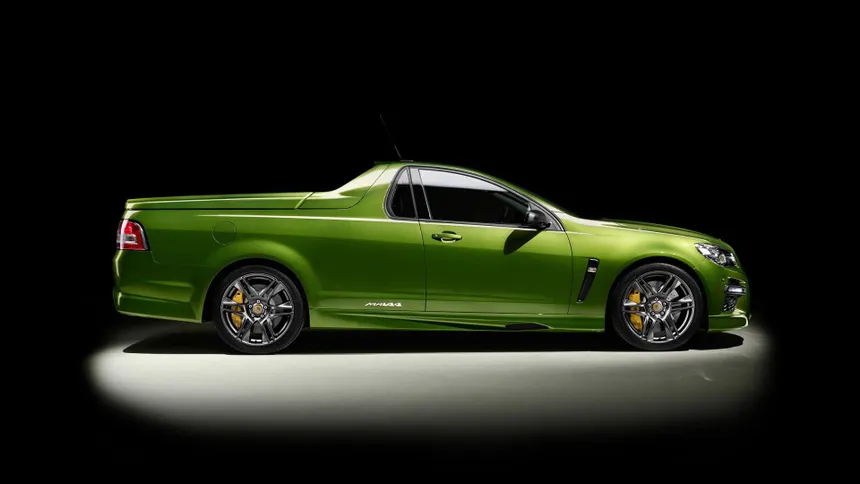
Here’s the part almost nobody connects to the Maloo. The VT through VZ Commodores, and the utes and Maloos built from them, were derived from the Opel Omega B, the big rear-drive Opel sold across Europe. Cadillac even sold a version in America as the Catera.
At the Geneva show in March 2000, Opel announced an Omega V8 for later that year. It carried the same Corvette LS1, rated there at 310 PS, with a 155 mph limiter and 0 to 62 mph in under seven seconds. Opel had already teased a V8 Omega wagon, the V8.com concept, at Frankfurt in 1999. Thirty-two prototypes and pre-production cars were built. Then Opel quietly killed it.
The official reason was lack of demand. The unofficial one, reported by Britain’s evo and the German press, is that the engineers didn’t trust the drivetrain to survive long stretches of wide-open throttle, the kind of driving that never happens in America but happens daily on an unrestricted autobahn. Germans have a word for it, vollgasfest, roughly “full-throttle proof,” and the Omega V8 didn’t earn it. Several sources point to the four-speed automatic as the weak link.
While Opel shelved the project, HSV was putting that same LS1 into a pickup. Six years later, a Maloo with the 6.0-liter evolution of that engine would run flat out across the desert at more than 168 mph. With a four-speed automatic.
The principal’s ute
The VZ Maloo arrived in October 2004 with the LS2: 6.0 liters, 297 kW (398 hp) at 6,000 rpm, 530 Nm (391 lb-ft) at 4,400 rpm and a 6,500 rpm redline. It rode on 19-inch wheels with Pirelli P Zero Rosso tires and a new multi-link rear end. For context, Ferrari’s F430, launched the same year, made 360 kW from its 4.3-liter V8 and 465 Nm of torque. The Maloo had less power than the Ferrari and more torque. The R8 listed at 63,895 Australian dollars.
Now back to America, because that’s where the speed war started. In July 2003, the Ford SVT F-150 Lightning, with its supercharged 5.4-liter V8, set the Guinness mark for fastest production pickup at 147.54 mph. In February 2004, Dodge answered with the Ram SRT-10, running the Viper’s 8.3-liter V10 and 500 horsepower. NASCAR driver Brendan Gaughan averaged 154.587 mph over a flying kilometer on the 4.71-mile oval at DaimlerChrysler’s Chelsea proving grounds. That regular-cab Ram weighed 5,130 pounds.
On May 25, 2006, HSV took a Maloo R8 to the Woomera range in the South Australian outback, an Air Force rocket testing area, with Mark Skaife, a five-time Australian touring car champion, and a Guinness adjudicator. The rules: a stock, unmodified production vehicle, and an average of two runs through a flying kilometer, one in each direction. A flying kilometer means the car is already at full speed when it enters the timed section. Running both ways cancels out the wind, because whatever you gain with a tailwind you lose into a headwind.
The truck didn’t come off a transporter from the factory. HSV borrowed it from Stuart Knox, the local school principal, who owned a new Maloo. Knox later said the team told him they wanted to drive it at high speed, that he figured they expected him to refuse, and that they gave him a ride at around 130 mph before the attempt.
The day before, HSV engineer Sam Davis made shakedown runs to check the truck and the timing gear. His first pass averaged about 149 mph. Then he asked for one more serious run and averaged 269.9 km/h, about 167.7 mph. With Guinness already on site, that counted as an official world record. It lasted less than 18 hours.
The next day, Skaife made a single attempt: 165.11 mph into the wind and 172.22 mph with it, for a 168.66 mph average, 271.44 km/h. That beat the Ram by about 14 mph. The course was a bumpy service road with two cattle grids, the steel grates set into the pavement to stop livestock. Skaife admitted his first reaction on seeing the road was that they had to be kidding, and said he wouldn’t be surprised if the truck got airborne a few times. Davis reported the traction control cutting in around 260 km/h, roughly 162 mph, over the grids.
And here’s the final drive again. The record truck was an automatic. Motor magazine explained that the six-speed manual couldn’t reach peak revs in sixth. At those speeds, aerodynamic drag grows with the square of velocity, and sixth in the manual was geared so tall that the engine ran out of power before reaching the rpm where it makes its peak. The automatic’s top gear let the V8 sit in its sweet spot exactly when it mattered.
According to Australia’s Drive, the record still stood as of March 2025.
The ute America almost got
In October 2007 the E Series Maloo moved to the Zeta platform, developed in Australia by Holden. GM liked Zeta enough to plan cars on it around the world, and the fifth-generation Camaro that Oshawa started building in 2009 rode on it, the only Zeta ever built outside Australia. The E Series Maloo came only in R8 trim, first with an uprated LS2 at 307 kW and from 2008 with the 6.2-liter LS3 at 317 kW, 425 hp. In 2011 HSV even offered a dual-fuel option that let the V8 run on liquid propane.
In March 2008, at the New York Auto Show, Pontiac unveiled the G8 ST, short for Sport Truck: a Holden ute with a Pontiac nose and the G8 GT’s 6.0-liter V8 rated at 361 hp, due as a 2010 model at around $31,000. It would have been GM’s first car-based pickup since the El Camino died in 1987. Bob Lutz later told Motor1 the ute was fully federalized. GM shelved it on January 6, 2009, on the road to Chapter 11, and killed Pontiac that same year. When GM brought the Commodore back as the 2014 Chevrolet SS, the ute stayed home.
Britain did get it, with the steering wheel on the right. From 2011 it was sold as the Vauxhall Maloo with the LS3, and in 2017 as the Vauxhall VXR8 Maloo LSA with 400 kW and 671 Nm.
The Spanish connection runs through a Camaro
We found no record of the Maloo ever being sold officially in Spain, and we’ll say so plainly. Any Maloo on Spanish plates came in as a private import.
But Spaniards could buy the Maloo’s hardware new from a dealer, under a different body. In September 2011, Chevrolet Spain began delivering the fifth-generation Camaro, riding on Holden’s Zeta architecture. Spain only got the V8: the LS3 with 432 PS and the six-speed manual, or the automatic version at 405 PS. The E Series Maloo R8 of the time made 317 kW, which works out to 431 PS, from the same LS3. The Camaro coupe cost 43,900 euros, the convertible 49,900. A Spanish Camaro buyer took home a first cousin of the Maloo: same Australian-engineered rear-drive architecture, same engine, no bed.
Superchargers, 4,160 pounds and two seven-figure auctions
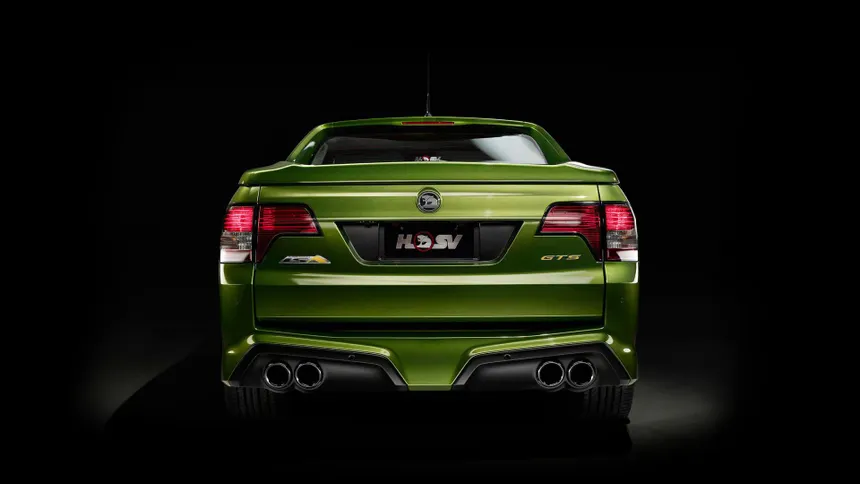
The last generation, Gen-F, arrived in August 2013 with the LS3 at 317 and 325 kW. Then HSV stopped pretending. The 2014 Maloo GTS got the supercharged 6.2-liter LSA with 430 kW, 577 hp.
A positive-displacement supercharger is an air pump driven by a belt off the crankshaft. It forces more air into the cylinders than the engine could draw on its own, and more air means more fuel can be burned for more power. Unlike a turbo, which runs on exhaust gas and needs revs to wake up, a supercharger delivers from idle because it always spins in step with the engine. The cost is some parasitic power loss and a fuel bill that explodes.
Motor tested the 2016 Maloo R8 LSA: 400 kW, 671 Nm, 1,887 kg (about 4,160 pounds), a claimed 4.6 seconds to 100 km/h, 79,490 Australian dollars, and roughly 25 L/100 km on a hard country run, which is under 10 mpg. Payload: 400 kg. In 2017 came the GTSR at 435 kW, 583 hp.
Then the madness. HSV built four Maloo GTSR W1s with the supercharged LS9, 474 kW, 636 hp. They weren’t sold to the public, only to hand-picked buyers. One color each: matte grey, pale yellow, gold and red. The gold one sold at auction in January 2021 for 1.05 million Australian dollars. The yellow one went for 1.2 million in December 2025, a record for a Holden road car. A ute. With a bed. For seven figures.
Lights out at Elizabeth
At 10:45 a.m. on October 20, 2017, a red VF Commodore SS-V Redline rolled off the line at Holden’s Elizabeth plant in South Australia, and Australian car manufacturing ended with it. The last utes were in that final batch. HSV kept finishing W1s into January 2018, and the Australian press called them the last cars built in the country. On February 17, 2020, GM announced it was retiring the Holden brand. HSV closed that year and was replaced by GM Specialty Vehicles, which now imports the Silverado and the Corvette to Australia.
The ute was invented because a farm family couldn’t afford a car and a truck. It ended with a model that carried less than the 1934 original, drank like a semi, and sold for supercar money. And as of March 2025, the fastest pickup on Earth in the Guinness book was still the one a small-town school principal lent out one May morning so a racing driver could run it flat out across a rocket range.
Check you’re still alive.