Alfa Romeo Canguro: The Contest Nobody Won
The most beautiful Alfa Romeo ever drawn exists because of a General Motors executive in Detroit.
Not directly. But the method that produced it was Bill Mitchell’s, and Alfa Romeo copied it a year later, right down to the two coachbuilders and the two donor chassis. Both experiments ended the same way: a gorgeous one-off, no production contract, and a young designer left holding the drawings.
And then the two cars from the two contests ran into each other on a racetrack and destroyed one another.
This is the Alfa Romeo Canguro, and the part everyone tells you about it is the smallest part of the story.
Detroit goes first
In late 1962, GM styling chief Bill Mitchell was looking at ways to sell the Chevrolet Corvair in Europe, and he wanted to see what a locally styled version might look like.
Rather than commission one house, he sent a Corvair Monza chassis to Bertone and another to Pininfarina. Let them compete.
At Bertone the job landed on the desk of a young staff designer named Giorgetto Giugiaro. He shortened and reinforced the Corvair’s unibody, pulling the wheelbase from 108 inches down to 94, and built a low berlinetta with pop-up headlights and a single canopy door that lifted the entire roof. He called it Testudo, Latin for tortoise. It broke cover at the Geneva Motor Show in March 1963, measuring 4,300 mm long and 1,060 mm high, at 898 kg.
Giugiaro has said the Testudo was the first car he was given a completely free hand on. GM never built it.
Milan copies the method
The next year, Alfa Romeo ran the same play.
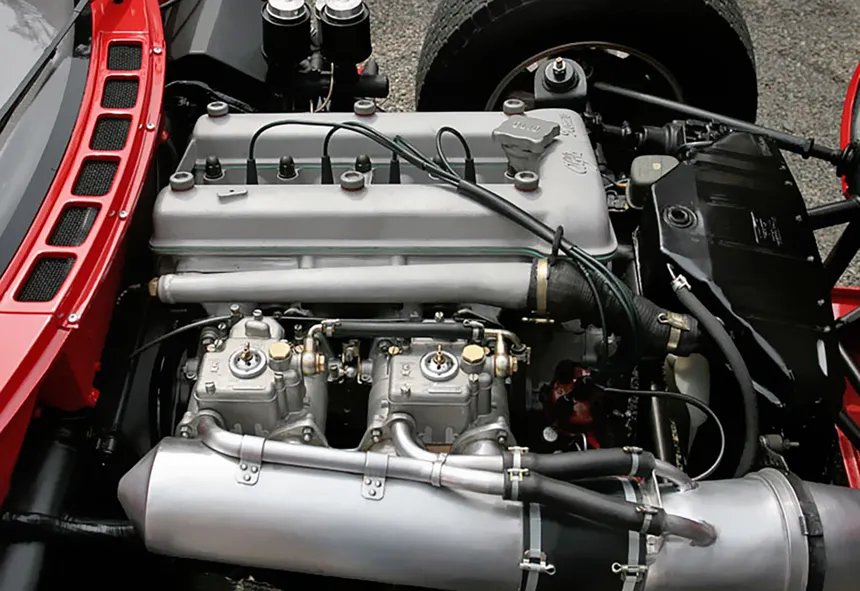
The starting point was the Giulia TZ. Tubolare Zagato: a hand-welded tubular frame with bodywork by Zagato, designed by Ercole Spada. A race car with plates, of which 112 were built between 1963 and 1967, because a hundred were needed to move it out of the prototype class and into production.
It worked on track, so Alfa started thinking about a road version. And instead of asking Zagato, who already had the car, it pulled two tubular chassis off the shelf and sent them to the rivals: 750101 to Bertone, 750114 to Pininfarina.
Nuccio Bertone handed his to Giugiaro again. Pininfarina gave theirs to Aldo Brovarone.
What Giugiaro did with his
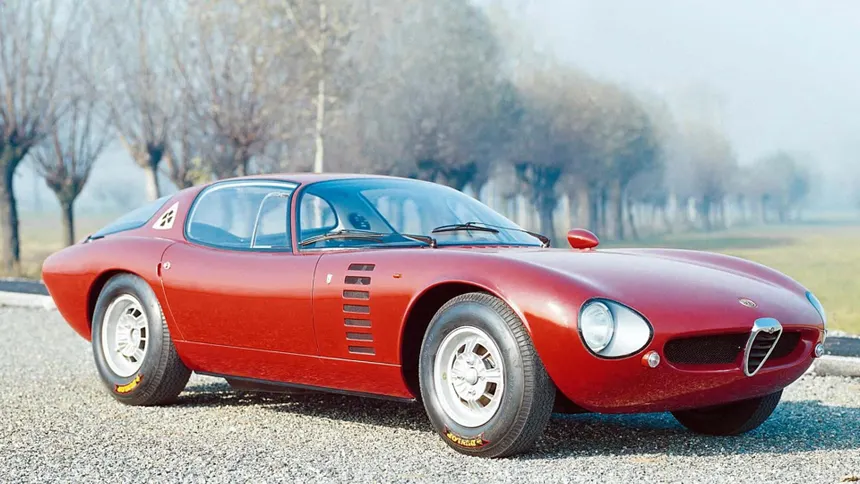
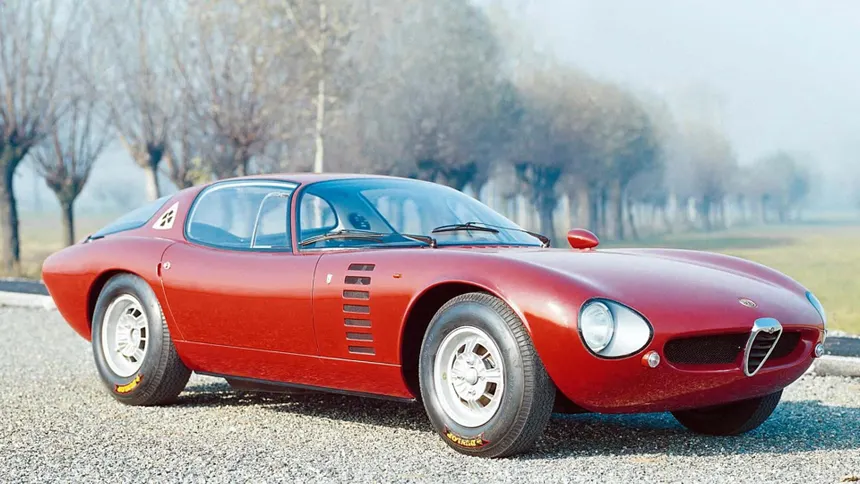
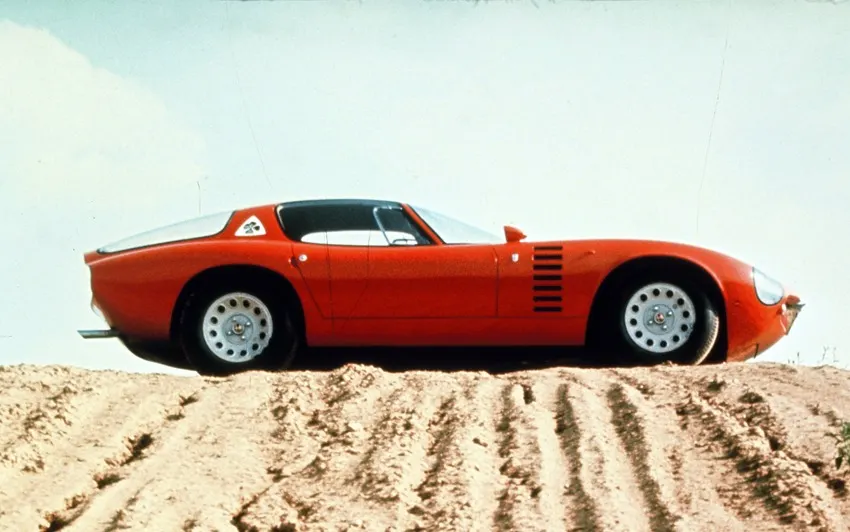
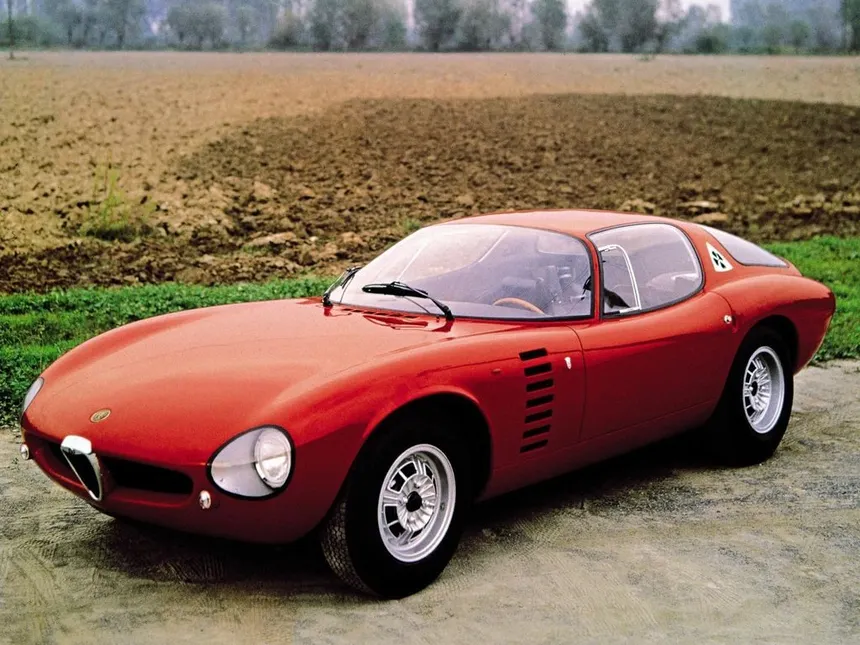
The Canguro was shown at the Paris Motor Show in October 1964. The name is Italian for kangaroo, and there’s no deeper meaning to it.
The numbers explain both why it photographs so well and why it could never have worked as a road car. It measures 3,673 mm long, 1,564 wide and 1,050 high on a 2,200 mm wheelbase, at 650 kg. For scale: the 1965 Alfa Romeo TZ2, a pure competition car, is 3,680 mm long, 1,020 mm high and 620 kg. The Canguro is a race car with upholstery.
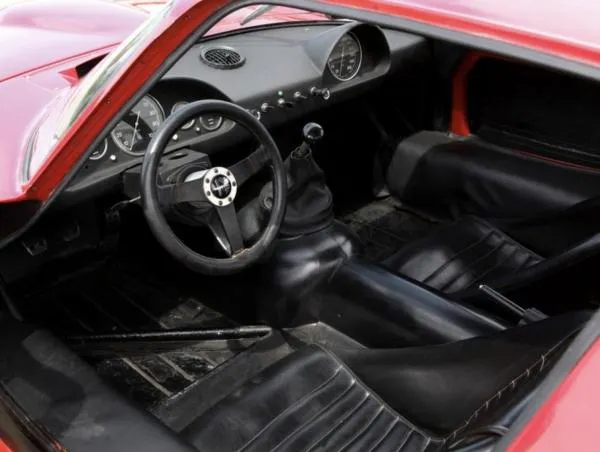
Forty-one inches of height forces strange decisions. The seats sit almost on the floor to buy headroom. The windshield and side glass wrap up into the roof so the driver can see anything at all. The side glass is curved so severely that only the quarterlights open, which means cabin ventilation comes through cloverleaf-shaped cutouts in the sail panels.
And here is the technical detail that hardly anyone mentions about this car: the Canguro’s windshield is one of the first bonded directly to the structure, with no metal frame and no rubber gasket. In 1964. The body is fiberglass rather than aluminum.
What Pininfarina did with the other one
Brovarone’s car was called the Giulia 1600 Sport and appeared at the Turin Motor Show in November 1965, fourteen months later.
It is lower and sharper than the Canguro, with long overhangs, pronounced front fenders and a crest running back along the hood from the badge. Anyone who knows the Ferrari Dino concept of those same months will recognize where that face comes from.
Two schools, one chassis. Bertone answered with curves and muscle. Pininfarina answered with edges.
Why Alfa said no to both
The usual explanation is “no production capacity,” which explains nothing.
The TZ’s frame isn’t a platform. It’s a hand-welded tubular structure built to homologate a race car in batches of a hundred, not to feed an assembly line. Building a road-going Canguro meant producing tubular frames in volume, and Alfa Romeo could not do that and had no interest in learning.
There was a money reason stacked on top. Alfa decided to spend its racing budget on sedans, and out of that decision came the Giulia GTA: a car it could actually build, actually sell and actually win championships with.
As an industrial call it’s flawless. Alfa picked the car it could manufacture over the car that looked incredible in Paris. No argument there.
The strange part is the rest of it. Calling the contest, burning two competition chassis on it, letting two rival coachbuilders spend months of shop time, and then buying nothing from either.
The two brothers wrecked each other
During a promotional film shoot at Monza, the Canguro went into the back of the Testudo.
The Testudo took a serious hit at the rear. The Canguro lost its entire nose.
For decades almost nobody knew what had become of it, until the Testudo came up for auction and its catalogue disclosed that the rear-end damage had been repaired. That line in a sale document is what finally confirmed how the other car had died.
Because the Canguro was never repaired. It was picked apart: the mechanicals, the windshield and most of the interior were stripped out, and what remained was parked behind the Bertone works under a tarp, outdoors, for years.
A German enthusiast named Gary Schmidt tracked down the remains and bought them. He never finished the job. He died in 2003.
The man who did finish it was Shiro Kosaka, a Japanese collector who already owned the other car from the contest, the Pininfarina. He bought the wreck, had it fully restored, and brought it back into the light at the Concorso d’Eleganza Villa d’Este in 2005.
The Testudo ended differently. It was offered from Bertone’s own collection at the RM Sotheby’s Villa d’Este sale on May 21, 2011, and sold for €336,000.
The jury took forty-one years
The finish is in the official results lists, not in the articles.
At Villa d’Este 2005, the Bertone Canguro entered by Shiro Kosaka took the Trofeo BMW Group, the jury’s Best in Show. It also took the Trofeo Corrado Millanta, the press award voted by journalists. And it won its class, cars from 1960 to 1970, with the first diploma and silver plaque, ahead of an Aston Martin DB4 GT Zagato.
What almost nobody mentions is that there were two separate votes that day, and the public did not agree with the jury. The Coppa d’Oro di Villa d’Este, Best of Show by public referendum, went to a 1951 Ferrari 212 Export Spider by Vignale.
So the car half the press calls the most beautiful ever drawn came back from the dead, swept the jury and the journalists, and lost the popular vote to a Ferrari from fourteen years earlier.
Five years on, at Villa d’Este 2010, the other one showed up. Brovarone’s Pininfarina, entered by the same Kosaka and preserved in original condition, collected three awards: a Mention of Honour, the FIVA trophy for the best preserved car, and the jury’s award for the most exciting design.
Add it up. The contest Alfa Romeo called in 1964 and refused to settle was finally settled in instalments on the shore of Lake Como, with both cars entered by the same owner, forty-one years late. Both of them won. Each in its own year.
What the badge never paid for
Alfa Romeo not building the Canguro is fine. The GTA was the right car, the tubular frame was never going to scale, and the company needed revenue rather than applause in Paris.
What grates is the mechanism, and it isn’t only Alfa’s. A large manufacturer calls in two coachbuilders, hands them racing hardware, consumes months of their shop time and talent, collects the motor show photographs and the magazine covers, and then buys nothing. Not the design, not an idea, not a headlight. General Motors did it with the Corvair in 1963 and Alfa Romeo did it with the TZ in 1964, and both times the hours came out of the same twenty-six-year-old in the same Turin workshop.
That kid went on to draw the Golf, the Panda and the DeLorean. He did all right. But the two cars that made his name ended up one auctioned off out of his old employer’s warehouse and the other rotting under a tarp in that same warehouse’s back lot.
Beauty contests between suppliers still exist. They have a different name now and they work exactly the same way: five studios working for free so that one gets paid. Sometimes not even one.
How much talent has this industry been paying for in applause instead of contracts?
Check you’re still alive.