
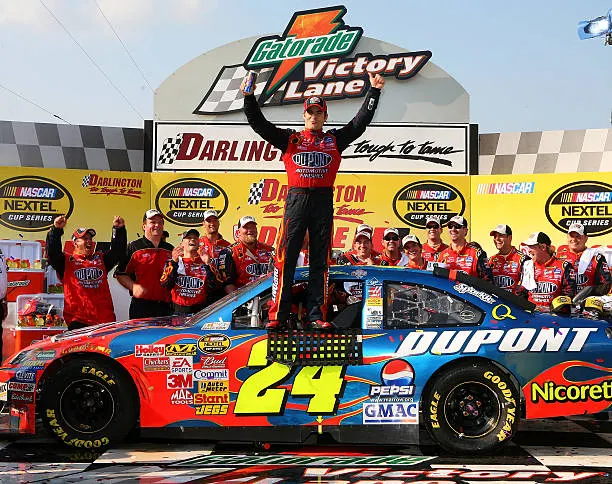
Jeff Gordon: The California Kid NASCAR Loved to Hate and Couldn’t Stop Admiring

NASCAR had a problem with Jeff Gordon. Not because he was bad. Because he was too good in the wrong way.
He was young in a sport of veterans. He was Californian in a sport rooted in the Deep South. He was handsome, articulate, and photogenic in a sport where heroes were measured by scars and grease under their fingernails. He drove a rainbow-colored Chevrolet in a paddock where black, red, and white were the only acceptable colors.
And he won. God, how he won.
93 Cup Series victories. Four championships. Three Daytona 500s. Five Brickyard 400s. 81 pole positions. 797 consecutive races. Third on the all-time wins list, behind only Richard Petty and David Pearson.
Jeff Gordon wasn’t just the best driver of his generation. He was the man who pulled NASCAR out of the southeastern ovals and placed it in American prime-time television. And he did it by being everything NASCAR supposedly wasn’t.
From Vallejo to Pittsboro: A Driver Who Was Never Southern
Jeffery Michael Gordon was born on August 4, 1971, in Vallejo, California. Not in Kannapolis, North Carolina, like Earnhardt. Not in Level Cross, like Petty. California. The state of surfers, wine, and Hollywood. On paper, the worst possible origin for a future stock car king.
But Gordon had something geography couldn’t take away: pure talent. By five, he was competing in Quarter Midgets. By six, he had won 35 events. That’s not a typo. Thirty-five victories before turning seven.
His stepfather, John Bickford, recognized that his stepson’s talent needed a different ecosystem. California restricted racing for minors. Indiana didn’t. So the Gordon family relocated to Pittsboro, Indiana, 30 minutes from Indianapolis Motor Speedway, to give the kid more opportunities to race.
By 13, Gordon was driving full-sized sprint cars against adults on Midwestern dirt tracks. By 16, he had a USAC license to compete professionally. In 1990, at 19, he won the USAC National Midget championship. In 1991, the Silver Crown title. The progression wasn’t normal. It was absurd.
But Gordon’s destiny wasn’t in open-wheel cars. During a Busch Series test session, team owner Rick Hendrick watched the kid drive. What he saw left him speechless. Hendrick signed Gordon to his Cup Series team before the young man turned 21.
1993-1995: The Rookie Who Devoured the World
Gordon debuted in the Cup Series at the final race of 1992, at Atlanta Motor Speedway. Richard Petty’s farewell race. Symbolically, the old king retired the same day the future king arrived. Gordon piloted the No. 24 Chevrolet for Hendrick Motorsports — the same number he would drive for his entire career.
In 1993, his first full season, Gordon won a qualifying race at Daytona, becoming the youngest driver to win a Gatorade Twin 125. He finished the season 14th in points and claimed Rookie of the Year honors.
In 1994, the first victories arrived. And one of them changed everything. On August 6, 1994, Gordon won the inaugural Brickyard 400 at Indianapolis Motor Speedway. The first stock car race at the cathedral of American racing. A 23-year-old kid, in his second season, winning the most media-saturated event of the year at the sacred temple of speed. NASCAR had never received so much media coverage for a single race.
In 1995, Gordon claimed his first championship at just 24, becoming the youngest champion of NASCAR’s modern era. He won seven races. The rivalry with Dale Earnhardt — who claimed his seventh and final title in 1994 — was officially on.
1997-1998: The Rainbow Warriors and the Perfect Season
What Gordon and his team — nicknamed the “Rainbow Warriors” for the car’s paint scheme — accomplished between 1997 and 1998 stands as one of the most dominant stretches in modern stock car history.
In 1997, Gordon won 10 races, including his first Daytona 500, and claimed his second championship. He was 26. Traditional NASCAR fans hated him. They booed him at every track. They threw beer cans. Gordon represented everything the old guard detested: youth, refinement, and a public image that connected with corporate sponsors and urban audiences that NASCAR had been desperately courting.
In 1998, Gordon achieved perfection. 13 wins in a season — a modern-era record, surpassing Earnhardt’s 11 in 1987. He claimed his third championship in four years. He won on short tracks, superspeedways, and road courses. He had no weakness. Ray Evernham, his crew chief, was a strategic genius who complemented Gordon’s talent with obsessive preparation.
That same year, at just 27, Gordon was named one of NASCAR’s 50 Greatest Drivers. He hadn’t even completed half his career.
The Earnhardt Rivalry: The Best Thing That Happened to NASCAR
Gordon and Earnhardt were perfect opposites. Earnhardt was the roughneck from Kannapolis who dropped out of high school at 16 to follow his father’s footsteps. Gordon was the California kid who looked like he stepped out of a Gap catalog. Earnhardt drove a black No. 3 Chevrolet. Gordon drove a rainbow No. 24. Earnhardt intimidated. Gordon dazzled.
They respected each other privately. They destroyed each other publicly. And NASCAR monetized it like no rivalry had been monetized before. Ratings skyrocketed. Sponsors lined up. The Gordon-Earnhardt era turned NASCAR from a regional sport into a media phenomenon with multimillion-dollar television contracts.
When Earnhardt died at the 2001 Daytona 500, Gordon lost more than a rival. He lost the antagonist who gave his narrative meaning. And curiously, 2001 was the year Gordon won his fourth and final championship, as if Earnhardt’s absence left a void that even Gordon’s talent couldn’t fully fill.
More Than an Oval Racer: Total Versatility
What separates Jeff Gordon from most NASCAR drivers is his absolute versatility. The numbers prove it: all-time leader in road course wins with 9, all-time leader in restrictor-plate wins with 12, a record five Brickyard 400s at Indianapolis, three Daytona 500s, and six Southern 500s. He won at 24 of the 25 tracks he competed at. Only Kentucky Speedway eluded him.
But perhaps most impressive is what he accomplished outside NASCAR. In January 2017, Gordon won the Rolex 24 at Daytona with Wayne Taylor Racing, piloting a Cadillac DPi-V.R. He became the first Cup Series champion to win the Rolex 24, and only the fourth driver in history to win both the Daytona 500 and the 24 Hours of Daytona, joining A.J. Foyt, Mario Andretti, and Jamie McMurray.
A stock car driver, 45 years old, competing in an endurance race against prototype specialists and winning it. That’s not adaptation. That’s pure genius.
The Iron Man and Retirement
Gordon set a record of 797 consecutive Cup Series races, surpassing Ricky Rudd’s mark of 788. From the final race of 1992 through his retirement in 2015, he never missed a single race. The Iron Man of American stock car racing.
His final victory came on November 1, 2015, at Martinsville. Win number 93. His teammate Jimmie Johnson — who had won seven championships while driving the car co-owned by Gordon and Rick Hendrick — was the first to congratulate him.
Gordon retired at 44, not because his talent had faded, but because he felt the time was right. He transitioned to broadcasting with Fox Sports, and in 2019 was inducted into the NASCAR Hall of Fame with 96% of the vote — the highest percentage ever recorded.
Jeff Gordon by the Numbers
The complete stats: 93 Cup Series wins (third all-time). 4 championships (1995, 1997, 1998, 2001). 3 Daytona 500s (1997, 1999, 2005). 5 Brickyard 400s (record). 6 Southern 500s (record). 81 pole positions (third all-time). 797 consecutive races (record). 325 top-5s. 477 top-10s. 805 total starts. Rolex 24 at Daytona winner (2017). 9 road course wins (record). 12 restrictor-plate wins (record). 1993 Rookie of the Year. Named one of NASCAR’s 50 Greatest Drivers in 1998. NASCAR Hall of Fame 2019 (96% of vote, record).
My Final Word
Jeff Gordon received more boos than any driver in NASCAR history. And he received them for one unforgivable reason: he didn’t fit the stereotype.
He wasn’t Southern. He didn’t speak with a drawl. He wasn’t missing teeth. He didn’t have grease on his hands or a 1970s mustache. He was young, clean, educated, and articulate. And in the NASCAR of the 1990s, that was a cardinal sin.
Fans hated him because he represented change. And change always hurts. But without Jeff Gordon, NASCAR wouldn’t have landed the television contracts that kept it alive. Without Gordon, Fortune 500 corporations wouldn’t have invested billions sponsoring teams. Without Gordon, the sport would have remained a regional southeastern party with shrinking audiences.
Jeff Gordon saved NASCAR from itself. And NASCAR thanked him by booing him for a decade.
If that doesn’t perfectly define the relationship between sport and its heroes, nothing does. Fans want legends who look like them. But the legends who change things never look like anyone.
Gordon didn’t look like anyone. And that’s why he won 93 races, four championships, and changed an entire sport.
You don’t owe him applause. You owe him the sport.
2 thoughts on “JEFF GORDON”