
Rotary valve engines: the F1 V10 that Penske's engine shop built and the FIA banned

The most interesting Formula 1 engine of the 2000s never turned a wheel in a race, and the shop that built it owed its existence to Roger Penske’s checkbook.
Ilmor Engineering was founded in November 1983 by Mario Illien and Paul Morgan, two engineers who had walked out of Cosworth. Penske put up the money for a 50% stake, and General Motors later bought 25%. Their first product wore a Chevy bowtie: the Ilmor-Chevrolet Indy V8 debuted at the 1986 Indianapolis 500 with Al Unser in a Penske car, and Rick Mears took it to Victory Lane at Indy in 1988. Between 1987 and 1991 the “Chevy A” won 64 of 78 Indy car races. By the late 1990s Ilmor was building Mercedes’ Formula 1 engines, the ones that won world titles for McLaren.
So when an Australian company showed up with a cylinder head that had no valve springs, no camshafts and no poppet valves at all, the people who listened were the best engine builders on the planet. And in 2004 the FIA rewrote its rulebook to make sure that head never raced.
Penske money, Sydney cylinder heads
The Australian company was Bishop Innovation, based in Sydney. Its design, developed with engineer Tony Wallis, used one spinning cylinder per combustion chamber, lying along the head and handling both intake and exhaust. As it turned, openings in its side lined up with the chamber, letting fresh charge in on one part of the cycle and burnt gas out on another.
Work with Ilmor started in 1997. The first tests ran on 300cc single-cylinder bottom ends that Ilmor shipped to Sydney, with Bishop responsible for designing the head and proving it would last. By late 2000, according to Bishop’s account of the program, back-to-back testing against an equivalent poppet-valve single showed a 10% power advantage and better durability. The first V10s with rotary valves were built and tested in 2002. An all-new V10 designed around the technology followed in 2003.
To put those V10s in context: the engine Ilmor was racing for Mercedes in 2004, the FO 110 Q in the McLaren MP4-19, was a 3.0-liter V10 making close to 900 hp at 18,300 rpm. That was the target the rotary head had to beat, with poppet valves opening and closing faster than in almost any other engine of its day.
A paragraph in the rulebook
Late in 2004 the FIA changed Article 5.1.5 of the F1 engine regulations. Bishop says the change had one specific purpose: banning its rotary valve technology. Testing stopped there.
How far the V10s actually got on the dyno is still argued over on engineering forums, and nearly everything public about the program comes from Bishop’s side. What nobody argues about is the timing. The governing body of the world’s most expensive engineering competition spent a rule change on a cylinder head that no team had raced yet.
Bishop’s patent ended up with BRV Pty Ltd, a company owned by Tony Wallis, which later converted a Honda CRF450 motocross engine and reported 17% more low-speed torque and 9% more at high speed.
To see why Ilmor bothered in the first place, you have to look at what a poppet valve goes through at 18,300 rpm.
Why valves float
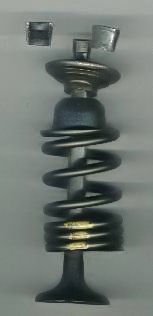
A poppet valve is a steel or titanium disc on a stem. A cam lobe pushes it open, a spring snaps it shut. On every cycle it accelerates, stops, reverses and stops again, and at 18,300 rpm a four-stroke opens each valve more than 150 times a second.
The spring is the weak link. The faster the engine spins, the harder the cam throws the valve open, and the harder the spring has to work to bring it back before the piston arrives. When the spring loses that race, the valve stops following the cam. Engine builders call it valve float. Mild float costs power. Serious float lets the piston hit a valve that hasn’t closed, and the engine is scrap.
Every engine builder who chases rpm fights it, from pushrod V8s in stock cars to the 18,000-rpm V10s of 2004. The obvious fix, the one people have been chasing for a century, is to stop moving the valve up and down at all. Spin something instead. Rotation is the one motion an engine does smoothly at any speed.
Two Englishmen and a pile of wet spark plugs
Bishop wasn’t first. Not even close. Back in Iowa, Fay Oliver Farwell had already made an entire engine spin around its crankshaft.
Roland Cross started working on a rotary valve in 1920 and filed his first patent in 1922. His layout is the direct ancestor of Bishop’s: a cylindrical valve lying across the head, divided inside by a wall so one side fed intake and the other carried exhaust. In December 1933 the British trade weekly Commercial Motor reported Cross’s claim that the valve worked perfectly up to 10,000 rpm.
That number meant something in 1933. Cross built many of his prototypes on Rudge bottom ends, and Rudge’s own top sporting single, the four-valve 500cc Ulster, made around 32 hp at 5,500 rpm in standard trim and about 40 hp at 6,800 when tuned. Cross was claiming nearly 50% more revs than the best head Rudge itself could build.
Frank Aspin, working in Bury, Lancashire, built a different shape: a cone in the cylinder head spinning on the same axis as the bore, with part of the cone cut away to uncover the ports. He first built it successfully in 1937, and Old Bike Mag reports a 250cc Aspin motorcycle engine capable of 14,000 rpm.
Both men hit the same problem, and it’s the problem that decides everything in this story. A poppet valve seals by sitting still. When it closes it rests on a seat, and combustion pressure pushes it harder into that seat. A rotary valve never sits still. It has to hold back burning fuel at high pressure while sliding against the surface it’s sealing. Fit it tight and it wears out, or seizes when it heats up and expands. Fit it loose and compression leaks past. Flood it with oil to stop the wear and the oil ends up in the combustion chamber.
Cycle World put the verdict in print in July 1964: the makers of the Cross engine had to choose between heavy valve wear or heavy oil consumption, and they chose oil. Aspin’s cone had the same wear problem and survived only on copious oil. NSU, the German maker that tried the Aspin principle in the mid-1950s and which Cycle World rated probably the most promising of the lot, found no clear gain over a comparable poppet-valve engine, with vast oil consumption and fast seal wear.
Cross tried a flexible phosphor-bronze lip that hugged the valve. It sealed well and wore out, and that wear was never solved. Too much spring pressure behind the seal and friction heated the valve until it partly seized.
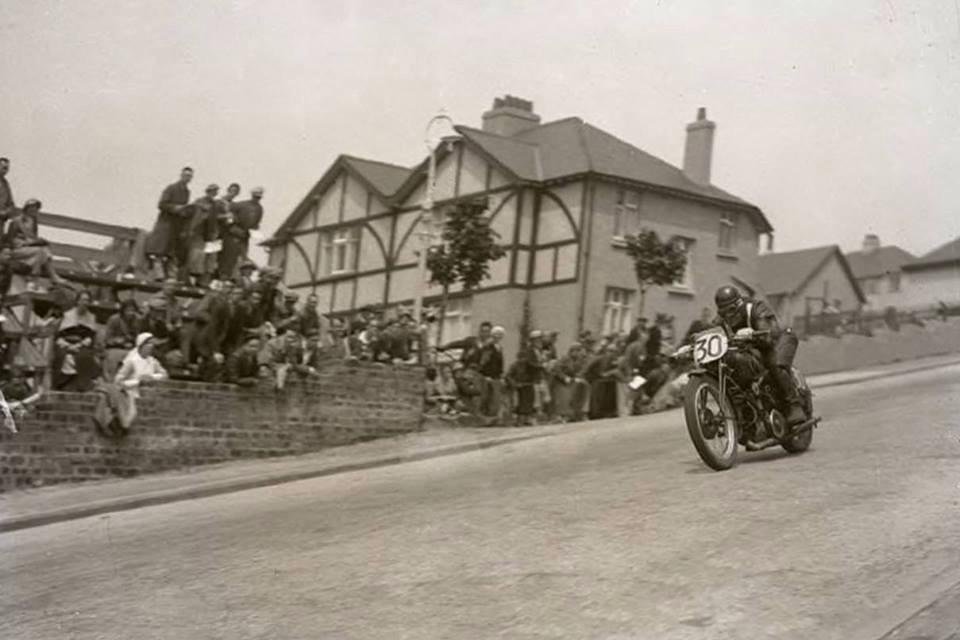
All that oil went somewhere, and much of it went onto the spark plug. That’s what Cross ran into on the biggest stage there was. For the 1935 Senior TT on the Isle of Man he entered a Vincent HRD with a Rudge engine wearing his valve and a 10.5:1 compression ratio. The record is muddy. Old Bike Mag says the entry was withdrawn after problems in practice. The Cybermotorcycle archive describes two bikes, one too slow to qualify and one retired after two laps with “spark plug problems”, blamed on oil mist from the valve.
The road version did better. When the British weekly Motor Cycling tested a Cross machine in 1937, its only real complaint was an exhaust manifold that roasted the rider’s leg. It reached 87 mph in 28.5 seconds and cruised around 75 mph at 6,000 rpm. Norton, which owned British racing at the time, seriously considered a Cross arrangement for its works Manx engines.
Aspin’s design had a surprise of its own. With no red-hot exhaust valve sitting in the combustion chamber, it could run high compression on poor fuel without knocking. According to Old Bike Mag, a 4.5-liter Aspin-valve truck engine developed for the British Army in the late 1940s ran happily on creosote, the black tar used to preserve railroad ties.
Detroit bought in
This part of the story rarely gets told in America. In 1938 Briggs Manufacturing of Detroit bought the US rights to the Aspin patents.
Briggs was no garage outfit. Walter Briggs had built the company into one of the biggest independent body makers in the country, turning out bodies for Ford, Chrysler and Packard, more than half a million a year at its peak. With the Aspin rights Briggs designed flat-four aircraft engines: the O-106, rated at 80 hp at 5,000 rpm and weighing 150 pounds in its first form, and later the O-200, rated at 100 hp, built between 1944 and 1946.
The Aircraft Engine Historical Society, which tracks American piston aero engines down to the last prototype, lists the applications for both as “none found”. Detroit money and Detroit engineering still couldn’t get an Aspin engine into an airplane.
The rotary valve that won world championships
There is one place where a spinning valve beat everything, and it gets left out of most rotary valve stories.
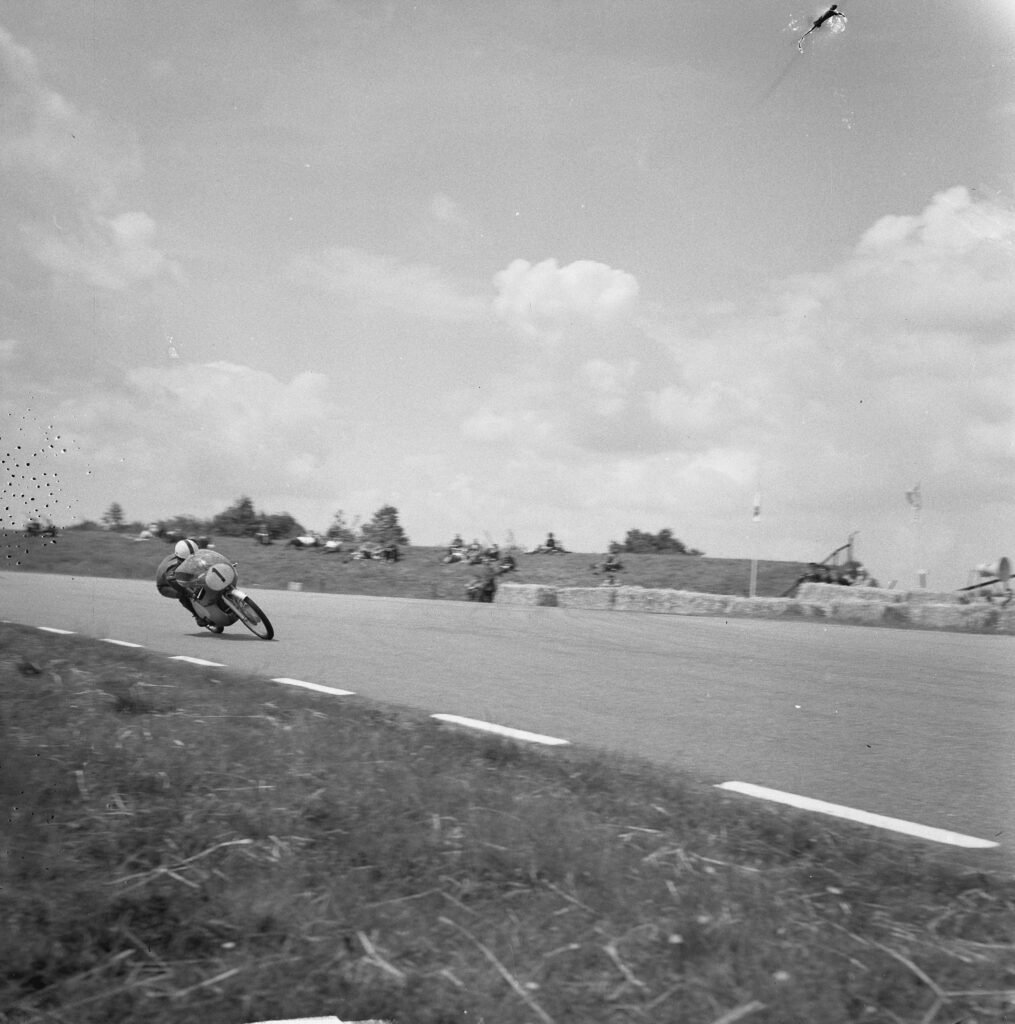
A two-stroke has no poppet valves, but it still has to control when fresh mixture enters the crankcase. In Zschopau, East Germany, MZ race chief Walter Kaaden had been developing Zimmermann-type rotary inlet valves since 1953: a thin half-disc of spring steel, about 4¾ inches across and 0.016 inches thick, spinning on the crankshaft and uncovering the intake port only when Kaaden wanted it open. Paired with a tuned expansion chamber exhaust, his 1961 125cc racer made 25 hp at 10,800 rpm. That’s 200 hp per liter, from an engine with no valvetrain at all.
In September 1961, at the Swedish Grand Prix, MZ’s lead rider Ernst Degner defected to the West. He brought what he’d learned from Kaaden to Suzuki, and in October 1962 Degner won Suzuki’s first world championship, in the 50cc class.
The disc valve works for a simple reason. It only handles the intake side, where the pressure is crankcase pressure and the gas is cold fuel mixture. It never has to seal against combustion. Take away the problem that killed Cross and Aspin, and the rotary valve is brilliant.
A Spanish 50cc with 380 hp per liter
The disc valve’s high point in the smallest class came out of Mollet del Vallès, near Barcelona.
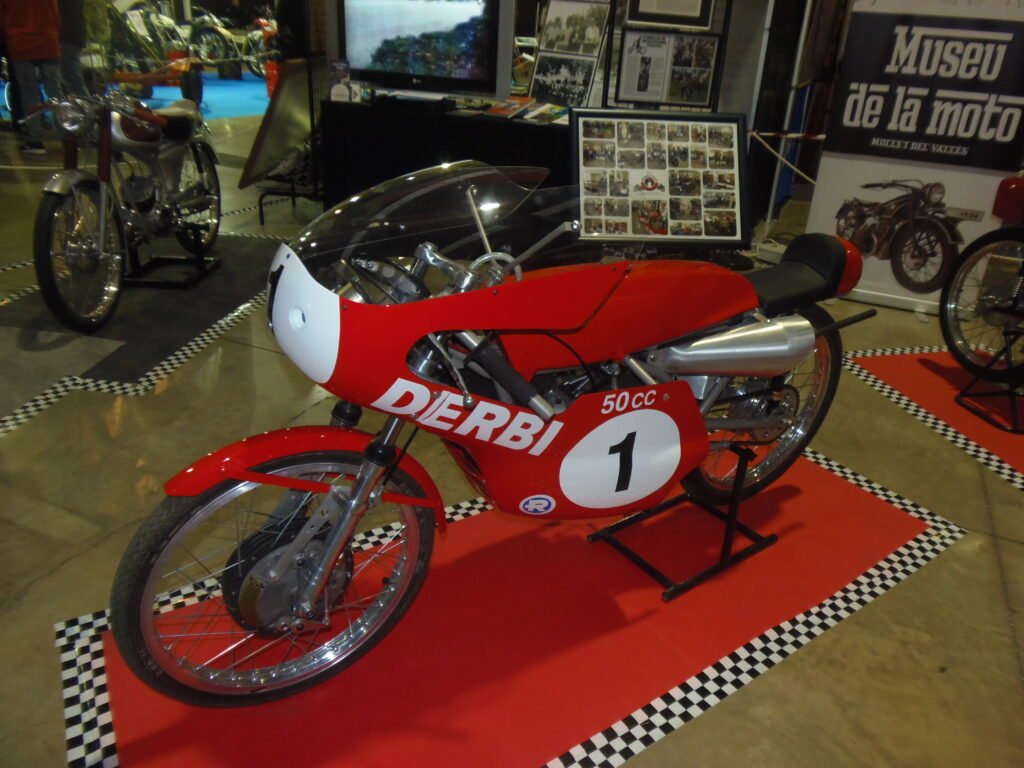
Derbi began in 1922 as a bicycle repair shop owned by Simeó Rabasa. The name comes from “derivado de bicicleta”, Spanish for “derived from a bicycle”. In 1961 engineer Francesc Tombas designed a disc-valve 50cc racer for the company, good for 11.5 hp at 12,000 rpm.
By 1969 Tombas had the water-cooled single making 19 hp at 14,000 rpm, in a bike weighing 52 kg (about 115 pounds). That works out to roughly 380 hp per liter. The same year Kreidler came back to the 50cc world championship with a disc-valve engine tuned by Van Veen to 15 hp, and it couldn’t stay with the Derbi.
The rider was Ángel Nieto, from Zamora, and the Derbi gave him the 50cc world title in 1969, 1970 and 1972. He went on to win 13 world championships across the 50cc and 125cc classes.
Put the numbers next to each other. In 1933 Roland Cross was claiming 10,000 rpm from a rotary-valve head on a 500cc bottom end and couldn’t keep it out of the oil. In 1969 a Spanish 50cc single spun 14,000 rpm with a rotary valve and won the world championship. Same principle. The difference was the side of the engine it worked on.
Two American bets
Two US companies are still chasing the four-stroke version, from opposite ends.
Coates International of New Jersey has been developing the Coates Spherical Rotary Valve, or CSRV, since its predecessor company was formed in August 1988. George Coates began the work in Ireland in the late 1970s and moved it to the US in 1986. The design uses spinning spheres in a two-piece cylinder head, with about a tenth of the moving parts of a poppet-valve system, and the company says it means longer engine life and less lubrication. In its own SEC filings, Coates describes its first engine sale as a natural gas engine-generator. More than thirty years in, independent data on Coates engines in service is hard to find.
Vaztec, based in Mooresville, North Carolina, a few miles from the race shops of NASCAR, started with the hardest sealing job there is: diesel. It has run diesel engines on its rotary valve at a 20:1 compression ratio and 100 bar of combustion pressure, and built prototypes ranging from a 5.3-liter V8 to a 28cc handheld four-stroke. Its sealing system is designed to adapt to the valve as it expands with heat, which is exactly where Cross’s phosphor-bronze lip gave up.
On paper, the ceiling is far higher. In a 2020 SAE paper, Australian engineer Alberto Boretti simulated lean-burn engines combining rotary valves, direct injection, jet ignition and heavy boost, and calculated up to 475 kW per liter on methanol, about 640 hp per liter. In the same body of work he puts current hybrid F1 engines at a little over 340 kW per liter. It’s a simulation. No such engine runs today.
Still pushed by a cam
Ninety years after Cross took his rotary valve to the Isle of Man, every production four-stroke in America still opens its valves with a cam and closes them with a spring. The small-block in a Corvette does it. The Coyote in a Mustang does it. The last time anyone came close to changing that at the top level was in a Sydney workshop, with Ilmor parts on the bench, and a rule change in 2004 ended it.
Check you’re still alive.
Photos: McLaren-Mercedes MP4-19 by 5225C (CC BY-SA 4.0). 1969 Derbi 50 replica by Peprovira (CC BY-SA 3.0). Via Wikimedia Commons.