Adams-Farwell: the Iowa car whose entire engine spun around a crankshaft that never moved
The Smithsonian credits the first successful rotary engine in history to an American, and he built it in a stove factory in Dubuque, Iowa. Not in Paris, not in Germany, not in some aviation workshop. In a plant that made stoves, fireplace fittings and milling machinery.
His name was Fay Oliver Farwell, and his engine did something no production car engine has done since. The crankshaft was bolted to the chassis and never turned. Everything else did: cylinders, heads, spark plugs, the whole iron star whirling around a fixed shaft under the seat of a car you could actually buy.
By 1909 that same engine had lifted a helicopter off the ground in Washington. A few years later its French cousins were dogfighting over the Western Front. And the car that started it all survives in exactly one example, sitting in a museum in Reno.
A helicopter in 1909, powered from Dubuque
Start with the flying part, because it’s the bit almost nobody knows.
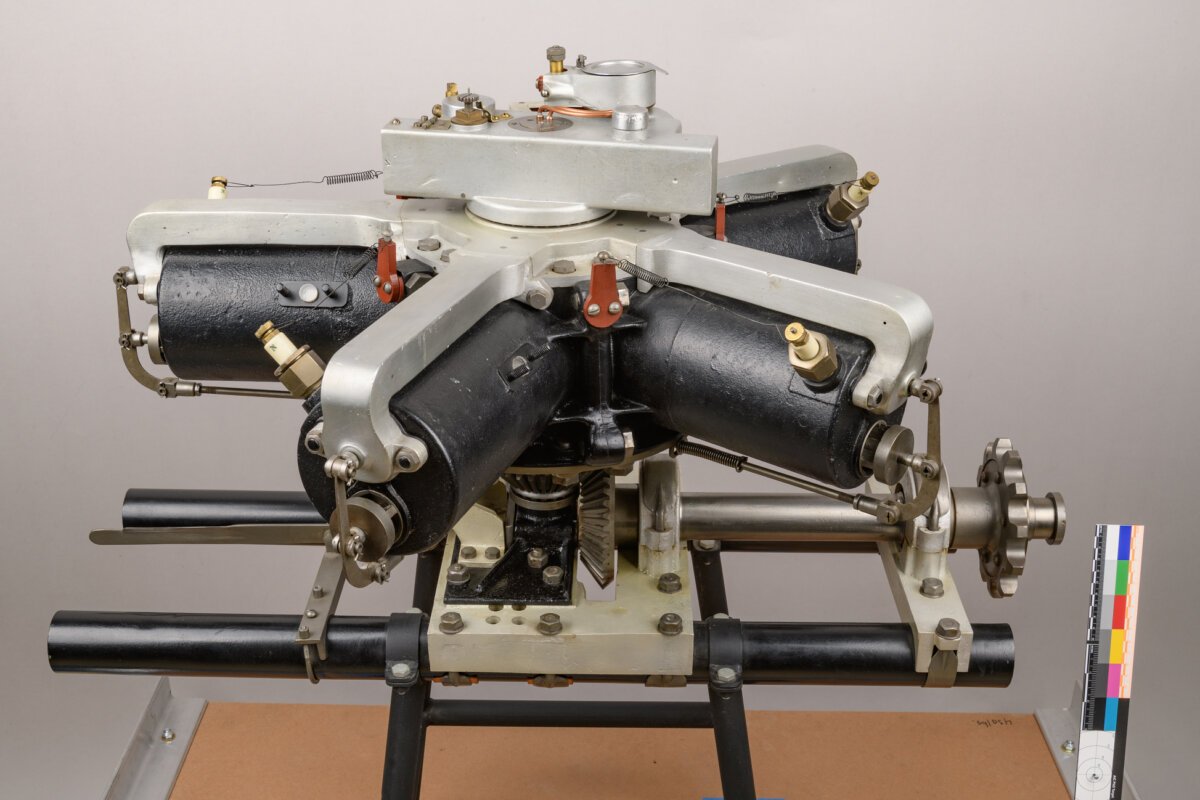
Emile Berliner, the man who gave the world the flat gramophone record, was chasing vertical flight in the years right after Kitty Hawk. According to the Smithsonian’s National Air and Space Museum, he picked Farwell’s compact five-cylinder rotary to drive the vertical shaft of a helicopter test rig in 1908. The New York Times reported on July 1, 1909 that a helicopter designed by Berliner and J. Newton Williams, fitted with two of these engines, had lifted a few feet off the ground in the last week of June, with Williams on board.
The Smithsonian still has one of those engines. Built in 1907, it displaces 4.07 liters (248 cubic inches), makes 36 hp at 1,500 rpm and weighs 97 pounds. For scale, the Ford Model T engine that went on sale in October 1908 displaced 2.9 liters, made 20 hp, and needed a radiator full of water and a flywheel to run smoothly. Farwell’s engine made nearly twice the power and needed neither.
How a spinning engine works
Every engine in every car on your street does the same thing. The block is bolted down and stays put. Pistons go up and down inside it, and they spin a crankshaft that sends power to the wheels.
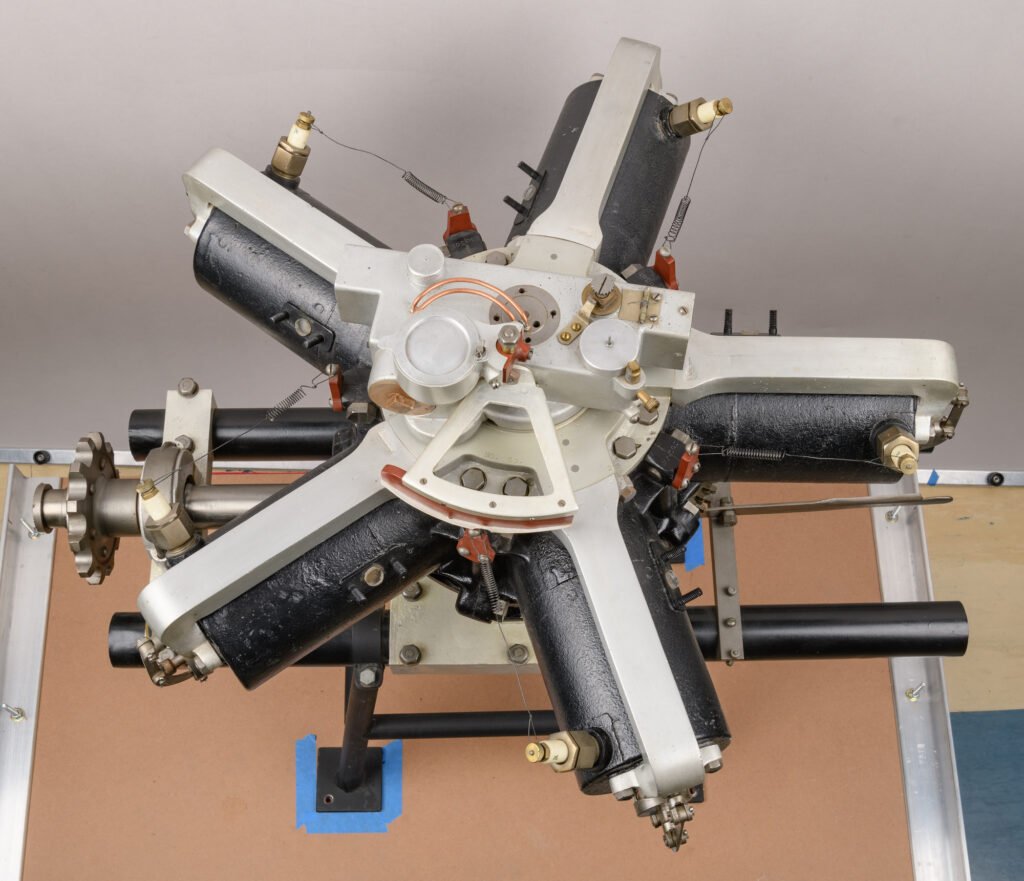
Farwell flipped it. He anchored the crankshaft to the frame and let the block go. Five cylinders were arranged like spokes around the fixed crank, and each time one fired, the whole assembly rotated around it. Power was taken off the spinning engine itself.
This is a true rotary, and it has nothing to do with Mazda. A Wankel spins a triangular rotor inside a housing that stays still. In the Adams-Farwell, the housing is what spins.
Farwell had two hard-nosed reasons for doing it this way. The first was the flywheel. Every piston engine needs a heavy wheel to store energy between power strokes, otherwise it shakes and stumbles at low speed. When the entire engine is spinning, its own mass does that job, so the flywheel disappears. The second was cooling. In the 1890s, water cooling meant a radiator, a pump, plumbing and a lot of extra weight, and a fixed air-cooled engine overheated because nothing moved the air past its fins. A spinning engine fans itself. Each finned cylinder cuts through the air on every revolution. No radiator, no pump, no water.
An Automobile Quarterly article traced the idea to a steam winch Farwell watched at work in the late 1800s.
From stoves to the Chicago Auto Show
The Adams Company was founded in Dubuque in 1883 by brothers Eugene and Herbert Adams. Farwell joined in the late 1880s and started building combustion engines on the side. In 1896 he produced the rotary the Smithsonian calls the first successful one, and in 1899, the museum says, a three-cylinder version probably powered the first rubber-tired automobile in the United States.
Cars followed from 1898. How many is a fair question with no clean answer. The Adams Company and the Encyclopedia Dubuque put it at 52 cars between 1898 and 1907. Other accounts run production to 1912 or 1913 at around 25 a year, with 52 to 54 built in 1910 alone. Either way, this was a hand-built car in a market that was about to be flattened by mass production.
At the 1905 Chicago Automobile Show it was singled out as one of the most attractive cars on the floor. The flagship Model 9 of 1908 carried a five-cylinder rotary of 8 liters (491 cubic inches) rated at 50 hp, fed through a four-speed transmission with two clutches worked by a single handle. The steering column could be unbolted and moved, and the front bench folded down to form a dash so the car could be driven year-round. The company claimed its 1906 cars could reach 75 mph, and they used an early unit body with no separate frame.
Prices ran from $2,000 to $4,000. In 1908 Henry Ford started selling the Model T for $850. In 1905, the entire Dubuque police force posed for a photograph in a three-seat Adams-Farwell, which tells you how proud the town was of it.
Why the Model T won
A spinning engine is a gyroscope. All that mass rotating at speed resists any change in direction, so every time the driver turned the wheel, the engine pushed back. On a car, that’s a flaw you feel in every corner.
Then there was the bill. Feeding fuel and oil through a hollow fixed crankshaft into an engine that’s whirling around it, keeping everything sealed and balanced, machining it all precisely enough to spin safely: none of that was cheap to build or to keep running. Ford was solving the opposite problem, making a simple car cheaper every year. There was no way a hand-built rotary luxury car from Dubuque could keep up.
The Adams brothers moved the company into gears, shafts and power-transmission parts, a business that kept them going long after the car was forgotten. Farwell stayed until 1921.
A Frenchman at the Chicago show
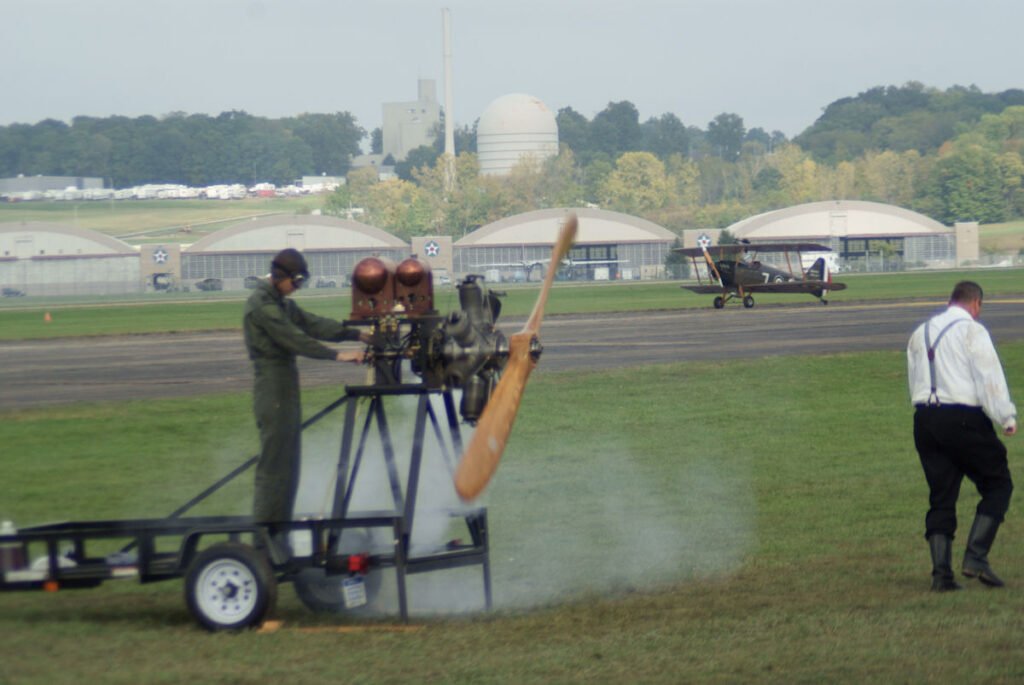
The engine had a second life, and Dubuque has its own version of how it started. According to local records, an Adams-Farwell was shown at a Chicago auto show in 1903, and a Monsieur Seguin from Paris saw it, went home, and built the Gnome engine on the same principle. That’s a local source and it deserves some caution: Laurent and Louis Seguin did their own serious engineering. The same records say J. W. Smith of Chicago saw the engine too and went on to develop America’s first radial aircraft engine, moving to England in 1915 to found the British Static Motor Company.
What happened next is documented history. The Seguins showed the Gnome Omega at the 1908 Paris show: seven cylinders, 8 liters, 50 hp at 1,200 rpm, the world’s first production rotary. At the great Reims air meet in August 1909, Henry Farman bolted one into his biplane and won the Grand Prix with 180 kilometers (112 miles) in just over three hours, setting distance and endurance records. More than 20,000 Gnomes of various types were built by the end of the First World War, plus licensed copies in Britain, the United States, Russia and Germany, where Oberursel’s versions powered the Fokkers.
Castor oil and the Camel
In the air, a spinning engine made sense. An airplane already has a big propeller turning out front, and the rotary was light for its power and cooled itself without a radiator.
The gyroscope came along for the ride, though. The Sopwith Camel, most often powered by a 130 hp Clerget rotary, could turn right faster than any other fighter of its time and turned left like a truck. Some pilots made a 270-degree right turn rather than a 90-degree left. In training it killed so many pilots that the joke was the Camel offered a choice of a wooden cross, the Red Cross or the Victoria Cross. In combat, Camel pilots were credited with 1,294 enemy aircraft, more than any other Allied fighter.
Lubrication was its own horror show. With the crankcase spinning, a normal pressurized oil system was impossible, so rotaries used total-loss lubrication: oil went in with the fuel and came out the exhaust. That oil was castor oil, because it wouldn’t dissolve in gasoline. Over two gallons an hour were flung out of a running engine, much of it over the pilot, who breathed it, swallowed it, and then dealt with its famous laxative effect.
Detroit and Barcelona built the replacements
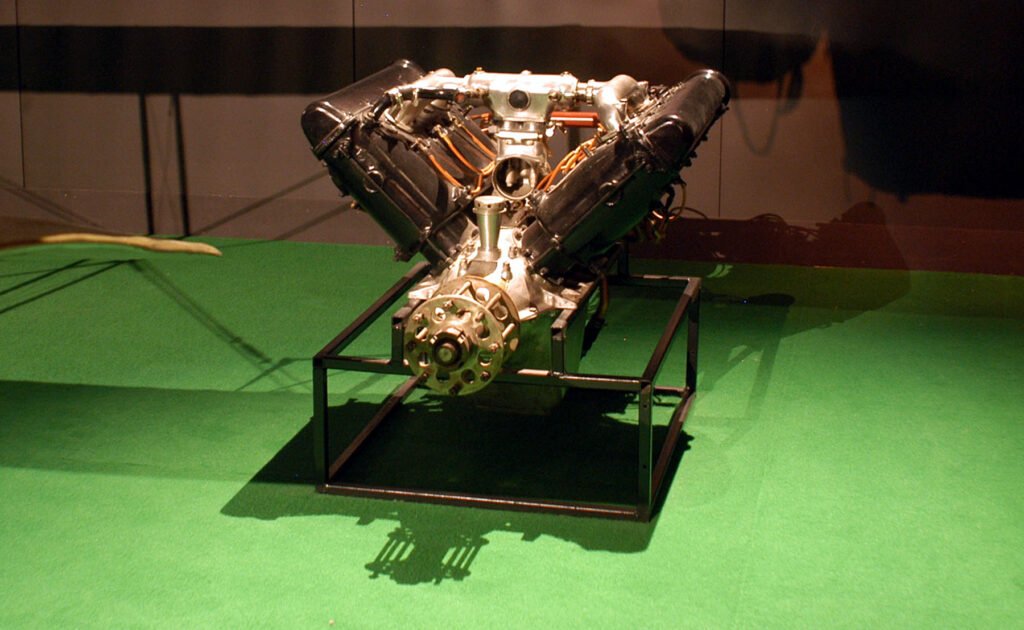
The rotary hit a wall. Fuel and air had to travel through the hollow crankshaft into the crankcase and then out to the cylinders, and that long path limited how much mixture the engine could breathe. It’s the same breathing problem the rotary valve tried to solve from a different direction. The most powerful production rotary, Britain’s Bentley BR2, made 230 hp for 490 pounds, and that was about the ceiling.
Fixed engines blew past it. In 1917 the Rolls-Royce Eagle VIII made 360 hp. That same summer an American consortium designed the Liberty L-12, a 27-liter V12 rated at 400 hp, with the first prototype assembled at Packard’s Detroit plant. When GM boss Billy Durant, a pacifist, wouldn’t let Cadillac build it, Cadillac founder Henry Leland quit and set up a new company to do the job on a $10 million contract. He called it the Lincoln Motor Company, and it built 6,500 Libertys before it ever built a car. More than 14,000 Libertys were built before the Armistice.
The fixed engine that pushed rotaries out of front-line fighters came from Spain. In 1915 SPAD designer Louis Béchereau decided rotaries had reached their limit and went looking for a fixed engine of at least 150 hp. He found it at Hispano-Suiza in Barcelona, where Swiss engineer Marc Birkigt had turned his car V8 into the Hispano-Suiza 8: a 90-degree V8 with cast-aluminum monobloc cylinders, 140 hp at first and up to 235 hp by the end of the war. It powered the SPAD VII, the British S.E.5a and the SPAD XIII, the fighter in which Eddie Rickenbacker of the 94th Aero Squadron scored 20 of his 26 victories to become America’s ace of aces. Production reached 49,893, including 112 built in Barcelona.
One car left
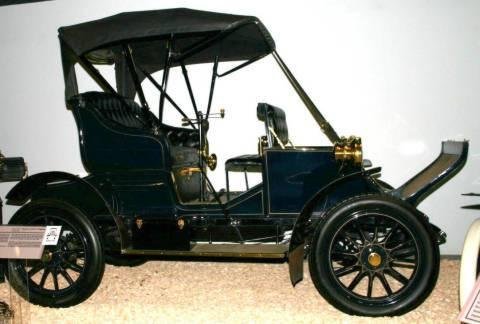
Only one Adams-Farwell is known to survive, a 1906 Model 6A. At the 2011 Pebble Beach Concours d’Elegance it won the Charles A. Chayne Trophy, given to the car with the most advanced engineering of its era, and it lives in the Harrah Collection at the National Automobile Museum in Reno, Nevada. One car from a stove factory in Iowa, with an engine the Smithsonian ranks first in its class, and a family tree that ends somewhere over the trenches of France.
Check you’re still alive.
Photos: Gnome Omega by Valder137 (CC BY 2.0). Via Wikimedia Commons.