Free-piston engine: GM ran one on whale oil in 1956, and Toyota wants it back
In 1956 General Motors built a car that could run on whale oil. Not as a stunt it planned to sell, just to prove a point: the engine under the hood of the XP-500 didn’t much care what you poured into it. Kerosene, diesel, crude, vegetable oil, whatever. It had no crankshaft, no connecting rods turning a shaft, and it was rated at 250 horsepower when a dual-quad 1956 Corvette, with Chevy’s 265 small-block wound to 5,600 rpm, was advertised at 225 or 240.
GM shelved it three years later. The idea behind it, the free-piston engine, has been dying and coming back for a century. Toyota and Germany’s aerospace agency have both built new ones in the last dozen years, and this time the reason it might stick is sitting in every EV on the road: power electronics fast enough to keep a loose piston in line.
The engine in a Firebird lookalike
GM unveiled the XP-500 in May 1956, the same month it opened its new Technical Center in Warren, Michigan. The car looked so much like GM’s turbine-powered Firebird show cars that people still confuse the two, and they’re not unrelated, because the XP-500 had a turbine too. The difference was what fed it.
Up front sat a Hyprex 4-4, two cylinders and four pistons, built by GM technicians in Detroit to a design by Swiss engineer Robert Huber, the man the industry called “Mr. Free Piston.” GM called it a gasifier. Its pistons hammered back and forth about 2,400 times a minute, and they didn’t turn anything. All they did was pump out hot, high-pressure gas. That gas was piped to a turbine at the back of the car, and the turbine drove the rear wheels.
GM Research wasn’t shy about it, either. In 1957 its engineers laid the whole thing out for the industry in an SAE paper titled “The GMR 4-4 ‘Hyprex’ Engine: A Concept of the Free-Piston Engine for Automotive Use.”
So the free-piston unit was really a gas generator, and the turbine was the motor. Split the job that way and you get some striking numbers. With no crankshaft spinning, vibration was said to be almost nonexistent. Thermal efficiency was quoted at 32 to 36 percent, in the same league as the diesels of the day and well beyond what a 1956 gasoline V8 could manage.
GM liked it enough to go big. It fitted six 1,250 hp free-piston gasifiers to a Liberty ship, the William Patterson, driving turbines for 6,000 shaft horsepower. It was the first free-piston gas turbine propulsion system installed on a ship in the United States.
Ford was chasing the same idea at the same time, on a farm. In March 1957 it unveiled the Typhoon, an experimental tricycle tractor that looked a lot like a Ford 900 series but ran a single-cylinder free-piston gas generator feeding a turbine spinning at 45,000 rpm. No crankshaft, no connecting rods, no spark plugs. The unit was rated around 100 hp, but in the Typhoon it was held to 50 drawbar horsepower. It never went through the Nebraska tractor tests, never reached production, and was reportedly taken apart in 1978. Two of Detroit’s Big Three had free-piston prototypes running in the same couple of years, and both let them go.
What “free piston” means
A normal engine is two machines bolted together. One burns fuel and pushes pistons down. The other, the crankshaft and connecting rods, turns that straight-line shove into rotation, because wheels go around. The second machine is so familiar nobody thinks about it, but it costs you friction, weight, and a heavy flywheel spinning just to smooth things out.
Delete the crank and the rods and you’re left with pistons flying back and forth in a cylinder, pushed by combustion and pushed back by something else: an opposing piston, a cushion of trapped air, or a spring. Nothing ties them to a shaft. That’s the free piston.
You can’t drive wheels with that directly. But there are things you can do with straight-line motion. You can compress air. You can pump gas into a turbine, like GM did. Or you can bolt magnets to the piston and run it through a coil of copper wire, and every pass generates electricity. That’s Faraday’s law from high school physics, and it’s how a free-piston linear generator works: fuel in, electricity out, nothing spinning in between.
Losing the crank buys real advantages. Fewer parts, less friction. Since nothing forces the piston to travel the same distance every stroke, compression can be changed on the fly. And with no fixed geometry, the same engine can be tuned for gasoline, diesel, natural gas, ethanol or hydrogen.
An Argentine marquis in Barcelona
The modern free-piston engine goes back to Raúl Pateras Pescara, a Buenos Aires-born engineer, lawyer and inventor with the title Marquis of Pescara and a habit of jumping into whatever was new.
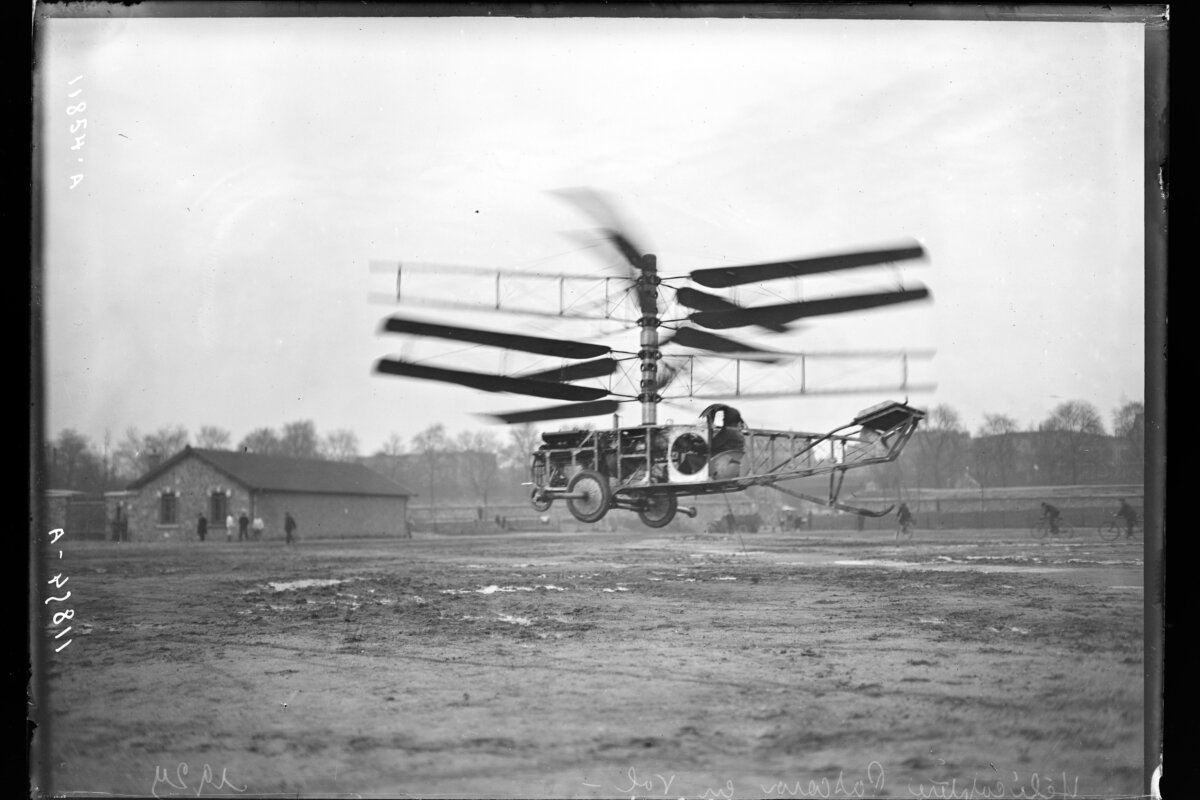
Before free pistons, he did helicopters. He filed his “rational helicopter” patent from Spain in February 1920, and his coaxial machines were among the first to use cyclic pitch, the control that lets a helicopter tilt its rotor and fly forward. In January 1924, at Issy-les-Moulineaux outside Paris, he set a world endurance record of 8 minutes and 13 seconds in the air.
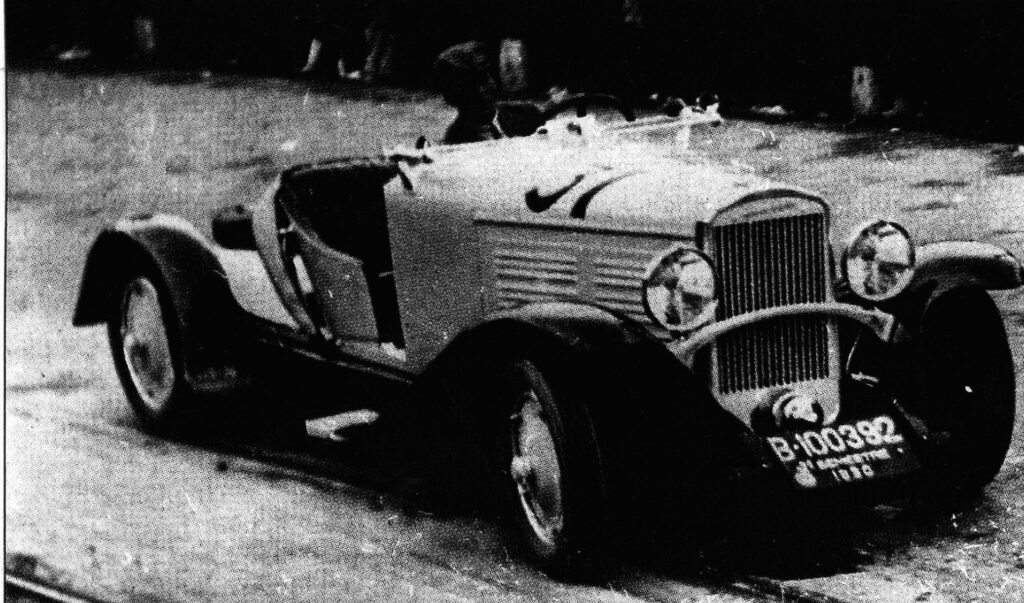
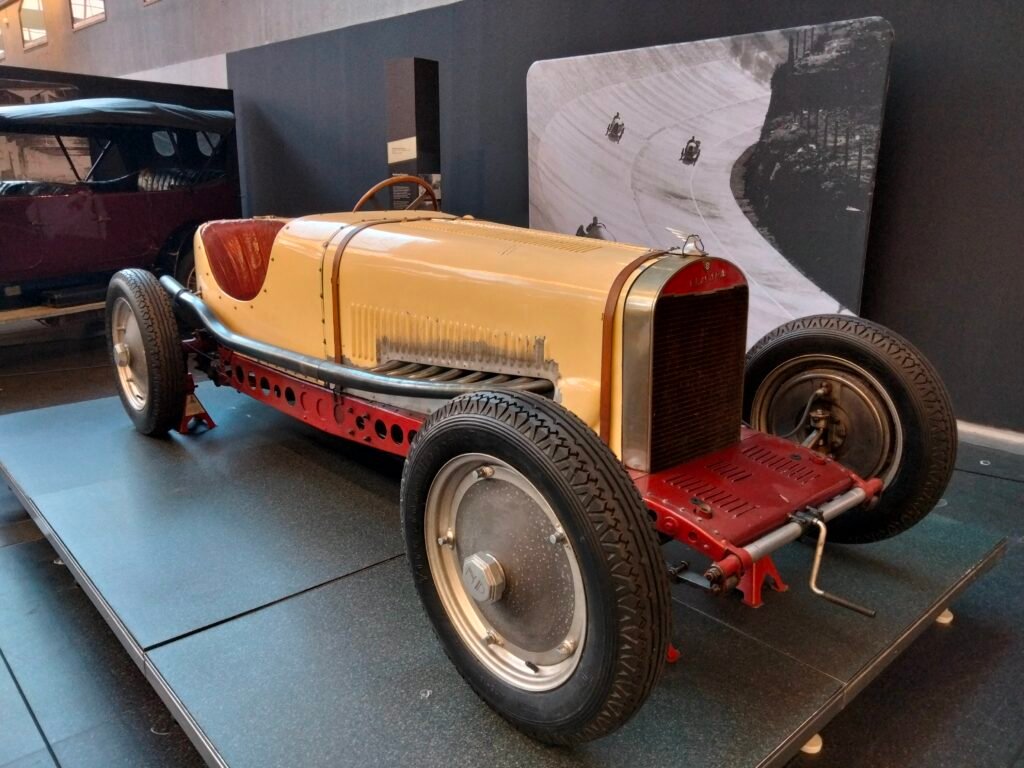
Then he tried cars. In 1929 Pescara and his brother set up a state-backed company in Barcelona meant to give Spain its own auto industry, with 70 million pesetas behind it. The Nacional Pescara was a twin-cam straight-eight of 3 liters and 125 hp, and in 1931 the Sport version won the European Hillclimb Championship. At home it raced on Barcelona’s two great circuits of the era, the twisting Rabassada hill road above the city and the Montjuïc park track, with drivers like Enric Tort and Juan Zanelli. Pescara even had plans for a 3.9-liter straight-ten that never reached the road. Production ran from 1930 to 1932, and the company was gone before the Spanish Civil War broke out in 1936. The only intact survivor, a 1929 race car, was bought by the Catalan government at a Brussels auction in October 2024 for €585,348 and is headed for the science and technology museum in Terrassa, near Barcelona.
In between, Pescara patented spark-ignition and compression-ignition free-piston engines in 1927 and 1928, and set up the Bureau Technique Pescara to develop them. Robert Huber ran it as technical director from 1924 to 1962 and oversaw nearly 30 different sizes and types of free-piston machine.
Compressors, generators and a ceiling
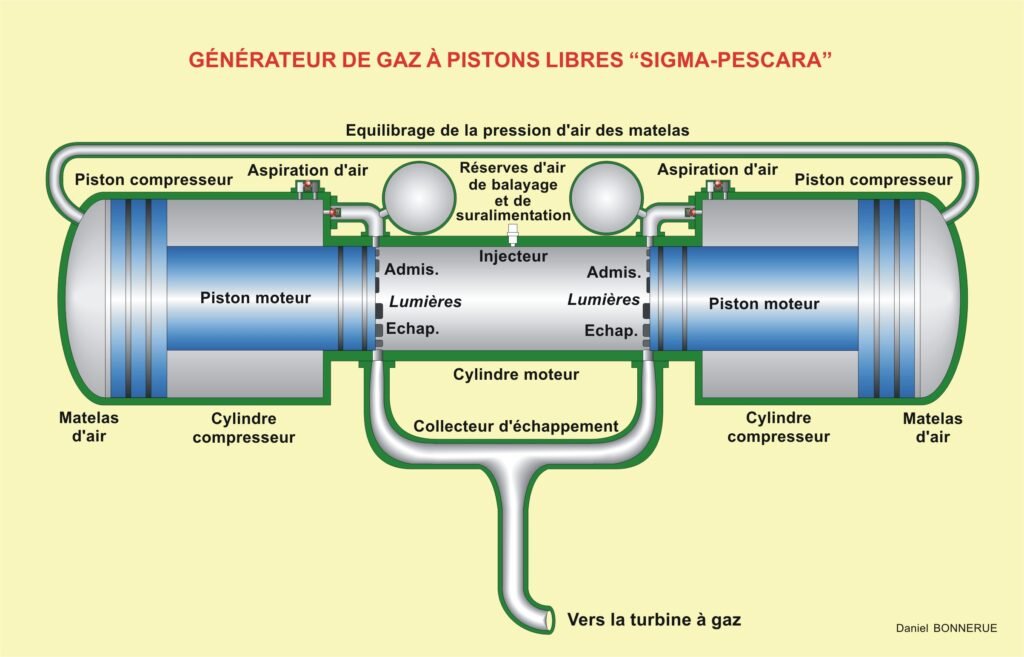
The first free pistons that worked were air compressors, the AC-2 on gasoline and the AC-3 on diesel. A compressor is a forgiving job. It doesn’t care if the piston’s travel varies a little from stroke to stroke, as long as air gets squeezed.
Most of those early machines were opposed-piston designs: two pistons facing each other in one cylinder, linked so they moved as mirror images. The symmetry cancelled out vibration. In 1938 and 1939 the world’s first free-piston power plant was built, two G-30 units feeding an 800 kW alternator. The French company SIGMA later put free-piston gas generators into series production, including the 1,138 hp GS-34, and from the 1930s into the 1960s free-piston units worked as compressors and as gas generators for turbines, which is exactly the role GM gave the Hyprex.
Why GM gave up
Mac’s Motor City Garage puts it bluntly: starting, lubrication and control problems proved insurmountable, and GM dropped the XP-500 after three years. The car is reportedly still in GM’s hands, though not in exhibit condition.
Some of the problems were practical. With no crankshaft, there was nothing to run the accessories off, so the fuel pump and starter needed their own drives. Starting the engine took bottles of compressed air.
The deeper problem was control. In a normal engine, the crank and rods dictate exactly where the piston is at every instant. Combustion can be a little strong or a little weak, and the piston still stops at the same top and bottom positions. A free piston has no such leash. A stronger bang throws it farther, a weaker one leaves it short, and where it stops decides how the next charge gets compressed and burns. Each stroke depends on the one before it. Keeping that stable with springs, valves and mechanical linkages, the only tools available in the 1950s, never worked well enough for a car, and first-generation free-piston engines were abandoned around the 1960s.
The computer arrives
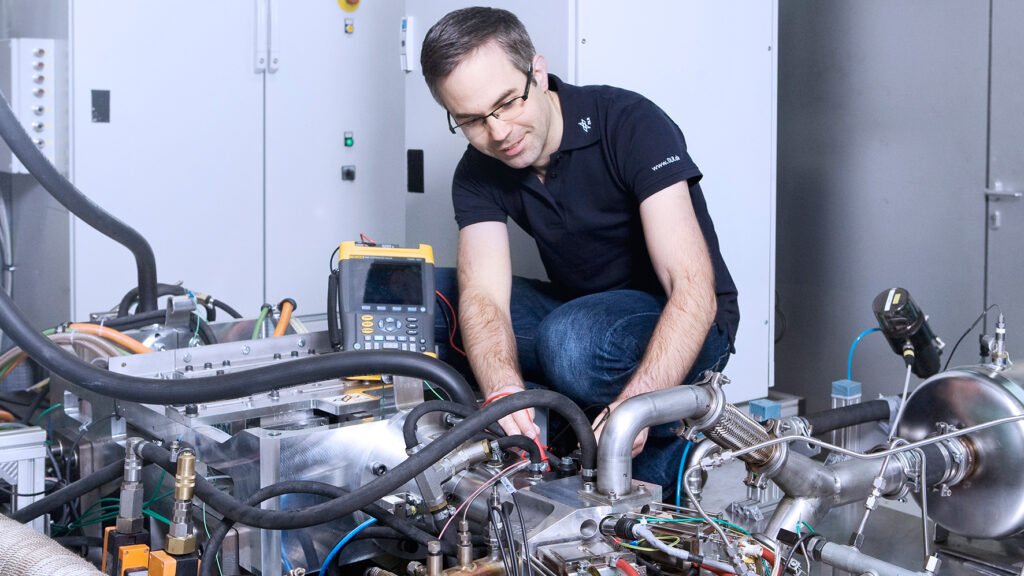
What the 1950s lacked, every hybrid and EV now carries. Position sensors can read the piston’s location thousands of times a second. Power electronics can use the linear generator as a motor, adding a push when a stroke comes up short or soaking up energy when one overshoots, and turning that surplus into current. The same trick starts the engine without a separate starter, or compressed air bottles.
And the EV gave the free piston a job it was born for. It was always hopeless at turning wheels. At making electricity, it’s a natural. A range extender doesn’t drive anything; it just tops up the battery. That’s the niche.
Germany’s aerospace center, the DLR, unveiled its free-piston linear generator as an EV range extender in February 2013, using gas springs to bounce the piston back and adjustable stroke and compression to run on gasoline, diesel, natural gas, ethanol or hydrogen. A year later, at the SAE World Congress in Detroit, Toyota Central R&D Labs showed a 10 kW prototype: two-stroke, a W-shaped piston, neodymium magnets on the moving part and a gas spring chamber that stores some of the piston’s energy and gives it back on the return stroke. It hit 42 percent thermal efficiency and ran for more than four hours with no cooling or lubrication trouble. Toyota said two of them, 20 kW in total, would let a compact EV cruise at 75 mph. Hydrogen-fuelled versions are being studied now, with piston control still the hard part, but no longer the impossible one.
Three dead ideas, one live one
The free-piston engine is the third story in this series about engine ideas the industry buried. The rotary valve ran into the materials of its day and then into an FIA rule change. The Adams-Farwell‘s spinning engine was killed by the gyroscope it carried around. The free piston was killed by a control problem nobody could solve with springs and linkages in 1956, and that same problem is now a few lines of code running on a chip.
Meanwhile, in a museum near Barcelona, the only surviving car built by the man who patented the free piston is waiting for visitors. It has a straight-eight, a crankshaft and eight connecting rods.
Check you’re still alive.
Photos: Pescara gas generator diagram by Daniel Bonnerue (CC BY-SA 2.0 FR). DLR generator by DLR (CC BY 3.0). Nacional Pescara at mNACTEC by Enric (CC BY-SA 4.0). Via Wikimedia Commons.